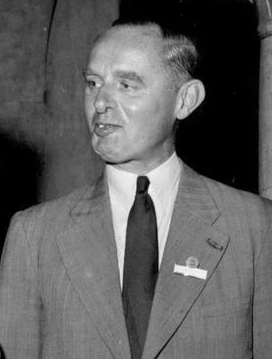
Biography
Bodenhausen grew up as an only child in a non-religious family. His father was a lieutenant colonel in the corps of engineers. Bodenhausen’s primary school was first in Breda, a garrison town in the southern part of The Netherlands, and then in the harbour city of Rotterdam. He attended the Gymnasium Erasmianum in Rotterdam from 1917 to 1923, studied law at the University of Leiden (1923-1927) and participated in rowing competitions. When, in 1926, two dozen professors and other intellectuals established the Dutch Commission on Intellectual Cooperation to support the League of Nations’ International Committee on Intellectual Cooperation (created in 1922) and the International Institute of Intellectual Cooperation (founded in Paris in 1926) Bodenhausen was tapped to be a member, in his capacity as Chairman of the Student Association for the League of Nations. This Leiden-based association was a federation of student associations in four cities. When Bodenhausen finished his studies, he was replaced on the Dutch Commission by another student from Leiden. He then stayed half a year at the Institute des hautes études internationales in Paris, which was created after the First World War to promote the study of international law from the general expectation that the League of Nations and the Permanent Court of International Justice would contribute to better relations among states.
In 1928 Bodenhausen became an independent attorney-at-law in Amsterdam, specializing in bankruptcies and industrial property. In 1929 he moved to The Hague, where he married in 1931 (eventually divorcing and remarrying a first time in 1937). In July 1946 the University of Utrecht appointed Bodenhausen, who maintained his law practice, as an extraordinary professor of industrial property law. This assignment was changed to intellectual property law in July 1951. Bodenhausen focused on the extension of intellectual property law and issues in the field arising after the war. In 1949 he prepared and published an updated version of the handbook of industrial property law, originally authored by Willem Drucker in 1929. This contribution remains one of Bodenhausen’s most enduring legacies, with this textbook being continuously updated through current day. In the second edition Bodenhausen expanded the section on patent law and, for the first time, devoted attention to planters’ rights. In the third edition (1954) he mainly included new case law. The fourth edition (1966) was updated by Leo Wichers Hoeth, who took over part of Bodenhausen’s law practice in the field of intellectual property law when Bodenhausen left for Geneva, Switzerland in 1963. In The Netherlands Bodenhausen promoted the debate about the protection of copyright in publications and by corresponding with both authors and publishers. He also supported the revision of guidelines for the practice of Dutch commercial law in 1947 and 1953. He chaired the Dutch Study Commission on Industrial Property and was a member of the Trademark Committee of the International Law Association.
The Dutch government made Bodenhausen a delegate at diplomatic conferences that revised intellectual property conventions or created new agreements: in 1948 in Brussels, Belgium (literary and artistic works), in 1957 in Nice, France (classification of trademarks), in 1958 in Lisbon, Portugal (protection of industrial property), in 1960 in The Hague (deposit of industrial designs) and, as head of delegation, in 1961 in Rome, Italy (protection of performers, producers of phonograms and broadcasting organizations). Bodenhausen thus became familiar with BIRPI (Bureaux internationaux réunis pour la protection de la propriété intellectuelle), the institution that oversaw various intellectual property treaties. In 1893 the institution was set up in Berne, Switzerland to take care of the Paris Convention for the Protection of Industrial Property (1883) and the Berne Convention for the Protection of Literary and Artistic Works (1886). BIRPI functioned as the combined international secretariat of the two public international unions based on these conventions, the Paris Union and the Berne Union. The Swiss government regulated BIRPI’s organization and supervised its work. Through the conferences Bodenhausen became acquainted with Jacques Secretan, BIRPI Director from 1953 to 1963. This highly pro-active international lawyer, who had extensive experience with the International Labour Organization (ILO), developed a strategy to modernize the BIRPI by being less dependent on the Swiss government and becoming a specialized agency of the United Nations (UN). Bodenhausen was to play a role in this strategy.
Secretan signed working agreements with several UN specialized agencies and regional organizations on behalf of the organization, eager to keep BIRPI the competent international body for intellectual property. BIRPI’s staff noticed several competitors because the ILO showed interest in intellectual property issues on behalf of workers and, in 1952, the United States (US), which had not signed the Berne Convention, helped to establish the competing Universal Copyright Convention (UCC), for which the UN Educational, Scientific and Cultural Organization (UNESCO) provided the secretariat. The UCC was created because the treaty to establish the International Trade Organization, which would also deal with intellectual property, did not come into effect. While the US explored a more formalized institutional structure for the UCC, Secretan addressed the UN Economic and Social Council (ECOSOC), the competent authority on new specialized agencies, to conclude an agreement with ECOSOC, but found out that this was not possible as BIRPI lacked an intergovernmental agreement (an essential feature of intergovernmental organizations). Secretan developed a proposal to change the structure of the Unions and its secretariat accordingly but the member governments at the 1958 diplomatic conference in Lisbon did not accept his idea. Given BIRPI’s loose and complex structure, Secretan estimated that the next opportunity to do so would be 1967 (with the revision of the Berne Convention) and started preparations for the structural reform of both Unions. Bodenhausen supported his plan.
Given the advance of decolonization, a critical atmosphere emerged within BIRPI about how intellectual property was being utilized internationally, namely dominated by industrialized and developed states. BIRPI encouraged the new states to join, aware of the possibility to expand the organization’s realm of governance but also mindful of development demands. Brazil expressed concerns about technology transfer to non-industrialized countries, the abuse of patent monopolies and the need to promote development in a draft resolution on intellectual property before the UN General Assembly, which in December 1961 acknowledged the issue but recommended to utilize BIRPI, the existing machinery, for the examination and possible revision of intellectual property arrangements. General Assembly Resolution 16/1713 on the role of patents in the transfer of technology to under-developed countries strengthened the position of Secretan, who had convinced the Swiss government to accept the principle of gradual transformation. In 1962 it was the first time that this government, which had always nominated Swiss BIRPI Directors on its own, consulted the parties to the conventions about the replacement of the Director. In June it sent an invitation for candidates through diplomatic channels. The Swiss government then sent the list of candidates received to the member states of the Paris and the Berne Unions. A joint meeting of these unions chose Bodenhausen, well-known as a professor and a delegate in the field, unanimously. The Swiss government accepted this result and nominated him on 13 December 1962 as BIRPI’s first non-Swiss Director to succeed Secretan. The Dutch government, which at the time made an effort to occupy high positions in international organizations, supported Bodenhausen’s candidacy.
Secretan retired as BIRPI Director on 15 January 1963. Bodenhausen, honourably discharged by his university, moved to Geneva and succeeded him the next day. On 1 March 1963 the Swiss government appointed Árpád Bogsch as Special Assistant to the Director and on 10 July he became Deputy Director. Bogsch, born in Hungary in 1919 but an American national since 1959, had worked as legal officer in UNESCO’s Copyright Division. The two non-Swiss experts formed a new leadership team, drawn from outside the organization. Secretan’s plan of reorganization, adopted at a joint session of two union bodies in October 1962, recommended that BIRPI’s system of contributions should be aligned to those of UN organizations and that the supervisory functions of the Swiss government should be transferred to an assembly of member states. In an article in Industrial Property (April 1963) Bodenhausen described the required measures to put forward Secretan’s plan: ‘it is this structure which has now to be finished off’ (Bodenhausen 1963: 87). In October 1963 he launched the Inter-Union Coordination Committee to advise the Swiss government on further reform, dealing with issues such as international rather than Swiss law, the lack of diplomatic immunity of staff, membership control over BIRPI operations and employment conditions of staff. In July 1963 the government had already promulgated new staff and financial regulations, which were similar to those followed by UN specialized agencies in Geneva. Bodenhausen, however, emphasized that the new organization needed more financial and human resources than BIRPI had available. In 1964 he established a Working Agreement between BIRPI and the UN Secretariat, which allowed BIRPI to be represented at meetings of several UN organs, including the General Assembly, ECOSOC, the Trade and Development Board and the Advisory Committee on the Application of Science and Technology to Development. As the Swedish government had agreed to host a diplomatic conference in 1967, Bodenhausen followed the plan to use the revision of the Berne Union for setting up a new international organization for intellectual property. In May 1964 a BIRPI Working Party drew up a Draft Convention of the World Intellectual Property Organization (WIPO).
The Working Party met with serious differences of opinion. The majority, with states such as the US, the United Kingdom, Germany and Sweden, called for modernizing the existing unions and the creation of a new organization, whereas the minority, led by France and Italy, preferred just an internal reorganization of BIRPI. This minority was concerned that states which were not party to any of the unions would damage the protection of intellectual property, even if these states were UN members. The legal departments of several specialized agencies expressed similar reservations. Relevant here was that these so-called third parties were newly independent states in Africa and Asia. None of these developing states (some were already members of the Paris and Berne Unions) were represented in the Working Group. Whereas several developed states were conservative, the UN Conference on Trade and Development (1964) and the UN Industrial Organization (1966) advocated in UN organs for the transfer of technology to developing countries to promote economic and social growth. Bodenhausen was attentive to the needs of developing states and, together with René Maheu, Director-General of UNESCO, convened a course on copyright law in Brazzaville, Republic of Congo in August 1963, the first course for experts ever held by BIRPI. The course created a Committee of African Experts to study a draft model copyright law. Bodenhausen enjoyed authoring several model laws for developing states. BIRPI set up a programme of fellowships for nationals of these states and started regional seminars and training courses. During Bodenhausen’s tenure 27 developing states joined the Paris Union. Bodenhausen also visited Moscow several times officially and encouraged the Soviet Union to join the Paris Union in 1965. In March 1965 and May 1966 the Committee of Experts representing the member states of the Paris and Berne Unions discussed and amended the Working Party’s Draft Convention. A compromise between the majority and the minority was reached, as a new organization with headquarters in Geneva would be set up with a General Assembly, a Coordination Committee, a Conference and a Secretariat (instead of BIRPI). The compromise consisted of the exclusion of the so-called third states, because the essential functions and most powers of decision were assigned to the General Assembly (only the member states of the two unions) rather than the Conference (all member states). Another compromise was that the status and role of the original unions remained untouched by the new organization, which in fact weakened it.
The Stockholm revision conference met in the Swedish Riksdag building in June and July 1967. It revised the texts of different conventions, notably the Berne Convention. This was the first revision which introduced special provisions for the benefit of developing countries. To enable the new organization the conference also changed the administrative clauses of the Paris and Berne conventions and five other agreements (twice Madrid, The Hague, Nice and Lisbon). On 14 July 1967 the WIPO Convention was adopted. BIRPI implemented the organizational aspects of the WIPO Convention, which entered into force on 26 April 1970. This changed the status of BIRPI employees from appointees of the Swiss government to international civil servants of the Secretariat, as common in the UN System. The number of staff during Bodenhausen’s tenure of office (1963-1973) grew from 52 to 149. Bodenhausen established a new Working Agreement with the UN through an exchange of letters with UN Secretary-General U Thant, which was adopted in September 1970 (and functioned until 1974, when a formal agreement with the UN made the WIPO a UN specialized agency). Bodenhausen had similarly reached an agreement with the Director-General of the ILO, David Morse, in May-June 1967. On 22 September 1970 the WIPO Coordination Committee unanimously nominated Bodenhausen as WIPO’s first Director-General, followed by a unanimous appointment by the General Assembly. Bogsch became Deputy Director-General.
Among Bodenhausen’s activities since 1968 was the publication of his frequently and widely used Guide to the Application of the Paris Convention for the Protection of Industrial Property as Revised at Stockholm in 1967 (1968). In 1969 he became the first Secretary-General of the International Union for the Protection of New Plant Varieties (UPOV). The Convention for the Protection of New Varieties of Plants was signed at Paris by eight states on 2 December 1961 and entered into force on 10 August 1968. The Office of UPOV functions under the high authority of the Swiss Confederation (hence, according to the old format) and under the direction of its Secretary-General. UPOV’s seat is at BIRPI headquarters in Geneva. On 21 October 1969 the Swiss Federal Council appointed Bodenhausen Secretary-General of UPOV. Furthermore, Bodenhausen was engaged in the negotiation and conclusion of seven new intellectual property treaties on international classifications of industrial designs (1968), patent cooperation (1970), international patent classification (1971), phonograms (1971), trademark registration (1973), international classification of the figurative elements of marks (1973) and protection of typefaces (1973). Bodenhausen retired as executive head from the WIPO and the UPOV on 30 November 1973, succeeded in both positions by Bogsch on 1 December. Bodenhausen, who had divorced and remarried in 1959, moved to Lausanne, where he died at the age of ninety-two in 1997. Among his success factors as executive head of BIRPI and the WIPO were his profound knowledge of all branches of the law of intellectual property, his sense of diplomacy and his ability to ‘identify those questions which, in a context of rapidly changing circumstances, required attention if not solution, and his capacity for introducing the International Bureau, at the right time and in the appropriate manner’ to assist the member states (Industrial Property, December 1973: 367). The UN also appreciated his contribution to the transfer of technology issue and the promotion of development in Southern states (Davies and Ricketson 2020: 25).