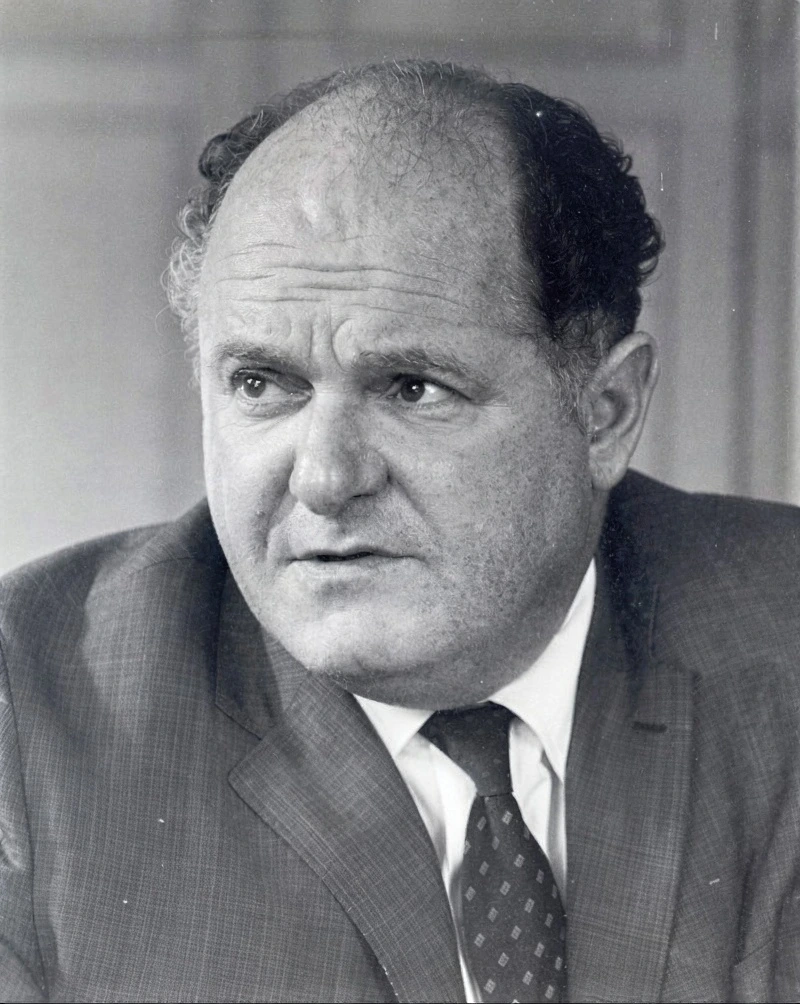
Biography
Wyndham White was educated at the Westminster City School in London and then studied law at the London School of Economics (LSE), where he excelled at sport (he was the captain of the golf team) and was involved in student politics in the Conservative Party. In 1938 he graduated with an LLB (Bachelor of Laws) with first class honours, was called to the bar of the Middle Temple and appointed assistant lecturer in law at the LSE. His political leanings seem to have been progressive as he subsequently joined the Reform Club (1940-1980). While a student, he was a member of the British delegation that attended the 1937 congress of the International Chamber of Commerce (ICC), at which business leaders gathered to promote world peace through economic interdependence. In 1937 the ICC met in Berlin, a time when the worst effects of the Great Depression were lifting, but relations amongst states were toxic. Adolf Hitler welcomed the business representatives at the opening meeting and praised their efforts to use trade to bring peace to Europe. Despite such a cynical endorsement, Wyndham White believed that liberal international trade was essential to a prosperous and peaceful world. He attended another meeting of the ICC in Copenhagen in 1939.
Wyndham White’s legal practice and teaching career were cut short by the start of the Second World War. Because of poor vision in one eye, he could not enlist. Instead, he joined the Ministry of Economic Warfare (1939-1941), which marked the beginning of his professional involvement in the economic field. In 1942 he joined the British Embassy in Washington DC as First Secretary of the Economic Warfare Department. In 1945 he was sent to the British embassy in Paris as the economic counsellor. He subsequently became an international civil servant when he was appointed special assistant to the European director of the United Nations Relief and Rehabilitation Administration. In 1946 he served briefly as Secretary-General of the Emergency Economic Committee for Europe, an international committee struck to deal with the urgent challenge of recovery from the war. Later that year, Trygve Lie, first Secretary-General of the United Nations (UN), seconded him to serve as Executive Secretary of the meetings of the International Conference on Trade and Employment. In 1946 Wyndham White was only 33 years old but, as one of his contemporaries recalled, he looked older and presumably had a gravitas beyond his years. The participants in the Trade and Employment conferences were trying to establish an International Trade Organization (ITO). In Geneva, from April to October 1947, officials from 23 countries convened to discuss a draft trade charter as well as to participate in tariff negotiations, but the two tracks of the conference got out of sync. By the end of October over one hundred bilateral pairings (such as between Australia and the United States of America) of tariff negotiations were concluded, but the charter had not been finalized. As Wyndham White (1950) explained later, the tariff negotiations were ‘a vast negotiation of exceptional complexity’ and the results were too important to be deferred. At the end of the conference, part of the draft charter that dealt with tariff negotiations and some general trade rules were bundled with the results of tariff negotiations and introduced as a temporary agreement. It went by the name General Agreement on Tariffs and Trade and, over the course of the next year, it was taken up by 23 countries.
Meanwhile, 56 countries sent representatives to the follow-up meeting of the Trade and Employment Conference in Havana, which opened in November 1947 and concluded in March 1948, to finalize the ITO charter. Wyndham White stayed on as Executive Secretary. He married en route and honeymooned in Havana. Alan Renouf, the Australian diplomat who worked with Wyndham White on trade matters, claimed to have introduced him to his wife, Tina Gibson Thayer. She was an actress whose career highlights included starring opposite Mickey Rooney in the 1942 production of ‘A Yank at Eton’. Her acting career seems to have ended after her marriage. Representatives of developing countries objected to the draft charter because its policies of economic openness would ill-serve, possibly even damage, their fragile economies. They proposed over 800 amendments and the result was that core principles of the earlier draft, such as tariff liberalization and the most-favoured-nation rule, were demoted. Commodity agreements, quantitative restrictions, and preferential trade agreements were highlighted as ways to realize economic development. Although the governments of Australia and Liberia moved quickly to ratify the ITO charter, most countries waited upon ratification by the US. However, American interest in the ITO faded quickly. As a result, the US Congress never ratified it and the ITO lapsed by 1950. That left the GATT: it was a provisional agreement that lasted for almost fifty years. Countries that adhered to it were called contracting parties. To administer the General Agreement, a small secretariat had been established at the end of the Havana meeting in 1948, called the Interim Commission for the International Trade Organization (ICITO). Wyndham White was elected Executive Secretary of the ICITO. He had expected his work with the Trade and Employment Conference to last six months, but after a varied and peripatetic early career he stayed put at GATT for the next twenty years.
Because of the unusual way in which the GATT came into being, one of Wyndham White’s most important contributions was to build up the infrastructure, mandate, and legitimacy of the accidental organization. In its early years the GATT was homeless (it took up temporary lodgings in the Palais des Nations in Geneva) and was badly funded (initially it depended on a loan of $86,490 from the UN Working Capital Fund, but subsequently relied on annual subscriptions from its parties). The organization had a small but skilful staff. In addition to Wyndham White there was an assistant executive secretary: Julio Lacarte (Uruguay), special assistant: Jean Royer (France), commercial policy officer: F.A. Haight (South Africa), information officer: Richard Ford (United Kingdom), legal adviser: Renouf (on loan from the UN), three research assistants and one support staff. In later years Wyndham White (1957) likened the GATT to the Cinderella of international organizations, an image that suggested the GATT was inherently good, although vulnerable, mistreated, and unloved. Wyndham White’s challenge was to turn the General Agreement into a de facto international organization with a clear purpose. As he explained in 1949, the ICITO needed ‘a definite program … rather than a series of tasks’ (Summary Record ICITO/1/14). The secretariat was crucial to defining a program and giving the GATT purpose and legitimacy. Early on it provided support for tariff negotiations and admitted new contracting parties at subsequent rounds of tariff negotiations, held in Annecy, France, in 1949 and Torquay, United Kingdom, in 1950. In time the secretariat initiated and regularized meetings of contracting parties and its mandate widened to include far-reaching elements of international trade, such as non-tariff barriers and the resolution of disputes amongst contracting parties. Sub-committees and working parties proliferated to examine trade-related questions, such as quantitative restrictions, trade in tropical products, agricultural protectionism, and trends in world trade. The secretariat also crucially continued to prepare for new rounds of tariff negotiations.
Wyndham White was a true believer in liberal trade, which he associated with a cooperative and inclusive international community. As Executive Secretary, he was proactive in explaining and defending the work of the GATT, which was necessary because the GATT had many detractors and few champions. He explained that the General Agreement brought order to world trade, bred habits of consultation amongst governments, spread the benefits of freer trade widely, deepened interdependence amongst people and states, raised standards of living, sustained employment, and contributed to expanded production. These were no mean feats. A decade after the GATT came into existence, Wyndham White affirmed that it now influenced national trade policies. However, its success was double-edged as the organization became a target for all those who objected to liberal trade policies. As Wyndham White (1957) put it, the GATT ‘tends to pay a high price in terms of general unpopularity’. The GATT’s challenge was magnified as protectionism gathered strength, and in 1958 he warned: ‘I fear that restrictive tendencies and divisive forces will come to the forefront, and that the institutions and habits of consultation and co-operation, which we have so painfully built on the basis of the agreements arrived at the end of the war, will be swept away on the tide’ (Wyndham White Montreal 1958). Although the GATT remained vulnerable to the opponents of liberal international trade, the de facto international organization was more securely established by the 1960s. In 1960 a Permanent Council was set up, meeting four times a year, to give consistent oversight to the ever growing work. By 1961 there were 106 staff on the payroll and the operating budget topped one million dollar per annum. Membership grew steadily, with 38 contracting parties in 1960 and 76 by 1967. And, at last, in 1968 it had a permanent residence at Villa Le Bocage, the former residence of Tolstoy’s aunt in Geneva. As Executive Secretary of the GATT, Wyndham White was crucial to all of these developments, giving the GATT purpose, structure, and the tools to act. His advocacy of freer world trade also continued as new threats to the organization arose in the form of regional trade blocs, such as the European Economic Community (EEC), and Cold War-inspired attacks.
Wyndham White also engaged head-on those who criticized the GATT for failing to promote economic development through trade. They denounced the GATT as a rich man’s club, upholding trade practices that benefitted the wealthiest and most highly developed economies in the world. This was a criticism that Wyndham White took seriously. He encouraged developing contracting parties to push their case within the GATT. The secretariat took steps to make the GATT more relevant to the trade positions of its developing contracting parties by establishing an International Trade Centre in 1964 to assist with market research and the development of trade strategies. The GATT also drafted a new chapter, Part IV on Development. However, it took two years before the requisite two-thirds of contracting parties endorsed the new chapter, a tepid endorsement of an initiative to which Wyndham White was deeply committed. But the GATT was not a creature of its influential Executive Secretary and could only do what its members willed. By the early 1960s developing countries had somewhere else to turn: the United Nations Conference on Trade and Development (UNCTAD), led by the dynamic and outspoken Argentine economist, Raoul Prebisch. At UNCTAD’s first meeting in 1964, Prebisch anticipated the GATT’s irrelevance to the evolving global economy. Wyndham White appeared at the meeting to defend his organization. He admitted that it was not without fault and that it had acted with more prudence than courage, but he insisted that it was a forum that was valuable to the cause of economic development.
Wyndham White was indispensible in sustaining the GATT’s on-going efforts to deepen the liberalization of world trade. By the mid-1960s there had been five rounds of tariff negotiations, but the results of these rounds had been somewhat disappointing and enthusiasm for such meetings was waning. In 1964 a new trade round began, called the Kennedy Round after the deceased American president who had believed that trade negotiations could revitalize transatlantic relations with the EEC and offset deteriorating American economic and financial circumstances. The contracting parties elected Wyndham White as secretary of the tariff negotiations. This put him in charge of coordinating and advancing the negotiations, not the customary role for the Executive Secretary. Even without such a role, he would have been at the heart of the negotiations, brokering seemingly impassable disagreements, particularly between the US and EEC, whose negotiations would make or break the round. He needed all of his skills in conflict resolution to surmount their differences. He stressed the disastrous consequences if the negotiations were to fail. He pointed out the awkwardness they would experience if either one was singled out as the cause of failure. The New York Times (10 January 1964: 68) described him as an ‘expert’s expert ... above all expert in coaxing, cajoling, and otherwise bashing together the heads of stubborn negotiators, in snatching agreement from squabbling dissention’. He used his own standing as leverage, threatening to resign unless a compromise was reached. A Canadian official had earlier described the threat of resignation as ‘an annual exercise in gamesmanship’ (Memorandum 1959). Some of his contemporaries commented on the significance of Wyndham White’s patience in brokering disputes. He did not rush the pace of negotiations. He let dynamics polarize, sensed room for rapprochement, and then moved in. He summoned delegates to small group meetings in the so-called Green Room where embattled positions were broken down in all night negotiations. As Jake Warren, a Canadian official with long experience in the GATT, explained, Wyndham White ‘smoked them out in the small hours of the night’ (author interview with Warren, 18 May 2005). After a few emergency extensions and several all night meetings, the Kennedy Round ended successfully in May 1967, having achieved the most far-reaching liberalization since the Geneva negotiations of 1947. Wyndham White was roundly praised for his efforts. The Kennedy Round was his ‘crowning achievement’ and he was a ‘towering presence’ (author interview with John Jackson, 17 November 2004).
Wyndham White’s contemporaries described his leadership in many ways: indispensible, impartial, savvy, a deft administrator, a shrewd manipulator of people, inventive, inspiring, wise and tireless. He devoted himself to the cause of GATT, having no favourites amongst its ever-growing number of contracting parties. Its successes were closely linked to him. He stood out as one of the few individuals who shaped the GATT (Curzon 1973: 317-318). As Kenneth Dam (1970: 339-340) put it: ‘At every major turning point and in every major success in GATT history has figured an imaginative compromise, an unexpected initiative, or a face-saving formula originated by Wyndham White’. Yet, he was not without institutional and personal ego. He resented the lower status of the GATT compared to the International Monetary Fund and World Bank. Wyndham White similarly had a lower status. His title (Executive Secretary) reflected the provisional nature of the GATT. It also came with a lower salary than his counterparts in other major international organizations earned, about which he had regularly complained. In 1953 he had tried to reclassify the ICITO as an international organization so that his salary would be tax-free, but this change did not occur. However, in 1965 the contracting parties decided to change Wyndham White’s title to Director-General. There was no change to his responsibilities but the nomenclature was consistent with other international organizations.
After the Kennedy Round, when his leadership shone most brightly, Wyndham White announced his retirement. This time it was not a negotiating tactic. There was no push for him to step down even though he had occupied the position for twenty years. As the deputy prime minister of New Zealand put it, Wyndham White was leaving the GATT ‘with honours thick upon him’ (Statement 1967). An editorial in the New York Times (11 November 1967:32) agreed that Wyndham White was leaving when he was ‘still respected – and, more important, trusted by rich and poor nations alike’. Wyndham White said this was the hardest decision he had ever made, but he hoped to continue the work he had done in GATT within the private sector, from whence he would presumably be better remunerated: ‘I hope to be able to make some contribution in finding a new and fruitful basis for relations between Europe and North America and also in the whole vital area of the economic development of the poorer parts of the world’ (New York Times, 8 November 1967: 94). At 54 he still had many productive working years ahead of him. There were accolades after he left the GATT. He was appointed Knight Commander of the Order of St. Michael and St. George in 1968 and received honorary degrees from universities in Switzerland and the US. In 1990, the contracting parties honoured Wyndham White’s contribution to the GATT by naming the main conference room at their Geneva office after him.
However, few professional opportunities came his way. When Wyndham White was invited to join the board of directors of Investors Overseas Services (IOS) Limited in 1968, he accepted. He had been recruited by James Roosevelt, the American congressman and son of former American president, at a time when IOS was seeking out business, diplomatic and political luminaries in Europe and the US to add lustre to its board. Wyndham White was apparently attracted to IOS because of its potential role in promoting economic development. But IOS was a scam and its improprieties and illegal activities were finally catching up with it just as Wyndham White joined the board. He was instrumental in the move to rout out corruption. He found himself pushed into leadership roles, assuming the presidency of IOS as well as becoming chairman of the board. He claimed to believe that the basic investment strategy of IOS was sound and, therefore, tried to establish it as a legitimate business operation. The journalists who wrote an exposé of IOS attributed his approach to his background as a practical-minded diplomat: ‘you must take things more or less as they are, patch up your troubles as best you can, and somehow keep the show on the road for the time being’ (Raw et al. 1971: 355). Although Wyndham White’s probity and integrity were never in doubt, his involvement with IOS seems to have tarnished his reputation. He ended his connection with IOS in 1971. One can only surmise that he did not look back on his involvement in IOS with pride – references to it were expunged in subsequent entries in Who’s Who. Afterwards, Wyndham White set up a consulting practice (which seems to have floundered) and occasionally participated in public discussion of international trade issues, particularly as they affected developing countries. He died in January 1980 of a heart attack while swimming in a municipal pool in the village of Ferney-Voltaire in southern France.
Wyndham White’s career after the GATT was disappointing. As one of his Canadian admirers noted regretfully, he ‘never found himself again’ (author interview with Simon Reisman, 17 May 2005). By all accounts, his marriage was strained and he and his wife were estranged. He had pastimes, such as gardening and music, for which he presumably had more time than when he had been at the helm of GATT. He was also a sportsman, an avid skier and cyclist. He used to ride his bicycle to GATT headquarters. There can be few heads of international organizations who rival Wyndham White for the widespread high regard in which he was held. There can be few who are as obscure in the historical record.