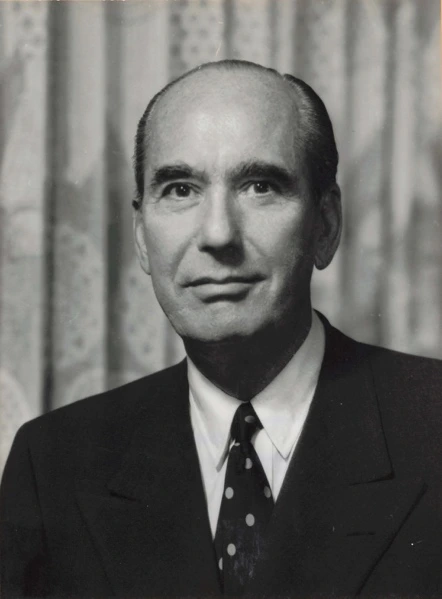
Biography
Woods was born poor and raised in a single-parent family, as his father died when he was only three. He attended Brooklyn Commercial High School, where he served as president of the school bank. His mother was a church regular, attending a Presbyterian church with her children. When he was grown, Woods dropped out of church. Family financial problems forced Woods to quit school to support his mother and younger sister Grace, who was born in 1904. He began his career with Harris, Forbes & Co., an investment firm, in Manhattan on 17 June 1918. He had gotten the job upon the recommendation of his high school’s assistant principal. As an office boy he quickly gained the attention of key figures at the firm. They convinced him to study theory of banking and finance, which he did at night at the American Institute of Banking and at New York University, albeit without a degree. He curtailed his studies, preferring to work overtime. Early on, he was sent to the Far East and South America searching for clients. Reflecting on those trips, Woods later said: ‘In those days, things had a simpler look: we left [economic] development pretty much to the businessman and to the laws of Providence and Adam Smith’ (Woods 1965: 1). In 1928, he was sent to Japan on his first important international assignment, to organize the financing of the Nippon Electric Company. By 26, Woods was vice president, a position he continued to hold when in 1931 Chase Bank acquired Harris, Forbes & Co. In 1934, Chase and First National Bank of Boston set up First Boston Corporation with Woods as vice president and a member of the Board. His work with First Boston was interrupted by the Second World War, in which he served for three years with the United States Army at the Pentagon as a buyer of supplies, rising in rank to colonel. Among his successes at First Boston, Woods was able to get the Kaiser Corporation out of debt. He is also credited with working out a compensation and reorganization plan to save Ringling Brothers and Barnum and Bailey Circus after a disastrous fire in 1944. He did this, in part, because of his love of the circus. He also made a lot of money on investments in Broadway shows, which he enjoyed. In 1947, he became one of two executive vice presidents at First Boston. In 1948, he became chairman of its Executive Committee and was selected as chair of the Board in 1951. He had written into his contract that he could do public service.
Beginning in 1952, First Boston managed the bond issues for the International Bank for Reconstruction and Development (IBRD, part of the World Bank Group), then headed by Eugene R. Black, who had worked with Woods at Harris, Forbes & Co. three decades earlier. Black often sought out Woods’ advice about the Bank’s dealings with economically less developed countries and Woods, in selling the Bank’s bonds, became interested in all of the Bank’s activities. He subsequently accepted assignments as an unpaid consultant and troubleshooter. As a result of a 1952 mission in which Woods participated, the Bank supported investments in India’s private steel industry. Woods later helped mediate the settlement of Suez Canal shareholders with the Egyptian government and helped to implement the Indus Basin Agreement between Pakistan and India. In 1962, he served on the International Finance Corporation’s (IFC) five-person international investment advisory committee. Woods was subsequently invited by President John F. Kennedy to obtain the business community’s support for his foreign assistance program. Shortly thereafter, Woods appeared to be ready to accept the position as the first head of the US Agency for International Development. However, there was Congressional opposition: liberal Democrats were upset about First Boston’s role in the Dixon-Yates affairs during the Dwight D. Eisenhower administration. First Boston had assisted Edgar Dixon and Eugene Yates in the financing of private power to the Tennessee Valley Authority. The criticism was that individuals associated with First Boston were advising the government and involved with the financing plans. Woods was not interested in a prolonged and painful confirmation hearing and quickly withdrew his name from consideration.
When World Bank President Black decided to step down from what had come to be known as ‘Black’s Bank’, he made clear to Kennedy that Woods was his choice to be his successor. Woods was also Kennedy’s personal choice. Kennedy told Woods that he wanted him to be the one to make the World Bank a bridge between rich and poor countries. There was no opposition to Woods, who became the Bank’s fourth President on 1 January 1963. He had had long experience with the problems of poor countries and a wide exposure to US security markets. He also had some knowledge of World Bank operations and personnel. The time seemed ripe for an active Bank president, as Black, following prostate surgery in 1961, had seemed content to let the Bank run itself. However, few people expected energetic and innovative leadership when Woods took over. He was over sixty and, after a serious heart attack in 1954, not in very robust health. In fact, he was vigorous and committed to changing the role of the Bank: ‘Within six months of his arrival, Woods had defined the agenda that guided most of his subsequent initiatives, in financial, operational, and lending policies’ (Kapur et al. 1967: 176). On the less positive side, Woods did not enjoy his predecessor’s agreeable relationship with the Board of Directors or his staff. Although perceptive and intelligent, Woods could be abrasive. He harshly criticized staff and publicly argued with the Executive Board.
Woods became President in the aftermath of a huge increase in Bank membership. Many of the new members ‘were poor and uncreditworthy by the Bank’s standards, but Woods wanted to lend to them and was frustrated by what he saw as the Bank’s straitlaced notions of who was fit to borrow and what was a suitable project’ (Caulfield 1996: 91). While he always saw the Bank’s loans as supplemental to what countries did on their own and to private investment - which he hoped would be increased by the establishment of a committee for conciliation or arbitration between investors and the governments of the countries in which they invest (what in 1965 eventuated in the International Centre for Settlement of Investment Disputes, ICSID) - Woods also called for longer grace periods for its loans. He also wanted to expand the range of activities for which the Bank could loan, complementing the traditional focus on infrastructure with investments in health, sanitation, and education. The idea of investing money, according to bankable standards, in the accumulation of intellectual capital was quite new and controversial. Accordingly, the initial focus was on science, technology and vocational skills (including crafts). He also wanted to take a broader approach to agricultural lending, moving beyond large-scale irrigation works to meet the credit, storage and other needs of individual farmers. Woods was careful to make clear that the Bank was not trying to replace the work of other United Nations specialized agencies. Indeed, he worked out cooperative agreements with René Maheu, UNESCO’s Director-General, and B.R. Sen, Director-General of the Food and Agriculture Organization. He also met with Pierre-Paul Schweitzer before he took office as the Managing Director of the International Monetary Fund in an attempt to promote better cooperation between the Fund and the Bank. Significantly, the diversification of Bank loans also included those from the IFC, the Bank Group’s institution that loaned exclusively to the private sector. The IFC’s traditional focus was on industrial development, but under Woods it made investments in power supply, agriculture and tourism. The diversification of lending helped Woods meet another objective: to increase the Bank’s lending at a time when it had excess reserves. Woods also made the decision to make a large loan to India to facilitate its imports, calling them ‘industrial import loans’. They actually had the same impact as a balance of payment loan, which was contrary to the spirit if not actually the letter of the World Bank’s Articles of Agreement. Woods’ view was that borrowing enabled countries to grow and thus increased their ability to borrow more. By expanding the range of projects the Bank financed, his view was that this would expand countries’ absorptive capacity and thus their creditworthiness. He argued against those worried about the heavy indebtedness of economically less developed countries being an obstacle to further borrowing. In terms of countries’ indebtedness, Woods believed the Bank should reschedule existing loans rather than cut back on them.
While there was general support for the Bank to expand loans and to provide grace periods on them, Woods’ movement into social lending clearly had its critics. These included not simply the senior staff but, initially at least, even the economists that he added in hopes that they could accelerate reform: ‘Economists … proved to be weak revolutionaries and were ineffective in bureaucratic in-fighting. They also had little sympathy for the social agenda; little inclination or knowledge of how to build in noneconomic factors’ (Kapur et al. 1997: 212). Not only was it more difficult to calculate the rate of return on such loans - under Woods the Bank had begun to use income per capita as a criterion for lending, rather than traditional creditworthiness or performance - but they almost inevitably involved the Bank in the domestic politics and economic policies of borrowing countries. For example, Woods agreed to make a loan to Milton Obote’s Uganda when told that without a loan Obote would likely fall from power and be replaced with the army, and Woods pressed India to devalue its rupee. Overall Woods’ agenda required riskier lending, a larger staff, more hands-on development assistance, and an increase in the Bank’s nonfinancial activities.
Over time, Woods found allies in his economic staff that increased from twenty to more than two hundred. They became serious agents of change and were able to legitimize social sector lending by formulating arguments and methodologies to establish economic rates of return, but even Woods drew some lines. Although he saw population growth as one of the major obstacles to economic growth and decided to include information on population trends and policies in all the Bank’s country economic reports, he stopped short of claiming a role for the Bank in addressing this issue. He had come a long way from believing the laws of Providence and Adam Smith as adequate to deal with the problems of economically less developed countries, but he left it to his successor before the Bank funded loans for family planning. After early 1964, Woods turned his attention from lending policy to the funding of the International Development Association (IDA). He was ‘almost obsessed by the delays and frustrations that accompanied the second replenishment, which was not obtained until after his departure in 1968’. He was quoted as saying that there ‘is no future in the World Bank Group unless IDA becomes more important than conventional lending’ (Kapur et al. 1997: 183).
Woods had risen from being a 17-year-old office boy to chairman of First Boston Corporation at 50, one of the World Bank’s two designated underwriters and thus a member of the New York financial establishment for a dozen years before he was elected as President of the World Bank Group. In summarizing Woods’ years as Bank President, many commentators write of two periods: a very strong start marked by growth and innovation - he was credited with more innovations in his first two years in office than in all of the Bank’s previous history - followed by years of frustration. In Woods’ five years in office, the Bank made nearly six billion dollars worth of loans, compared with seven billion over the previous fifteen years. He is also credited with strengthening the young professional staff of the institution by instituting the Junior Professional Program (later called the Young Professional Program) as a means of recruiting graduates from leading universities. Woods was also instrumental in diversifying the Bank’s staff. However, funding frustrations persisted. In 1967, in a last ditch effort to overcome the challenges of getting more funding for the Bank - partly attributed to his poor relations with US Secretary of the Treasury Henry H. Fowler - Woods proposed a ‘Grand Assize’ of experts to examine the challenges of funding economic development. Although the proposed commission, headed by former Canadian Prime Minister Lester Pearson, did not come into existence until after Woods had left the Bank, his sponsorship of the Commission on International Development (commonly known as the Pearson Commission), and his tying it to the Bank gave it greater prominence that it might otherwise have had. Thus, Woods ‘resigned, disillusioned with the lack of support for this attempted transformation of the institution from a bank to a development agency’ (Preet 2003: 119). That transformation would have to wait for his preferred successor, Robert S. McNamara. Woods lobbied the Lyndon B. Johnson administration for McNamara, because he was impressed by McNamara’s speech to the American Society of Newspaper Editors in which he had argued that the best guarantee of international security was a decent standard of living for all people. Woods actually postponed his retirement from the Bank so that McNamara could conclude his work at the Defense Department. When McNamara moved into the Bank, Woods arranged to stay a few extra weeks to help with the transition, but McNamara ignored him.
After leaving office, Woods became chairman of the board of the Henry J. Kaiser Foundation, a position he held until 1971. He also rejoined the board of the New York Times company and the board of directors of the First Boston Corporation, and served First Boston as a paid consultant. In 1968, New York Governor Nelson Rockefeller appointed him chair of the New York State Urban Development Corps and he served on its board until 1974. In 1968 he also became chairman of the board of the International Executive Service Corps, a position he held for six years. In 1969, he agreed to be a member of the US presidential mission to Latin America. Woods also served in the 1970s as president of the Foreign Bondholders Protective Council. As he and his wife aged, however, they increasingly spent more time in Portugal, where they had a summer home. In the spring of 1982, Woods was told that he had an inoperable brain tumor. He died that year at the age of 81 and had his ashes scattered in the East River in New York. There was no funeral or memorial service. His wife died four years later, from cancer.
May 2021: IBRD/World Bank Group explained in header