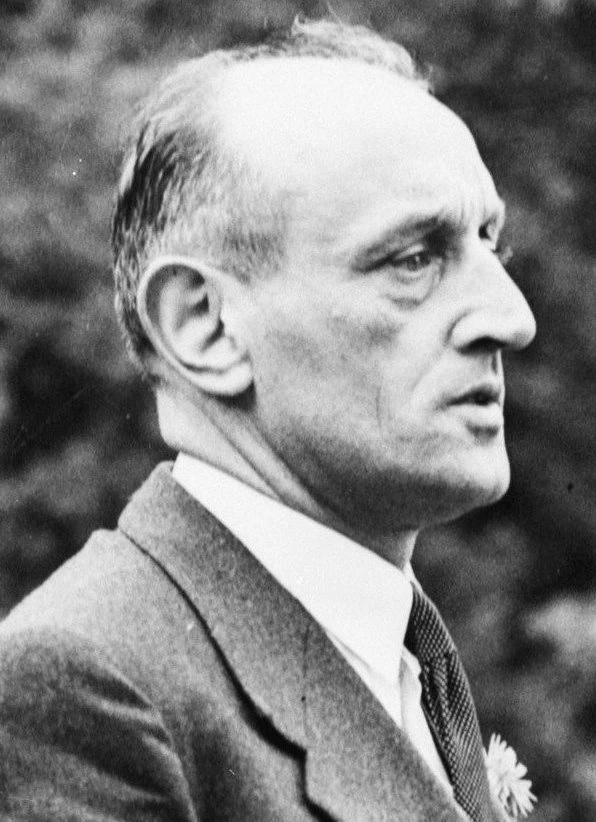
Biography
Goedhart was the second oldest in a middle-class family with four boys. Both parents enjoyed playing the violin, while Goedhart became a passionate piano player. When the father abruptly decided to leave his position as an independent bookseller to become a student in theology, the family went through various years of poverty, followed by years of moving between the cities where his father worked as a Protestant vicar. Goedhart thus went to school in various places. In his last year at grammar school his mother died unexpectedly and he failed his final exam. Goedhart’s relation with his father worsened. He saw him as negligent and selfish, both in his marriage, and in the education of his children. In 1933 he was the sole brother who chose to adopt his mother’s maiden name, in order to distance himself from his father. Between 1920 and 1925 he studied Law at Leiden University, where he developed a growing sympathy for the struggle for independence in the Dutch East Indies and became acquainted with the ideas of Hugo Grotius on international law. In 1926 he received his doctoral degree by defending a study of the Dutch unemployment insurance system. After he graduated in 1925 the newspaper De Telegraaf employed him. Within one year he was included in the editorial board and in 1930 became its editor-in-chief. His first marriage with the daughter of a publisher, Francis Becht, dating back to 1924, failed in 1931. Seven months after the divorce he remarried a prominent Norwegian industrialist’s daughter, Erna Hauan, who had lived in various countries and moved to the Netherlands to marry Francis’ younger brother, from whom she divorced. Because of a severe conflict with the newspaper’s owner, H.M.C. Holdert, Goedhart was dismissed in May 1933. Holdert accused him of not being able to stop the newspaper’s declining circulation, whereas Van Heuven Goedhart himself thought that his own opposition to the pro-Hitler stance of the editorial line was the true reason for his dismissal. Between 1933 and 1940 he was editor-in-chief of the Utrechtsch Nieuwsblad. At this regional daily newspaper he managed to increase its circulation and prestige, all the while solidifying it as one of the most anti-Nazi newspapers in the country. Besides his work as editor-in-chief, he played a role in two associations that opposed Nazism and anti-Semitism and defended democracy.
Van Heuven Goedhart’s activism was the reason for his immediate dismissal from the newspaper once the Dutch Army capitulated to Nazi Germany in May 1940. As an unemployed journalist, he joined a resistance group, whose first aim was to get in radio contact with the Dutch government, which had since moved to London. This group operated legally under the name of the Grebbe Commission helping war victims in the Grebbe region. It quickly grew into a movement that opposed the German occupiers. Its members also worked on ideas for a renewed postwar Netherlands. These thoughts on the future of the Netherlands were published in Het Parool, an underground magazine established in the summer of 1940. Van Heuven Goedhart became its leader from late 1942 onwards. Het Parool was part of a progressive wing within the divided Dutch resistance movement. It rejected the pre-war political relations marked by stagnation and polarization. Van Heuven Goedhart and his comrades were strongly in favour of a new democratic order, without political blocs. In April 1944 it became impossible for him to work and move around freely any longer as the Germans tried to locate him. In a dangerous escape, he fled under the name of Colonel Blake via France, Spain and Gibraltar to the United Kingdom where he desired to bring information to the Dutch government-in-exile. Almost immediately after arriving in London in July 1944, he was asked to become Minister of Justice in the second war cabinet led by Prime Minister P.S. Gerbrandy. As a minister, Van Heuven Goedhart witnessed the liberation of the southern part of the Netherlands in September 1944. In his attempts to restore the rule of law he was confronted with a strong opposition by former resistance groups, since these were included in the Dutch Armed Forces, established by the Dutch government to maintain order in the country’s liberated part. At the root of the conflict lay the question of who had authority to arrest Dutch citizens having collaborated with the Germans. As a result of this major issue, on which the government was deeply divided, Queen Wilhelmina dictated the ministers be replaced by candidates from the liberated south, and thusly reshuffled the cabinet. Van Heuven Goedhart was not asked to join the newly formed government of February 1945.
After Germany’s capitulation in May 1945, Van Heuven Goedhart returned home. His desire for rehabilitation in a public position was, however, ignored, and in September 1945 he accepted the urgent request of the now legally published newspaper Het Parool to become its editor-in-chief. Under his leadership, it grew to become one of the most successful newspapers in the Netherlands, with a daily circulation of nearly 150,000. As editor-in-chief he also led the opposition against the policies of the Dutch Government to refuse Indonesia’s independence. In 1946 Van Heuven Goedhart chaired a state committee that laid the foundation of the government’s information service. In October 1947 he was also elected a Senator of the newly formed Labour Party (Partij van de Arbeid) and hoped that his ideas on the renewal of Dutch politics, which he had developed during the war, could be achieved. This was to be a disappointment because the resistance of the Labour Party, one of the ruling parties since 1946, against the independence of Indonesia was most distressing. From 1947 onwards the Dutch government asked him to take several short-term positions in the United Nations (UN) circuit, often parallel to his profession as a journalist. In 1947 and 1948 he chaired the debates in the UN Sub-Commission on Freedom of Information and of the Press, which contributed to Article 19 of the 1948 Universal Declaration of Human Rights. As an expert he belonged to the Dutch delegation to the Economic and Social Council’s seventh session in August 1948. As a member of the Dutch delegation to the third UN General Assembly in March 1949 he had to adjust to diplomatic practices and defend the government’s position on Indonesia. In 1949 and 1950 he was vice-chairman of the Dutch delegations to the fourth and fifth General Assemblies. During the fifth session in October 1950 he also chaired the Assembly’s Third Committee, which dealt with the issue of refugees and oversaw the creation of the office of UN High Commissioner for Refugees (UNHCR).
As a result of the intensifying Cold War, the political environment within the UN was hostile to the new UNHCR. The United States (US) was developing a foreign policy that focussed on refugees fleeing from Communist regimes and preferred operations by the International Refugee Organization (IRO), which was set up in 1946 and had American Directors-General. The US regarded the UNHCR as a sideshow, but did not succeed in having the High Commissioner appointed by the UN Secretary-General (rather than the General Assembly) or in having its own candidate, IRO Director-General Donald Kingsley, chosen because the General Assembly of 14 December 1950 elected Van Heuven Goedhart in a secret ballot by 30 votes against 24 for Kingsley. Van Heuven Goedhart had the support of the United Kingdom and the Commonwealth countries that favoured a commissioner from small and neutral countries, but not from France, who had its own candidate, Robert Rochefort. The Soviet Union regarded the UNHCR an instrument of Western powers. Van Heuven Goedhart gave up his Dutch careers, and on 1 January 1951 was named the first UN High Commissioner for Refugees, a position with a mandate of only three years, whose sole objective was solving the problem of one last ‘remnant’ group of war refugees (approximately one million, of whom 400,000 problematic cases). To accomplish this, Van Heuven Goedhart had an annual budget of $300,000, purely for administrative costs, and after a year a staff of 33 people housed on the top floor of the Palais des Nations in Geneva. Van Heuven Goedhart is reported to have described the beginnings of the UNHCR as: ‘I found three empty rooms and a secretary and had to start from scratch’ (Loescher 2001: 50). He and his family moved to Grand Saconnex where they rented Maison Mérimont, a property which had previously belonged to American Arthur Sweetser of the Leauge of Nations Information Section. Although a 15-minute walk to his office, he preferred to drive his car. While the Frenchman Rochefort sought the position of Deputy High Commissioner, Van Heuven Goedhart chose the American educationalist James Read for this post. By then the IRO focused on transportation and resettlement of refugees, rather than on protection. However, the staff of the IRO’s legal protection department could not help but feel marginalized. In this internal IRO conflict Kingsley fired all of them with one month’s notice. As a result most of the legal protection staff moved to the UNHCR, where they subsequently formed its core. During Van Heuven Goedhart’s term in office the number of staff employed was to grow threefold and to be housed in twelve offices all over the world.
Kingsley and Rochefort aligned themselves to obstruct any cooperation between the UNHCR and the IRO, with an attempt by Rochefort to replace the UNHCR by a European refugee service of the Council of Europe. The IRO continued to claim the protection function for displaced persons and refused to hand over its files to the UNHCR. This inter-agency rivalry over responsibilities went on for over a year, since the IRO’s mandate did not expire until early 1952. Van Heuven Goedhart’s main problem with regard to UNHCR refugee operations was a lack of resources, due to the US policy of marginalizing the UNHCR. Within the UN the US managed to keep Palestinian and North Korean refugees excluded from the UNHCR competence and generously funded the UN Relief and Works Agency for Palestine Refugees in the Near East (UNRWA), set up in 1949, and the UN Korean Reconstruction Agency (UNKRA), set up in late 1950, with Kingsley as its first Agent-General. Furthermore, as part of its policy of focusing on refugees from Communist regimes, the US created two non-UN institutions. When the US considered the replacement of the IRO by an international migration agency, Van Heuven Goedhart warned that it would create duplication of activities and problems of coordination. The new agency was based on the American assumption that overpopulation in Central and Western Europe would threaten the order in Austria and West Germany. In October 1951, David Morse, Director-General of the International Labour Organization (ILO), organized an ILO conference on migration in Naples in order to incorporate the proposed agency into the ILO. The US, however, opposed his move, as the ILO would not be equipped for transporting migrants and refugees, and began to favour an agency independent of the UN. One month later this resulted in the Provisional Intergovernmental Committee for the Movement of Migrants from Europe (PICME), soon to be renamed Intergovernmental Committee for European Migration (ICEM) and from 1989 International Organization for Migration. The US promoted and funded the ICEM as the IRO’s successor. Furthermore, in April 1952 it established the US Escapee Program (USEP), administered by the Department of State. To overcome his operational and financial restrictions, as well as the reluctance of states to grant the UNHCR the capacity to raise funds, Van Heuven Goedhart tried to convince the UN General Assembly that he needed resources to provide material and legal assistance to refugees, in particular to the hard core of ‘unwanted’ people who were still in camps. He was well informed, because he drove himself in his second-hand Studebaker to visit refugee camps in Austria, France, Germany, Greece, and Italy, and used this information in speeches to UN meetings. He then turned to prominent outsiders. A 1951 grant by the Rockefeller Foundation resulted in the report The Refugee in the Postwar World (1952). Shortly after taking up office Van Heuven Goedhart had invited the French researcher Jacques Vernant to undertake a scientific study of the postwar refugee situation. Vernant headed the Rockefeller-funded survey group. The survey gave a comprehensive picture of the refugee movements at the time, together with a country-by-country description of the refugees and the legal and other regulations concerning them and documented that the refugees under the UNHCR’s care did need various forms of assistance. A telephone call to the High Commissioner by Queen Juliana of the Netherlands in September 1951 had resulted in a conversation with Van Heuven Goedhart, who had known the royal family since his stay in London, and a public letter by Juliana to US President Harry S Truman, in which she argued that international protection was insufficient and that refugees needed to be integrated into economic life. The Dutch government was not pleased with her self-willed move, inspired by Van Heuven Goedhart, but nevertheless began to relax its rather strict refugee policies. Truman, in his reply, stressed the official American position. Van Heuven Goedhart, however, lobbied governments, and in November requested the General Assembly to allow him to raise voluntary contributions. In January 1952 US delegate to the UN, Eleanor Roosevelt, supported his idea of a fund (but without American financial support) and in February the General Assembly authorized him to launch an appeal for government donations for a UN Refugee Emergency Fund (UNREF) of $3 million for emergency cases, hence not for the long-term solution Queen Juliana and Van Heuven Goedhart were promoting. Finding the money for UNREF proved hard, despite Van Heuven Goedhart’s continuous ‘begging’. By March 1954 only 11 UN members had contributed about one third of the Fund’s capacity. The UNHCR used part of the UNREF money to help the so-called Hong Kong refugees.
Given this situation Van Heuven Goedhart had turned to the private sector for help. In the summer of 1952 the Ford Foundation granted $2.9 million to the UNHCR. Ford Foundation Director, Paul G. Hoffman, stated that the grant was meant to help solve the refugee problem and not for UNREF, because he regarded direct relief a matter of governments. The grant was to be used for pilot projects to promote the integration of refugees in the communities in which they lived. The assistance programmes that were set up enabled the UNHCR to develop relations with non-governmental organizations as implementers of the programmes. The Ford funds proved a psychological stimulus as well as a turning point in the emphasis of refugee policies from mass migration toward integration and helped the UNHCR to receive further donations by other private organizations, albeit in a competition with the ICEM. Crucial was Van Heuven Goedhart’s awareness of the refugee crisis, which in early 1953 was taking place in Berlin with large numbers of refugees fleeing from East Germany. Although strictly speaking these people were not within his mandate, he argued that they could not be housed in temporary barracks. He engaged a German architect to build prefab houses, used some of the Ford funds for this, received the support of the West German government and sent a UNHCR representative to Berlin in order to coordinate activities. This achievement during the Berlin crisis increased awareness of the German refugee problem and related the UNHCR’s operations to political stability in Europe. In March 1953 Queen Juliana sent a letter to US President Dwight D. Eisenhower urging him to support the UNHCR’s approach of integration. Although Van Heuven Goedhart was aware of the more positive attitude toward the UNHCR that was developing within the Department of State, he kept arguing that his mission was for all refugees and demonstrated this by visiting a refugee camp in Communist Yugoslavia during the Berlin crisis and praising the Yugoslav government. A majority of both the Third Commission in April 1953 and the General Assembly of 21 October voted in favour of renewing the UNHCR’s mandate with another five years and reappointing Van Heuven Goedhart, with the five votes of the Soviet bloc against. Van Heuven Goedhart used this backing to ask for more support. In 1954 he lobbied American non-governmental organizations and was received by US Secretary of State John Foster Dulles. To promote publicity for the UNHCR he invented the Nansen Award, with Eleanor Roosevelt as the winner in 1954 (also to honour her late husband Franklin D. Roosevelt, who in 1938 promoted the setting up of the Intergovernmental Committee on Refugees) and Queen Juliana in 1955. During the summer he worked out a four-year plan for permanent solutions of the refugee problem including a renewal of UNREF. The Americans agreed under the proviso that he coordinated with the ICEM and USEP and that an Executive Committee led by an American replaced UNREF’s Advisory Committee. In October the US cosponsored a UN General Assembly resolution calling for his four-year plan through UNREF. This resulted in a reconstitution of UNREF and US financial support to the UNHCR in 1955. That year the award of the Nobel Peace Prize recognized the achievements of the UNHCR. Van Heuven Goedhart’s address on the occasion of the award in Oslo was in Norwegian and the money received as part of the Prize was used to close a refugee camp in Greece.
In July 1956 Van Heuven Goedhart died suddenly of a cerebral haemorrhage during his daily game of tennis, in his hometown of Geneva. He had struggled all his life: against colonial conservatism in the Dutch East Indies, the German occupiers of the Netherlands, Dutch sentiments of revenge as a result of the Second World War and international disinterest to refugees. He used mottos such as ‘keep up’ and ‘nose in the air’, because he needed those self-invented wisdoms for his own courage, giving him the strength to fight back. ‘I feel like a merchant in human capital’, so he characterized himself and his work as High Commissioner in a speech at the Hague Academy of International Law on 22 March 1956. His speeches were well-documented and appealing because of his personal and touching illustrations. Loescher (2011: 52) describes him as very good political fighter, strongly committed to human rights and refugee causes: ‘a cultivated man who was a product of interwar European culture and a fine orator whose speeches drew people to UN meetings’. With his impressive tall figure Van Heuven Goedhart was a charming person, who devoted all his social skills and other abilities (playing the piano when required) to raising funds and winning support. He turned the marginalized UNHCR into a relevant actor in international relations, as the refugee crises of 1956 (Hungary) and 1957 (Algeria) were to show. In 1955 the Dutch Carnegie Foundation awarded Van Heuven Goedhart the Wateler Peace Prize and in 1956 he won the Nansen Award posthumously.