Biography
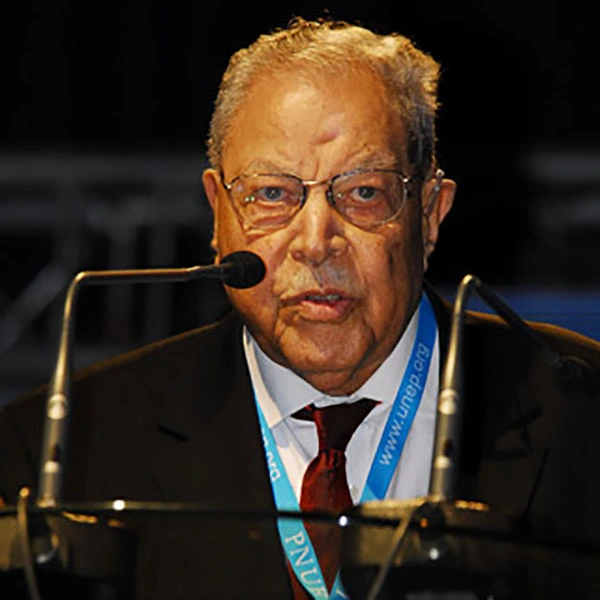
Tolba was born into a small, close-knit community, consisting chiefly of his relatives, in the Nile Delta north of Cairo. He was the fifth and only surviving child, as the others died in infancy. His early years unfolded during a time of intense political change. The British declaration of limited independence for Egypt in 1922 (Tolba’s year of birth) and the adoption of a new constitution in 1923 left a mark on his formative years. Tolba’s father, an educated man and respected teacher, studied at the Al Azhar Theological University in Cairo, but had negligible interest in religious brotherhoods or politics. He was a peacemaker, providing counsel and settling family disputes. Tolba saw his father as a role model, crediting him with instilling problem-solving skills and self-confidence. At the age of thirteen his father entrusted him, as the sole heir, with managing the family land and keeping track of rents and contracts. Thus, from an early age Tolba developed critical skills like management, delegation and communication. His mother was illiterate but was described as having ‘an outstanding sense of feeling’ (Weiss 2001: 6). Her intuition would later shape Tolba’s education. After Tolba completed primary school the family moved to Cairo. In the late 1930s and the early years of the Second World War Egypt plunged into turmoil over occupation and divided over support for the British. Tolba became increasingly engaged in political action and, although he initially struggled academically, failing his baccalaureate English exam and repeating a year, he quickly rebounded. That setback, in hindsight, ‘was probably in my favor because I got very high marks in all the subjects the following year’ (Canan and Reichman 2002: 50). Following his secondary education (graduating seventeenth nationally) Tolba planned to enroll in military college. His mother, with strong objection to this, led him instead toward science and medicine. He was accepted into the Faculty of Science at Fouad I University (later Cairo University). In 1943 he received his Bachelor of Science in botany with first-class honors, followed by a Master’s in plant physiology in 1946. By the time he graduated, Tolba had married his paternal uncle’s fifth daughter, Saneyah Labib, to whom he had been betrothed at the age of four.
In 1946 Tolba received a national scholarship for graduate studies in the United Kingdom (UK). He started in Liverpool but soon transferred to Imperial College in London upon learning that William Brown, the UK’s leading plant pathologist, was teaching there. Because of Brown, Imperial College had become ‘something of a Mecca for aspiring pathologists,’ the Association of Applied Biologists noted. Tolba was committed to learning from the best: ‘I boldly went to his office at eight o’clock one night and told him I wanted to study with him’ (Canan and Reichman 2002: 51). Tolba knew what he wanted, how to get it and convinced people to come on the journey with him. He shortened his name, retaining his given names Mostafa Kamal and his father’s name Tolba. In 1949 he received his PhD in plant pathology and returned to Egypt. He joined the Faculty of Science at Cairo University, where he taught botany as an assistant lecturer, lecturer and professor of microbiology and established a department of microbiology. From 1954 to 1959 Tolba was professor and head of the Department of Botany at the University of Baghdad in Iraq, the only job for which he formally applied. Tolba recalls his path as something unexpected to his younger self. He was a prolific author, publishing extensively on plant diseases, anti-fungal substances and the physiology of microorganisms.
After Tolba’s tenure in Iraq, he became Assistant Secretary-General and subsequently Secretary-General of the Supreme Science Council of Egypt (1959-1963), thereby entering the Egyptian civil service. He then became Cultural Counsellor and Director of the Education Bureau at the Egyptian embassy in Washington DC (1963-1965). From 1965 to 1971 he served as Undersecretary of State for Higher Education. In 1970 he took part in the first and second delegations to negotiate the New International Development Strategy. In 1971 he briefly served as Minister of Youth and was appointed President of the newly established Academy of Scientific Research and Technology. He also served as President of the Egyptian Olympic Committee (1971-1972).
In 1972 Tolba chaired Egypt’s national commission for preparation of the United Nations (UN) Conference on the Human Environment and, later that year, headed the Egyptian delegation to the conference in Stockholm, Sweden. Leading up to the conference, Tolba, like other delegates from the Global South, possessed skepticism toward the emerging environmental movement, concerned that it would be a tactic used to restrict economic prosperity of developing countries. He was concerned that environmental regulations could perpetuate inequalities by limiting the industrialization of the developing world. ‘We didn’t care in the developing countries about pollution at that time,’ Tolba remarked, recalling an Egyptian banknote that depicted a chimney releasing smoke to symbolize industrialization and economic growth, ‘We considered our industrialization a miracle’ (quoted in Ivanova 2021: 13). He prioritized goals of poverty elimination and modernization. The resulting turbulence presented an underlying threat of developing countries boycotting the Stockholm conference, which was chaired by Canadian businessman and diplomat Maurice Strong. Tolba spearheaded the initiative that resulted in Principle 22 of the Stockholm Declaration, which called for states to cooperate in developing international law regarding liability and compensation for the victims of pollution and other environmental damage. Following the conference Tolba championed a new outlook on the environmental agenda, adopting the idea of ‘development without destruction’ (Ivanova 2021: 153). Recognizing that disregarding environmental degradation to stimulate industrialization could directly undermine national development, Tolba acted as a steward for sustainable development and reinforced the presence of developing countries in environmental discussions previously driven by wealthy Western countries.
When governments created the UN Environment Programme (UNEP) at the end of 1972, Executive Director Strong requested that UN Secretary-General Kurt Waldheim appoint Tolba as Deputy Executive Director. Impressed by Tolba’s energetic participation and scientific qualifications, Strong handpicked his small team of expert staff from a network assembled for the conference. The UN appointed Tolba on 14 May 1973. Strong and Tolba shared a vision of UNEP as a catalytic, collaborative and influential institution that would inspire environmental action across a multitude of actors. They designed it as an independent body with a rightful place at the UN table. Although Strong had agreed to a full term as Executive Director, he announced his intention to step down once UNEP was firmly established. On 23 December 1975 the UN General Assembly unanimously elected Tolba as Executive Director to complete Strong’s final year and ensure institutional continuity. Tolba was subsequently elected for four consecutive four-year terms, serving until 1992. Strong served UNEP by using the extraordinary personal influence he built over the years. He had the persuasive ability to convene the executive heads of the UN specialized agencies at UNEP headquarters in Nairobi, Kenya. As a scientist, at the outset of his leadership Tolba struggled to mirror Strong’s political visibility and sustain the interest of other heads. As a result, he lost some of the networking prestige that Strong enjoyed. As a respected scientist, however, he redirected UNEP’s focus to science and development, enhancing the organization’s reputation as a scientific authority and a global environmental monitoring institution.
Tolba understood the critical importance of reliable data and rigorous monitoring. He oversaw the progress of Earthwatch, an international environmental charity established in 1971, which analyzed data on various issues, such as changes in the mass balance of glaciers (an early indicator of climate change), methyl mercury levels in regional fisheries and pesticide residues in human tissue. He also recognized the urgent need to develop legally binding instruments for collective action to tackle environmental degradation and dedicated considerable energy to treaties and institutional development. Under his leadership, UNEP adopted a firm stance in favor of strong international regulation, laying the groundwork for science and diplomacy to underpin global cooperation. Notably, scientific assessments like the one on the depletion of the ozone layer provided essential input for policymakers to craft environmental laws and address the problem. Tolba acted as a catalyst for environmental policy utilizing scientific connections to bring forward undisputed experimental evidence, clearly shown in his negotiations for protecting the ozone layer. He successfully helped develop treaties to protect the Mediterranean Sea (1976), the Red Sea (1982) and the Gulf of Aden (1982), the Vienna Convention for the Protection of the Ozone Layer (1985), the Montreal Protocol on Substances that Deplete the Ozone Layer (1987), the Basel Convention on the Transportation of Hazardous Wastes and Their Disposal (1989), the Convention on Biological Diversity (1992) and the Convention to Combat Desertification (1994). He also contributed to the creation (with the World Meteorological Organization) of the Intergovernmental Panel on Climate Change (1988) and the UN Framework Convention on Climate Change (1992). Deputy Executive Director Peter Thatcher (1991: 442) noted that UNEP’s scientific assessment ‘shed light on rates of desertification, deforestation, loss of biological diversity and stratospheric ozone depletion.’ Rising concerns over desertification during the 1960s and 1970s led to the Plan of Action to Combat Desertification entrusting UNEP to perform a general assessment of progress. Despite Tolba’s personal pressure for action regarding desertification, it did not become a priority for African governments or donor countries (the UN Convention to Combat Desertification was not adopted until 1994).
Tolba excelled in combining his knowledge of science, proficiency in diplomacy and aptitude in negotiation to support intellectual innovation. His thirst for knowledge and interdisciplinary technical capacity helped him in moving ahead with UNEP. He continuously reskilled himself. ‘I’m a microbiologist,’ he noted, but ‘I taught myself law because of the international treaties; I taught myself economics because of the cost-benefits of Montreal and climate change from economists or international lawyers’ (quoted in Ivanova 2021: 152). As a scientist, Tolba knew what had to be done and had the authority to bring it forward to governments. As a politician by experience, he grew regarding how to get things done and had the legitimacy to ask and even push governments. An African and an Arab, he could connect directly with several countries on their own terms and obtain their backing of important initiatives. Perceived as an overt supporter of developing countries, he also had the backing of the Eastern Bloc countries and was therefore seen as opposing what the United States (US) considered to be its interests. A US official noted him as ‘the darling of the Group of 77 and was seen to be pretty much in their camp’ (Ivanova 2021: 154).
At UNEP’s ten-year anniversary (1982) Tolba mentioned raising the general level of environmental awareness in decision-making circles as UNEP’s most important success, with reversal of the depletion of the ozone layer as UNEP’s greatest achievement. Tolba acted as architect, driver and diplomat for the 1987 Montreal Protocol. The process was bolstered by an atmosphere of urgency and crisis brought about by the discovery of the ‘ozone hole’ over Antarctica in 1985 and by scientific evidence on the causes and consequences of the problem. Talks of the ozone crisis began in 1974, with provisional agreement reached in 1985. Tolba’s mastery of science and policy meant that he only needed six months of that longer window to get global scientists to discuss and agree on a way forward. His leadership in creating the ozone treaty was instrumental in its successful establishment and effective implementation and the resolution of the ozone problem created ‘a model for effective multilateral action’ in tackling significant global environmental problems (Benedick 1991: 6).
Tolba was an entrepreneur who used structural power deriving from his connections to developing countries and his intellectual capacity. Chief US negotiator Richard Benedick noted that Tolba ‘broke all the stereotypes of the docile United Nations servant to governments.’ He took the risk of abandoning traditional neutrality, taking little care for his own popularity and placing himself and UNEP unequivocally behind strong international regulation of ozone-destroying chemicals. Tolba ‘pleaded, provoked, cajoled, shamed, and sometimes bullied reluctant governments ever closer to the treaty provisions that he, as a scientist, knew were necessary for the world’ (quoted in Andersen and Sarma 2012: 139). He deployed unexpected negotiation tactics, such as the ‘prisoner of war room’ tactic (locking people in a room until they came out with a decision) and proved to be a hardnosed negotiator. He brokered deals among countries perceived as impossible and developed the idea of the Multilateral Fund that would financially support the ability of developing countries to participate and phase out ozone-depleting substances.
In 1981 ‘Sustainable Development’ was coined by UNEP’s Governing Council to address the environmental perspective beyond 2000. In 1982 UNEP adopted the Montevideo Programme for the Development and Periodic Review of Environmental Law, which is revised every ten years. The Programme supports the development of environmental law and legal frameworks, improves implementation at the national level and supports capacity-building for member states and a range of stakeholders. Among Tolba’s contributions connecting science and policy to create new international environmental law is the 1989 Basel Convention on the Control of Transboundary Movements of Hazardous Wastes and Their Disposal. After media reporting on illegal dumping of hazardous wastes in the Nigerian village of Koko, Tolba convened scientists to inform governmental discussions and supported developing countries in effectively preparing for negotiations and fighting for proper representation. Tolba’s engagement in the intense negotiations that ran around the clock over several days left him hospitalized from exhaustion. He returned to the conference from his hospital bed wearing a suit over his pajamas and the striped pant leg pulled over his shoes for government delegates to see. Tolba ushered the negotiations to a close using an emotional plea to governments: ‘I had to get out of my bed sick to come and convince you to come to a close’ (quoted in Ivanova 2021: 106). Ten years after the treaty was finalized, he continued to use his personal influence (Tolba 1999).
In 1983 UN Secretary-General Javier Pérez de Cuéllar created the World Commission on Environment and Development for a report to review issues on the nexus of environment and development, assess the achievements in the years since Stockholm and imagine how to take a quantum leap forward. Although UNEP had been the primary institution leading this agenda, the 20-member commission was independent, with Gro Harlem Brundtland as chair and Strong as a member, but not Tolba. With an ideology that emphasized the environment as a core precondition for human life and development, Tolba and UNEP were isolated. Tolba really wanted to run the commission, feeling that producing the report was ‘UNEP’s job’ and that all ‘attempts to innovate and create something new were… a threat to what he was trying to do’ (Mark Halle in Ivanova 2021: 159). However, the Brundtland Commission’s report, Our Common Future (1987), strongly influenced the agenda of the UN Conference on Environment and Development in Rio de Janeiro, Brazil (1992), known as the Rio Earth Summit. Tolba’s commanding style had previously alienated some governments, notwithstanding UNEP’s results regarding issues such as desertification, ozone, biodiversity, forests and climate change during the 1980s. Serious commitments to action remained hamstrung by tensions between priorities and expectations of industrialized and developing countries. UNEP’s greatest challenge came in the early 1990s as the end of the Cold War altered the political and economic reality across the world, with a neoliberal economic order that led to a single-minded focus on economic growth. Countries then descended into a period of sharper division on issues of inequality, uneven technological development and thus uneven access to information and connectivity, which dramatically diminished contributions to UNEP.
Tolba recognized the changes that were taking place and deliberately chose not to actively engage in the preparations for the Rio Earth Summit. He ceded leadership to the conference secretariat, with Strong as Secretary-General, and other organizations. This led to UNEP’s further marginalization. A new global narrative about sustainable development replaced the earlier environmental focus and UNEP’s message for the future, causing attention to move away from UNEP’s core expertise. The Earth Summit became the defining event in global environmental governance by catalyzing a wave of new norms, policies and institutions with 27 universal principles and Agenda 21. States set up secretariats for the new conventions on climate change and desertification in Geneva, Switzerland and on biodiversity in Montreal, Canada and launched the Commission on Sustainable Development in New York and the Global Environment Facility (GEF) in Washington DC all largely independent from UNEP. The GEF was reminiscent of UNEP’s core financing mechanism, the Environment Fund, which supports multilateral environmental agreements and research bodies. These outcomes weakened UNEP and shifted the focus away from its achievements.
After seventeen years Tolba retired as UNEP’s Executive Director on 31 December 1992, with Canadian Elizabeth Dowdeswell as his successor. Tolba returned to Egypt where he established the International Center for Environment and Development (1993), a non-profit organization financing environmental projects. He became its first President and also chaired the Environmental Research Council at Egypt’s Academy of Scientific Research and Technology. Tolba remained active in the environmental field and continued engaging with UNEP. In 2009 the Global Environmental Governance (GEG) Project (now part of the School of Public Policy and Urban Affairs at Northeastern University in Boston) convened the GEG Forum: Learning from the Past, Moving into the Future (documented in the movie Quest for Leadership). The forum, held in Glion, Switzerland brought together all five successive Executive Directors of UNEP at the time and convened eighty leaders in the field, including the people who imagined and created the system for environmental governance and those who led many of the institutions. It facilitated an intergenerational dialogue between UNEP’s founding generation, current and future leaders. Tolba’s generation thrived on bold negotiation and policy, ideas the forum sought to discuss and instill in future leaders. Tolba, one of the most decorated scientists in Egypt, passed away in Geneva in 2016 at the age of 93. He left a legacy of pioneering environmental diplomacy, shaping policy driven through his reliable data, negotiation skills and transformative leadership.