Biography
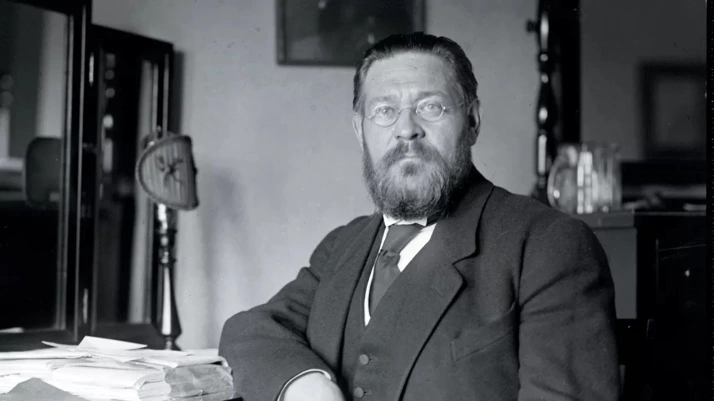
Thomas was born into a family of bakers in the East Paris suburbs, where he lived until moving to Geneva, Switzerland in 1920. He was raised as the only son, since his four brothers and sisters died before he was born. He showed a similar nature as his mother, who ran the loving and close-knit household, and remained close with her all his life. His father was a staunch Republican, an admirer of the 1848 Revolution and a firm opponent of Napoleon III’s Second French Empire (1852-1870). He was imprisoned during the Prussian occupation of Paris in 1870. When frequenting his father’s bakery at a young age, Thomas developed a concern about the living and other conditions of working-class people. After his classical Catholic primary education with the Sisters of Saint-Vincent-de-Paul he attended the Lycée Jules Michelet in Vanves on a scholarship, where he prepared for the competitive examination of the École normale supérieure (ENS), which he passed in 1898. After his military service he entered the ENS in November 1899. Studying at the ENS, which was a Republican and Socialist stronghold with many supporters of Alfred Dreyfus, the Jewish artillery officer falsely accused of treason, reinforced Thomas’s Socialist convictions. He took his bachelor’s degree in history, writing a thesis about popular ideas of social reform developed between 1832 and 1834. In 1902 he graduated as the best of his class for the ‘agrégation d’histoire’, the French higher teaching diploma in history. He received a travelling scholarship to the Eastern Mediterranean and another one for the Friedrich Wilhelm University in Berlin, where he studied German trade unionism. Although this stellar academic background opened up the way to a teaching career in secondary school or at university, he increasingly devoted himself to political activities, alongside his teaching and intellectual production as historian. In 1903 he became the tutor of Jean Hugo, the great-grandson of author Victor Hugo, and he taught at the Collège Sévigné for a few years, where he trained girls for their ‘agrégation’ competitive examination. He was the author of Volume X of the Histoire socialiste de la France contemporaine (1908), edited by Jean Jaurès and devoted to the Second French Empire. He became a recognized historian of this period and was asked to contribute two chapters to The Cambridge Modern History project in 1909. In 1911 he completed his doctorate on the freedom of education in France since 1789 at the Faculté de droit et des sciences économiques de l’Université de Paris.
At the beginning of the twentieth century Thomas began to socialize as part of numerous political circles and led seminars at so-called folk universities in Paris. He met political figures such as Radical Socialist Georges Clemenceau and the director of the French Labour Office, Arthur Fontaine, who also played an important role in the International Association of Labour Legislation, founded in 1900. Thomas was close to Socialist leader Jaurès and became one of the main contributors to his newspaper L’Humanité which was created in 1904. Thomas joined the SFIO, the French Section of the Second Workers International, which was the first French unitary Socialist party, created in 1905 under the aegis of Jaurès. Thomas’s involvement in the party and his political responsibilities grew. Between 1908 and 1912 he was a town councillor in Champigny-sur-Marne. In 1910 he was elected as a Member of Parliament for the Seine electoral division and in 1912 he became mayor of Champigny-sur-Marne (until 1919). During the 1910s he also proved to be a key figure in the ‘reformist’ wing of the SFIO, advocating for government participation, municipal Socialism and nationalization of public services. His reformist stances earned him the animosity of the ‘revolutionary’ wing of the party, embodied by Jules Guesde. As editor of La revue syndicaliste (since 1905), then as editor-in-chief of La revue socialiste (since 1910) he was committed to the development of strong trade unions and a unified French and international cooperative movement. Within the Second International he supported Jaurès at the Stuttgart Congress in 1907 and the 1913 meeting organized in Bern, Switzerland, with French and German parliamentarians arguing to avoid war. In parliament Thomas specialized in economic and social issues. As rapporteur on the railway budget for the 1912-1913 parliamentary session, he advocated for its nationalization. Tackling all the political issues taken up by the SFIO from an economic perspective, such as a three-year conscription law passed in 1913, he asserted himself as a genuine expert for the party. The assassination of Jaurès in July 1914 and the beginning of the First World War in August shocked the labour movement. Left orphaned by the death of its leader, the movement sided with national defence. The General Confederation of Labour (CGT) refused to call for a general strike against the war and his party voted in favour of the war credits in order to ensure national defence against German aggression. This was the beginning of the so-called Sacred Union in France, in which Thomas played a key role both as an actor in rallying the party and as a specialist serving the country’s mobilization.
In August 1914 Thomas was mobilized as second lieutenant to the 78th territorial army regiment in Paris. Recognized for his technical skills in railway matters, he was seconded to the Ministry of Public Works by the end of August, where he helped to prepare for the evacuation of Paris and carried out a survey of the country’s industrial resources. The government appreciated his strong investment in the mobilization process and, when the military front in Northern France turned into a deadlocked trench war and France experienced a crisis in its munitions production, government leader René Viviani asked him to take up the brand-new post of Under-Secretary of State for Artillery and Munitions, placed under the responsibility of the Ministry of War. In 1916 the post was converted into the Minister of Armament, held by Thomas until September 1917. In the context of industrial warfare, this position was strategic as Thomas had access to the meetings of the government’s Secret Committee and therefore to confidential information on the progress of military operations. He proved to be an outstanding organizer, with the French press even referring to him as the French Walter Rathenau, the German industrialist who was in charge of the supply chains in the Ministry of War in Berlin. The position brought Thomas in contact with French industrial players with whom the state signed major production contracts, such as car manufacturer Louis Renault and the Secretary-General of the iron and steel Foundry Committee Robert Pinot. He was also in charge of the thorny issue of recruiting the workers needed by armament factories and contributed to the hiring of women, the requisitioning of French mobilized workers and the recruitment of a growing colonial and foreign workforce. To enable mobilization and avoid social unrest that would have slowed down industrial production, Thomas was also in close contact with the trade unions, particularly with CGT General Secretary Léon Jouhaux, whom he involved in numerous consultative committees.
Thomas paid special attention to inter-Allied industrial collaboration in the war effort. He connected with British Prime Minister David Lloyd George, to whom he regularly sent collaborators on missions. On several occasions they met at inter-Allied conferences that were set up in order to coordinate purchases and make an efficient use of available means of transportation. Thomas developed a form of industrial diplomacy, spearheading many missions in Europe, and then became a key player in inter-Allied political diplomacy. In 1916 he carried out his first mission in Russia, alongside Viviani, to strengthen the Franco-Russian partnership and industrial alliance. After the first Russian Revolution of February 1917 he was sent there as an extraordinary ambassador for the French government. Sending a Socialist was a way of facilitating negotiations with the Socialist ministers of the provisional revolutionary government to convince them of the need to continue the war. In October 1917 the Bolsheviks’ rise to power wiped away the purposes of this diplomatic mission, as the new government worked toward a separate Peace Treaty with the Central Powers, which was signed in Brest-Litovsk in March 1918. In the meantime Thomas’s policies were being criticized within his party and the trade unions. Pacifist and minority forces blamed him for participating in the Sacred Union government and for a labour policy that contributed to the exploitation of workers for the benefit of an imperialist war. These criticisms were supported by his party, which led to his resignation from the government in September 1917. Thomas, however, remained active in French political life as a Member of Parliament, carrying out socio-economic projects for the reconstruction of France based on nationalizations and new social legislation, such as the adoption of the eight-hour-working-day law, passed in France in April 1919. He was also active in the French Association for the League of Nations, led by Léon Bourgeois.
Thomas was re-elected to parliament in 1919. He did not play a role at the Peace Conference that led to the signing of the Treaty of Versailles on 28 June 1919, which established the League of Nations and the International Labour Organization (ILO). He was also absent from the first International Labour Conference, held in Washington DC in October, where he was elected Provisional Director of the International Labour Office, the ILO’s secretariat, on 27 November. His election came at the expense of the British candidate, Harold Butler, who served as secretary-general of the Washington conference and, together with Edward Phelan, had been an active participant in the British preparations and proposal of a tripartite international organization in the field of labour relations, bringing together representatives of workers, employers and governments. When Jean Monnet had noticed in Versailles that a British national was to head the League, he arranged that a French national would lead the ILO. The election of someone from France also limited the risk of British hegemony over the new international organizations created by the Treaty of Versailles, following the appointment of Eric Drummond as Secretary-General of the League of Nations. The French representatives of both workers and employers present in Washington, Jouhaux and Pinot, regarded Thomas as the right person for the job: a moderate Socialist with relations with the trade unions (something Butler did not have) and with the stature of a statesman, well positioned to reassure government circles while at the same time giving a signal of goodwill to workers’ circles. Thomas won by a small margin after two rounds of voting (he received eleven votes, Butler nine). The ILO’s Governing Body confirmed his appointment on 26 January 1920 and Thomas appointed Butler as Deputy Director, although he personally was not in favour of such a position, and Phelan as the Head of the Diplomatic Division.
Thomas succeeded in making the ILO’s tripartism operational by personally establishing good contacts with the three groups of actors. Aware of being supported by the trade union movement, he used his position as Director as a base for the organization’s initiative in social policies and acted within the ILO’s bodies from a ‘position not unlike that of a minister introducing and defending his proposals in Parliament’ (Ghebali 1989: 12). Both the trade unions and the employers’ organizations joined together as blocs and discussed the issues on the agenda from a functional rather than national perspective, which enhanced his position. The International Labour Office profited from the fact that it was enabled to take over the library and some staff members of the International Association of Labour Law in Basel. Thomas introduced a centralized ILO administration, inherited from French bureaucratic traditions, as he himself had practiced as Minister of Armament. He managed his administration with authority, picked figures he trusted to lead the different sections and divisions of the Office and instructed the teams to be fully committed to their work for the objectives of the ILO. This attitude resulted from his political training and dual role as administrator and activist. He was a workaholic and had an extremely good memory. In the Office he created certain sections as early as 1920 to bear the mark of his political commitments, among these was the one for the war-disabled entrusted to French Socialist Adrien Tixier, who was a teacher and a Deputy. From 1920 Thomas contributed to the creation of a series of publications, among them the International Labour Review, soon to be published in English, French and Spanish. After he had established a research section the ILO published regular labour statistics. The number of employees working for Thomas grew to about 400 in 1922 and 700 in 1931. He expanded the ILO’s scope as he was convinced that the process of solving economic problems should include social issues. He therefore secured a seat for the ILO in the major postwar economic conferences and succeeded in making the ILO the indispensable meeting forum for European social experts. In 1922 he pleaded and won the case at the newly created Permanent Court of International Justice in The Hague, The Netherlands, following a complaint from the French government that denied ILO competence in the field of agricultural work. He sought to separate the work of the ILO from that of the League, as this prevented certain states from becoming an ILO member, and created an agreement on budgetary matters, which provided the ILO with sufficient resources. Although the ILO’s services sometimes competed with those of the League, Drummond gave him the room to elaborate the International Labour Office as he liked and allowed him to address the Permanent Court for advisory opinions.
During Thomas’s term in office the International Labour Conference adopted a large number of ILO conventions and recommendations (during the first two years, respectively, 16 conventions and 18 recommendations) with regard to the regulation of working hours, recruitment of labour, protection of workers, social insurance, protection of women and children and vocational education. Thomas’s interest in diverse approaches to labour led his Office to study colonial forms of labour, which Thomas observed directly during his trip to the Far East in 1929. This was followed by the adoption of a convention on forced labour in 1930 which aimed to protect workers in colonial situations. During the interwar period colonial powers, such as France and the United Kingdom, sought to weaken this convention. During his term in office Thomas strongly developed what he called labour diplomacy by travelling to almost forty countries around the world, where he would meet the actors represented at the ILO: representatives of government, employers’ organizations and workers’ organizations. Through these missions he hoped to speed up the ratification procedure of the labour conventions, to make the ILO’s missions known to the public in the member states and to promote the adhesion of states that were not yet members. He travelled across Europe and undertook trips lasting several months to North America in 1922-1923 (to the United States, because he believed that its absence from ILO bodies undermined the universality of the organization, and Canada), to Latin America in 1925 (Argentina, Brazil, Chile and Uruguay) and also to the Far East (China, the Dutch East Indies, Indochina, Japan and Russia) in 1928 and 1929. During the 1920s he faced difficulties in getting member states to ratify and implement conventions, in particular the organization’s first convention on the eight-hour-working day since major industrialized states challenged its principle. Thomas focused on obtaining ratifications and found himself forced to develop new tools to adapt to the diversity of the political, economic and social contexts in the member states, such as technical cooperation and regionalization of the organization’s missions, which his successor Butler later elaborated upon.
The years Thomas was in office were marred with severe difficulties, such as the failure to conclude an agreement guaranteeing freedom of trade unionization. When the Italian Fascist government banned free trade unions in 1926 and imposed instructions on workers’ representatives at the ILO, this provoked strong protests. Thomas had somewhat ambiguous relations with the Italian government, as he met with Prime Minister Benito Mussolini several times and was present at a congress of Fascist trade unions in 1928. As these relations were the subject of negative press campaigns, they damaged his international image, particularly in non-European states where Communist groups relayed the propaganda of the Communist International, which was hostile to both the League of Nations and the ILO. Thomas’s last years in office were marked by the economic crisis of 1929. Although the crisis weakened international economic and social cooperation, his concern about the preservation of peace in Europe made Thomas introduce draft resolutions and suggest major European projects aimed at reducing unemployment and enabling economic development throughout Europe. In April 1931 he responded to Aristide Briand’s Federal Europe project, proposed in May 1930, and submitted a memorandum to the Governing Body proposing that the Study Commission for a European Union be asked to submit proposals for major European projects to reduce unemployment. Thomas’s work thus oscillated between the desire to develop social legislation at the international level and to protect peace in Europe. On 7 May May 1932 Thomas died suddenly from a heart attack in a Parisian restaurant. His unexpected death at the age of 54 left the Office in a difficult situation, given the ongoing major economic crisis and problematic international cooperation. His successor Butler, who took office on 1 July, had to take up the challenges left by his predecessor, such as the process of integration of the Soviet Union and the United States into the organization, the development of technical cooperation and the ratification of conventions.
Thomas remains a relatively unknown figure in France, despite his intense political activity in his country of birth. However, his role as ILO’s founding father has been recognized, including at the ceremonies celebrating the ILO’s ninetieth and centennial anniversaries in 2009 and 2019. He was an active and enthusiastic Director of the International Labour Office. During his time in office he helped to legitimize the unique tripartite international organization. He shaped the role of ILO Director into a political tool and made the International Labour Office a platform that could be used to speak out in the European community of states in particular, while also laying the foundations for a debate on the regulation of capitalism on a global scale. The Office was listened to as a result of the high-quality socio-economic expertise it made available. As the first Director of the ILO, Thomas developed his qualities as an organizer and politician and helped to make the Office a leading political, economic and social body, far beyond its initial role as a mere secretariat.
May 2021: starting dates in office specified