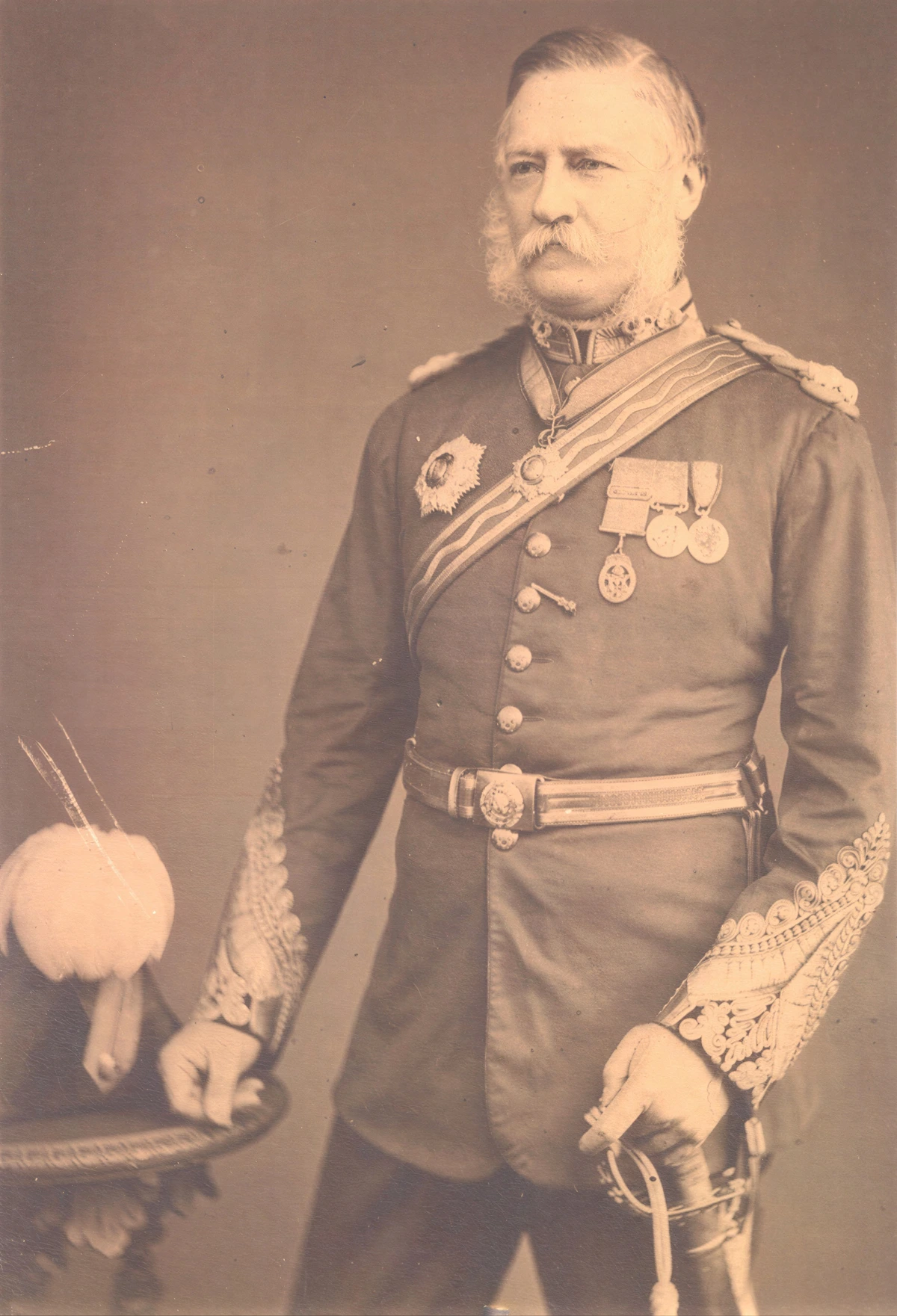
Biography
Stokes was the second of six children. After completing primary education in Cobham, he graduated from the Royal Military Academy at Woolwich, where he learnt all practical military work. He then attended the Military Engineering School at Chatham and went ‘through the practical military course of drill, surveying, field works, pontooning, etc.’ (Stokes 1902: 6-7). Ordered to South Africa in 1845, Lieutenant Stokes fought in the Zulu Wars and completed engineering works meant to strengthen Britain’s newly conquered positions in the colony of Kaffraria, located in what is today the Eastern Cape of South Africa. In 1849 he married Henrietta de Villiers Maynard, the second daughter of a local British merchant, in Grahamstown. They returned to Britain in 1851, where he later served as an Assistant Instructor in Surveying and Field Works at the Royal Marines Academy. Captain Stokes volunteered to serve in the East after his country’s involvement in the Crimean War and in 1855 he was entrusted with establishing an Engineer Corps, including both military and civil engineers, to support the Ottomans on the Russian front. He got to the battlefront just before the end of the war. The signing of the Paris Peace Treaty on 30 March 1856 made it necessary to disband the Anglo-Turkish Contingent of Engineers and to sell off important quantities of military material, a mission assigned to Stokes. His exact and careful mastering of responsibilities was appreciated by Lord Panmure, the Secretary of State for War, and Lord Stratford de Redcliffe, the influential British Ambassador to the Ottoman Empire.
While in Istanbul in July 1856 Lord Stratford de Redcliffe offered Stokes the office of British Delegate to the European Commission of the Danube, which was established under the Treaty of Paris for the improvement of the Mouths of the Danube (the river’s delta has three branches flowing into the Black Sea: Chilia, Sulina and St. George). Stokes accepted the position, which fit well with his engineering expertise, technical skills, military training and also diplomatic ambitions. This was a decision that ‘changed my whole life’ (Stokes 1902: 57), as he remained at the Danube until the early 1870s and his subsequent public career was related to the governance of international waterways. The European Commission of the Danube, seated in the Moldavian (later Romanian) port-city of Galați, consisted of delegates of the seven signatory powers of the Paris Peace Treaty and was ‘charged to designate and to cause to be executed the works necessary below Isatcha [Isaccea], to clear the mouths of the Danube, as well as the neighbouring parts of the sea, from the sands and other impediments which obstruct them, in order to put that part of the river and the said parts of the sea in the best possible state for navigation’ (Congrès de Paris, Paris 1856: 11-12). The duties of the Danube Commission were to be transferred, after two years, to a Riparian Commission, similar in many aspects to the Central Commission for the Navigation of the Rhine, set up by the Congress of Vienna in 1815. During the first two years the commissioners discussed solutions and drafted regulations on almost a daily basis. Stokes’ technical background made him quickly realize that the Danube Commission required capable engineers and large financial resources to fulfil its task. He invited Charles Augustus Hartley, who had devoted himself to hydraulic engineering and had rendered good service in the Anglo-Turkish Contingent of Engineers, to become the organization’s Engineer-in-Chief. Hartley spent most of 1857 completing scientific surveys in the Ottoman Danube Delta and thus based his technical proposals on solid and relevant empirical data for the river’s seasonal variations. In early 1858, after lengthy discussions amongst the seven European commissioners, a majority voted for provisionally improving the Sulina branch of the Danube. Stokes and Hartley favoured the St. George branch, a more expensive and complex technical choice, but a better solution in the long term. By the same time the governments required the assistance of an international Technical Commission, which in August 1858 in Paris decided in favour of St. George, but with a different engineering solution than envisaged by the commissioners. Stokes was summoned by his government (as other delegates also had been) to discontinue the works started at Sulina, but he evaded compliance, as the improvement project had been approved by his colleagues, and, he claimed, he could not withdraw his support (Ardeleanu 2008: 89). As the Danube Commission’s initial term of two years had passed, an ambassadorial conference of the signatory powers in 1858 also decided in Paris to prolong the Danube Commission until the completion of the provisional works which had started at the Lower Danube. The prolongation adjusted the deliberative work of the commissioners.
Stokes felt he had a duty to extend the term and scope of the Danube Commission as much as possible, as both a European bulwark against the hydro-hegemonic ambitions of the Austrian Empire and for the protection of Britain’s economic interest in the large Danubian grain trade. One of the best ways in which he could support Hartley’s engineering programme was to secure the institution with sufficient financial resources. According to the 1856 Paris Treaty, all preliminary costs were to be covered by the central government of the Ottoman Empire, known as the Sublime Porte, but the complexity of hydro-technical improvements needed at Sulina exceeded all initial expectations. In 1857 Stokes travelled to Istanbul to convince Ottoman officials to advance money for ongoing works and then the Danube Commission used the commissioners’ private contacts to get loans from German and British banks in Moldavia, which provided Hartley with the necessary cash flow. When the Ottoman instalments completely ceased in 1860 Stokes strongly favoured the introduction of a navigational toll, as stipulated by the Paris Treaty. Since September 1860 ships trading on the maritime Danube paid a tariff proportional with the advantages they derived from the increased depth of the river. The organization could collect the toll on its own account and use this income for further funding of its hydro-technical works. Stokes’ greatest success was to convince the British Foreign Office to guarantee a loan contracted from a British bank, which reduced the huge interest paid in the absence of such governmental support from 10-12 to 4 per cent. Lord Stanley, British Secretary of State for Foreign Affairs, backed his motion and in 1868 ‘on the initiative of H.M. Government, all the Powers, except Russia, had consented to guarantee the loan for the permanent works’ at Sulina (Stokes 1902: 95). The loan secured the existence of the Danube Commission, as the international organization was to be prolonged until the complete repayment of the loan.
After the Danube Commission put its first tariff into force in 1860, Stokes and his colleagues understood that levying tolls on vessels of different nations based on their tonnage was rather unfair, as ‘hardly any two vessels had adopted the same rule of measurement, and that consequently very unequal dues were being paid’ (Stokes 1902: 80). To remedy the inequality, he persuaded his government to measure foreign ships and compare them so as to establish a table of conversion between national standards. During the 1860s the seven commissioners improved this system and recommended further international standardization in the measurement of tonnage, which in the 1870s was achieved by the Suez Canal Company. By then the Danube Commission had gone through structural changes. When the Commission’s mandate was extended in 1860, the commissioners agreed on a Public Act that set the tariff tables, the rules of conduct for the shipping personnel and the police regulation. They also appointed inspectors to oversee the navigation process. In November 1865 the seven signatory powers signed the Public Act. The Commission, which since the early 1860s held two sessions a year (in spring and autumn), then enjoyed legislative, executive, administrative and judicial powers that allowed it to directly regulate and control navigation along the maritime Danube. Stokes was one of the main artisans of this early international organization. By the mid-1860s most of the early commissioners had been replaced and Stokes used his seniority and experience to be the informal leader of the collegial institution and its bureaucracy. While most of his colleagues held other offices in their countries’ consular and diplomatic service, Britain had decided to keep the commissionership separate from the position of vice-consul to Galați (until 1881). This was dictated by the leading role of British subjects in Danubian trade and shipping, and it strengthened Stokes’ position as primus inter pares. Stokes had insisted on the importance of his position and on maintaining the Commission from the beginning. Running the everyday business of the Danube Commission as a member in its executive committee, Stokes built a solid understanding of the juridical, administrative and nautical aspects of inland navigation. In dealing with the Ottoman authorities in the Danube Delta and at Istanbul he also gained an apprenticeship in Oriental politics and diplomacy. He was a persevering writer of minute reports with which he virtually bombarded his superiors, who initially did not pay due attention to his reports. However, in Istanbul, Vienna and Galați he was regarded as one of the most qualified experts in the navigation of transboundary waterways.
After being prolonged for five years by the 1866 Paris Conference, the future of the Danube Commission was discussed once again during the London Conference of 1871, which followed Russia’s denunciation of Black Sea neutrality. Stokes wrote strongly to Foreign Secretary Lord Granville ‘on the subject, setting forth the view that English interests were of such paramount importance in the Danube, that Great Britain ought to maintain its share in the control of the river, which, under present arrangements, was only extended to the Spring of 1871’ (Stokes 1902: 103). He urged that this was an excellent opportunity, while conceding points to Russia, for insisting on British permanent hold upon the Danube. In Vienna Stokes negotiated to gain Austria-Hungary’s support for the Danube Commission and then headed for London where, after a cold welcome, his relations with the Foreign Office soon improved. The government referred all matters connected with the Danube to Stokes, who also attended meetings of the Committee of the Cabinet which was considering the Danube questions in relation to the Conference. He was in constant communication with the Ambassadors and special Plenipotentiaries sent over to London for the Conference. Finally, he drafted the Articles of the Treaty of London of 13 March 1871, which embodied the rules for the maintenance of the Danube control and prolonged the Danube Commission for 12 more years. As Baron Hammond, the Permanent Under-Secretary of the Foreign Office, recounted, Stokes had done his duty ‘and done it well’ (quoted in Stokes 1902: 105).
Shortly after the Treaty was signed in 1871 Stokes decided to quit his position with the intention of returning to his military career. In June he sent his wife and children home to England and in October Charles Gordon arrived to take over Stokes’ commissionership. Stokes, who was anxious for work to continue as before, prepared an introductory memorandum of several hundred pages for Gordon. In December Stokes relinquished his commissionership and joined his family. His experience gained on the Lower Danube proved useful again in another region vital for British interests when, in 1873, he was appointed one of the two British commissioners in the International Tonnage Commission that assembled in Istanbul for settling uniform measurement rules for the tonnage of ships passing through the Suez Canal (which had opened in 1869). His experience in running an international organization proved helpful. Together with Baron Adolphe d’Avril, the French commissioner in both the Danube Commission and the Tonnage Commission, he imposed the Danube Commission’s procedures for the guidance of discussions in this big Commission of 24 members from the world’s leading twelve maritime countries. After lengthy discussions most of the delegates voted for applying a version of the so-called Danube Rule to the Suez Canal, which measured the tonnage of ships more precisely than under the original English Rule. Stokes bargained for a compromise which was acceptable not only to the management of the Suez Canal Company, but also for its shareholders and the community of international ship owners. While in the Ottoman Empire, the British Government ordered him to report on the condition and administration of the Suez Canal and he advised on the desirability of transferring its administration and maintenance from a private company to the direction of a public authority. In January 1875 Stokes was appointed Commanding Engineer at Chatham, where he was allowed to unite his functions at the Foreign Office with those of a military nature. However, the Government was soon informed about the financial difficulties of the Khedive, the governor of Egypt, and Stokes was instrumental in Britain’s acquisition of his shares. Stokes then visited Egypt and eventually convinced Ferdinand de Lesseps to sign an agreement that was a good compromise between the Suez Canal Company and the European powers. Stokes became one of the three directors of the Company appointed by the London cabinet and remained in this office until his death in 1902, reaching the position of Vice-President in 1887. His contribution to solving problems satisfactorily for British interests secured him a Knighthood in the Order of the Bath in 1877.
During the last decades of the nineteenth century, Stokes was also involved in many other projects where his expertise proved useful. In 1880 he led an international commission appointed to examine the work necessary for the improvement of the port of Alexandria which ultimately decided on a fair tariff on shipping. He was a member of the British Royal Commission on Tonnage Measurement, served as an advisor to the Royal Commission of Colonial Defence on matters related to the Suez Canal and served as a board member for a company aiming to cut a canal to deepen the passage through the straits between Ceylon and India in order to shorten the voyage to Calcutta. When he finished his military work in 1886 he moved to Haywards Heath in Sussex. In 1895 he began to write his memoir, originally intended for private circulation, which ends in 1899 when he unveiled De Lesseps’ statue in Port Said, Egypt. He was troubled by an old leg injury for some years and died of apoplectic seizure in 1902.
Stokes’ work is illustrative for the political relevance of navigation experts during the second half of the nineteenth century. While he was appointed to the Danube Commission for his engineering background, he and other commissioners soon moved their focus from technical aspects to administration, trying to establish a stable and secure political environment in an anarchical peripheral Ottoman province. The Danube Commission under Stokes’ guidance started to draft legislation for this international river in a manner which accommodated Ottoman law, the privileges of foreign citizens in the Ottoman Empire as well as their own national legislation. This encouraged a great degree of cooperation at a pan-European level and implied an information exchange with governments, private companies and academics around Europe. Britain’s position along with Stokes’ technical expertise and diplomatic qualities made him the informal leader of this collegial institution and the de facto first chair of the European Commission of the Danube. Stokes also managed to convince his government of the importance of the Lower Danube for British and European interests, and he equally proved himself to be a valuable expert in these topics. Later in his life this expertise made Stokes part of numerous epistemic communities connected to everything that had to do with international rivers, canals, harbours, navigation tariffs and tonnage measurement.