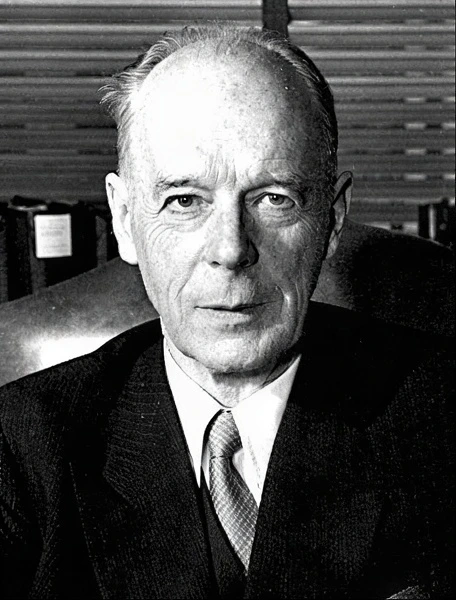
Biography
After graduating from secondary school in Stockholm in 1906, Rooth enjoyed his time as a student in general subjects, economics and law at the University of Uppsala. In 1911 he graduated with a law degree and moved to Germany to study at the Berlin School of Economics for an additional year. After his return to Stockholm he began his career as a clerk in courts in Stockholm and Uppsala, but moved to the commercial banking world in 1914, where he performed as manager and ombudsman at several banks. During the 1920s he also became involved in discussions about public inquiries into the possible introduction of a sales tax and the abolition of monopolies on spirits and tobacco. His political engagement led him to become an executive member of the Liberal Party (1923-1927), which offered him the post of minister of finance in 1926, but Rooth did not see a political career for himself and declined. On 14 March 1929 he was elected as Council member and Governor of the Central Bank of Sweden (Riksbank), a post he held for almost twenty years. As Governor he had an independent position since the representatives of the Parliament (Rikstag), which owned the Central Bank, appointed him. The emerging worldwide economic depression and the United Kingdom (UK)’s decision to leave the Gold Standard in September 1931 resulted in a decline of Sweden’s foreign exchange reserves. Rooth agreed with the British policy and the Nordic central bank governors decided to follow the UK position one week later.
Rooth’s domestic position as Governor became arduous due to the Central Bank’s unforeseen support operation for the troubled Kreuger & Toll business group. Although the Bank’s Council refused Kreuger & Toll’s applications, the government forced the Central Bank to grant a loan twice. After the collapse of Kreuger & Toll in 1932 Rooth was accused of having neglected the country’s currency by reducing the foreign exchange reserves, but he succeeded in defending the Central Bank’s position in a parliamentary debate and remained Governor. In his autobiography (1988) he admitted that he was an ‘autodidact in economics with no formal training in economics at a Swedish university’, but to him it was ‘learning by doing’ as well as listening to the views of economists (Jonung 2023: 33). As the Central Bank was given new tasks, among them currency policy, Rooth attracted young economists to the Bank such as Dag Hammarskjöld, who had defended his dissertation on the spread of business cycles in 1933, and Erik Lundberg, who had studied economics in the United States (US) as a so-called Rockefeller scholar in 1931-1933. Rooth kept the responsibility for currency policy in his own hands and intensified cooperation with other central banks. In 1931 the Board of the Bank for International Settlements (BIS) in Basel, Switzerland elected him unanimously to the Board, although Sweden was only a shareholder and not a founding member. The BIS, set up in 1930 to deal with the reparation payments imposed on Germany by the Treaty of Versailles, soon widened its role. Rooth, whose term on the BIS Board ended in 1933, established close personal relationships with other central bankers through both the BIS and frequent visits to central banks. The Swede Per Jacobsson, Head of the Monetary and Economics Department of the BIS since 1931, was a close friend. Rooth, well known for his ‘constructive work of collaboration’, returned to the BIS Board in 1937, ultimately remaining until 1949 (Lebor 2013: 109).
When the Soviet Union invaded Finland in November 1939, three months after the outbreak of the Second World War, Rooth persuaded the Swedish government to support Finland by granting a large loan. When Nazi Germany occupied Denmark and Norway in April 1940, he used his Scandinavian contacts to help refugees from these countries in neutral Sweden. During the war, however, the Central Bank came under Allied criticism because Swedish firms supplied Nazi Germany with large quantities of iron ore for its military production, with the Swedish Central Bank purchasing gold from the German counterpart to regulate the clearing of trade between the two countries. In 1943 the Allied countries warned neutral states, such as Sweden and Switzerland, not to deal with Germany, as it could be a matter of gold stolen from Jews and it was known that Germany melted stolen gold down and provided it with pre-war German stamps. Rooth, already aware of the issue, tried to get a German guarantee that future deliveries would not contain gold from occupied countries, but after a new Allied warning in 1944 the Central Bank decided to no longer accept German gold bars. After the war Rooth survived the domestic criticism of these purchases and he discussed the issue with his Swiss colleague to provide similar information to the Allied Gold Commission. Their claim of having acted in good faith was not convincing and Sweden returned gold to former occupied countries in 1946.
When the Allied states gathered for the monetary conference in Bretton Woods in July 1944, the neutral states were absent. Rooth, however, was kept well informed through the Swedish mission in Washington DC. His first impression of the outcome was that the ‘rules laid down are going into much more details than I think advisable for a fund which is in fact acting as the central bank of central banks’. He also wanted to distinguish between a ‘transitional post-war period and what came after that’ and hoped that, if the BIS was to be terminated (as was proposed), its leaders could be used in ‘some international context’ (Ahlström and Carlsson 2005: 59). In that autumn Hammarskjöld, who meanwhile worked at both the Central Bank and the Ministry of Finance, discussed an Anglo-Swedish payments agreement in London as well as the Bretton Woods outcome. Hammarskjöld, along with Rooth, was ‘the leading actor on the Swedish road towards Bretton Woods’. He personified the Swedish attitude of: ‘Wait and see, but don’t erect barriers on the road ahead’, to which the respective Ministers of Commerce and Industry, Bertil Ohlin (1944-1945) and Gunnar Myrdal (1945-1947), also agreed (Ahlström and Carlsson 2005: 77). Sweden did not feel an urgency to join, but when Rooth visited the Treasury Department in Washington DC in early 1947 he mentioned the possibility of Sweden joining the International Monetary Fund (IMF) and the International Bank for Reconstruction and Development (IBRD), but Sweden still waited for developments regarding international trade. After Sweden joined the United Nations (UN) in 1946, Rooth participated in the Investment Committee of the UN Pension Fund (1947-1961). In Sweden Rooth also undertook the duties of attorney for the Swedish Post Office Savings Bank (1944-1948) and the state’s Pension Fund (1946-1948).
Domestic relations turned against Rooth, resulting from a conflict with the Social Democratic government, which wanted to keep rents down and prevented the Central Bank from raising interest rates. In Rooth’s eyes, however, keeping a low interest rate entailed the risk of inflation. This dispute became a conflict of principle, with an election outcome that prevented a moderate interest rate increase. Rooth therefore resigned as Governor of the Central Bank on 4 December 1948. He spent his time studying, writing and lecturing on fiscal matters. His international engagement did not end, as the IBRD commissioned him with heading a mission to Iraq to investigate the country’s economic development in February 1951, which resulted in a report in 1952. In the interim, in April 1950, Sweden had decided to join the IMF and the IBRD, based on a contribution of one hundred million dollar to each of the institutions (as calculated by the Central Bank). The Fund and the Bank were expected to decide about Swedish membership at their annual meetings in September. However, the US representative on the IMF Board, Frank Southard, argued that Sweden ought to contribute 155 million dollars and had the issue of Swedish membership postponed. Sweden found itself caught in a power play between the US, which wanted a stronger Asian voice in the two institutions, and the UK, which (backed by France) wanted another European representative on the Boards of the Fund and the Bank. This created a deadlock, which eventually could be solved ‘if the Swedes wanted to present a candidate to succeed [Belgian Managing Director] Camille Gutt, who was to retire from the IMF in the spring of 1951’. Among the Swedish names mentioned were Myrdal, Ohlin and Rooth (Ahlström and Carlsson 2005: 71). Dutch candidate Wim Beyen had insufficient European support. In April 1951 the IMF membership committee accepted Sweden’s 100-million-dollar contribution and opened application for membership until the end of August. In July Sweden was invited to join both institutions and on 31 August it became the fiftieth member of the Bretton Woods System, helped by the fact that on 10 April the IMF Board agreed to the nomination of Rooth as IMF Managing Director. Southard was the one who proposed that Rooth should succeed Gutt. Rooth accepted the nomination but, given his IBRD mission, he did not assume his IMF functions until 3 August 1951. Until Rooth took over the position, US Executive Director Andrew Overby worked as Acting Managing Director.
Rooth inherited an internally divided organization which had practically come to a standstill, with no IMF lending in 1950. While the UK insisted on the automaticity of the use of IMF resources, the US, through Southard, argued that the IMF should strictly manage its lending programmes. However, conditions of loans were never specified. Gutt had tried to make the IMF an international policy advisor, but the 1948 Marshall Plan and the subsequent Organization for European Economic Cooperation (OEEC) resulted in the IMF policy that members supported by Marshall Aid should refrain from using IMF resources. The creation of the European Payments Union (1950), with strong roles for the OEEC and the BIS, further eroded the IMF mandate. In November 1950, however, Gutt succeeded in convincing an informal meeting of the Executive Board that the IMF should serve as an active and useful advisor to its members through conditional lending. Earlier in March Gutt had established a committee, charged with ‘examining all major issues among the staff’, to enhance staff autonomy (Nishikawa 2024: 16). The Board approved Gutt’s policy in April 1951. Rooth took over by continuing staff engagement and by shaping IMF lending policies regarding borrowing costs (encouragement of short-term borrowing), repayment (with a later swap of domestic currency in US dollars) and a tranche policy (making relatively small drawings automatic and larger drawings conditional). The Executive Directors approved this ‘Rooth Plan’, which linked tighter conditions to higher levels of borrowing, in February 1952, followed by an agreement on so-called standby arrangements in October. These ‘standbys’ allowed member states access to negotiate higher tranches on the conditionality that certain policy measures were taken. Both Gutt and Rooth were driven by ‘bureaucratic motivation’ to introduce the practice of conditional lending in the IMF (Nishikawa 2024: 24).
When Rooth floated his ideas to the Executive Board in October 1951, he received its general support and appointed a staff working party to draft specific recommendations. Most of the IMF staff had been with the organization for a long time (since Bretton Woods) and had a high level of expertise, with a specialized training programme since April 1950. They signed a statement that they would not accept instructions from any country and enjoyed a fairly autonomous position. Edward Bernstein was Director of the Research Department and Jacques Polak was Chief of the Statistics Division. Eager to contribute, the staff ‘generalized the concept of standbys for the board and drafted the terms under which they were made’. The Board approved the staff’s recommendations in 1952, making the standby arrangement the IMF’s ‘principal vehicle for conditionality’. Under these arrangements member states ‘could negotiate access to higher tranches (to be drawn as needed) on the condition that certain policy measures were taken’ (Barnett and Finnemore 2004: 58). Following his own plan and the staff contributions, Rooth worked on convertibility of the British pound as part of the new IMF policy of exchange liberalization, in which the pound had a key position, given the UK’s planning for convertibility to restore its position as an international currency. The IMF staff began investigating the liberalization of the members’ exchange rates by asking member states about their prerequisites for exchange relations in 1952. Rooth regarded convertibility of the pound as the first step towards the early establishment of a multilateral payments system. Although the UK’s gold and dollar reserves were still inadequate to meet large conversion of the pound, Rooth continued with the UK and encouraged member states to use IMF resources to promote exchange liberalization. However, the new UK plan for convertibility reflected UK interests too strongly to be attractive to other European states. The IMF staff had prepared a standby credit for six months, but to accommodate the UK Rooth and, by the end of 1953, also the Executive Board preferred the possibility of a longer period.
In early 1954 Rooth and his staff presented a programme to conclude a standby arrangement with the UK. The staff saw several problematic ingredients but ‘could not figure out a clear solution on how to settle the matter’ and left the outcome to secret consultations between Rooth and the UK Chancellor of the Exchequer (Nishikawa 2014: 20). The UK, however, was hesitating about its reliance on the IMF and did not request a standby arrangement. While the IMF staff emphasized the effect of international cooperation on mitigating the dollar shortage, the UK government gave priority to full employment over balance of payment equilibrium. The staff warned that the UK’s full employment policy would cause inflation and wage increases, and thus a deteriorating of its balance of payments. The UK government, however, did not see this inflationary pressure but rather noticed the sign of recession. In autumn 1954 Rooth warned the UK about an inflation of costs, and the IMF staff became concerned that the UK’s expansionary policy would spoil their plan for sterling convertibility. Eventually these IMF efforts to conclude a standby arrangement with the UK came to an end, with IMF exchange liberalization coming to a standstill during the years 1955-1957.
However, sterling convertibility remained a keen interest for the IMF staff, as they concluded in 1955 that in the UK case the balance of payments disequilibrium was caused by wrong macroeconomic policies. In its 1955 consultation with the UK Rooth therefore requested that the UK ‘should commit to stringent policies’. The UK, however, argued that exchange liberalization would be difficult for a while, though it realized that it was inevitable to stop its expansionary policy (Nishikawa 2014: 25). Within the IMF staff discussions continued. Polak formalized a new adjustment theory and monetary approach which showed that, to improve balance of payments, bank credit to both the private and the public sector should be curtailed. In its late 1950s consultations the IMF therefore emphasized the control of bank credit to its member states. In 1957 Polak presented a general equilibrium model, known as monetary model of balance of payments (or ‘Polak model’), that highlighted domestic credit expansion as the main driver of balance of payments difficulties (Momani and Hibben 2018: 77). This model formed the theoretical basis of later IMF financial support actions.
In this period of disagreement with the UK (spearhead in Rooth’s IMF policy) and the IMF’s exchange liberalization coming to a temporary end, Rooth’s term as Managing Director ended on 27 April, but he accepted the Executive Borad’s request to serve until 3 October. His friend Per Jacobsson succeeded him as IMF Managing Director on 21 November 1951 (with American Horace Cochran as Acting Managing Director between 4 October and 20 November). Rooth continued his function as head of the UN Pension Fund (until 1961) and was an economic advisor to the government of Kuwait as head of its Currency Board (1960-1962). He returned to Sweden, where he occasionally published articles or lectured on economic affairs, and passed away in 1972. His autobiography, written with the help of his son Gösta Rooth, was published in 1988.
In the literature about the IMF’s early years, the opinion was expressed that ‘strong-minded’ Jacobsson took over as Managing Director from ‘rather weak-willed’ Gutt and Rooth. As Beyen remarked: ‘Gutt had no roots and Rooth had no guts’ (Van Lennep 1998: 115). However, it can also be defended that Gutt and Rooth succeeded in laying the foundation of IMF lending policies by standing up to US strategies that seriously restricted IMF policies, both within the IMF (through Southard) and outside (through other US policies, such as Marshall Aid). Moreover, Rooth allowed the qualified IMF staff to play a large role of its own, resulting in a deeper understanding of the functioning of the balance of payments, exchange rates and financial support lending, an issue the US could not solve. In the 1950s the IMF staff ‘developed adjustment theory, which laid the foundation for IMF conditionality’ (Nishikawa 2024: 22). These staff efforts, promoted by Rooth, ‘greatly broadened the role and work of the Fund in facilitating international development’ (Kuehl 1983: 636).