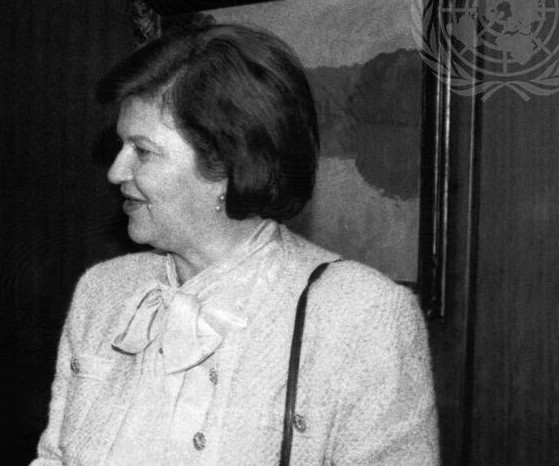
Biography
Pastizzi’s father was a watchmaker in Zagreb, a big city in the north of what was then known as the country of Yugoslavia (now Croatia). He also was a musician, author and Esperantist. Her mother had an administrative job. Pastizzi’s early years coincided with the Second World War, during which Nazi Germany occupied Yugoslavia. The partisan resistance movement against the Germans, Italians and their local collaborators was led by Josip Tito, leader of the Yugoslav Communist Party who became Prime Minister of then liberated Yugoslavia in November 1944. Tito’s People’s Front won the November 1945 elections by a landslide. In 1945, nine-year-old Pastizzi saw her father, who had come from a prosperous family, sent to a forced labor camp. Under Yugoslavia’s new order the family property, including the family home that her father had built, was expropriated. Her father was released in 1949, when information emerged that he had been sheltering anti-fascist partisans during the war. Despite the early difficult family circumstances, Pastizzi excelled as a student, including learning French in school. She never joined the Communist Party but advanced nonetheless, soon entering university to study foreign languages. At the University of Zagreb (1955-1960) she studied English and French, briefly teaching English and French Language and Literature at the Zagreb Experimental Gymnasium.
After Pastizzi’s marriage to Ante Ferenčić in 1960, the couple left for Caracas, Venezuela, where he worked on a geological project as mining engineer. She studied Spanish and gave birth to their twin daughters. They returned to Zagreb, where they lived with her father in the flat that the government had given him after his release and rehabilitation. She resumed her studies at the university, this time in economics and international trade. In 1966 the family returned to South America, where Ante worked on a Panamanian mining project for the United Nations Development Programme (UNDP) while she studied Spanish Linguistics at the University of Panama. While still pursuing postgraduate studies, Pastizzi-Ferenčić began her international professional career. Between 1964 and 1972 she served as a consultant for the UNDP’s Institute for Developing Countries, undertaking work in Panama and Venezuela. By this time Yugoslavia had left the Soviet Union’s camp due to political differences and Tito’s plan for an independent economic development of his country. Yugoslavia became active in the international Non-Aligned Movement, developing close ties with newly independent countries in what became known as the Third World.
In 1968 the family returned to Zagreb, where Pastizzi-Ferenčić resumed her studies while also serving as researcher at the university’s African Research Institute. She was a member of the Yugoslav Committee for Economic Cooperation with Development Countries (1969-1970). In 1971 the family went back to Caracas for some time. He worked for the Yugoslav Chamber of Commerce and, as a representative, engaged with the Non-Aligned Movement and South-South cooperation. Back in Zagreb, she earned her Diploma in Economic Development in 1973. Both her travels and academic studies shaped her professional interests in economic development policy, international organizations, technical cooperation, women and development, as well as the environment and sustainable development. In addition to her native Croatian, she was fluent in English, Esperanto, French, Russian and Spanish. From 1972 to 1981 she worked at the African Research Institute in Zagreb, serving as Project Coordinator for the Institute for Developing Countries. During those years she became active in national associations, such as the Council for International Organizations of the Yugoslav Federal Chamber of Commerce (1976-1979) and the Yugoslav Standing Conference on the Role of Women in Development (1979-1981). In 1980 she prepared the paper Research on the Status of Women in the Projects of the International Center for Public Enterprises in Developing Countries for an international expert group meeting on the links between women’s work, development and public enterprises. Internationally she was active in professional associations and networks such as the Advisory Council of the International Water Supply Association, the Foundation for Transfer of Knowledge, the Women International Leadership Programme, and the Association for the Advancement of Policy Research & Development.
In December 1976, during the first year of the United Nations (UN) Decade for Women (1976-1985), the International Research and Training Institute for the Advancement of Women (INSTRAW) was created by a resolution of the UN Economic and Social Council (ECOSOC). INSTRAW was initially intended to be based in Iran since hosting was of interest to the Shah of Iran’s twin sister Princess Ashraf Pahlavi. However, when political protests and the 1979 Revolution took place in Iran a new venue for INSTRAW was found in Santo Domingo, Dominican Republic. INSTRAW’s Board of Trustees met for the first time in October 1979 to adopt its program budget for the years 1980-1981. The Board recommended, pending the appointment of a director, that a coordinator be designated and staff appointed to begin the work of the Institute. The report was submitted to ECOSOC in February 1980 and to UN Secretary-General Kurt Waldheim. Following consultations with member states in 1981 and taking into account the views of the Board of Trustees on (few) suitable candidates, Waldheim approved the appointment of Pastizzi-Ferenčić, which ECOSOC welcomed on 6 May 1981. The Yugoslav government had nominated her despite her never having joined the Communist Party. However, her knowledge of languages, experiences in South America and Africa, her work at various scientific institutes, and her international contacts had impressed government officials and made her a strong candidate for the INSTRAW position.
Pastizzi-Ferenčić began her tenure as INSTRAW Director in June 1981 at a time when the UN Decade for Women was in full swing, following the Second UN World Conference on Women in Copenhagen in July 1980. The first World Conference on Women in Mexico City (1975) had influenced the creation of three UN entities for the advancement of women. INSTRAW was conceived as a research, training and documentation center, while the 1976 UN Voluntary Fund for the Decade on Women (in 1985 UN Development Fund for Women UNIFEM) was to be an operational body aligned with the UNDP. The third UN organ that focused on women was the Division for the Advancement of Women, which at the time was situated within the Center for Social Development and Humanitarian Affairs of the UN Office in Vienna, Austria. Pastizzi-Ferenčić’s first activities for INSTRAW consisted of acquiring resources and setting up headquarters with a small staff. INSTRAW was not funded out of the UN budget but had a voluntary budget that relied on contributions acquired from governments, international non-governmental organizations, other UN entities and private donors. Each year the Director was expected to prepare a report on INSTRAW activities for dissemination at the meetings of the UN General Assembly. INSTRAW’s headquarters were officially inaugurated on 11 August 1983 by the government of the Dominican Republic, with experts in the field of women and development present, such as Ester Boserup from Denmark and Vilma Espín de Castro from Cuba, who were also members of the Board of Trustees. Once the Institute was set up, Pastizzi-Ferenčić, who was a good organizer, supervised the production of INSTRAW News, first published in 1984, and began to arrange seminars and training sessions for women leaders from government, academic and civil society. In 1985 UN Secretary-General Javier Pérez de Cuéllar visited INSTRAW during his three-day official visit to the Dominican Republic.
INSTRAW, the first UN body headquartered in a developing country, was tasked with helping to improve the availability and reliability of data on women in the economy, including the informal sector. To that end, Pastizzi-Ferenčić worked with the Statistical Office of the Department of International Economic and Social Affairs of the UN Secretariat in New York and with specialized agencies such as the International Labour Organization (ILO) in Geneva, Switzerland and the UN Industrial Development Organization in Vienna. She promoted the need for countries and policies to recognize women’s roles in both production and reproduction, which was the theme of INSTRAW’s first inter-regional seminar on the incorporation of women into development planning held in Santo Domingo in December 1983. Pastizzi-Ferenčić helped INSTRAW identify, conceptualize and measure the varied forms of women’s economic activities, both public and private and formal and informal, that had hardly been statistically depicted, either nationally or internationally. In 1984 the Institute produced two studies on measuring women’s work: Improving Concepts and Methods for Statistics and Indicators on the Situation of Women and the companion study Compiling Social Indicators on the Situation of Women. Pastizzi-Ferenčić also contributed to the UN’s first world survey on women, which was prepared for the World Conference to Review and Appraise the Achievements of the UN Decade for Women: Equality, Development and Peace in Nairobi, Kenya in July 1985. Women and Developing Countries’ Self-Reliance (1984) was the INSTRAW contribution to the first World Survey as part of the preparations for the Nairobi Conference. The emphasis on self-reliance reflected the broader goal within the developing world, whereby many Southern countries sought to avoid dependence on either the capitalist economies of the West or the centrally planned economies of the East. This also reflected Pastizzi-Ferenčić’s Yugoslav background, which similarly sought a path between East and West, and INSTRAW collaborated on at least one occasion with the International Centre for Public Enterprises, based in Ljubljana, Yugoslavia. Subsequently, and in collaboration with the Department of International Economic and Social Affairs, INSTRAW contributed to the regular editions of the UN’s World Survey on the Role of Women in Development, first published in 1985.
For INSTRAW’s seminars and training sessions Pastizzi-Ferenčić hired consultants and commissioned studies that often made their way into larger UN reports or stand-alone publications. Lourdes Urdaneta-Ferran of Venezuela was consulted on conceptualizing and measuring female labor. Pastizzi-Ferenčić’s own publications during her tenure focused on new approaches and concepts in statistics on women (1986) and women’s work in the informal sectors of economy (1989). INSTRAW publications under her direction discussed topics such as the incorporation of women into development planning, the role of women in the international drinking water supply and the sanitation decade, and the role of women in international economic relations. The latter topic resulted in the book Women in Economic Activity: A Global Statistical Survey, 1950-2000 (Santo Domingo 1985), coproduced with the ILO, and Susan Joekes’ book Women in the World Economy: An INSTRAW Study (Oxford 1987).
Technology transfer with women’s participation and for their advancement was a key theme for Pastizzi-Ferenčić. In September 1983 she set up an expert meeting on women, science and technology, jointly organized with the UN Center for Science and Technology for Development and the American Association for the Advancement of Science. This resulted in the book Women and Technology in Developing Countries: Technological Change and Women’s Capabilities and Bargaining Positions (Santo Domingo 1985), written by Deborah Bryceson and commissioned in collaboration with the UN Conference on Trade and Development. This was followed by the INSTRAW publication Choice of Technology for Women: Theories and Realities (Santo Domingo 1986). For the more comprehensive 1989 World Survey, INSTRAW contributed an annex focused on methodological issues in measuring women’s labor, especially in the informal sector. Recognizing the distinctive status and needs of aging women, Pastizzi-Ferenčić took part in the Fourteenth International Congress of Gerontology in 1989, addressing the informal sectors of the economy and their development potential for the aging. Her final contribution to INSTRAW in 1990 covered the financial policies for improving women’s access to credit. Pastizzi-Ferenčić’s tenure ended in June 1990, when Margaret Shields from New Zealand, who had worked at the Department of Statistics, succeeded her as INSTRAW Director.
After leaving INSTRAW Pastizzi-Ferenčić turned her attention to the environment and sustainable development and, in 1990, she joined the UN’s Department of Technical Cooperation for Development as Director of its Natural Resources and Energy Division in New York. Her work on natural resources reflected her passion for sustainable development and people’s wellbeing. She took part in the preparations for the UN Conference on Environment and Development in Rio de Janeiro, Brazil in June 1992. In advance she helped produce a special issue of the UN’s Natural Resources Forum (1992), explaining the UN’s longstanding work on natural resources and the environment. Appointed in 1993 as Deputy Executive Secretary of the UN Economic Commission for Europe (UN ECE) in Geneva, she contributed research and policy papers on a range of topics, comprising the inclusion of unpaid work in national accounts and several subjects in preparation for the UN’s Third World Conference on Women in Beijing, China in September 1995. She represented UN Secretary-General Boutros Boutros-Ghali at the 16th World Energy Council Congress in Tokyo, Japan in October 1995 and in October 1997 she delivered a message to the World Tourism Organization, on behalf of UN Secretary-General Kofi Annan, at its general assembly meeting in Istanbul, Turkey.
After her retirement from the UN ECE in 1997, Pastizzi-Ferenčić continued serving in various fields. She started teaching at the Diplomatic Academy in Croatia, served as a member of the Honorary Committee of the World Esperanto Congress and took part in the UN’s Special Session of the General Assembly on Women in 2000. At the end of 2003 Pastizzi-Ferenčić passed away in Croatia, whose Ministry of Foreign Affairs’ obituary recognized her as the first high-ranking Croatian international civil servant. She is remembered as an effective servant, a dedicated supporter of women’s advancement and a mentor to the many researchers and assistants who worked on INSTRAW projects during her years there as Director. Pastizzi-Ferenčić promoted the visibility of women in the global economy through the design of statistics and the development of methodological tools to better count and measure women’s diverse economic activities, also in their informal forms, a field not yet covered by economics. The analyses she promoted covered new fields such as women and development, technology transfer and aging women. Annan noted that ‘Under her guidance, INSTRAW made breakthroughs in the fields of gender, water and energy and achieved important inroads in the area of gender statistics and indicators’ (Letter to Nina Ferencic, 5.1.2004). Dunja’s daughter Nina followed her mother’s career in the international civil service and worked at the Joint United Nations Programme on HIV/AIDS in Geneva and the UN Children’s Fund in New York.