Biography
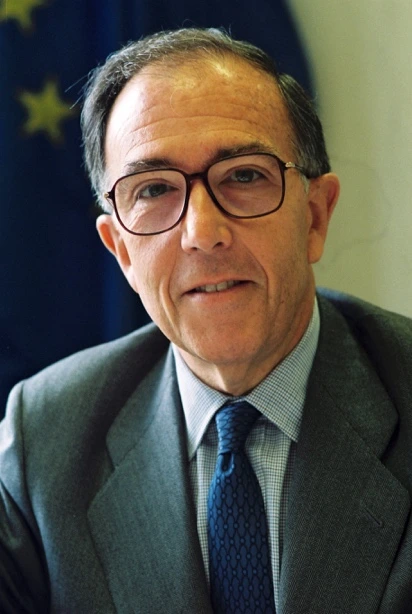
Oreja was born into a Catholic family four months after his father was killed in Mondragón during the so-called October Revolution of 1934, while serving as a Traditionalist and Carlist Member of Parliament for Biscay, a province in Northern Spain. His father had been president of the Unión Cerrajera de Mondragón, a large iron and steel firm, and was shot dead by a group of Socialist trade unionists who took over the town. The October Revolution sharpened the opposition between Left and Right in Spanish politics and later resulted in the Spanish Civil War (1936-1939). Oreja, the only child, grew up in San Sebastián, a spa town on the Northern coast, thirty kilometres south of the French border. At his mother’s insistence, he learnt English, French and German at a young age and spent summers abroad (Oreja 1998). His summer stays in Southern France between 1945 and 1947, with a village priest who told him stories about the Second World War, French Resistance and freedom, left an impression. After studying at the Jesuit school of San Ignacio in San Sebastián, Oreja finished his baccalaureate at San José, a Jesuit boarding school in Valladolid, in 1951 and then moved on to pursue undergraduate studies. He began studies in law at San Pablo’s College at the Central University of Madrid, but in order to skip one year he moved to the University of Salamanca to complete his degree. He then returned to the Central University of Madrid for his doctorate in law, earning a special award for his doctoral thesis on the extension of the territorial sea, which focused on Spain and the revision of the classic concept of jurisdictional waters. He did much of his doctoral research at the Peace Palace Library in The Hague, the Netherlands. Oreja entered Spain’s Diplomatic School in 1958, where, upon completion, he ranked first in his year.
In 1960 Oreja joined the diplomatic service, becoming technical advisor to Spain’s Minister of Foreign Affairs, Fernando María Castiella, who in Oreja’s (2001: 13) eyes was ‘first and foremost, a great Basque, for he was devoted… to the highest ideals: Spain’s global defence, its interests, and its good name all over the world’. In 1962 he became Castiella’s chief of staff and modelled himself after Castiella, his boss and mentor for a decade. During that time Oreja worked on Spain’s 1962 accession letter to the European Economic Community (EEC) and on Spain’s 1970 EEC preferential agreement with José Joaquín Puig de la Bellacasa and Antonio Oyarzábal as his closest collaborators, who provided him with access to Prince Juan Carlos. In 1967 he married Silvia Arburúa, with the couple’s sons born in 1969 and 1970. Since 1962 he had also taught at the Diplomatic School, where he became deputy head in 1968, but eventually he was not allowed to continue teaching because of his Christian-Democratic leanings. In October 1969 Gregorio López Bravo was appointed Minister of Foreign Affairs, replacing Castiella, who was on bad terms with Vice President Luis Carrero Blanco. Oreja left the Ministry soon after Castiella’s dismissal and was appointed International Relations Director at the Bank of Spain, a position he held for four years. In addition to this job he took up a position as teaching assistant to the International Law Chair, which was held by Castiella, at the Complutense University of Madrid in 1971. Oreja had this position for six years. Also in 1971 Oreja was elected as a member of the National Movement for Guipúzcoa and, thereby, secured a seat in the Spanish Parliament. He and other members of the National Movement set up the informal Núñez de Balboa Group to promote change within the political institutions. In May 1973 Oreja and a number of Madrid-based individuals founded the Grupo Tácito, a name he came up with after the Roman historian Tacitus, meaning that due to government censorship not everything could be said (Oreja 2011: 107). Grupo Tácito was set up ‘after a lengthy gestation period, which had its origins in a meeting of the Asociación Católica Nacional de Propagandistas’ (Catholic National Association of Propagandists) (Powell 1990: 252). The group’s early influence was largely determined by its ready access to the Catholic press. According to Powell (1990: 265 note 25), Grupo Tácito’s programme was conceived as an attempt to provide fresh answers to the many questions posed by the prospect of Franco’s death and was based on the premise that Spain under Franco had developed into ‘a country not unlike her Western European neighbours, and that Spanish society was therefore ready for democratic rule’. Members would meet regularly to discuss Grupo Tácito’s weekly article, which would come out every Friday, first in the Ya newspaper and then in up to nineteen papers, between 1973 and 1976.
In 1974, after four years at the Bank of Spain, Oreja returned to the government when he was appointed Under Secretary for Information and Tourism. In December 1975 he moved to the Ministry of Foreign Affairs, when Spain’s first post-Franco Minister of Foreign Affairs, José María de Areilza, named Oreja Under Secretary. Oreja helped to prepare King Juan Carlos and Queen Sofia’s June 1976 trip to the United States as well as Spain’s 1976 bilateral Treaty of Friendship and Cooperation with the US. Oreja also presided over the Cooperation Commission at the Hague Conference on International Private Law in that year. Seven months after Franco’s death in November 1975 the King named Adolfo Suárez President. Minister Areilza, who was hoping to be appointed President, handed in his resignation. The King and Suárez asked Oreja to replace Areilza as Minister of Foreign Affairs. To convince him to take the job, Suárez told Oreja that his other cabinet ministers were ‘more your friends than mine’ (Powell 1996: 249). Seven out of 20 ministers in Adolfo Suárez’s 1976 Cabinet were members of Grupo Tácito. Taking up the post of Minister from 5 July 1976, Oreja set out to reform Spain’s 1953 Concordat with the Vatican, which resulted the same month in agreements with the Holy See laying out the separation of church and state. Two months later Oreja signed the Universal Declaration of Human Rights on behalf of Spain. With Suárez more concerned with domestic politics, Oreja soon realised that foreign policy was not Suárez’s top priority. However, in a little under four years Oreja succeeded in establishing diplomatic relations with 19 countries, including the German Democratic Republic, Mexico, Mozambique, Poland, the Soviet Union and Vietnam. In April 1977 Oreja joined the Union of the Democratic Centre (UCD), a coalition party founded by Suárez. He also became Senator by royal appointment in Spain’s first free elections held in June 1977 and he won the right to represent Guipúzcoa as a Member of Parliament two years later. On 28 July 1977 Oreja submitted Spain’s application to join the EEC, even though he knew the accession process would take many years to complete. In the meantime ‘we needed to take some kind of initiative that would speed up Spain’s accession to a European institution, and Europe’s political institution par excellence was the Council of Europe’ (CVCE 2010: 9). Spain joined the Council of Europe on 24 November 1977.
Oreja’s sudden replacement as Spain’s first constitutional Minister of Foreign Affairs in September 1980 came as a general surprise. Just when the second follow-up meeting of the Conference on Security and Cooperation in Europe was set to start in Madrid, José Pedro Pérez-Llorca took over. Jaime Mayor Oreja, Oreja’s second nephew and second on the electoral roll for Guipúzcoa, took up his uncle’s seat as Member of Parliament. While some accounts point to party infighting as the reason behind Oreja’s dismissal, others say it was down to his and Suárez’s public disagreement over Spain’s membership of the North Atlantic Treaty Organization (NATO). After his dismissal Suárez made Oreja ambassador, offering him the Council of State presidency and several embassy jobs, but Oreja rejected them all. Instead, he served as the first National Government Representative to the Basque Country between 1980 and 1982, which was ‘probably the hardest job I’ve had from both a personal and a family perspective’ (CVCE 2010: 10). In 1980 alone terrorists belonging to ETA (Euskadi Ta Askatasuna, Basque Country and Freedom) killed 91 persons, approximately one murder every four days. When the Spanish Socialist Workers’ Party (PSOE) won a landslide victory in the October 1982 general elections, Oreja left politics and returned to diplomacy. President Felipe González’s Minister of Foreign Affairs, Fernando Morán, offered Oreja a job at the United Nations. Because Morán never delivered on his promise, Oreja (2011: 486) decided to follow the bureaucratic procedure at the Ministry, which allocated him to the Spanish Consulate in Lisbon, Portugal. The appointment was highly inappropriate for a former Foreign Affairs Minister and diplomat with ambassador rank and, before Oreja could make it to Lisbon, President González took matters into his own hands. He suggested that Oreja run for Secretary General of the Council of Europe instead. All parties in Spain supported Oreja’s candidacy, seeing him as a ‘bridge-man’ (Powell 1996: essay title) or, in his own words, being ‘a man of the Transition’ (Oficina 1983: 849; La Galería 2013). During the Council of Europe elections in Strasbourg, France on 9 May 1984 Oreja won an absolute majority, receiving 85 votes compared to then Secretary General Austrian Franz Karasek’s 39 votes and Norwegian Ole Algard’s 36 votes. Oreja was Spain’s first executive head of an international organization, followed by Federico Mayor Zaragoza (UN Educational, Scientific and Cultural Organization, 1987) and Javier Solana de Madariaga (NATO, 1995), all appointed during González’s presidency.
Oreja assumed the post of Secretary General of the Council of Europe on 1 October 1984. He strengthened the Council’s collaboration with the EEC and set up the Commission of Eminent European Personalities to develop policy recommendations for the future of European cooperation. The so-called Colombo Committee, which was chaired by former Prime Minister of Italy, Emilio Colombo, and included José María de Areilza, Maurice Faure and Geoffrey Rippon, worked hard to get the EEC to adopt the European Convention on Human Rights. As part of the Colombo Report’s recommendations, Oreja and European Commission President Jacques Delors signed a new arrangement for cooperation between the EEC and the Council of Europe in June 1987. From that moment on the European Commission was allowed to sit on all expert committees and attend all ministerial conferences of the Council of Europe. Civil servants could participate in Council of Europe activities and regular meetings were set up to exchange information (Oreja 2011: 510). Oreja’s main goal as Secretary General was to promote cooperation between European countries. He and German Minister of Foreign Affairs Hans-Dietrich Genscher teamed up to get the Council of Europe to work towards East-West cooperation and to build a relationship between the countries of Central and Eastern Europe and the Council of Europe. Oreja obtained Yugoslavia’s signature on the European Cultural Convention in October 1987. He was the first Secretary General of the Council of Europe to visit a Communist country. In 1987 he travelled to Hungary and in 1988 to Poland, where he met with General Wojciech Jaruzelski and leaders of Solidarity, the non-Communist Polish trade union. He furthermore welcomed Pope John Paul II to speak to the Council of Europe in 1988. Finland joined the Council of Europe in May 1989 and, as a result of his policy to promote closer East-West relations, the Council of Europe voted to grant special guest status to Hungary, Poland, the Soviet Union and Yugoslavia in June 1989. On 6 July Soviet Union leader Mikhail Gorbachev addressed the Parliamentary Assembly of the Council of Europe.
As Secretary General Oreja appointed José Vidal-Beneyto Director of Education, Culture and Sport in 1987, as there ‘had never been a Spanish Director General at the Council’ (Oreja 2011: 499). In that year the Council of Europe launched its so-called cultural routes programme. For Oreja this was ‘one aspect that I made every effort to promote’. The Way of St James (The French Way), a pilgrim route through Northern Spain, beginning in the French Pyrenees and leading to Santiago de Compostela, was the Council’s first European Cultural Route. In Oreja’s view the Way of St James was ‘a representation of a pilgrim Europe, a travelling Europe, an intercultural Europe, a Europe of human relationships, of true relationships’ (CVCE 2010: 11). During his term Oreja’s team started work on the European Charter for Regional or Minority Languages as well as the Common European Framework of Reference for Languages: Learning, Teaching, Assessment, a guideline to foreign language competency across Europe, which was completed in 1992 and had an effect on student mobility and the standardized assessment of language proficiency. Oreja also brought forward the 1985 Convention for the Protection of the Archaeological Heritage of Europe, which gave new momentum to heritage programmes and cooperation across Europe (Pickard 2002: 120). When the Council of Europe approached its 40th anniversary in 1989, Oreja (1988) wrote a letter to the President of the Council’s Assembly asking what the future role of the Council of Europe should be, arguing that ‘the traditional distinction between integration Europe (the Community) and co-operation Europe (Council of Europe) is no longer realistic’. After his five-year term Oreja kept his 1984 pledge and did not run for re-election, but instead successfully ran for a seat in the June 1989 election of the European Parliament of the European Community, with Catherine Lalumière, then French Secretary of State for European Affairs, replacing him as Secretary General of the Council of Europe on 1 June 1989.
Oreja had left the UCD party in Spain and in 1983 he joined the conservative Alianza Popular (People’s Alliance). In January 1989 the Alianza Popular and some smaller parties merged to become the Partido Popular (People’s Party), with Oreja acting as Vice-President from January 1989 to March 1990. Oreja ran as the new party’s lead candidate in the June 1989 elections for the European Parliament against former Minister of Foreign Affairs Morán of the PSOE. He did so on the condition that the Partido Popular leave the group of European Conservatives and join the European People’s Party instead. Oreja won a seat and began as Member of the European Parliament on 26 July 1989. He served as Vice-Chair of the Group of the European People's Party and was appointed Chair of the Committee on Constitutional Affairs, the area that most interested him. While working with Valéry Giscard d’Estaing and Maurice Duverger from France, he got involved in work for stronger integration of Europe. In 1993, however, Partido Popular President José María Aznar called Oreja back to Madrid for the Spanish general elections. Oreja, who ended his position in the European Parliament on 29 June 1993, won a seat as Member of Parliament for Álava and presided over the mixed Congress-Senate Commission.
However, Oreja did not stay long in national politics because Spain’s Partido Popular European Commissioner Abel Matutes resigned and Oreja was asked to step in. Between 27 April 1994 and 25 January 1995 Oreja acted as Transport and Energy Commissioner in the third European Commission led by Jacques Delors. According to Oreja (2010: 12), Delors was ‘the best President the Commission has ever had’. Oreja signed the first Implementation Treaty of the European Energy Charter in December 1994 and successfully focused on setting up a true single market in aviation. Between 25 January 1995 and 17 September 1999 Oreja was Institutional Relations and Culture Commissioner in Jacques Santer’s Commission. He was in charge of the Amsterdam Treaty negotiations and took on public engagement work to promote the euro and to explain to citizens across the EU what the treaty changes meant. He launched the Culture 2000 Programme, the first comprehensive programme supporting cultural activities, to promote a common cultural area that protected Europe’s cultural diversity and shared cultural heritage. From 1993 to 1999 Oreja worked alongside European Commissioner Manuel Marín, who was from the PSOE. They worked well together in spite of their different political backgrounds (Marín 2003).
Between 1995 and 1999 Oreja held the Jean Monnet Chair in European Institutions at the Complutense University of Madrid. On his return to Spain in 1999 he was appointed head of the European Studies Centre at the CEU (Centre for University Studies) San Pablo Foundation and Vice-Chair of the BBV (Bilbao Biscay Bank) Foundation. Oreja served as president of Fomento de Construcciones y Contratas (FCC), a construction company, and Northern Telecom Spain and was an Advisor to Acerinox and Repsol. Like his father and maternal grandfather before him Oreja presided over the iron and steel firm Unión Cerrajera de Mondragón. He kept his father’s wooden cross with the words: ‘Instead, love your enemies and do good to them, and lend without any hope of return’. Oreja furthermore served on the boards of directors of Portland Valderrivas, Agroman Inversiones, Acerinox, Editorial Católica y Diario Informaciones, Iberia Airlines, Banco Exterior de España, Instituto Nacional de Industria and Banco Guipuzcoano and is an advisor to FCC and Barclays Bank. In 2001 Oreja joined Spain’s Royal Academy of Moral and Political Sciences (RACMP). He was elected RACMP president in 2010 and successfully stood for re-election in 2013. As RACMP president, he sat on the Council of State and presided over the Institute of Spain between 2014 and 2015. After his last term he became RACMP’s honorary president. Oreja also presides over the Fundación España Constitucional, a foundation made up of former ministers of all parties, who aim to promote Spain’s constitutional values and encourage consensus building and togetherness. He sits on the Board of Trustees of the Elcano Royal Institute, a think tank for international and strategic studies, and published his memoirs in 2011.
Oreja has received numerous awards. In October 1988 Oreja was distinguished with the European of the Year award from the European Academy of Arts, Sciences and Humanities in Paris for his work as Secretary General of the Council of Europe. That month he was named adoptive son of Santiago de Compostela and awarded the city’s Gold Medal. The universities of Zaragoza and Seville awarded him Honorary Degrees in 1996 and in 2010 King Juan Carlos made him Marquis de Oreja. Oreja also holds various national and foreign honours including Commander of the Order of Merit of the Federal Republic of Germany, Knight of the Legion of Honour of France, Commander of the Order of Merit of Poland and in 2017 the Carlos V European Award for ‘his lifelong contribution to the process of European construction and integration’ (www.fundacionyuste.org/en/marcelino-oreja-aguirre-awarded-the-carlos-v-european-award-now-in-its-eleventh-edition/).
May 2021: Gorbachev addressed the Parliamentary Assembly