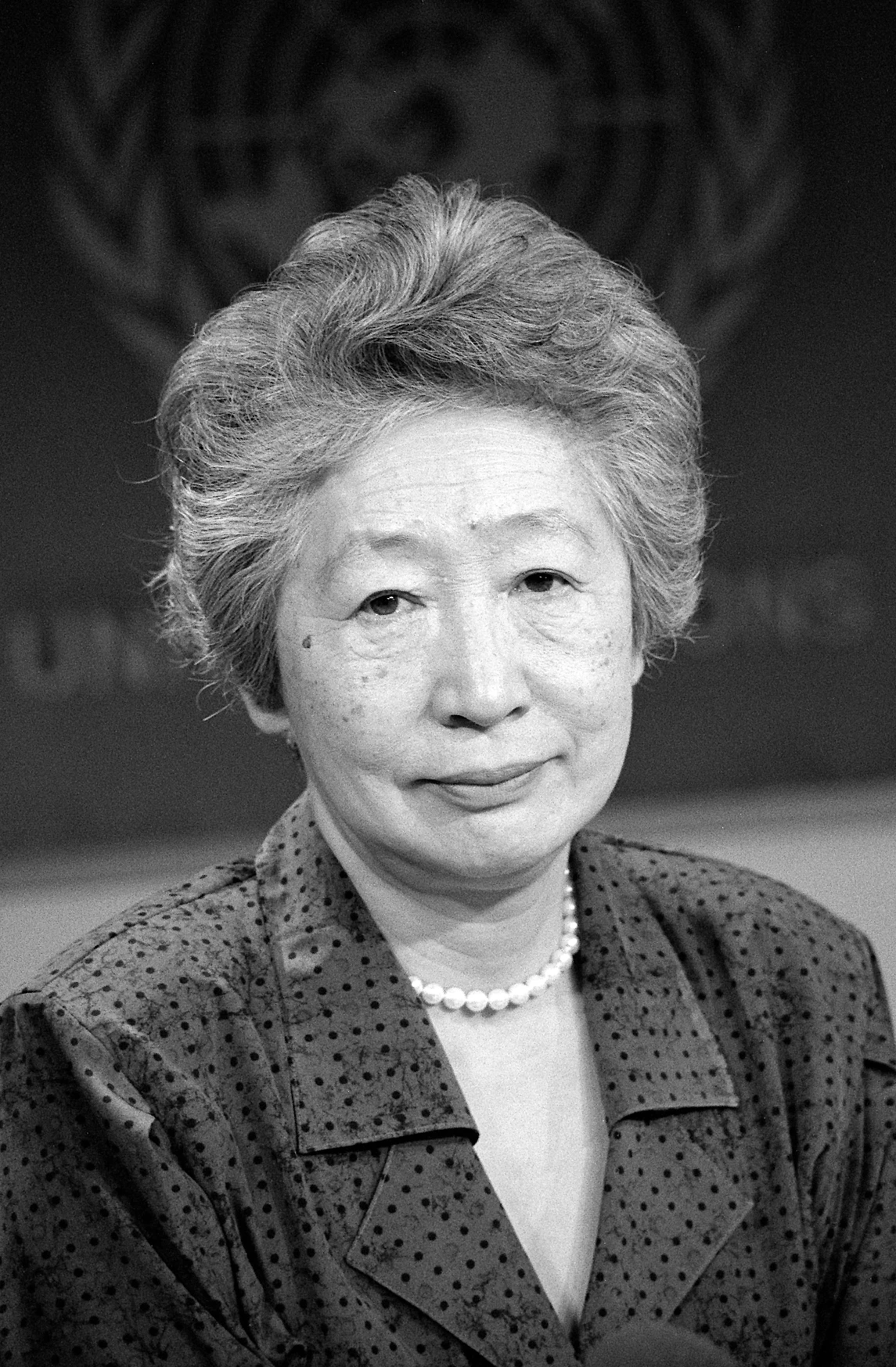
Biography
Nakamura was born into a family with a background in diplomacy and politics. Her father served with the Japanese Foreign Ministry in several overseas posts, including in the United States (US) and China. Her mother was the eldest daughter of Kenkichi Yoshizawa, who held prominent positions in the Japanese Foreign Ministry from the 1920s through the 1950s, and a great granddaughter of Prime Minister Tsuyoshi Inukai (1931-1932). Nakamura grew up in a cosmopolitan environment, learning English as child and living in places as diverse as San Francisco, Portland (Oregon), Guangdong and Hong Kong. She returned to Japan for the fifth year of elementary school and was a teenager when US bombs were dropped on Tokyo. Even though her family home was spared, the war gave her ‘sympathy for victims’ (Powers 1995: 383). She earned her bachelor’s degree in 1951 from the University of the Sacred Heart in Tokyo and then, courtesy of a Rotary Foundation Fellowship, attended Georgetown University’s School of Foreign Service in Washington DC, where she earned her master’s degree in 1953. She was one of the first Japanese women to do graduate work in the US. While in Washington she worked as a guide and translator for Michiko Fujiwara, a Japanese woman in politics and on tour in the US. That experience introduced Nakamura to the social welfare issues Fujiwara was examining and brought her into contact with a number of prominent people, including Eleanor Roosevelt. While at Georgetown she developed a keen interest in Japanese diplomatic history, which she pursued as a graduate student under the direction of Yoshitake Oka at the University of Tokyo (1953-1956), where she also served as a lecturer. In 1956 she enrolled as a PhD student in political science at the University of California, Berkeley and worked as a research assistant to Robert Scalapino. Because of her father’s declining health she returned to Japan in 1958, where she conducted research on her dissertation on Japan’s foreign policy in the 1930s. In 1960 she submitted the first draft and shortly thereafter she married Shijuro Ogata, whom she had met during her graduate work in Tokyo, whose father was a prominent journalist and influential statesman. Her husband’s work with the Bank of Japan took them to the United Kingdom and the US. She received her PhD in 1963 for the dissertation Defiance in Manchuria: The Making of Japanese Foreign Policy 1931-1932 (Berkeley 1964) which tried to link the domestic political situation to Japan’s aggression. After returning to Japan, Ogata became active in academic and public life while raising her children and caring for her elderly parents. She chose an academic career ‘because, at that time, it was virtually impossible for a Japanese woman to enter the foreign service’ (Current Biography 1997: 424). In Tokyo she was a part-time lecturer at the University of the Sacred Heart and the International Christian University (1965-1973) and associate professor of diplomatic history and international relations at the latter (1974-1979). In 1980 she became a professor at Sophia University and, as the first woman to hold a major administrative post (Matray 2001: 143), served as director of the Institute of International Relations (1987-1988) and dean of the Faculty of Foreign Studies (from 1989). In 1994 she was named Professor Emeritus.
While in academia, Ogata also held positions in the United Nations (UN). She joined the Japanese delegation to the 23rd Session of the UN General Assembly (1968) at the invitation of Fusae Ichikawa, a leader in the Japanese suffrage movement, who valued her understanding of international relations and her English skills (Weiss 2002: 8). When Japan joined the UN in 1956 an alliance of women’s organizations had made the Foreign Ministry agree to include a woman on the delegation. Ogata was also Japan’s delegate to the 25th and 30th to 33rd Sessions and the General Assembly’s Tenth Special Session on disarmament. Her early UN service furthermore included being a minister at the Permanent Mission of Japan to the UN (1976-1978) and an envoy extraordinary and minister plenipotentiary in 1978 and 1979. She ‘got to know the UN well’ during this stay in New York with her family (quoted in Weiss 2002: 11). In 1978-1979 she also chaired the UNICEF Executive Board, which allowed her to go ‘to the field and see how it [development] really worked because I didn’t know the developing world very well’ (quoted in Weiss 2002: 12). In 1979 UN Secretary-General Kurt Waldheim appointed her as a special emissary to investigate the situation of Cambodian refugees trapped on the Thai-Cambodian border, which was her first direct exposure to refugees. She subsequently served as Japan’s first representative to the UN Commission on Human Rights (1982-1985), where she was ‘exposed to the horrors of human rights violations’ (Ogata 2005: 14). She was also a member of the Independent Commission on Humanitarian Issues (1983-1987). In 1984 she became a member of the Trilateral Commission and, beginning in 1986, sat on the board of governors of the International Development Research Council. In 1990 she served as Special Rapporteur in Myanmar, examining conditions on behalf of the UN Commission on Human Rights.
In 1990 the position of the UN High Commissioner for Refugees (UNHCR) opened up because of the early resignation of Thorvald Stoltenberg, who was returning to Norway to become foreign minister. He had assumed the position due to the sudden resignation of scandal-ridden Jean-Pierre Hocké, who had used a UNHCR fund earmarked for the education of refugee children to cover his family’s first class travel expenses. At the time morale in the UNHCR was at a nadir. Ogata, still in Myanmar, was an obvious candidate, but there were more than a dozen others. Two attributions worked in her favor: she was from Japan, then a major donor to UN humanitarian relief budgets, and a woman, at a time when both were scarce in the UN. On 12 December 1990 UN Secretary-General Javier Pérez de Cuéllar told her that he wanted to recommend her to the General Assembly as the next High Commissioner. Elected by the General Assembly for a three-year term starting 1 January 1991, Ogata assumed office in mid-February, due to the need to finish reading theses and grading student papers. Her primary task was to improve staff morale and to guide the organization’s efforts to provide immediate, short-term protection for refugees, including employment, education and asylum. This included securing guarantees that neither the life nor liberty of refugees would be threatened upon return to their country of origin. A second task was more comprehensive: searching for permanent solutions by facilitating the voluntary repatriation of refugees, their integration into new national communities, or their resettlement abroad. The magnitude of the escalating global refugee crisis while she was High Commissioner, with displaced persons representing more than one in every 130 inhabitants in the world, forced her to expand UNHCR’s traditional role and (never adequate) budget, as over 90 per cent of the budget is provided by voluntary contributions from governments. Ogata summarized her role as protector and negotiator for refugees, as well as a fundraiser. She frequently travelled to the 22 countries that made voluntary contributions, often pleading for them to make good on promises of financial support, and was especially harsh in criticizing Japan ‘for its failure to offer shelter and adequate money to help the world’s refugees’ (Matray 2001: 143). Less than a week after she assumed office, she faced her first international crisis: 1.5 million Kurds fleeing from Saddam Hussein’s Iraq, and Turkey refusing them entry. Iraq was another option for asylum. Ogata asked US President George H.W. Bush ‘not to withdraw his soldiers so quickly because we were not sure we could guarantee the Kurds security’, but he replied: ‘I cannot stay on and be criticized as being an imperialist at the head of an imperialist power’ (Weiss 2002: 22). She then turned to Iran, a country with few resources to assist the fleeing refugees. She flew to Teheran and secured Iranian agreement for UNHCR refugee camps on the Iran-Iraq border, which is sometimes understood as the genesis of the ‘safe haven’ concept (Pick 1993: 10). Her ‘unwavering resolve’ on behalf of the Kurds earned her the nickname ‘Diminutive Giant’ (Matray 2001: 143-144), while her staff called her the ‘Field Marshall’ (Halloran 2003: 1).
In 1992 civil war broke out in Yugoslavia, with three million refugees by early 1993. Ogata’s efforts at helping them were stymied by obstructed relief deliveries. Her calls for help from UN and Western government forces went unheeded. Accordingly, she announced in February 1993 that she was halting all UNHCR relief efforts. This infuriated UN Secretary-General Boutros Boutros-Ghali and other high-ranking UN officials, because ‘they had not been consulted or even forewarned of her plans’ (Current Biography 1997: 424), but her controversial tactic worked. Four days later the warring parties indicated that they would no longer obstruct the relief convoys and the US announced that its planes and those of its allies would begin parachuting supplies into isolated areas. The Yugoslav crisis marked the first time the UNHCR had operated on such a large scale and with such a long-term commitment inside an active war zone (Gibson and Elson 1995: 30). The organization responded quickly and well, its budget doubled virtually overnight (Weiss and Pasic 1997: 50) and for the first time the UNHCR provided logistical and technical support for the delivery of local services, including water, gas, electricity, bread and coal (Bartkowski 2005: 78). The crisis became a testing ground for Ogata’s call for ‘emergency preparedness’. She was less successful, however, in getting the international community to separate refugees from combatants and criminals, including in refugee camps themselves (Opening Statement 1998: 28), even though she chaired the Humanitarian Issues Working Group of the International Conference on the Former Yugoslavia and regularly met negotiators, government leaders and leaders of the warring factions. For a High Commissioner, Ogata had ‘unusual access to prime ministers, presidents and their foreign ministers’ (Weiss and Pasic 1997: 44). She was the first High Commissioner ever to address the UN Security Council and was ‘in and out of the Security Council meetings almost on a permanent basis’ (Bartkowski 2005: 106). In 1993 she reportedly ‘embarrassed’ the Council by demanding that the UN either break the Serbian siege of Bosnian Srebrenica or carry out a large-scale evacuation. She was ignored, but proved right in 1995, when the Serbs killed 8,000 Muslim men in Srebrenica (Harden 2008: A15). At the same time there were also war victims in Cambodia, Afghanistan, Iraq, Somalia, Ethiopia, Mozambique, Liberia and some of the Central Asian republics of the former Soviet Union. In 1994 the civil war in Rwanda further depleted the UNHCR’s resources. At the war’s end Ogata, after viewing the camps in Zaire, openly disagreed with some of her representatives on the ground and other UN officials who called for repatriation, encouraging the more than one million Rwandan refugees in Zaire to return home. Ogata declared: ‘I’ll never say they should go home until I’m absolutely convinced that everything is all right’ (quoted in Richburg 1994: A18). Her view ultimately prevailed, but when the refugees did return Rwandan President Pasteur Bizimungu wanted the UNHCR to stay and assist with their reintegration into society. Ogata sought to get the UN Development Programme and World Bank to respond instead, but their modus operandi was too slow. As a consequence, the UNHCR responded and was criticized for overstepping its bounds for undertaking what development agencies should be doing.
The overall assessments of Ogata’s period as High Commissioner are for the most part very positive. Some even regarded her as a prime candidate to replace Boutros-Ghali as UN Secretary General, so much so that they called her ‘Sadako Sadako-Ogata’ (Matray 2001: 144). When Kofi Annan was selected for that position, he asked her to be his deputy. She declined, but hinted she might consider a shortened third term as High Commissioner. Being in her 70s, she wanted to be sure to be energetic enough to carry out the job at the same high level of performance. On 29 September 1998 the General Assembly re-elected her for a further two-year-period. The extension followed a recommendation by Annan, respecting her request not to serve another full mandate. Upon completion of the extension (from 1 January 1999 to 31 December 2000) Ogata had served as High Commissioner for ten years. Writing after her time in office concluded, Ogata declared that an agency such as the UNHCR will remain relevant not only as an essential player in the international community’s response to humanitarian crises, but also as ‘an advocate for early and effective conflict prevention and resolution’ (Ogata Comprehensive 2003: 300). She contended that an effective and humanitarian approach to the refugee issue must focus on causes as much as effects (Bartkowski 2005: 95). She noted that the UNHCR had no universal mandate with respect to people displaced within their country. However, upon the request of the Secretary-General and the General Assembly, the UNHCR had taken responsibility for internally displaced persons in Bosnia and Herzegovina, Sri Lanka, Georgia, Armenia, Azerbaijan, Tajikistan and the Russian Federation. To do this required the consent of the country in question, although there was often no functioning government to give consent (Ogata Towards 1996: 79). She further believed that the UNHCR had to persuade governments ‘to interpret the refugee definition liberally’. This included training government officials to recognize that gender-specific grounds can be relevant to asylum claims (Ogata Refugee 1999: 19). Under Ogata’s leadership, the UNHCR also became involved in providing relief to people who became internally displaced as a result of natural disasters (for instance, an earthquake in Turkey and a typhoon in El Salvador). Furthermore, the UNHCR became responsible for demining activities in Ethiopia and Cambodia, justified by its concern for a safe return of refugees to their homes. Not surprisingly, Ogata’s task expanding activities often encountered criticism, including by those who believed that embracing human rights was a major challenge for the organization, one whose traditional mandate was for the High Commissioner to work in ‘an entirely non-political’ manner (Bartkowski 2005: 106). Still, Ogata, who realized that the focus on reintegration of individuals into communities was inadequate, initiated ‘quick impact projects’ for emergency rehabilitation in areas of return, which encountered criticism for overreaching on the organization’s mission (Ogata Comprehensive 2003: 305). In spite of her strong record and the fact that the UN accommodated her with a limited extension of her term as High Commissioner, there were other issues raised regarding her tenure. At times these were highly personal, particularly because the High Commissioner’s position is different from others at the UN in being institutionally distinctive and some contend ‘probably excessively, personalized’ (The Lady 1994: 42). They included the liberal interpretation of the agency’s constitutive documents, which was often explained by the fact that she was charismatic, uncommonly energetic, action-oriented, results-driven, pragmatic, fiercely independent, experienced in field operation and empathetic with those in difficulty. She herself proudly declared: ‘I am not a lawyer – lawyers are always behind the times … I am a political scientist, and political scientists are always with the times. In fact, they are people who think ahead’ (Pick 1993: 10). The agency under her leadership was also criticized for being ‘aggressively publicity hungry’ in the way it responded to new crises. It had made ‘tactical errors’ such as allowing refugees from Rwanda’s civil war ‘to destroy ecologically sensitive forests by cutting down trees for firewood’. The agency was also accused of ‘callously’ repatriating Vietnamese from camps in Hong Kong, even though the refugees faced almost certain retribution in their country, but UNHCR strongly denied that allegation (Gibson and Elson 1995: 39).
After leaving the Commission, Ogata co-chaired, with Amartya Sen, the Commission on Human Security (2001-2003), was appointed as the special representative of the Japanese Prime Minister for Afghanistan Assistance in November 2001 (serving until 2004), was Ford Foundation Scholar in Residence in 2002, a member of the UN High Level Panel on Threat, Challenges and Change from 2003-2004 and Chair of the Advisory Board on Human Security beginning in 2003. From October 2003 to March 2012 she served as President of the Japan International Cooperation Agency, where she emphasized a new approach to Japan’s development agency by allocating more staff to the field and introducing an overseas, on-the-job training system for new staff. She also focused on human security and assistance in peace building. Subsequently she was appointed as Special Advisor to her successor President Akihiko Tanaka. She was also a distinguished fellow with the Brookings Institution, under its Foreign Policy and Global Economy and Development programs, and an Eminent Member of the Sergio Vieira de Mello Foundation. Ogata received many awards and recognition for her career, especially her years as the High Commissioner, as well as a number of honorary doctorates. In 2013 NHK TV Japan aired a special 90-minute documentary in her honor. She died in 2019 when she was 92 years old.