Biography
Myrdal, the oldest of four children, had his roots in rural life in central Sweden. He was born in a cottage, but his father gave up farming when Myrdal was eight years old. The family moved to Stockholm, where his father became a railway employee. When cycling on vacation in 1919 Myrdal met Alva Reimer, who impressed him as a humorous, self-confident and intelligent woman. Both felt that they came from unhappy families and were determined to live their lives differently. When they married in 1924, they could not bring themselves to invite their parents and the wedding was a private ceremony with only two friends. Myrdal graduated from Stockholm University with a law degree in 1923 and subsequently served as a law clerk in the Stockholm municipal court, a magistrate in Mariefred and a public prosecutor in Norsköping. He regarded the work as boring and, encouraged by his wife, started to read economic literature and then continued his studies in this area. In 1927 he earned his doctorate in economics at Stockholm University with an analysis of the role of expectations in price formation, supervised by Gustav Cassel.
Myrdal’s doctoral dissertation was influential in the so-called Stockholm school, which focused on macroeconomics and problems of monetary equilibrium. This was in opposition to the Austrian school, which departed from the subjective choices of individuals, now called methodological individualism. Between 1925 and 1929 Myrdal spent periods in Germany and the United Kingdom (UK) to continue his studies. He became interested in abstract mathematical models and contributed to the creation of the Econometric Society in London, but later criticized econometrics because of its obsession with economic growth and its ignorance of the distribution of wealth. He then obtained a Rockefeller travelling fellowship for the United States (US), where he was during the Wall Street crash of October 1929. This economic event and the consequences for public policies aroused his interest in the political dimensions of economic theory and contributed to his first book publication in 1930 on this topic. When Myrdal returned to Europe in 1930, he became associate professor at the Graduate Institute of International Studies in Geneva for one year. His wife Alva had travelled with him to the US, where she had studied early education and American experimental teaching schools, and to Geneva, where she studied social psychology at the University of Geneva. After graduating from the University of Uppsala in 1934 she worked as a teacher and pedagogue, developing theories regarding childcare. Myrdal and his wife were interested in population planning and reflected on the world’s population crisis. Their book Crisis in the Population Question (Kris i befolkningsfrågan, Stockholm 1934) inspired the Swedish minister of social affairs to provide social support to families. In 1933 Myrdal had become Professor of Political Economy and Public Finance at the Stockholm School of Economics (until 1947). He succeeded Cassel, who had (unsuccessfully) recommended him to the League of Nations’ Secretariat as a potential collaborator in the League’s research into business cycles. Myrdal, who was firmly convinced that economics was not a science and could not be objective, criticized mainstream neoclassical economic and social theory and its pretention to objectivity. As an economist he developed key concepts such as ex ante and ex post analysis and the notion of ‘circular cumulative causation’, which postulates increasing returns through specialization and economies of scale and shows how small advantages are magnified. His analyses are seen as a precursor of Keynesian ideas, which he actively supported. In 1933 he was elected Member of Parliament for the Social Democratic Party, of which he was a member. In his political career at this time of economic depression he pushed for public investments in order to promote employment in private firms and to advance economic growth.
In 1938 Myrdal began a comprehensive study of race relations in the US, which the Carnegie Corporation in New York funded. Between 1938 and 1942 both Myrdal and his wife spent much time in the US and lectured at Columbia University and elsewhere. Myrdal’s research resulted in An American Dilemma: The Negro Problem and Modern Democracy (New York 1944). He characterized the problem of race relations as a dilemma because of a contradiction between the high ideals of the American creed in justice, liberty, democracy and equality of opportunity and a simultaneous attitude of intolerance. Myrdal argued that President Franklin Delano Roosevelt’s economic policies, in particular his restrictions on agricultural output and the minimum wage, had badly hurt the Afro-American population and described how minimum wage legislation, ostensibly meant to improve working conditions, actually worsened the economic standing of Afro-Americans. Myrdal explained their poor conditions in terms of the interplay of low opportunities, low incentives and, hence, low effort. His book, and the fierce critique it contained of the ‘separate but equal’ doctrine, was later influential in the US Supreme Court’s 1954 decision in the Brown versus Board of Education of Topeka case, which outlawed racial segregation in public schools. However, the work also had its critics. The American historian Herbert Aptheker, who had published his doctoral thesis American Negro Slave Revolts (1943), criticized Myrdal’s book in 1946 for overlooking the role Afro-Americans would have to play in their own liberation. The ‘Aptheker-Myrdal controversy’ was part of an extensive body of commentary on Myrdal. Myrdal planned to do a similar study on gender inequality, but could not find funding for the project so it was not undertaken.
During the Second World War Myrdal maintained a firmly anti-Nazi stance. During a short return to Sweden in 1940 he and his wife became concerned over the pro-Nazi sentiments they encountered. They wrote the book Contact with America (Kontakt med Amerika, Stockholm 1941), in which they praised American democratic institutions as a counterweight to National Socialist ideas. When Myrdal and his wife were living in Princeton, Alexander Loveday, head of the Princeton Mission of the League of Nations, asked him to participate in a study on the transition from war to peace economy, but Myrdal declined. He returned to Sweden in 1942. After the end of the war in 1945 Myrdal headed a committee that drafted the Social-Democratic postwar programme for Sweden and returned to Parliament. He also became a member of the board of directors of the Swedish central bank, chairman of the Swedish Planning Commission and served as Sweden’s Minister of Commerce from 1945 to 1947. During this period he was heavily criticized because of a financial agreement between Sweden and the Soviet Union and his dismantling of wartime controls on economic developments. Once again Myrdal contributed to Social-Democratic thinking and ideas about what was to become the Swedish welfare state. He emphasized the unequal distribution of power and property as an obstacle not only to equity but also to efficiency and economic growth. He therefore regarded direct planning by institutions as necessary. His political approach can be seen as a third way between Soviet authority and capitalist laissez faire. He advocated using prices for planning purposes and making institutions the instruments of reform. His political situation became difficult during the Swedish currency crisis of 1947. While some accused the Finance Minister of being responsible for the crisis, others blamed Myrdal.
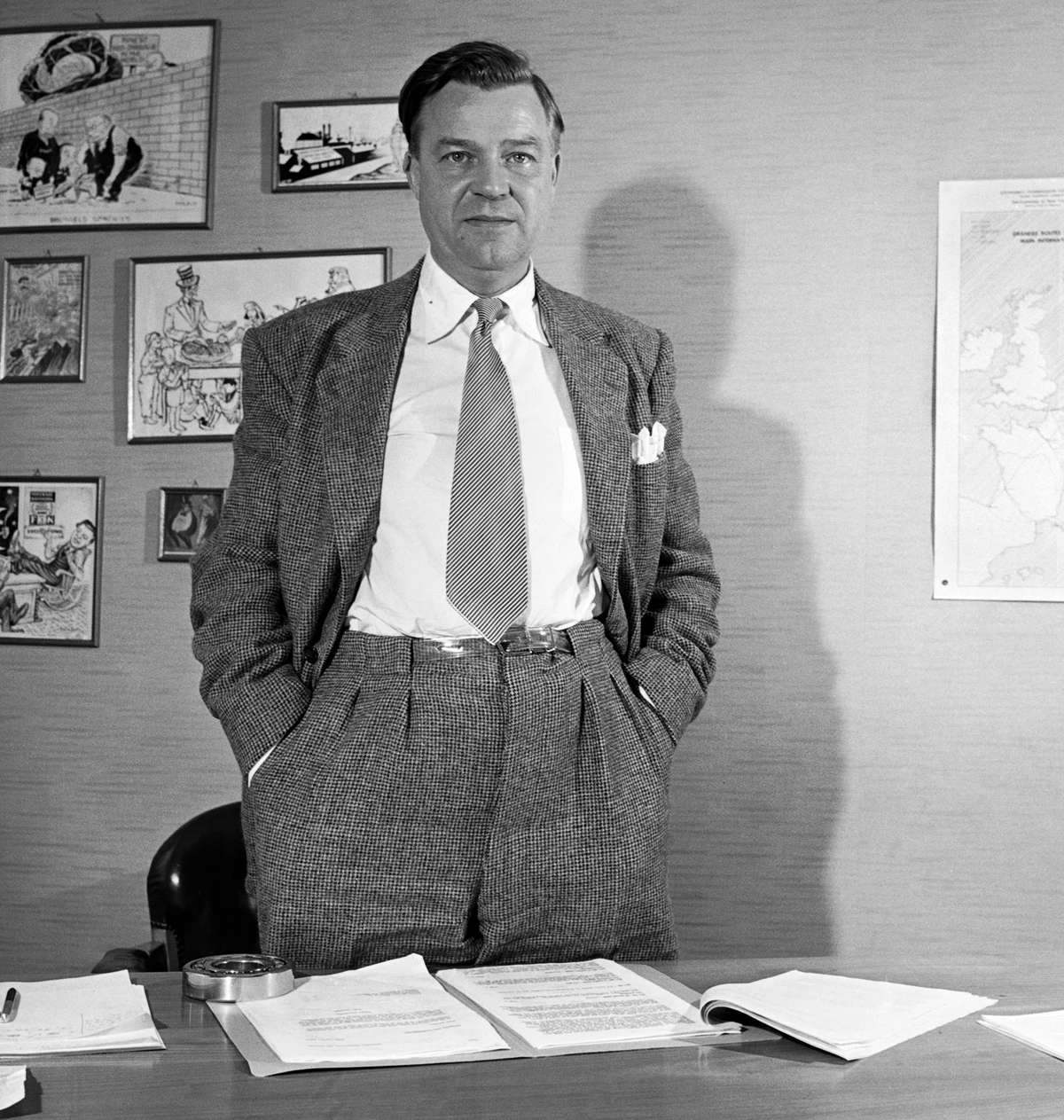
In April 1947 Myrdal was appointed the first Executive Secretary of the United Nations (UN) Economic Commission for Europe (ECE), the first Regional Commission to be created by the UN Economic and Social Council. UN Secretary-General Trygve Lie, who was looking for someone able to navigate between East and West, chose Myrdal, who accepted the post because he believed the UN at the time inspired intellectuals with hopes of an international body able to prevent wars. The ECE was initially created as a temporary body, meant to take over the work of the United Nations Relief and Refugee Agency and the work of three European organizations the Allied powers had established shortly after the war’s end: the Emergency Economic Committee for Europe, the European Coal Organization and the European Central Inland Transport Organization. However, in 1951 the ECE became a permanent body, notably resulting from the dynamic action of its Executive Secretary. In the first half of the 1950s the ECE Secretariat had about 155 posts with staff from 16 European and 6 non-European states, with the largest single nationality being the British (over 50), followed by the French (about 30) and some ten members from Scandinavian countries. Myrdal managed to resist the pressure of governments that sought to control his choice of staff (Wightman 1956: 66-67). During his tenure he tried to make the ECE Secretariat an independent and scientifically based body, for which he recruited a small team that proved outstanding and hard working. He hired the talented British economist Nicholas Kaldor, who became the head of the research and planning division. Both men tried to expand trade between Eastern and Western Europe. During the Cold War the ECE was one of the few institutions that made the two parts of Europe cooperate in what were considered ‘technical’ areas such as transport. In order to gain the confidence and support of the Soviet Union, Myrdal named a Soviet as his deputy and made Russian an official language of the ECE, together with French and English. This eventually gained the consent of the US, which, as one of the occupying powers of Germany, was part of the ECE from the beginning. Myrdal’s wife, who was Director of the UN Department of Social Welfare between 1949 and 1950, became Director of the Department of Social Sciences of the UN Educational, Scientific and Cultural Organization (UNESCO) in 1951. At this post she supervised a UNESCO programme on race relations, based on the UNESCO statement on race of July 1950, which affirmed that there was scientifically no foundation for racism. Myrdal and other experts submitted comments on the statement, which led to a revised text in June 1951.
Under Myrdal’s leadership the ECE developed two main areas of activity. The first was doing research and publishing studies on the economic situation in Europe. At Myrdal’s initiative the ECE began to publish its yearly Economic Survey of Europe in 1948, which furnished statistics on the economic situation in Europe. The publication was established independently from national governments, which did not have the right to modify the report. With the Survey the ECE contributed to harmonizing statistics in Europe. In 1954 the ECE published the study Growth and Stagnation in the European Economy, prepared by Ingvar Svennilson of Stockholm University and published with the financial aid of the Rockefeller Foundation. The study, which became a classic work, argued that restrictions to trade had been responsible for the economic stagnation of the interwar period. The ECE’s second area of activity was reaching agreements and setting up standards on technical matters between European countries. Several technical committees were created within the ECE, respectively on inland transports, timber, housing and the building industry, coal, steel, electric power, agriculture, engineering and raw materials, and trade. The ECE devoted the first years of operation to stimulating postwar rehabilitation. In 1947 the ECE was initially considered as the channel through which the Marshall Plan aid would be distributed and organized. Myrdal pushed for that and went to Moscow on 16 June 1947 in order to convince the Soviet Union that the ECE was the proper place to draft a European Recovery Programme. On 26 June, the day before the opening of the Paris conference on the Marshall Plan, Myrdal gave a press conference urging that the ECE be selected as the proper body to draft a common European response to the American offer. But political objectives on the side of the US to unite non-communist Europe played a major role and in 1948 the Organization for European Economic Cooperation (OEEC) was created to take this responsibility instead. The OEEC took over much action that could have been done by the ECE, such as the liberalization of trade in Western Europe, and thus the ECE was weakened. However, the ECE, and notably its Steel Committee, which tried to solve the problem of lack of steel at the time, still had some influence. In 1949 the ECE published its extensive study European Steel Trends in the Setting of the World Market that warned against the risk of overcapacity. When some governments feared that it would weaken their arguments to finance new steel plants in the context of the Marshall Plan aid they tried to stop the publication, but did not succeed. The study had a broad impact and, at the request of the French government, the Steel Committee advised Jean Monnet, the French architect of European unity, on European trends. Myrdal himself considered this input an inspiration for the plan to create a supranational European Coal and Steel Community put forward by French Foreign Minister Robert Schuman in 1950 (Berthelot 2004: 81; Myrdal 1956b). However, Myrdal did not support the idea of regional integration, because he preferred strong nation-states, as he argued in his paper Towards a More Closely Integrated Free World Economy that was prepared for the 1954 Bicentennial Celebrations of Columbia University.
Under Myrdal’s influence the ECE adopted a middle way between the neoclassical approach and the communist view of economics by promoting social reforms and the welfare state. The ECE reflected on how to increase productivity and economic growth all over Europe, including encouraging industrialization as the mode of economic development for Southern European countries like Greece, Italy, Portugal, Spain, Turkey and Yugoslavia. In order to maintain ECE cohesion in spite of the East-West divide, Myrdal chose to focus the work on practical matters, such as furnishing coal and grain. Technical cooperation in these areas encouraged the development of a common spirit between the member states. The technical committees helped to ensure that bottlenecks in providing important products were avoided, in one instance convening a European Grain Convention in 1950. In addition, between 1948 and 1950 the Coal Committee circumvented a dramatic lack in coal by allowing the distribution of 60 millions tons of coal to countries in need. The ECE’s 1949 study on timber production and consumption in Europe, written by Walt Rostow and Alfred Maizels, had real practical impact and was followed by other studies on timber in Europe. After the death of Soviet leader Joseph Stalin in 1953, East-West cooperation became easier and resulted in stronger activities for the ECE, which was regarded as a unique pan-European forum for economic cooperation. Within the UN system the ECE was a pioneer in promoting an early preoccupation with the environment, raising the theme of pollution of rivers at an experts meeting on waterways in 1955. The organization’s actions remained sensitive as well. An ECE study of the price of oil in Europe initiated in the mid-1950s provoked opposition from big oil companies, with the US, the UK and the Netherlands pressuring UN Secretary-General Dag Hammarskjöld to prevent the report’s publication. Hammarskjöld successfully asked Myrdal not to distribute the report. Disappointed about developments within the UN and also feeling lonely – his wife later complained that the ECE was everything for him, the family nothing (Exhibition 2007: 8) – Myrdal resigned as Executive Secretary in April 1957 to continue his life as an economist. The Twentieth Century Fund, one of the numerous private foundations Myrdal had been linked with, had asked him to direct a comprehensive study of economic trends and policies in South Asia. Before starting this research he returned to Sweden. Sakari Tuomioja of Finland replaced him at the ECE, officially starting on 1 September 1957.
Myrdal published his views on the international economy and the rising divide between North and South in the books An International Economy: Problems and Prospects (London 1956) and Rich Lands and Poor (London 1957). In his Economic Theory and Underdeveloped Regions (London 1957) he analysed the problem of inequality among countries and explained the increasing international inequality in terms of cumulative causation. He recognized that there are so-called spread effects from rich to poor countries due to, for instance, economic expansion in the rich countries, which increases the demand for products from the poor countries. However, he also showed that backwash effects outweigh these spread effects, because of increasing returns and external economies leading to a high level of profitability in the rich countries and the siphoning of capital from the poor to the rich countries. Between 1960 and 1967 Myrdal was Professor of International Economics at Stockholm University, where he founded the Institute for International Economic Studies in 1961. Throughout the 1960s he followed his wife Alva, who had been named Swedish Ambassador to India, to Asia where he worked on the Twentieth Century Fund study, which resulted in the three-volume book Asian Drama: An Inquiry into the Poverty of Nations (New York 1968). In this interdisciplinary study of the problems of less-developed countries he explored the issue of underdevelopment and poverty in Asia and pointed to dysfunctional land tenure systems and their consequences for the lack of agricultural productivity and growth. He analysed the crisscrossing of interest groups based on caste, religion and economic status and criticized the weak kind of government in what he called ‘soft states’ (such as India, Indonesia and Pakistan) because of their unwillingness to act forcefully when implementing declared policy goals. He stated that the only way to bring about rapid development in South East Asia was to control population, redistribute agricultural land and invest in health care and education. Myrdal was also a pioneer in the area of peace studies. As a strong opponent to the Vietnam War in the mid-1960s, Myrdal urged the US to begin negotiations with North Vietnam. He later headed the Swedish Vietnam Committee and co-chaired the International Commission of Inquiry into US War Crimes in Indochina. He and his wife helped to create the Stockholm International Peace Research Institute in 1966, and he presided over the institute from its foundation until 1973. He remained a board member and also chaired the board of the Latin America Institute in Stockholm. In the early 1970s he travelled to lecture at several American universities.
Both Myrdal and his wife were awarded Nobel Prizes. Myrdal and the British classical liberal economist Friedrich Hayek were awarded the Prize for Economics in 1974. His wife Alva and the Mexican diplomat Alfonso Garcia Robles were awarded the Peace Prize in 1982 for their advocacy of world disarmament. Myrdal made a considerable contribution to economic thinking, political practice and international cooperation. His concern for economic and social justice made him a strong advocate of state interventionism and planning, also applying the concept of the welfare state to the world as a whole through increases in foreign aid to poor countries, which at the time proved visionary. David Wightman (1956: 256-257), who analysed the work of the ECE, wrote about Myrdal that it was impossible to be indifferent to his complex personality as he evoked strong antipathies and affections: ‘Self-centered and temperamental, a voluble talker …, he is a man of ideas and intensity, has great intellectual integrity and preserves a highly objective atmosphere within the organisation’. Wightman calls him politically courageous and apparently a good judge of a long-run political situation. He mentions Myrdal’s belief that facts are the greatest persuaders and that Myrdal repeatedly confronted governments with facts, no matter how unpleasant these might be. Myrdal was unwilling to remain silent when he believed that wrong decisions were being made. This policy of toughness and independence won Myrdal the respect of most member governments of the ECE.
23 July 2026 new biography added