Biography
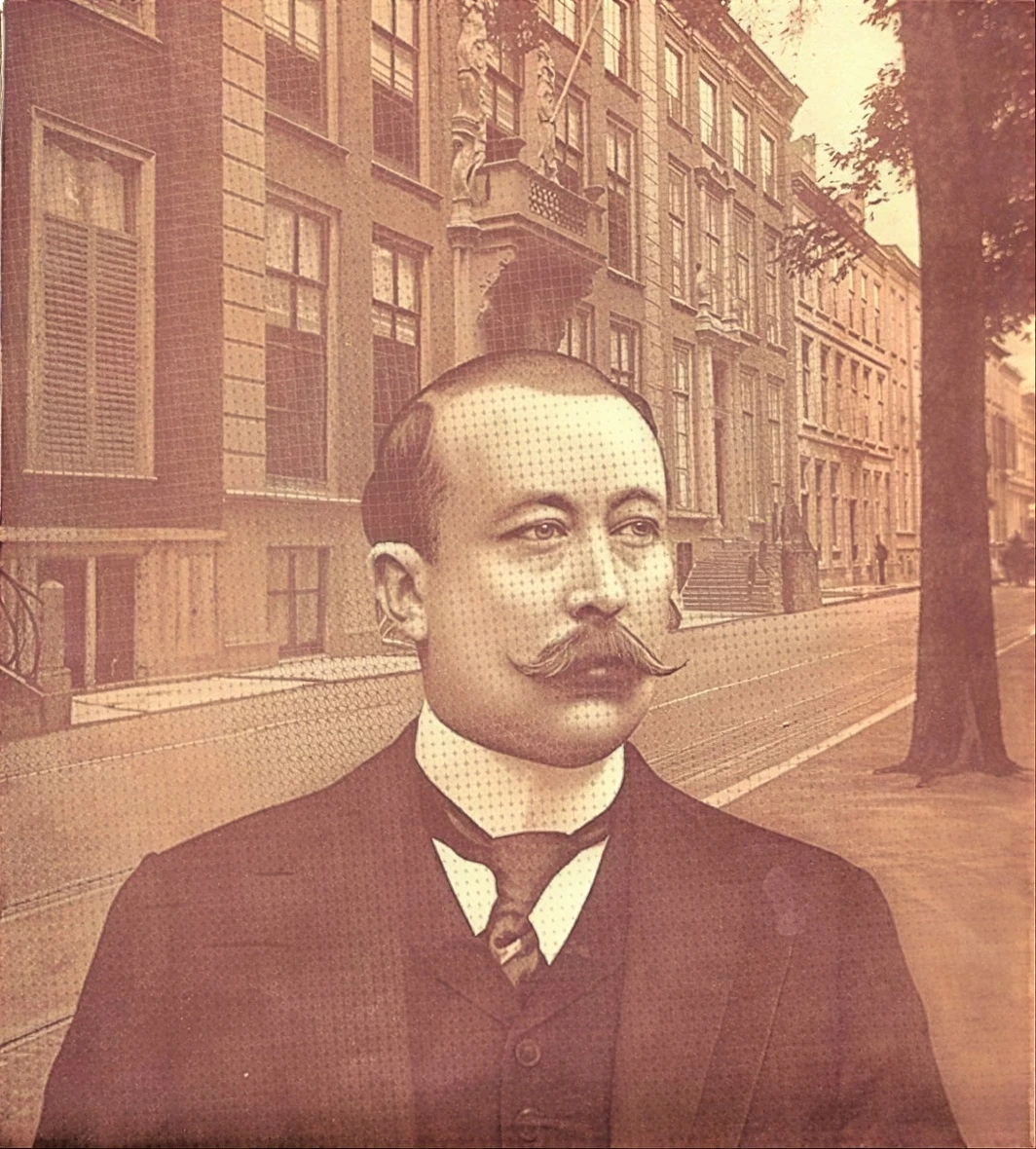
Michiels van Verduynen grew up in a noble family of Barons in the city of Roermond, in the southern part of the Netherlands, where his father served as President of the District Court and participated in local and provincial politics. Between 1874 and 1881 Michiels studied law at Leiden University, where he graduated with a dissertation that addressed aspects of animal abuse in the light of the new criminal code of 1881. While still studying law, he started his diplomatic career as secretary to the Dutch legation in Stockholm, Sweden (1879) and was posted in London, United Kingdom (UK) for one year (1880-1881). In 1881 he married and left the diplomatic service to settle down as barrister in The Hague, where he lived for the remainder of his life. Like his father, he engaged in politics. He was a member (1884-1897) and an alderman (1887-1888) of the Municipal Council and then turned to national politics. From 1888 to 1905 he was a Member of Parliament on behalf of the Roman Catholic party. He was a prominent spokesman for this party, chaired the preparatory commission of the electoral law of 1896 and became an acknowledged expert on agriculture. From 1895 to 1901 he was also a Member of the States of South Holland, the legislative body of this province. Michiels was well versed in the world of business and industry. He was a member (1883-1903) and then chair of the supervisory board of the mining company Billiton, was on the board of the Netherlands Petrol Company and became a trustee of Delft University of Technology (1905). In 1900 he chaired the committee that oversaw the Dutch pavilion at the Paris World Fair.
In March 1899, during the political skirmishes prior to the opening of The Hague Peace Conference, Michiels lodged a formal protest on behalf of the Roman Catholic faction in Parliament against the cabinet’s yielding to the (ultimately successful) pressure exerted by Italy to bar the Holy See from participating. The Peace Conference put the moral prestige of the Papacy at stake. Pope Leo XIII claimed a role as high arbitrator between the nations. In 1896 he had launched the idea of a Permanent Arbitral Tribunal, preferably under his high patronage, and in 1898 he mediated in a dispute between Argentina and Brazil. At the close of the Conference the vexed issue resurfaced in the discourse on the (open or preferably closed) nature of the Arbitration Convention. A closed Convention would forestall the Holy See’s accession. Netherlands delegate Tobias M.C. Asser ingeniously broke the stalemate, suggesting to leave the issue at rest awaiting later agreement among the powers. Michiels was not a delegate at the Conference, but its outcome and the first years of the Permanent Court of Arbitration (PCA) determined the conditions under which he came to serve as the PCA’s Secretary-General starting in 1905. By the Convention for the Pacific Settlement of International Disputes of 29 July 1899 it was agreed to have the seat of the PCA, the foremost institutional achievement of the Conference, offered to the host country and have its foreign minister arrange the PCA’s organization. Response in the Netherlands, however, was reserved, as the government was never overly charmed by the Conference or the Court from fear of being lured from its comfort zone of neutrality into the whirlwinds of international affairs. Neither was the government keen to invest heavily in the risky undertaking. The idea to reserve a prestigious mansion at Korte Vijverberg 3 for the Court’s headquarters was soon dropped in favour of humbler lodgings at Prinsegracht 71. On 19 September 1900 the Administrative Council was installed and on 9 April 1901 Dutch Senator Robert Melvil van Lynden was appointed Secretary-General. Many of the 24 Contracting Powers had objected to the idea of a strong candidate for the position, be it an expert diplomat or scholar of repute, and Van Lynden fit the bill of a more moderate option. The International Bureau served as registry for the Court, channelled the communications relative to the Court’s meetings and was in charge of the archives and conducts of all the administrative business (Article 43). Van Lynden soon dispatched a circular letter to the Contracting Powers calling for subsidies to help launch a Court library, but response was minimal. This disinterest, however, triggered Andrew Carnegie’s private initiative that brought about the Peace Palace. Van Lynden’s term was short, as on 1 August 1901 he was appointed Foreign Minister.
In August 1901 Leonard H. Ruyssenaers, Secretary-General at the Foreign Ministry, was installed as Van Lynden’s successor. By then the hesitation of the Contracting Powers to work with the PCA had become apparent. The embarrassing refusal at London and Bloemfontein to submit the Boer War of 1899-1902 to the PCA was only topped when the UK and Germany bypassed it and submitted their dispute over Samoa to arbitration by the King of Sweden. Still, in July 1902, the modest premises of the idling Court were inaugurated to host the hearings in a whaling dispute between the United States (US) and Russia, in which Asser served as sole arbitrator. The successful outcome, also thanks to Asser’s tact and legal abilities, gave a boost to the concept of arbitration, notably so within the US. In the same year US President Theodore Roosevelt submitted two other disputes to the PCA, a relatively harmless financial dispute with Mexico, in which Asser and Dutch politician Alexander de Savornin Lohman acted as arbitrators on Mexico’s behalf, and an acute, lingering dispute between Western Powers and Venezuela over outstanding debts. In December 1902 the conflict had incurred the blockade and bombarding of Venezuelan ports by British, German and Italian flotillas. Two more cases were introduced during Ruyssenaers’ term of office. By the time of their awards, he had resigned for health reasons. The four cases helped refine the Court’s machinery. Arbitrators volunteered recommendations to improve upon procedure as well as organizations and academia started to display keen interest. Still, the Court’s appeal to the public at large was negligible. By a twist of fate, an incident in the Russo-Japanese War (1904-1905) substantially enhanced its prestige. In the night of 21-22 October 1904 the Russian Baltic Fleet, unnerved by rumours of the presence of Japanese torpedo boats off the coast of Hull near Dogger Bank, sank a flotilla of British trawlers. This brought Russia and the UK to the brink of war. An International Commission of Inquiry operating under the auspices of the PCA pursuant to the Hague Convention intervened. Its report of 26 February 1905 appeased the crisis and possibly prevented war.
Michiels took up office as Secretary-General on 1 October 1905. Propositions by France to have a political or legal heavyweight appointed, such as the former Prime Minister of France, Léon Bourgeois, or the Chief Justice of the US Supreme Court, Melville Fuller, were summarily dismissed by the UK and the US. The Dutch government must have been keenly aware of the political context of the Court proceedings and this begins to explain why it picked Michiels for the position. He was not the most likely candidate, as he had little experience with international affairs, and had not been on the Netherlands delegation to the Peace Conference or been involved with the PCA. He never figured among the four experts nominated by the Netherlands to the list of the PCA’s Members of the Court kept by the PCA Secretary-General since 1900, from which parties to a dispute might select arbitrators at their discretion. However, in 1904 Michiels was appointed Board member of the Carnegie Foundation, launched that year to monitor the construction of the PCA courthouse and library. Upon his appointment to the PCA he resigned from this Board and gave up his seat in Parliament. In appointing Michiels the Dutch government intriguingly passed over more likely national candidates for the position, such as its long-standing counsellor on international affairs Asser, Willem Hendrik de Beaufort who as Foreign Minister had organized the Peace Conference and had engineered the framework of the PCA to full content, as well as expert politician De Savornin Lohman who (up to 1913) was involved in no less than five cases at the PCA.
Michiels’s appointment as a Roman Catholic politician came at an intriguing moment. When, in January 1905, Van Lynden’s position as Foreign Minister had become untenable and the Calvinists could not provide an appropriate replacement, the Roman Catholics were unwilling to proffer their candidate so long as the issue with the Vatican had not been settled. Was Michiels’s PCA appointment an enticement for the Catholic faction and a token of goodwill towards the Vatican? In his diaries De Beaufort time and again remonstrated that appointments at home were forever conditioned by the delicate balance of political and religious ideologies. Later, in 1905, when deliberations in preparation of the Second Peace Conference (intended for 1906) were opened, the claims of the Holy See were as vigorous as ever, and so was Italy’s staunch opposition. This affected Dutch politics. Anticipating opposition from its Roman Catholic constituency, the Dutch cabinet actually settled on the remarkable policy to try and drop the issues of arbitration and PCA from the Conference programme. In other words, to avoid a predicament in the national arena, the PCA’s host country was willing to sacrifice debate on the pacific settlement of disputes. Foreign Minister Dirk van Tets van Goudriaan readily construed some fallacious reasoning to underpin his policy. As he advanced, over 1900-1905 the PCA and its Commission of Inquiry had obtained impressive successes and it would be wise to let the mechanism quietly mature. From his offices at Prinsegracht, Roman Catholic Michiels must have vigilantly watched the ongoing skirmishes through 1905-1907, which posed the Court’s interests against his political confession.
At the Second Hague Peace Conference of 1907, which remarkably enough was not attended by Michiels, Van Tets’s scheme backfired when the Russian counsellor Feodor Martens swept away his arguments, very likely at Asser’s timely hint. The role and record of the PCA became an issue of the highest pertinence and controversy. It may have been the worldwide media attention the Dogger Bank incident had drawn that carried away the Court’s protagonists. The Dutch Foreign Ministry and the PCA were taken wholly unawares by a fundamental overhaul of perspective. Rather than bolstering the PCA, legal luminaries decided to abandon the institution. They conceded they had been misguided, or rather had been trapped. The PCA was a mere phantom court, a recorder with a list. The formula never warranted the independence or impartiality of a court of law. Most arbitrators did not qualify as trained lawyers and the incidental nature of their performance foiled developing consistent case law. Hence, debates delved deeper and struck at the roots. Was arbitration first and foremost an instrument of peace, or rather of the law? A tool of diplomacy, or of the judiciary? The conundrum resulted in the call for an international court of law proper. What kept these learned gentlemen divided was the issue of whether their new idol, the so-called Permanent Court of Arbitral Justice, was to supplant or rather be juxtaposed to the PCA. To Michiels’s relief no doubt, the latter formula prevailed. The PCA was to be reserved for political issues and left to the world of diplomacy, the new Court of Law was to deal with strictly legal disputes. However, the launch of the new Court was wrecked on the formidable obstacle of how to find a proper formula for the distribution of seats and election of judges, an issue only solved in 1920 via the two-tiered formula of Council and Assembly of the League of Nations. Up to that juncture the PCA remained responsible in both domains.
In the years of growing tension prior to the First World War, from about 1907 onwards, ten cases were submitted to the PCA. These never threatened peace, most of them never even made a serious indent, but they helped refine the Court machinery, its procedure and the law, as a result of the Tribunals’ findings and conclusions. It was very unlikely from the outset that the major powers would ever submit issues that truly affected their sovereignty or so-called vital interests to an international tribunal. To that extent the clashing ideologies in high politics never really impaired the PCA’s role, while Michiels upheld standards of impartiality and competence throughout and wisely avoided rubbing the great powers the wrong way. On 28 August 1913, when the Peace Palace was inaugurated, Foreign Minister René de Marees van Swinderen, and not Michiels, received the ornamental key to the entrance gates from the President of the Carnegie Foundation. For another fifteen years Michiels worked (as do his successors to the present day) from the stylish offices adjoining the solemn Japanese Room where the Administrative Council meets, made up of the representatives of the Contracting Parties.
The cataclysm of the First World War underscored the inadequacy of voluntary arbitration as a device to preclude war. At Versailles in 1919 US President Woodrow Wilson was adamant in replacing the PCA and its work. Within the context of a new world architecture, the League of Nations, emphasis was shifted from the diplomatic to the judicial settlement of disputes by a standing court of international law with compulsory jurisdiction. Meanwhile, the profitable neutrality of the Dutch during the war and their pertinent refusal to hand over the foremost war criminal, German Emperor Wilhelm II, for trial in blatant affront to the pertinent rule of law (dedere aut judicare) had seriously impaired the country’s moral standing in the world. The seat of League headquarters went to Geneva and it was only thanks to the urgent plea by the stalwart advocate of the PCA, Bourgeois, that the PCA survived the onslaught at all and that international The Hague received a new lease of life. In 1920 a Commission of Jurists gathered in the Peace Palace to draw up a Draft Statute for the Permanent Court of International Justice (PCIJ). Michiels’s name does not feature in the debate. He might have received formal cabinet orders to avoid interfering, but there is no evidence that he ever felt inclined to speak up in a personal capacity or to bring the weight of his position to bear. In drafting the Statute of the PCIJ the Commission amply weighed the PCA formula and continued the practice of nominations for judges to be submitted through the so-called National Groups of four that have served the PCA from 1900. One may wonder why the PCA, given its purely diplomatic and political mandate, never claimed a role or secured a niche within the League of Nations system. Rather than a consequence of Michiels’s unobtrusiveness, this should be understood in relation to the fairly negative opinion of the League in official and legal circles in the Netherlands at the time.
In 1924 the international committee chaired by Charles Dawes published its plan to resolve the issue of the outstanding German war debts. The Dawes Plan resolved a serious international crisis and the creation of an arbitral tribunal was part of the plan. Both the Allied Powers and Germany hoped that the PCA would cooperate by providing a Registrar for this tribunal, pursuant to Article 47 of the 1907 Convention that the PCA’s International Bureau was ‘authorized to place its offices and staff at the disposal of the Contracting Powers for the use of any special Board of Arbitration’. Because the PCA did not take any initiative, the Dutch Foreign Ministry requested its legal advisor Eelco van Kleffens to investigate whether the Bureau could support the Dawes Plan. Michiels reacted positively but also told Van Kleffens that he had to consult with his legal advisor, his then Deputy Secretary-General (and successor in 1929), M.A. (Claude) Crommelin. The next day Van Kleffens (1980: 198) found out that the advisor had raised the formal objection that one of the parties, the international committee, was not a sovereign state. Van Kleffens thought this interpretation too narrow but noticed that Michiels did not wish to continue his own judgement. During the second half of Michiels’s term of office (1918-1929) only two more cases came to the PCA, one of them a dispute between the US and the Netherlands regarding the sovereignty over the Island of Palmas (1925). It was the only case that came to the PCA during the golden years of the League of Nations system (1923-1930): the era of the Geneva Protocol, the Locarno Treaty and the Briand-Kellogg Pact, when antagonisms between victors and vanquished were at last dwindling and arbitration treaties figured high on the political agenda in Geneva. By comparison, the range of ‘legal disputes’ submitted to the PCIJ over the years 1923-1930 was impressive, with 24 judgments and 19 advisory opinions.
Michiels never became a high-profile international official. However, his presence as Secretary-General (1905-1929) benefitted the rest of the institution. He upheld this welcome status through a troubled quarter-century that saw the world change beyond recognition and put international organization on an entirely new footing. This alone is no mean accomplishment. A low-profile administrator who steered away from the hustle and bustle may well have been what the Court needed most. Still, perhaps the most conspicuous feature of his career at the PCA was his discretion whenever crisis lurked. Michiels did not attend the 1907 Conference. He never published views of his own on interstate dispute settlement. He was not involved with the League of Nations, never lectured at The Hague Academy of International Law and did not join the boards of legal bodies. He was an able facilitator who never caused a stir. In the Court’s successes, as in its pitfalls, the outcome may have been defined by the passive policy steered in The Hague. Was Michiels the pliable tool of the Foreign Ministry? There is no record of any attempt by Michiels to bring to bear the weight of the PCA on the Contracting Powers, or in Geneva. As of 1922 strictly legal disputes were covered by the PCIJ. The far greater challenge in international affairs, the peaceful settlement of political disputes and the precarious balancing of the elements of power and morality in attaining this goal, kept eluding the powers as before. Michiels appears to be a curious paradox in the PCA’s history. His term of office embodies the Court’s most productive period, when it established its identity and left its mark. During the first two decades of his term the PCA withstood all crises in the intellectual and political domains. Precisely when the fabric of world organization thickened, the PCA missed the boat to purposefully reposition itself and claim a significant role in the process. Michiels’s demise marked the end of the PCA’s early role in the international arena.
In early 1929, at age 74, Michiels van Verduynen died during a trip to Monaco. In a brief statement the Administrative Council referred to ‘the authority of his high competence in arbitration’. On 18 April he was succeeded by Crommelin. Michiels held a knighthood (1896) and Commandership (1900) in the Order of the Dutch Lion, was vested by the Vatican with the grand cross in the Order of Saint Gregory the Great and was Great Cross Officer of the Légion d’honneur of France and the Wasa Order of Sweden. He was the father of Edgar F.M.J. Michiels van Verduynen, diplomat and Dutch Foreign Minister (1942-1945) and the last in the family line.