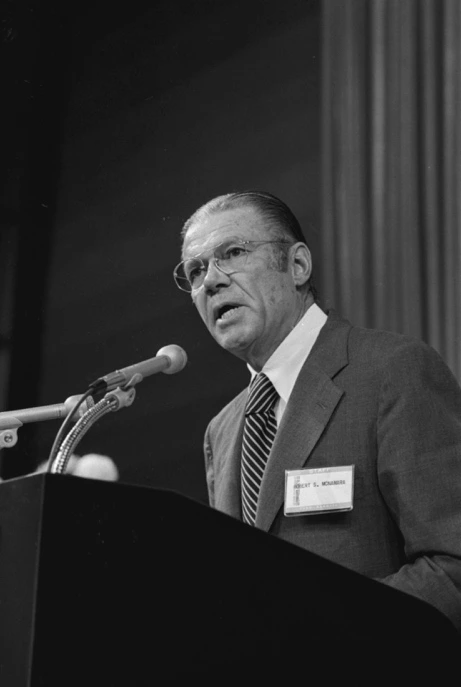
Biography
Even as a child, McNamara was quick to learn and had a phenomenal memory: he could read at a thirteen-year-old level when he entered grade school. He grew up in Oakland, California, where his father, the son of Irish immigrants, worked his way up to manage a wholesale shoe firm. McNamara graduated, Phi Beta Kappa, in 1937 from the University of California, Berkeley with a degree in economics and philosophy. During summer vacations he worked as a camp counselor and as a seaman traveling through the Panama Canal. He earned his Master of Business Administration from Harvard in 1939 and spent a year at the accounting firm of Price Waterhouse in San Francisco before returning in August 1940 to teach in the Harvard business school, where he was known as an exacting professor. He married his college sweetheart Margaret McKinstry Craig, who was a biology and health education teacher. When the United States (US) entered the Second World War, McNamara volunteered for military service, but was rejected for active duty because of his nearsightedness. Remaining at Harvard, he served as a special consultant to the Army Air Forces on the establishment of a statistical system to control the flow of money, equipment and personnel. On leave from Harvard, he went to England in 1943 to set up a statistical control system and received a captain’s commission. He served with the Army Air Forces in England, India, China and the Pacific, leaving active duty with the rank of lieutenant colonel. In 1946 the Ford Motor Company, which was then plagued by serious managerial problems, hired McNamara and other Air Force statistical control experts to work to rationalize all departments. Their successful diagnoses earned them the epithet ‘Whiz Kids’. McNamara was named manager of the offices of planning and financial analysis and promoted to controller in 1949. In August 1953 he became assistant general manager of the Ford division, general manager in January 1955 and in May 1957 vice-president in charge of all of the car and truck divisions. McNamara was credited with changing the Ford Thunderbird from a two- to a four-seater, developing the compact Falcon, promoting safety belts in cars, and the 12,000-mile warranty. On 8 August 1957 he became a Ford Director and was selected to run Ford on 9 November 1960, the first president not a member of the Ford family.
McNamara had been president for about a month when the self-described Republican was offered the position of Secretary of Defense in the incoming Democratic administration of US President John F. Kennedy. On 13 December he accepted the offer, making a large financial sacrifice in doing so, and even though he was not especially knowledgeable about defense matters. He was sworn in on 21 January 1961 and at his first news conference as Secretary, on 2 February, he outlined steps he would take to make the Pentagon more efficient. His charge from Kennedy was ‘to determine what forces were required and to procure and support them as economically as possible’ (Roherty 1970: 67). After a major review of the military challenges facing the US, McNamara in 1961 decided to increase the limited war capabilities. Increased attention to conventional military strength complemented the build-up of Special Forces. He also undertook a comprehensive review of the origins of the so-called missile gap. His belief that the Air Force had used this gap like its predecessor had used the ‘bomber gap’ to obtain larger budget appropriations was a reason to create the Defense Intelligence Agency, that is, to preclude institutional parochialism from driving intelligence analyses. His early years in the Department were a kind of trial by fire, marked by the erection of the Berlin Wall, the ill-fated Bay of Pigs invasion and the Cuban Missile Crisis, during which he was a strong advocate of a blockade as a way to defuse the most dangerous of East-West crises. He played a much larger role in the formulation of nuclear strategy than did his predecessors. Most famously, he came to embrace ‘assured destruction’, which he characterized as the capability ‘to deter deliberate nuclear attack upon the United States and its allies by maintaining a highly reliable ability to inflict an unacceptable degree of damage upon any single aggressor, or combination of aggressors, even after absorbing a surprise first attack’. He believed that the US would be able to destroy in retaliation 20 to 25 per cent of the Soviet Union’s population and 50 per cent of its industrial capacity (Defense.gov 2013: 3). Vietnam came to occupy most of his time. While serving as President Kennedy’s Secretary, US troops in Vietnam increased from 900 to 16,000 ‘advisers’. US involvement there, however, escalated after the August 1964 Gulf of Tonkin incident. McNamara was instrumental in presenting this event to the US Congress as justification for the war’s escalation. President Lyndon B. Johnson ordered retaliatory air strikes. The Gulf of Tonkin Resolution authorized him to take all necessary measures to repel any armed attack against the forces of the US and to prevent further aggression. Although McNamara was the person aside from Johnson most publicly identified with the Vietnam War, McNamara’s support waned over time. Johnson reportedly complained that ‘he’s gone dovish on me’ (Kraske 1996: 160). One of the country’s most prominent military figures explained that McNamara ‘had come to doubt the application of military power for political ends, whether he recognized it or not’ (Trewhitt 1971: 238). By March 1967 McNamara had concluded that increasing the troop level to what was requested by General William Westmoreland would add 10 billion dollars to the defense budget, divide the American people and result in a national disaster.
Three weeks after McNamara learned of Westmoreland’s troop request, he received a visit at his office from World Bank President George Woods, who was impressed by McNamara’s speech of 18 May 1966 at the American Society of Newspaper Editors meeting in Montreal. There McNamara had argued that ‘we would achieve greater security by transferring marginal dollar expenditures from defense to foreign aid’, an unexpected perspective for a Secretary of Defense during wartime (McNamara 1995: 311-312). Woods, who planned to retire in August, hoped that McNamara was interested in having Johnson nominate him as his successor at the Bank. McNamara apparently told Johnson of the visit, but Johnson was noncommittal. Shapley (1993: 416-417) suggests that while they both had reasons for thinking this was an ideal position for McNamara (one that would use McNamara’s talents, but also where he would be barred from commenting on US politics), both concealed their thoughts from one another for months. It was only several months later that Johnson, ‘out of the blue’, asked McNamara if anything further had developed in terms of the Bank presidency. McNamara (1995: 312) said he was interested but would stay on as Secretary of Defense as long as Johnson wished him to. It is reported that when Johnson was finally shown a list of potential nominees, he expressed surprise to see McNamara’s name on it, commenting that he did not know that McNamara was interested. But, he added, if he wants it, ‘he can have it. He can have anything he wants’ (Shapley 1993: 427). Johnson informed the Secretary of Treasury, who told him that three nominees were normally put forward by the US President to the World Bank Board, so he should tell them that McNamara was his first, second and third choices for the position (Trewhitt 1971: 274). Johnson’s formal steps to nominate McNamara appear to have come after he had come to loggerheads with McNamara over the latter’s views on the war, including a proposal for what would later be called ‘Vietnamization’. McNamara (1995: 311) claimed he did not know ‘whether I quit or was fired. Maybe it was both’.
On 29 November 1967 the World Bank’s directors unanimously confirmed McNamara’s selection. In his resignation statement from the US government an hour and a half later McNamara made no mention of his disagreements with the President in spite of pressure from many of his friends to do so. He left office on 29 February 1968 and started at the World Bank on 1 April (Woods resigned later than he had planned). Although McNamara’s role in Vietnam left him with enemies in Congress, and thus a difficult relationship with the US government, he hit the ground running at the World Bank ‘in a way that accelerated the pulse of the Bank and rewrote its priorities to a degree not previously experienced’: he ‘brought a sense of moral mission to the Bank that had not been seen before or since’ (Rich 1994: 81). From the outset he made field visits to a number of economically less developed countries and authoritatively verbalized quality-of-life concerns such as education, nutrition and population. He saw his first 90 days in office as critical, ‘when he established his view that the Bank’s role should change from being an institution for infrastructural project lending to being a development agency’ (Stern with Ferreira 1997: 603). His overriding concerns were poverty and economic growth. This was as true in rural development and the agricultural sector as in any other. He always emphasized the importance of alleviating what he called ‘absolute poverty’, those people whose conditions of deprivation fell below any definition of decency, a perspective that became known as the ‘basic needs’ approach to development (Clark 1981: 173). He argued that 40 per cent of the population of economically less developed countries could be so defined. The Bank’s successful campaign against river blindness, which McNamara initiated following his first visit to West Africa, is a clear example of his personal impact in addressing a serious problem. He spoke about environmental issues as the keynote speaker at the 1972 United Nations Conference on the Human Environment in Stockholm and established the Office of Environmental and Health Affairs (soon the Office of Environmental Affairs). But it lacked the power or resources to do much and it rarely saw projects before the last stage of the preparation cycle (Wade 1997: 618-624).
The overall scale of the Bank’s expansion under McNamara was dramatic. He wanted the Bank to be actively engaged in every country that needed help, noting that neither Egypt nor Indonesia had received assistance in the recent past, and took personal charge of the negotiations to admit China as a member. The staff grew from 767 professional staff members in fiscal year 1968 to 1,654 in fiscal year 1973. At the same time the staff became far more representative of the Bank’s total membership (Clark 1981: 169). Over the last four years of McNamara’s presidency (1978-1981), compared with the five years before his arrival (1964-1968), Bank lending expanded more than three times in real terms and the administrative budget increased almost three and half times in real terms (Kapur et al. 1997, 1: 16). To pay for this expansion, McNamara increased International Bank for Reconstruction and Development borrowings from non-US private markets and he worked slavishly and innovatively in raising funds from member states for the International Development Association. The growth of the International Finance Corporation, the Bank’s third arm, however, was much less dramatic since McNamara, in step with the prevailing views at the time, did not see private capital as a realistic option in addressing critical development needs. In the aftermath of the Organization of Petroleum Exporting Countries’ oil embargo of 1973-1974, McNamara, along with International Monetary Fund Managing Director Johannes Witteveen, unsuccessfully sought to get a significant amount of money from Iran. Still the Bank was able to provide funds for energy-related projects and expanded its structural adjustment loans, which ‘facilitated a degree of intrusion into the policymaking process of the Bank’s borrowers that went far beyond the subtle influences traditionally associated with project lending’ (Kraske 1996: 204). Several governments, especially in Latin America but also the Philippines, ‘initially objected to the Bank giving advice on social matters such as population control’ (Clark 1981: 175). Reflecting back on this experience, McNamara asserted that ‘I had become convinced by that time, and I remain even more strongly of the opinion today, that the greatest contribution the Bank can make to a developing country is in helping it formulate its macroeconomic policies and in assisting it in implementing those policies’ (Kraske 1996: 204). One of McNamara’s most significant and sustained personal legacies to the Bank was a massive increase in the financial support and status of research. Decisive in this regard was the recruitment of Hollis Chenery to run the Bank’s research activity, the consequence of which was to make the Bank the global center for authoritative studies of key development issues and problems. In 1978 the Bank’s development policy staff began publishing an annual World Development Report, which became a ‘guiding light for the development community around the world’ (Clark 1981: 178). Organizationally, McNamara initiated Country Program Papers that responded to member countries’ priority projects and vastly extended the scope of the Programming and Budgeting Department. He was also instrumental in the sponsorship of two very influential reports, those of the Commission on International Development, chaired by Lester B. Pearson, and the Independent Commission on International Development Issues, chaired by Willy Brandt.
While the Bank’s global impact under McNamara is hard to overstate, many of its projects failed to achieve their stated goals. In part, this is explained by a focus on expansion for expansion’s sake. Cost overruns were rampant, projects were often not completed before related new ones were undertaken, and much of the money expended did not reach the poorest of the poor. Some argued that ‘loans were pumped out without regard for quality’ and that there was little concern about a country’s absorptive capacity, a problem that McNamara never referred to in any of his major speeches. There were other criticisms of his presidency. Because of his larger-than-life presence at the Bank, ‘many were afraid to speak up, leading some to argue that at least some discussions at the Bank during the McNamara years were stultified’ (Stern with Ferreira 1997: 603). There was also a pervasive perception that McNamara was not interested in hearing about delays: ‘time-consuming reservations would be regarded as obstructionist’ (Kraske 1996: 194). Relations with the regional development banks were ‘rather rugged in the McNamara years’ (Kapur et al. 1997, 1: 189). Moreover, unlike during the tenure of some of his predecessors, McNamara’s Bank did not serve as an international mediator. It was also criticized for contributing to environmental devastation and providing funds that propped up dictatorships and governments that violated their citizens’ human rights. In retrospect, McNamara himself suggested that more importance should have been given to the ‘political, human, and economic structures in the process of development’ (Stern with Ferreira 1997: 604). Some development pundits argued over the originality of McNamara’s revolution (Kapur et al. 1997, 1: 16). For example, it was Woods, McNamara’s immediate predecessor, who had presided over a broadening of the lending portfolio into agriculture and education and, although the Pearson Commission report was closely identified with McNamara, he was actually implementing Woods’ ‘grand assize’ idea. Although McNamara claimed he was anxious to leave the Bank at the end of his second term in 1978, he actually was eager to accept a third term. But it has been seen as a sign of his dedication to the mission of the Bank that he announced abruptly in June 1980 that he would leave before completing his third five-year contract. Thirteen years was long enough for anyone to occupy the post, he believed, and conservatism was clearly on the rise, with Thatcherism in England and the election campaign of President Ronald Reagan. The fight for foreign aid funds to use for poverty alleviation had already begun as well as arguments against large multilateral donor institutions like the World Bank, now a better-known institution than when he first took office. Somewhat ironically McNamara’s most explosive interaction with the US government came over the Bank’s decision to loan funds to Vietnam. More generally, he regarded the challenges of the 1980s as daunting, calling for a leadership ‘he would no longer be able to provide’ (Kraske 1996: 209). His last successful dealing with the US government was their agreement to nominate A.W. Clausen as his successor.
Although McNamara had a reputation as an ‘egghead’, he was an avid skier, camper and mountain climber as well as an engaged reader especially of history, sociology and philosophy, who enjoyed going to concerts and art exhibitions. While working as a volunteer teacher in 1966, his wife Margaret McNamara created Reading Is Fundamental, a literary program for poor children. This had served three million children at the time of her death from cancer in 1981. McNamara tried to deal with his grief by getting away from Washington, including taking a 140-mile hike up to the 18,000-foot level of Mount Everest. Although his grieving continued, within two years he began to write and speak out against the nuclear arms race, the imbalance between population growth and social and economic advances in economically less developed countries, world hunger, East-West relations, and the anti-apartheid movement in South Africa, for which he did fund raising. Simultaneously he chaired the Overseas Development Council and worked with non-profit institutions such as the Ford Foundation, the Brookings Institution and the Barbara Ward Fund. He also served on the boards of Corning Glass Works, TWA, Royal Dutch Shell Petroleum, The Washington Post, Caspian Holdings, the Urban Institute, the Enterprise Foundation, California Institute of Technology and Bank of America. Fourteen years after leaving the World Bank he published his denunciation of the Vietnam War and his role in it in In Retrospect: The Tragedy and Lessons of Vietnam (New York 1995, with B. VanDeMark), for which he received widespread criticism. Unlike any other US Secretary of Defense, McNamara publicly struggled with the morality of war and the uses of US power. ‘We are the strongest nation in the world today’, McNamara said in the documentary film The Fog of War (directed by Errol Morris), released at the time of the 2003 invasion of Iraq. But ‘I do not believe that we should ever apply that economic, political, and military power unilaterally. If we had followed that rule in Vietnam, we wouldn’t have been there. None of our allies supported us. Not Japan, not Germany, not Britain or France. If we can’t persuade nations with comparable values of the merit of our cause, we’d better re-examine our reasoning’. ‘War is so complex’, he concluded, ‘it’s beyond the ability of the human mind to comprehend … Our judgment, our understanding, are not adequate. And we kill people unnecessarily’ (Weiner 2009: A21). The following year, 2004, he married Diana Nasieri Byfield in Assisi, Italy. Already in his late eighties, his public appearances became less frequent and the pace of his writing slowed. Five years later, he passed away at home. For his achievements, he received a number of honorary degrees from universities in the US and Britain, and received countless awards, including the Presidential Medal of Freedom (with distinction), the Albert Einstein Peace Prize and the Franklin D. Roosevelt Freedom from Want Medal.
May 2021: IBRD and World Bank Group explained in header