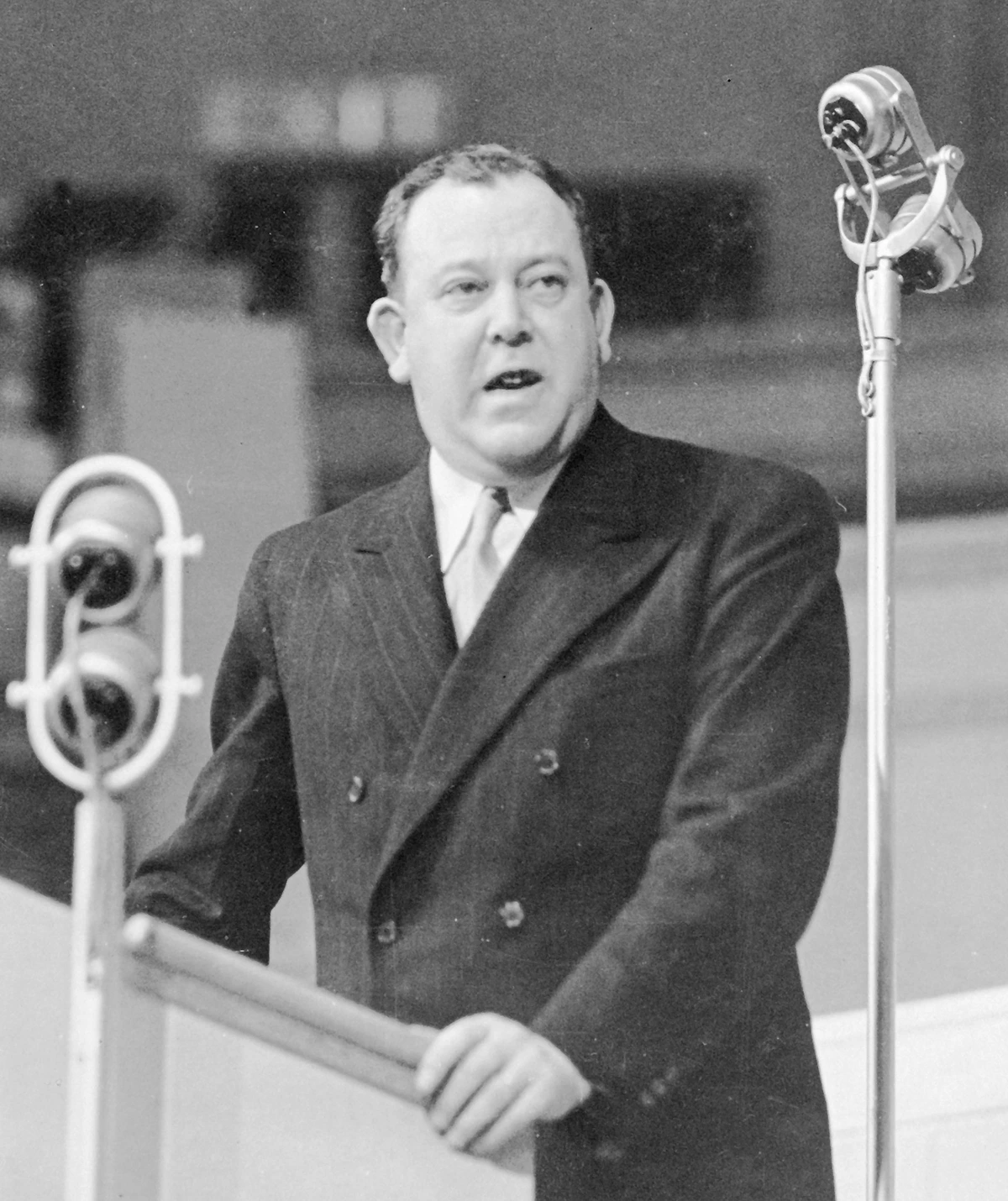
Biography
Lie was born in a working-class neighbourhood of the Norwegian capital. He never knew his father, who packed his bags and tools and set sail for the United States (US) before Lie was born. The task of raising Lie and his older sister Ruth was left to their strong, broadminded and independent mother, who never remarried. To make ends meet the three moved to Grorud, outside Oslo, where they converted their home into a café and boarding house. Growing up in this environment made for a life of constant toil for Lie, whose childhood provided little to no luxuries. Nonetheless, he found time to enjoy sports and outdoor activities. He competed in football, athletics and skiing, and held organizational responsibilities in various sports clubs. The milieu in which he grew up, as well as the ideas and values of the growing labour movement and Socialism of the early twentieth century, shaped his social and political views. Since the boarding house residents were workers from throughout Northern Europe, Lie heard about the Russo-Japanese War of 1904-1905, the failed 1905 revolution in Russia and discussions about trade unions. A scholarship allowed him to continue his studies beyond primary school, which was unusual at the time for working class children, and in 1914 he began to study law at the University of Oslo.
Lie’s political career started at the local level at the age of 16, when he helped to organize the election campaign for his teacher who was running for the Norwegian Labour Party. A year later, in 1913, Lie was one of the founders of a local branch of the party’s youth organization and he rose quickly through the ranks of the party. He funded his university studies by working as secretary of the party’s local branch in Aker (near Oslo), as treasurer of an insurance fund and by taking minutes of political meetings for the magazine Sosialdemokraten. In 1919 he earned his Master of Law degree. After finishing his studies Lie began working as assistant to the Labour Party’s Secretary, Martin Tranmæl, and in 1921 he served as secretary to the delegation that travelled to Moscow to discuss relations between the Norwegian labour movement and the Communist International. In 1922 he took up the position of general counsellor to the Norwegian Confederation of Trade Unions, a position he held until he was elected to Parliament in 1935. Among his trade union tasks was the promotion of peaceful arrangements between workers and management. Lie’s character and outlook were shaped by his early involvement in local politics. He became known for being rather blunt in speech and thought, yet honest and loyal in his dealings with others. Passionate and steadfast in his convictions, he was sociable and developed a fondness for company as well as good food and wine. Socialism and the Labour Party became the framework to support his conviction in Social-Democratic principles and values, including social justice, fairness, equality, religious freedom and respect for the law. Yet, his embrace of Socialism was more practical than ideological. He did not belong to the far-left wing or intellectual groupings in the party, and his rapid rise was largely due to his political acumen in navigating the various party splits after it had briefly joined the Communist International in 1921. Lie had an aversion to the more extreme leftist elements and developed strong anti-Communist sentiments, which grew as his political career advanced.
After the 1935 parliamentary elections a Labour government was formed, with Lie appointed as Minister of Justice. In 1939 he became Minister of Trade, Industry, Shipping and Fishing. During the invasion of Norway by Nazi Germany in April 1940 he ordered the large Norwegian merchant fleet to avoid Norwegian ports, which saved the ships for the Allies during the Second World War. Throughout much of the arduous flight of the Norwegian government into exile in London in 1940 he accompanied King Haakon VII. In February 1941 he was appointed Foreign Minister of the Government in Exile, which was a considerably different role for Lie, whose ministerial experience had heretofore been in the domestic arena. Despite his lack of diplomatic experience, he quickly learned how complex and limited a small state’s diplomatic room for manoeuvre was, trying to keep Norway and its concerns a priority for the Allies while simultaneously protecting Norwegian interests from being compromised by the great powers. Lie strived to be even-handed in managing Norway’s relations with its wartime allies, knowing that his country’s freedom and independence were at stake if he failed to maintain good relations with the US, the United Kingdom (UK) and the Soviet Union. His five years as Foreign Minister in Exile were a crash course in the realities of power politics.
In April 1945 Lie headed the Norwegian delegation to the United Nations Conference on International Organization in San Francisco, where the United Nations (UN) was established. During the conference Lie served for a time as Chairman of Commission III, which drafted the section of the Charter on the Security Council. Intimately familiar with the power-sharing arrangements in this important UN organ, he was a firm defender of giving the great powers special rights and responsibilities for preserving the peace, believing that their continued cooperation was crucial for the organization’s very survival. In May 1945 Lie travelled back to London to prepare the government’s return to liberated Norway, continuing in the post of Foreign Minister in a temporary coalition government over the summer. In the first postwar elections in Norway the Labour Party won an absolute majority in Parliament and in October 1945 Lie was reappointed as Foreign Minister. In January 1946 he headed the Norwegian delegation to the first UN General Assembly session held in London.
Lie’s appointment as the UN’s first Secretary-General on 1 February 1946 was an unexpected and unwelcome development for Lie, who had not sought the office. Originally the US delegation had approached him to ask if he would be willing to serve as President of the first General Assembly session, which he agreed to in the interest of preserving his country’s good relations with the US, while not relishing the prospect of taking on the administrative burden of managing a large multilateral conference. After a confusing combination of backroom deals and procedural intricacies, Lie narrowly lost the election for Assembly President to Paul-Henri Spaak of Belgium. His name then appeared on the shortlist of candidates for the office of Secretary-General at a meeting of the Security Council’s five permanent members on 23 January alongside Lester Pearson (Canada’s Ambassador to the US), Stanoje Simic (Yugoslavia’s Ambassador to the US), Wincenty Rzymowski (Foreign Minister of Poland), Henri Bonnet (France’s Ambassador to the US) and Eelco van Kleffens (Foreign Minister of the Netherlands). Lie was no one’s first choice. The US preferred Pearson, whose candidature was supported by the UK and China, while the Soviet Union argued for an Eastern European candidate. In the context of the emerging Cold War neither side could agree to a candidate from the opposing bloc. At this time Norway had not yet firmly joined the Western alliance and Lie’s name did not elicit strong objections from either side. He was thus elected as the compromise candidate. Lie (1954: 17) felt ‘catapulted’ into the job, which he saw as a challenge beyond his ‘wildest dreams’, but also a ‘nightmare’. He succeeded British diplomat Gladwyn Jebb, who had served as Executive Secretary of the London-based UN Preparatory Commission (from August to October 1945) and then as Acting Secretary-General until the appointment of the first Secretary-General.
Upon assuming office on 2 February 1946 Lie, in spite of his lack of preparation, enthusiastically set to work, determined to help make the UN a success and convinced that the Secretary-General’s office had a central role to play in both politics and administration of the new organization. From the very start he was focused on consolidating and expanding the political powers of his office. His first initiative on a political question came in April 1946 during the Security Council’s debate on the Iranian complaint against the slow withdrawal of Soviet troops from Iranian territory. During the war the Soviet Union and the UK had jointly occupied Iran, under agreement that both would leave within six months after the war’s end. However, in January 1946 the Soviet Union showed no indication of withdrawing its troops anytime soon and also asked for an oil concession. Iran addressed the Security Council and, after a short discussion, the Council asked the two parties to continue negotiations and to keep the Council informed of their progress. In mid-April Iran and the Soviet Union reached agreement on all outstanding issues, which made Iran retract its complaint from the Council. The Soviet Union immediately moved to have the question removed from the agenda, which the US and the UK strongly opposed. In this tense, early East-West clash Lie presented a legal memorandum, arguing that the Council had no right to retain the question on its agenda once Iran had withdrawn its complaint. Although the majority of the Council’s members disagreed with Lie’s legal analysis, the episode led to a change in the Council’s rules of procedure to recognize the Secretary-General’s right to address the Council on any item under its consideration.
Lie continued to inject his office into political situations. He took advantage of crises to expand the powers of his office and gain recognition from the member states for the Secretary-General’s political role. In the context of security issues, such as the Greek civil war, Palestine, Kashmir, Berlin and Korea, Lie gained recognition for the Secretary-General’s independent right to establish investigative committees, draft Security Council resolutions, appoint so-called Special Representatives and delegate his authority to them, propose solutions to problems, coordinate the responses of member states and UN organs to crisis situations and take initiatives in order to have UN decisions implemented. During the UN’s involvement with the Palestine question from 1947 to 1949 Lie had a complicated working relationship with Ralph Bunche, the American Director of the Trusteeship Division, whom he appointed as his personal representative to the various UN committees working on the issue. Bunche and Folke Bernadotte of Sweden, the first UN mediator appointed in May 1948, sometimes felt that Lie did not support them in their work or went behind their backs to hold meetings with representatives of the Jewish Agency, later the state of Israel, in New York. Lie may have been jealous of the attention Bunche received, including being awarded the 1950 Nobel Peace Prize, feeling that his own contributions to peace in the Middle East went overlooked (see Barros 1989: 207-208). As head of the UN Secretariat Lie worked closely with some Assistant Secretaries-General, among them Arkady Sobolev from the Soviet Union, whom he would often use as a go-between to the Soviet government. Lie built close relations with many ambassadors to the UN. His preferred way of seeking to influence the Security Council was to work privately with the ambassadors of the permanent members, particularly with Warren Austin (US, 1947-1953), Andrei Gromyko (Soviet Union, 1946-1948) and Alexander Cadogan (UK, 1946-1950). His closest team of advisors included Abraham Feller (US), Director of the Legal Department, Tor Gjesdal (Norway), Director of the Department of Public Information, the journalist William H. Stoneman (US), who helped him with speechwriting and press contacts, and the Norwegian army colonel A. Rocher Lund, who advised him on military matters.
Originally Lie sought to chart a middle course between East and West, but following the political takeover by the Czechoslovakian Communist Party in February 1948 he gradually became more suspicious of the intentions of the Communist world. In the UN attempt to solve the Berlin Blockade (the Soviet Union had blocked the Western Allies’ access to their sectors of Berlin in June), Lie, in October 1948, proposed using Andrew Cordier, who served as his Executive Assistant, and Assistant Secretary-General Sobolev as intermediaries between the Soviet and US governments in order to negotiate a solution. When the US and the UK turned down his suggestion a few weeks later, Lie issued a public statement together with General Assembly President Herbert Evatt of Australia, appealing to the great powers to resume negotiations. In April and May 1950 Lie embarked on a twenty-seven-day peace tour of major capitals in order to promote his ten-point ‘twenty-year programme to win peace through the United Nations’, which he had launched in Washington DC in a speech on 21 March in the hope of injecting new momentum into the UN’s work for easing Cold War tensions. The majority of the ten proposals merely called for renewed attention on existing problems or the increased use of activities already in place. The most specific suggestion was the call for the Security Council to initiate ‘periodic meetings’ (mentioned in Article 28.2 of the Charter, but never held). Lie preferred to seek out the presidents, prime ministers and foreign ministers of major member states to directly discuss his programme, rather than merely relaying his information through their UN delegations. In order to enlist the support of the Executive Heads of the UN specialized agencies he also visited the UN offices in Europe and attended UN meetings in Paris, Geneva and The Hague. Although the peace tour and Lie’s earlier specific initiatives were mostly unsuccessful, his activities did create precedents for an activist role for the Secretary-General in all areas of UN activity.
During the Korean War, when North Korea, aided and advised by the Soviet Union, invaded South Korea, Lie’s actions seemed to put him squarely on the Western side of the Cold War. His strong opposition to the North Korean invasion certainly earned him the praise of many in the West, and Lie (1954: 323) would later write that he considered his stance in June 1950 ‘the best justified act of seven years in the service of peace’. During the Security Council meeting on 25 June Lie spoke first and he strongly urged the Council to come to the aid of South Korea. Legal scholars agree that this was not a case of directly invoking Article 99, since the US had asked for the meeting to be called. Nonetheless, Lie helped to legitimate the following military intervention and sought to ensure that it was a true UN operation. The Soviet Union took notice of Lie’s support for the US-led intervention and opposed his re-election to a second term as Secretary-General later that year. The US, however, insisted it would veto anyone but Lie. On 1 November 1950 the General Assembly decided to extend Lie’s original term by three years from 1 February 1951. The Soviet Union henceforth refused to recognize Lie as a legitimate Secretary-General and boycotted his office, both in formal and social contexts, effectively rendering him politically impotent during the rest of his time in office.
As the chief administrative officer of the UN, Lie presided over important administrative developments. He had to establish the organization nearly from scratch and with little time to waste. He left some of the administrative tasks of recruitment and running the Secretariat to his staff, in particular to Cordier, who served as Executive Assistant to the Secretary-General (1946-1961), and to the Assistant Secretaries-General for Administration, John Hutson (1946-1947) and Byron Price (1947-1954), all from the US. During Lie’s tenure the UN established its headquarters and buildings in New York. The organization first worked out of a hotel in midtown Manhattan, then at Hunter College in the Bronx, before settling down at Lake Success in Long Island and Flushing Meadows in Queens. Finally, in 1951, the UN began to move into its current purpose-built headquarters in the Turtle Bay neighbourhood of Manhattan, with the Secretariat building the first completed structure. Lie helped to secure the UN a permanent location in Manhattan. With his previous experience from local politics, he forged relations with New York mayor William O’Dwyer and other prominent figures such as Robert Moses and Nelson Rockefeller. Together they managed to find a location and secure a grant of 8.5 million dollars for the purchase of the site from John D. Rockefeller. Lie then brought on board a team of world-class architects, led by Wallace Harrison from the US, to design the new UN buildings. The New York headquarters, completed in 1952, stands as a testament to Lie’s time as Secretary-General. The Secretariat building, with its 39 stories, was designed by Brazilian architect Oscar Niemeyer and the General Assembly building by Swiss-French architect Le Corbusier. Lie himself, however, would only work in the new building for a few months.
The rapid speed with which the Secretariat had to be established in 1945 meant that a large share of the personnel were British, hired during the first few months of setting up the organization in London, and American, hired during the first months in New York. Lie asked several governments for help in screening potential applicants, but many were unwilling to lend assistance. When the so-called McCarthy hunt for Communists in the US reached the UN with full force in 1951-1952, this caused severe problems for American nationals working in the Secretariat. Pressured by the US government, Lie gave in and allowed the US Federal Bureau of Investigation to enter UN premises, where US nationals were fingerprinted and interviewed. He also dismissed some staff members on the basis of US suspicion of Communist sympathies. These actions did irreparable damage to his standing with the Secretariat staff, who felt that Lie had betrayed Article 100 of the Charter on the Secretariat’s exclusively international and independent character. Given the Soviet refusal to recognize Lie as a legitimate Secretary-General and continuing tensions with the Secretariat staff and the US government over his handling of the McCarthy events, Lie resigned from office on 10 November 1952, but continued to occupy the post until Dag Hammarskjöld from Sweden was sworn in as the UN’s second Secretary-General on 10 April 1953.
After leaving office Lie returned to Norway, hoping to contribute to Norwegian and international politics, where he felt annoyed that no one found a use for his expertise. From 1955 to 1963 he served as county governor of Oslo and Akershus. In 1959-1960 Lie returned briefly to the world of international politics, when the Norwegian government appointed him to mediate a border dispute between Italian Somaliland and Ethiopia. He served simultaneously as ‘industrial ambassador’ for Norway, which included travelling to the US and several European countries to promote Norwegian industry and trade. The death of his wife in March 1960 after a period of illness affected Lie deeply and may have contributed to the sudden end of this short period of international activity. In 1963, during a time of political turmoil after a large mining accident, the Labour Party asked him to take on the post of Minister of Industry. A year later he became Minister of Trade, a position he held until 1965. Between 1954 and 1968 Lie published his memoirs, one volume on the UN (published in 1954 in Norwegian and English), three volumes dealing with his experiences during the Second World War (published between 1955 and 1958 in Norwegian) and one volume detailing his childhood and early career (published in 1968 in Norwegian). Lie passed away in December 1968 in Geilo, Norway, while on holiday with his daughter.
Lie’s contribution to the UN and international relations in the immediate postwar years has largely been overlooked. Lie himself felt neglected and ignored after he left the UN. He strongly resented the way media and other observers portrayed Hammarskjöld as the founder of the office of UN Secretary-General. UN analysts often do the same, with some (e.g. Barros 1989 and Urquhart 2007) even arguing that Lie was the wrong man for the job, lacking the necessary qualifications and personality for the office and making no noteworthy contribution apart from ensuring the Manhattan location of the UN headquarters. Lie, however, served as Secretary-General during a difficult time for the organization. His failure to do more to help solve political problems in the world was less related to his personal shortcomings than to the unwillingness of UN member states, particularly the great powers, to do more. Most administrative problems resulted from the necessity to establish a large and complex organization in a short time. Whether anyone else could have succeeded better in this ‘most impossible job in the world’ (Lie in 1953) at this time is debateable. In his design of the Secretariat, Lie focused his attention on establishing a foothold for the UN and its Secretary-General in international politics and did achieve a meaningful, albeit limited, role for both in addressing the critical issues of the time. Although the member states rarely adopted or implemented Lie’s initiatives in political matters, he succeeded in carving out a space for an active and expansionist Secretary-General and established a number of precedents for his successors to build on.
James P. Muldoon, Jr. (†) and Ellen Jenny Ravndal
May 2021: name Spaak corrected; 2023: publications added