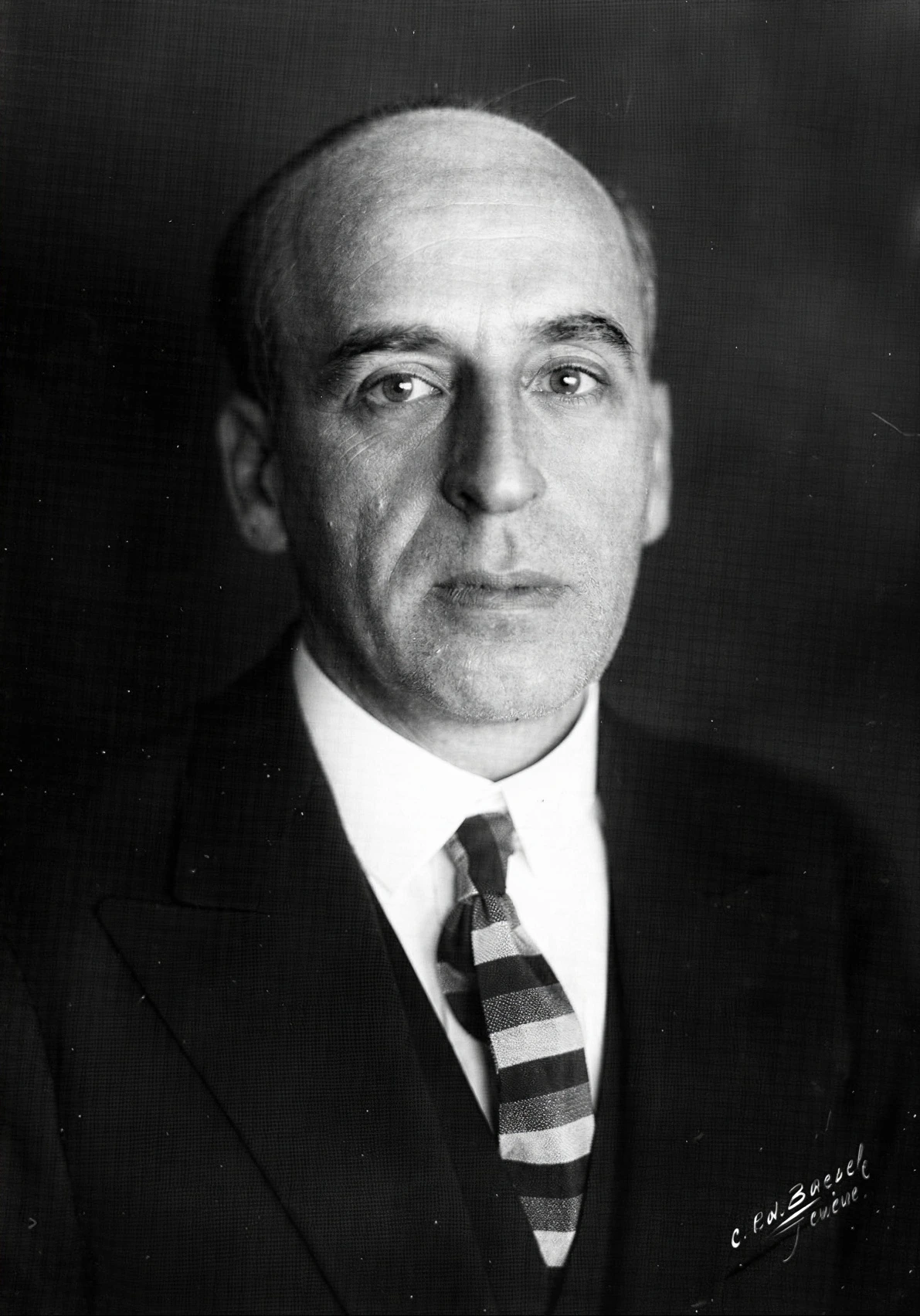
Biography
Lester was the second son and fifth child of the owner of a Belfast grocery shop. He was educated at Methodist College in Belfast in 1901-1902. On leaving school he went through many jobs, including working for the Belfast and County Down Railway in Bangor near Belfast. As his colour-blindness prevented him from distinguishing railways signals, he realized he would never be promoted and so he sought another occupation. In 1905, aged 17, he began a career in journalism with the Unionist North Down Herald, where Presbyterian Irish Nationalist Ernest Blythe was a colleague. Lester came from a ‘Protestant’ Methodist background and, in an Ireland where religion generally dictated political outlook, his upbringing and religion suggested he would develop in the Protestant ‘Unionist’ tradition. The Unionist tradition favoured Ireland being ruled from London, as opposed to the Catholic ‘Nationalists’ who favoured Dublin. Protestant Nationalism was very much a minority political outlook. In Belfast, through Blythe, Lester discovered the Gaelic League, which promoted Irish language and culture and had an ‘advanced’ Nationalist political outlook. The idea that Irish nationalism was not just for Catholics came as a revelation to him. He was now using the Irish version of his first name ‘Seán’, in preference to the English ‘John’. In 1908 Lester joined the revolutionary Irish Republican Brotherhood (IRB), an oath-bound secret society which sought an independent Irish republic. In 1909 he joined Arthur Griffith’s Sinn Féin, an advanced Nationalist political party which sought greater Irish independence from Britain, as opposed to the generally favoured devolved government in Dublin known as ‘Home Rule’ which had the support of the majority of Irish Nationalists. Though of an increasingly advanced Nationalist outlook Lester became chief reporter with the Dublin Evening Mail and the Dublin Daily Express, both Unionist papers. He also worked for the Nationalist Galway Connaught Tribune. Although a member of the IRB, Lester did not fight in the 1916 IRB-inspired Easter Rising against Britain. In the confusion surrounding the call to arms he understood, with many others, that the order had been countermanded. In outlook he was also close to those sections of the IRB who did not want a Rising to take place. After the Rising he joined the Dublin Freeman’s Journal, a prominent Nationalist paper with countrywide circulation, where he became News Editor, a post he held through 1922. In 1920 he married Elsie Tyrell.
Ireland gained independence from Britain in 1922 as a dominion in the British Commonwealth under the terms of the 1921 Anglo-Irish Treaty. Lester supported this development, though many of his fellow Irish Nationalists did not. A bitter divisive Civil War was fought in 1922-1923 over the terms of the Treaty and the level of continued association with Britain offered. As a dominion Ireland, now known as the Irish Free State, could develop its own foreign policy. The new state comprised only 26 out of 32 counties, the island having been partitioned into Northern Ireland and Southern Ireland by the 1920 Government of Ireland Act. Southern Ireland became the Irish Free State in 1922. Lester’s hometown of Belfast was now in Northern Ireland, where a devolved Unionist government continued to ensure that the province was part of the United Kingdom. As a northern Methodist Irish Nationalist who supported the Irish Free State, Lester occupied an almost unique political pedigree in independent Ireland to the south. In 1923, through his continuing friendship with Blythe, who was now an Irish government minister, Lester joined the fledgling Irish Free State Department of External Affairs as an officer in its Publicity Department. He served as Director of Publicity from 1925 to 1929. In April 1929 Lester, who freely admitted that he had little international experience and had rarely to that point travelled outside Ireland, moved to Geneva as Irish Free State Permanent Representative to the League of Nations. He was responsible for the formulation and execution of Irish policy at the League. Along with Irish Minister Plenipotentiary to France Count Gerald O’Kelly de Gallagh, he played an essential part in masterminding the Irish Free State’s successful bid for election to the League Council in September 1930. The state’s election was a sign that Ireland was seen at Geneva as an independent-minded small state who would try to represent the members of the League Assembly on the Council facing the great powers.
At Geneva Lester represented Ireland at numerous international conferences, as well as serving as Irish representative on the League Council from 1930 to 1933 when the minister for External Affairs was not present. He was also a member of the League of Nations Preparatory Commission for the Disarmament Conference and represented Ireland at sessions of the Disarmament Conference from 1932 to 1933. He held the post of President of the conciliation committees for Leticia (Peru-Colombia) and Gran Chaco (Bolivia-Paraguay) disputes. The rights of small states and minorities ‘brought out his particular abilities’ (The Times 1959). As a creator of modern Irish foreign policy, Lester believed in international organization and the primacy of international law. At Geneva he moved from nationalism to internationalism. Geneva made him. He maintained that the experience offered ‘possibilities which it would be regrettable to ignore’ and he wrote that the League was ‘a place of work and it was also a University for the study of world affairs. I was still learning when I left it after eighteen years’ (Gageby 1999: 21). Lester was not an idealist. His international view was, as he put it at the time of Japan’s invasion of Manchuria in 1931, in ‘principle well-seasoned by the sauce of realism’ (Lester to Walshe, 7 December 1931, Documents on Irish Foreign Policy, Volume III, nr. 614, www.difp.ie). He showed sound judgement and learnt to use the wiggle room that small states, powerless in general, could apply to forge compromises and alliances. He saw the League fail to deal with the Japanese invasion of Manchuria, he saw the organization propose peacekeeping forces and arms embargoes to bring to an end wars in Latin America, and he saw the dream of Geneva fade as the ill-fated Disarmament Conference collapsed in the face of a resurgent Nazi Germany.
Lester’s experience on the League Council internationalized him and brought him to the attention of the League of Nations Secretariat. In autumn 1933 Lester was seconded to the Secretariat. After Edward Phelan at the International Labour Organization he was the second Irish diplomat to serve in an international organization. In January 1934, following a proposal by British Foreign Secretary Sir John Simon, he took up office as League of Nations High Commissioner for Danzig (Gdansk). The initial mood in the city suggested that Poles, Germans and Danzigers alike felt that an Irishman could understand their respective points of view and defend their respective interests, but what Lester encountered at Danzig he later called ‘a tragedy of European concern’ (Lester Diary, 18 June 1937, quoted in McNamara 2009: 227). His task was to broker a compromise between the competing factions and to prevent Danzig, Europe’s powder keg, from exploding. This required a rare mixture of diplomatic and political skill. The political climate in Danzig worsened year after year and Lester did not succeed in halting Nazi dominance over the city, though he did manage to keep the Nazi-dominated Danzig Senate, the Polish- and German-speaking opposition and the local Nazi thugs from coming to serious blows. He was careful but not spineless, tough but not reckless and diplomatic without being overly cautious. His policy in Danzig was to uphold the rule of law and make both sides aware of their transgressions of the laws of the Free City. This was a policy of constant action, seen in particular through the use of his annual report to the League and of the quarterly League Council sessions to bring the unruly Nazi elements in the Free City to international attention. Under increasing German and Polish pressure and with ever-dwindling support from Britain, France and the League, Lester knew his position was weak, yet he used that fundamental right which the Nazis aimed to crush (free speech) to condemn the Danzig Nazis in the court of international public opinion at Geneva via his reports to the Council, which annoyed many in Danzig, Berlin and Warsaw. This was seen in particular with his handling of the April 1935 elections in the Free City. He was viewed as interfering in domestic affairs. Yet the Council chose to ignore him. Danzig had massive exposure in 1930s Europe. Lester’s was a household name, but he sought no personal publicity and managed League affairs in the city with his trademark quiet resolve. He was, after all, one of the first non-Germans to see the Nazi mask slip. Berlin and Warsaw thought less positively of the League High Commissioner and Lester had a difficult relationship with Polish Foreign Minister Józef Beck. While Lester sought to ensure the operation of the Danzig Senate and Constitution and protect the Polish opposition, Beck, disdainful of the League, saw him as a powerless functionary and an enemy of Polish interests in the city. He bypassed Lester and dealt directly with Berlin over Danzig. This was shortsighted, because Lester was Poland’s last best chance at averting chaos in Danzig as Berlin sought to manipulate forces within the city to engineer Danzig’s return to the Reich. Berlin conspired to remove Lester and he was eventually toppled, on Adolf Hitler’s personal orders, by the combined forces of Berlin and the local Nazis. This task was made easier by the equivocal view of Poland towards the High Commissioner’s mandate. Lester, by the time of his departure from Danzig in New Year 1937 had, at the very least, delayed the Nazi takeover of the Free City by a year. He emerged from the trials of Danzig with his reputation intact. That he had failed in Danzig was less important than that he had tried.
On his return to Geneva in February 1937 Lester was promoted to the post of Deputy Secretary-General of the League. The only other such post-holders in the early 1920s had been Jean Monnet and Joseph Avenol. As Deputy Secretary-General Lester played a mainly administrative role until the outbreak of the Second World War in 1939 left him responsible for gathering the pieces of the discredited League together and assisting in preparing plans for the dispersal of League offices to North America. In the summer of 1940, as the Nazis pushed west, Lester fought another battle. As Deputy Secretary-General he stood up against the attempts of Secretary-General Avenol, who admired Hitler and Mussolini and expected an imminent German victory with a Europe under German control following, first to liquidate as much of the League as possible and then to turn the remnants into a new pro-Axis body, having removed all European staff. Lester wrote about Avenol in his diary: ‘one may put up with pomposity when it is backed by a quick intelligence, but when one has to put up with pompous futility coupled with demoralization, the last shred of respect goes’ (Lester Diary 1940: 436-437, from a letter from Lester to Arthur Sweetser). There was no love lost between the two and their arguments were frequent. Lester also confided to his diary about Avenol’s ‘prima donna temperamental storms; feminine spite and distortion. Funk and failure, mixed with an Indian god’s dignity and self-complacent “infallibility”’ (Lester Diary 1940: 442). He felt Avenol had acted treasonously toward his position as Secretary-General and had betrayed the League. Though the two men rarely spoke after June 1940, in a battle of wills Lester saw himself as the core in the Palais des Nations of Secretariat resistance to Avenol’s plans to turn the League into a pro-Axis body. Avenol publicly belittled Lester, made tantalising offers of the post of Deputy Secretary-General to others and tried to get Lester to resign, or at least to go on extended leave or a mission to the League bodies which had been transferred to North America. Avenol anticipated that Ireland would be banned from the new European order he believed would follow an Axis victory. Lester could not be allowed to remain in Geneva. Lester refused all suggestions and threats that he leave Geneva, knowing that any leave or overseas mission would be a permanent removal from Geneva, allowing Avenol to continue his plans to run down the Secretariat to a standstill before handing it to Vichy France. He stonewalled and would not resign, writing to Avenol teasingly: ‘I wish therefore to assure you that you may count on my full determination not to desert my post as long as I feel convinced there is a duty to be done’ (Gageby 1999: 195). The fact that Lester cited himself, not Avenol, as the arbiter of his own future and the judge of the nature of the duty to be done is noticeable. Working at times with League Treasurer Seymour Jacklin, Lester now ensured the failure of each of Avenol’s attempts to downsize the Secretariat, get rid of non-European staff and gain control of the League’s capital assets. Lester held on and the League survived. By late summer 1940 it had become clear that Vichy France did not want Avenol to remain as Secretary-General of the League. Lester was worried that Avenol might try to pull the entire Secretariat down before his departure. Now aware of Vichy’s attitude, Avenol offered inelegantly to step aside in August 1940. Lester had hung on through the critical summer months of 1940 and his stubbornness, mixed with the French change of mind on Avenol’s place in the League, forced Avenol’s departure. Lester’s administrative outmanoeuvring of Avenol and the subtlety of his argument to the former Secretary-General had been his core actions in his resolve to protect the League. Lester now became Acting Secretary-General, formally replacing Avenol on 2 September 1940. Lester then spent the wartime in Geneva as the League’s last Secretary-General, carrying on the non-political technical work of the League with a skeleton staff of only one hundred. They rattled around the deserted Palais des Nations and maintained contact with League bodies already dispersed to Canada and the United States (US). After Lester’s battle with Avenol the staff supported him for his integrity and courage. He was determined to keep the League’s organization together for the postwar era and was also concerned that pro-Axis, anti-democratic elements might try to take over the League’s activities and mane for their own ends.
Lester rose to the circumstances of a world at war. In normal times, since he had become a diplomat by accident and was, by his own admission, unambitious, he would not have accepted the post of Secretary-General. However, with democracy under threat he felt compelled to accept the challenge. The British Labour politician Philip Noel-Baker said the words of Seneca came to mind concerning Lester’s wartime vigil: ‘with nothing to hope for, he despaired of nothing’ (Gageby 1999: 251). Lester regarded these wartime years as the hardest of his life. Not only was the League far from secure as an institution, but also until 1943 a Nazi invasion of Switzerland was considered likely. Lester did not believe he was running an organisation with nothing to offer the world and in 1945 he handed over the remains of the League to the Allies, ensuring continuity between the League and the United Nations (UN) and providing substantial foundations for the UN system. As well as the spirit of peaceful international cooperation, the League’s most sizeable inheritance to the UN was its technical organizations, the quiet bodies that are the building blocks of international life. He represented the League at the San Francisco United Nations Conference on International Organization that founded the UN, but he was assigned no role in the foundation of the new organization. With the US and the Soviet Union dominating the postwar order, a representative of an organization of which they had few fond memories stood in low stature. The UN was to symbolize a new beginning and the last Secretary-General could not be allowed to taint this. Being Irish, Lester was also looked upon with disdain as a citizen of a neutral state. In 1946 Lester prepared for the 21st and final Assembly of the League, which opened on 8 April and awarded Lester with the title of full Secretary-General, retroactive from 1940. It was Lester’s final task to formally dissolve the League and dispose of the organization’s assets. On 31 July 1947 the League officially ceased to exist.
Lester retired to Ireland to the village of Recess in the wilds of County Galway to fish and garden. Despite offers, he did not serve the Irish government in any further posts. As an international civil servant, he felt he could not return to serve any one country. There was some speculation that he would be a potential candidate for the presidency of Ireland in 1945, but he did not stand for election. In 1945 the Woodrow Wilson Foundation awarded him for his distinguished service in maintaining the League throughout the war. Also in 1945 he took over the post of President of the Permanent Norwegian-Swiss Conciliation Commission. He was awarded an Honorary Doctorate from Dublin University in 1947 and an equivalent honour from the National University in 1948. In 1956 Lester was appointed for six years to the Irish national group that nominated candidates to fill vacancies in the membership of the International Court of Justice. He died at the Calvary Hospital in Galway in 1959.
Lester was a modest man and did not seek public office or publicity. He was a reluctant hero cast into battle with endless villains, the quiet man who, because of force of circumstance, rose to the challenges facing him. In Danzig and Geneva he ensured that the League stood for democracy. To British Foreign Secretary Anthony Eden, Lester was ‘an Irishman with gentle manners but a firm will’ (McNamara 2009: 103). To Eden’s contemporary, journalist Elizabeth Wiskemann, Lester was ‘a man of integrity and warmth [who] endured vexation verging on persecution for the sake of the League of Nations, or perhaps just for the sake of decency’ (quoted in McNamara 2009: 109). His greatest legacy to international organization and democracy is that his determination saved the League from Avenol’s plans and kept the embers of international organization alive during the Second World War. He was treated with disdain by the international community, in particular the founding fathers of the UN, and by his former colleagues in the Irish Department of External Affairs on his retirement, seen as the leftover from a defunct and tainted organization. The UN showed little appreciation of Lester’s custodianship of the League through the Second World War. Internationally his postwar role was limited and in Ireland he was ignored and largely forgotten as an international diplomat. In part this was due to a sense of insecurity amongst his former colleagues in the Department of External Affairs: in such a local body where could a former Secretary-General of a major international organization fit in? To an extent Lester also felt that his job was done and a return to relative obscurity suited him. Despite some academic attention in Ireland in the 1970s, it was only in the 1990s, with the release of the archives of the Department of External Affairs in 1991, that academic and ultimately popular interest in Lester’s role in Geneva grew and he was remembered and appraised in Ireland. Lester’s portrait now hangs in a place of honour in the Department of Foreign Affairs and Trade in Iveagh House in Dublin, a memorial lecture named after him takes place in Dublin City University and in 2003 a 45-minute television documentary on his life and achievements was aired on Irish television. In Gdansk and in his native Belfast the city authorities have each reflected Lester’s legacy by mounting plaques in his honour.