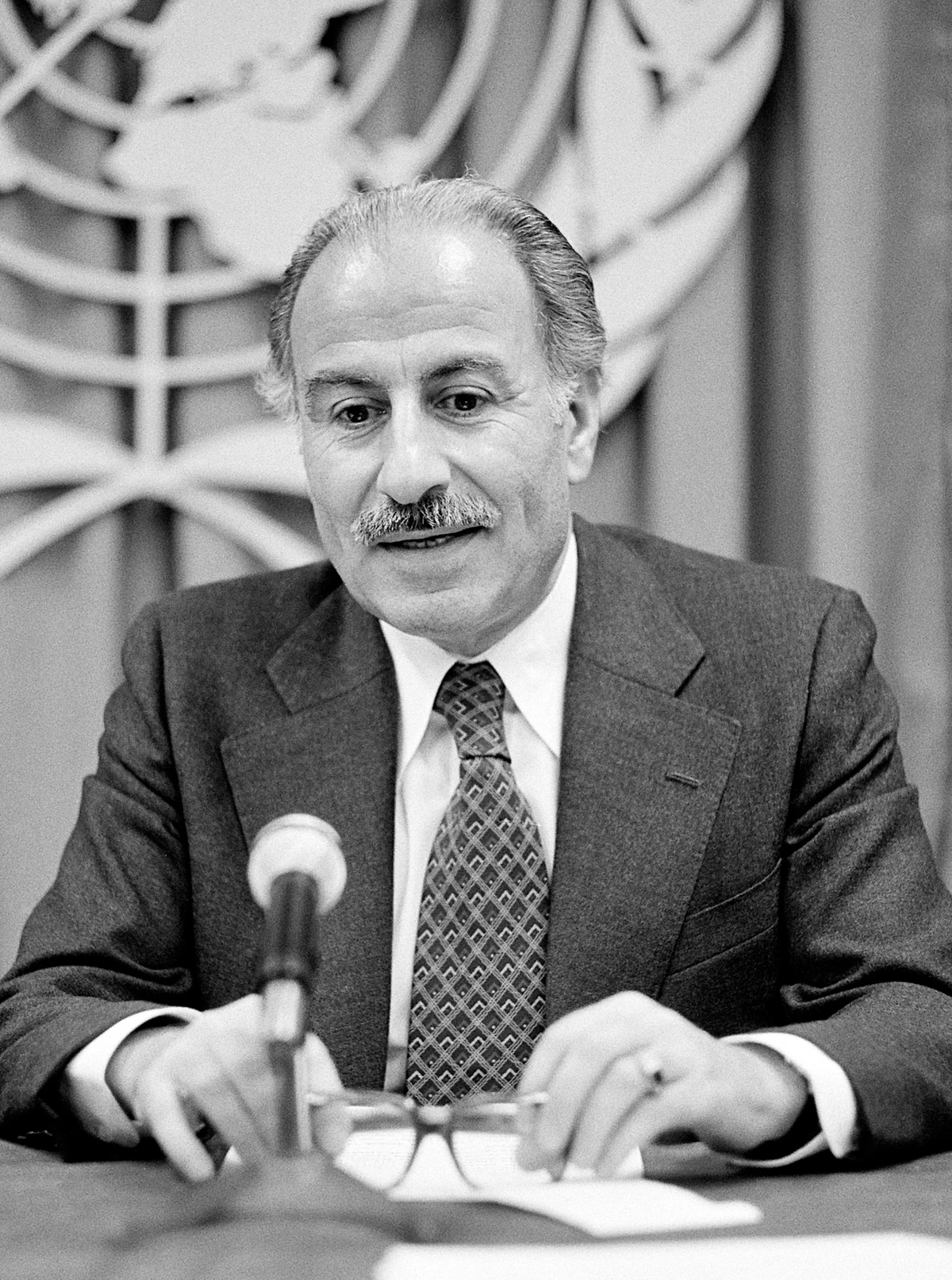
Biography
Kotaite hailed from an influential political family in Hasbaya, Lebanon and was a member of the Greek Orthodox Church of Antioch. His paternal grandfather, made an effendi by the Ottoman Empire, served as a member of the House of Notables in Damascus. His father took on the traditional responsibilities of community leader and regional mediator and worked as a civil servant. His mother was a humanitarian who worked with internal refugees. The Lebanese government recognized her through the issuance of a special certificate with the affectionate title Mother of the South. Kotaite was educated at a school associated with the St. George Orthodox Church, then at a British school and later at a multicultural public school in his hometown. His father died in 1939 while he was studying at the Boarding College of Les Frères Maristes in Jounieh. Kotaite then assumed his father’s traditional roles at the age of fifteen, taking on social and political responsibilities as well as overseeing the family’s land. After the Second World War (and Lebanon’s independence in 1943) he studied law at the renowned Université Saint-Joseph in Beirut. In 1949 he joined the Université de Paris, where he earned a PhD in international law in 1952. During his post-doctoral career he worked in The Netherlands at The Hague Academy of International Law under the direction of Daniel Goedhuis, whose expertise in aviation law inspired Kotaite to become an expert in that field.
In 1953 Kotaite returned to Lebanon. Following a meeting with Prime Minister Khaled Chehab, a close friend of the family, he was appointed on 27 April as Chief of Legal Services, International Agreements and External Relations of the Directorate General of Civil Aviation. Kotaite represented Lebanon at the meetings of the Legal Committee of the International Civil Aviation Organization (ICAO) until 1956, when he became Lebanon’s representative to the ICAO Council. During this transition he discovered his true vocation, as the work at ICAO combined his passions for international affairs and the law. From 1957 to 1959 he served as a member of the United Nations (UN) Transport and Communications Commission. In 1958 he took on the Vice-Presidentship of the ICAO Council and, in 1959, he became Chairman of the Air Transport Committee. In 1962 he returned to Lebanon to serve as Director of Administrative Services at the Directorate General of Civil Aviation. In 1965 he resumed his role as Lebanon’s representative at the ICAO Council. Lebanon’s role in the Council was regarded as ‘highly strategic’ (Kotaite 2013: 73), as the country represented the bloc of Arab countries, was an aeronautical middle power and functioned as a diplomatic intermediary between developed and developing states. Pursuant to these roles, Kotaite was instructed to advocate for technical assistance for smaller states. Following an Israeli raid on Beirut International Airport in 1968 that purposely destroyed fourteen civilian aircrafts, related to the hijacking of an El Al aircraft at Athens, Greece and the enforcement of sanctions, Kotaite eloquently, albeit unsuccessfully, called for the Council’s condemnation of the Israeli action.
On 1 August 1970 Kotaite was appointed ICAO’s Secretary General, succeeding Dutchman Bernard Twigt. Although the ICAO Council formally appointed Kotaite during the 17th Assembly, no record of this decision appears in the Assembly’s official archives. Since the Secretary General is appointed rather than elected, the behind-the-scenes negotiations surrounding his selection remain unclear. However, it is known that Kotaite maintained a close working relationship with Council President Walter Binaghi. This proximity led some delegations to speculate his appointment resulted from the President’s personal discretion. ICAO’s governance structure, consisting of an Assembly, a permanent Council and a Secretariat, is unique within the UN system, as the Council stands as the only executive body empowered to enact binding legislation. While the Secretary General manages the Secretariat and daily operations, the role is separate from, and subordinate to, the Council President’s role. The President oversees the Council’s quasi-legislative functions (such as adopting Standards and Recommended Practices) and quasi-judicial responsibilities (including dispute resolution) under the 1944 Chicago Convention on International Civil Aviation. Given that the Convention includes only a single Article that narrowly defines the Council President’s authority, the President’s role, influence and stature were ‘permitted to grow out of proportion’ (Milde 2016: 161), further eclipsing that of the Secretary General.
Kotaite’s appointment marked the ascendance of the Arab-African coalition within ICAO, propelled by the momentum of the ongoing decolonization movement. Proficient in five languages, Kotaite served in this role until his election as Council President six years later, becoming the longest-serving leader in that position until his retirement in 2006. His tenure as Secretary General (1970-1976) was marked by close alignment with Council President Binaghi, who orchestrated his succession as ICAO’s highest-ranking officer. Binaghi viewed Kotaite as a politically viable candidate, one who could maintain support from developing states while possessing the requisite technical expertise and diplomatic acumen to effectively lead the Council’s work. A confidential United States (US) Mission cable records Binaghi’s veiled threat that blocking Kotaite would likely fail, forcing him to extend his own term. Hence, upon his resignation mid-term in 1975, Binaghi (having both private and strategic reasons) skillfully maneuvered Kotaite’s interim election on 17 November 1975 during the 86th Council Session, leading some Council members to perceive it as a ‘crown prince selection’ (National Archives and Records Administration [NARA], Washington DC, CFPF 1973-1979, RG59, Document 1975STATE276334). Kotaite ultimately secured the interim presidency to complete Binaghi’s three-year term. On 1 August 1976 he formally assumed this interim role, through the support of a coalition of African, Arab and Latin American states, reflecting the growing influence of the Global South within ICAO. Notably, this election contradicted earlier preferences among the African bloc, which had supported Ghana’s Edward Dwemoh for the presidency while backing Kotaite’s reappointment as Secretary General. Critics questioned Kotaite’s transactional diplomatic style, suggesting he was a ‘very shrewd manipulator’ (NARA, CFPF 1973-1979, RG59, Document 1976MONTRE00416). Several member states expressed concern over a perceived Francophone bias in his decision making, exacerbating existing geopolitical tensions within the Council. The general disagreement showed in the aftermath of the election process when Council members pointedly remained seated as Kotaite entered the chamber.
The underlying tensions resurfaced during Kotaite’s formal election, or rather re-election, as Council President on 18 October 1977, this time for his first full three-year term. He won the election, but the delegations, except for the French, staged a silent protest by remaining seated during his inaugural entrance, signaling continued opposition. Contemporary records indicate this protest reflected persistent concerns among member states regarding Kotaite’s perceived ‘wheeling and dealing’ leadership style (NARA, CFPF 1973-1979, RG59, Document 1977MONTRE01717) and alleged favoritism toward Francophone interests and those of the coalition that elected him. Major aviation powers particularly objected to two unprecedented developments: Kotaite’s appointment of a Lebanese delegate to chair the pivotal Economic Commission and the Assembly’s failure to elect a chairman from any major aviation state for the first time in ICAO’s history. Some interpreted these decisions as indicative of a broader shift in organizational power dynamics that disadvantaged traditional stakeholders at a time when ICAO was perceived as being overly politicized. Alternatively, these actions may be understood as part of Kotaite’s deliberate strategy to reinforce ICAO’s institutional legitimacy, sustain its credibility across the member states and preserve its operational independence. Throughout his tenure, re-elected each time and consolidated as Council President over thirty years, Kotaite demonstrated his ability to maintain balance among competing blocs, skillfully deploying ‘aviation diplomacy’ (Kotaite 2013: 207). As a multilingual diplomat he leveraged his cultural and linguistic fluency to foster collaboration across diverse stakeholder groups, showing strategic diplomacy. He assumed leadership during a turbulent era which was characterized by a reconfiguration of power structures, driven by the rapid influx of decolonized states and the inclusion of the Soviet Union and the People’s Republic of China as ICAO members. All this reshaped the organization’s political balance. Simultaneously, civil aviation faced a surge in unlawful acts of interference, including hijackings and sabotage, compounded by severe economic challenges arising from the 1973-1974 oil embargo, which triggered unprecedented rises in fuel costs and exposed vulnerabilities related to the air transport’s economic sustainability.
As ICAO became involved in an increasing number of global conflicts, the Council President’s role evolved into that of a prominent arbiter and conciliator. Kotaite was particularly well-suited to this role as his diplomatic skills, shaped by his family’s background, enabled him to guide the organization through various conflicts. He was inspired by the leadership styles of UN Secretary-General Dag Hammarskjöld and Canadian Secretary of State for External Affairs Lester Pearson, describing them as ‘architects of multilateralism who selflessly combined objectivity, an ability to inspire trust and engage parties in conflict and the patience needed to find collective solutions’ (Kotaite 2010: 70). These role models, along with the guidance of his mentor Binaghi, informed his development of a distinct diplomatic style emphasizing quiet mediation and preventive diplomacy. Kotaite frequently provided his good offices in delicate negotiations and played a key role in defusing tensions before they escalated into full-blown confrontations. His efforts were instrumental in addressing various conflicts. Upon assuming his mandate, he was called to mediate in a sensitive dispute between Senegal and Cape Verde regarding flight information services for crucial transatlantic routes, with competing interests between Senegal’s established Francophone air traffic system and Cape Verde’s economic aspirations as a smaller state. Through direct mediation with both presidents, Kotaite brokered a territorial compromise that divided the contested airspace, ensuring economic benefits for both parties. He later pursued similar diplomatic efforts to facilitate airspace agreements between North and South Korea, aiming to establish reciprocal overflight rights and open-air corridors. These negotiations achieved only partial technical coordination, with full normalization of airspace access remaining unrealized due to ongoing political tensions and differing implementation capacities between the two states. Similar geopolitical tensions that had direct incidence over air navigation were channeled through ICAO. A long-standing Greek Turkish dispute over airspace control, centered on Cyprus’ contested airspace and Nicosia flight information region operations, escalated in the 1980s-1990s. While Kotaite’s technical mediation established provisional coordination measures in the 1990s, an agreement was concluded only in 2003 when Olympic-related political priorities created sufficient bilateral will to overcome longstanding deadlocks. Kotaite’s personal diplomacy played a decisive role in resolving the 1990-1992 dispute over fifteen Kuwait Airways aircraft seized by Iraq during Kuwait’s invasion, six of which had been covertly relocated to Iran. Following ICAO Assembly Resolution A28-7’s 1990 declaration affirming Kuwait’s ownership rights, Kotaite engaged in direct negotiations with Iranian President Akbar Rafsanjani, securing the aircrafts’ return.
The most politically sensitive issue that ICAO was confronted with under Kotaite’s mandate was the downing of civilian aircraft by state actors, particularly in the 1980s. Both superpowers, the Soviet Union and the US, brought down one civilian aircraft each during this period. The Cold War tensions were exacerbated in the aftermath of the downing of Korean Airways flight KAL 007 over Soviet airspace in 1983, resulting in the death of 269 individuals. Later, in 1988, the US brought down Iran Air flight 655, killing 290 people. In both cases ICAO became the epicenter of a politically charged battleground where geopolitical tensions played out. Maintaining the façade of a technical agency devoid of politicization was not an easy feat, given the calls for ICAO to investigate the incidents. Doing so, however, risked embroiling the organization in controversy or appearing to take sides. Under Kotaite’s direction, ICAO navigated this delicate balance by conducting fact-finding investigations focused strictly on technical aspects. This approach addressed the affected states’ demands for accountability while upholding ICAO’s neutrality, ensuring that its inquiries remained narrow in scope to avoid further inflaming political tensions. Kotaite’s tenure saw a purposeful expansion of the Council President’s role, facilitated by the Convention’s ambiguous delimitation of the presidential powers. For instance, when US sanctions prevented Iran Air from obtaining spare Boeing parts, Kotaite unilaterally opted for direct bilateral negotiations between American and Iranian technical authorities instead of following the protocol of referring the matter to the Council. While framed as addressing aviation safety concerns, this mediation resulted in US Commerce Department approval for the parts transfer, effectively bypassing formal ICAO dispute resolution mechanisms.
Kotaite framed ICAO discursively as a depoliticized technical agency, where cooperation and consensus were essential. This enabled ICAO’s framework to be perceived as neutral and detached from political interests, despite its inherently political nature. This discursive construction allowed states to strategically distance themselves from the decisions, thereby reinforcing ICAO’s institutional authority while maintaining a veneer of impartiality and neutrality. By his own account, he depoliticized and even demilitarized conflicts by ‘disassociating them from any non-aviation matters, thereby bringing the focus of the Council back to the safety and efficiency of civil aviation’ (Kotaite 2013: 114). His most salient accomplishment was ICAO’s elevation to supranational authority in matters related to the safety and security of international civil aviation. From the perspective of internal institutional development, however, this was debatable, as the Assembly’s powers were purposely eroded by a series of organs with no constitutional justification. Moreover, the mechanisms established to strengthen ICAO’s authority raised questions about biased norm transfer and monitoring, favoring large aeronautical states. In the realm of safety, Kotaite embraced and supported initiatives spearheaded by the US and the European Civil Aviation Commission during ICAO’s 29th Assembly in 1992. These efforts culminated in the establishment of a system designed to harmonize safety standards and provide for an oversight mechanism, which evolved into the Universal Safety Oversight Audit Programme, officially launched in 1999.
In the aftermath of the 11 September 2001 attacks, which posed a serious threat to ICAO’s legitimacy, Kotaite presented a landmark aviation security initiative aimed at addressing vulnerabilities in aviation security and restoring confidence in international air transport. The initiative culminated in the establishment of the Universal Security Audit Programme (USAP), officially launched in 2003. USAP became instrumental in harmonizing global security standards and auditing compliance, significantly enhancing ICAO’s authority and prestige on the international stage. However, the initiative was not solely the product of Kotaite’s vision, as the proposal was orchestrated by the G7 countries, who recognized the importance of strengthening ICAO’s legitimacy and authority in the aftermath of 9/11. The G7 organized a campaign to drive USAP’s adoption, while also advocating for enhanced security standards and other measures that would fortify ICAO’s role in global aviation governance. Strategically, Kotaite convened a High-Level Ministerial Conference on Aviation Security in February 2002, designed to project an image of broad consensus and maintain political distance from the primary advocates of the initiative. This approach allowed ICAO to uphold its longstanding reputation for impartiality and neutrality, even as it aligned with the priorities of powerful actors such as the G7. By framing the conference as a collaborative global effort, Kotaite positioned ICAO as the central, unbiased authority in aviation security, while subtly navigating the geopolitical interests that promoted the initiative. He thus aligned ICAO’s agenda with the interests of the influential global powers and leveraged the momentum generated by the G7 and other powerful stakeholders, aligning with prevailing discourses on (counter)terrorism and threats to civil aviation. This ensured that ICAO retained and elevated its standing as the central authority on civil aviation security, reflecting Kotaite’s acumen in seizing opportunities to expand ICAO’s role.
Kotaite maintained close ties with successive leaders of the International Air Transport Association (IATA), reflecting the necessary operational coordination between ICAO and the airline industry body. These ties included ceremonial interactions, such as IATA Director General Knut Hammarskjöld’s receipt of an ICAO award, as well as working collaborations with IATA Directors General Pierre Jeanniot and Giovanni Bisignani. While framed in personal terms, these relationships also served institutional objectives of aligning regulatory and industry positions on multilateral and multistakeholder aviation issues. Kotaite placed particular importance on reinforcing personal relationships through face-to-face interactions, arguing that direct engagement, where he could observe an interlocutor’s reactions, held far greater value than remote communication. Due to his diplomatic leadership style, Kotaite also developed close working relationships with numerous heads of state and high-level political figures. During the 20th ICAO Assembly in Rome (1973), he was received by Pope Paul VI, securing the Vatican’s endorsement of ICAO efforts to combat aircraft hijackings. He also held an audience with Pope John Paul II. Given ICAO’s headquarters in Montreal, Canada he maintained a strong rapport with both federal authorities and the Government of Quebec, frequently inviting them to inaugurate ICAO’s high-level sessions and assemblies. To defuse conflicts and negotiate critical agreements, he often engaged directly with heads of state and senior officials. These included Ugandan President Idi Amin, Iranian President Rafsanjani, Chinese President Jiang Zemin, Vietnamese President Trần Đức Lương, Pakistani President Pervez Musharraf, US Secretary of State Colin Powell and Belgian Prime Minister Guy Verhofstadt. He also engaged with the Taliban regime to negotiate the release of hostages from a hijacked Indian Airlines flight in 1999. His mediation extended well beyond the boundaries of civil aviation. Given that aviation intersects with broader issues, such as counterterrorism, competition among industrial manufacturers of security and navigation equipment and geopolitical tensions related to the management of Flight Information Regions, his role often brought him into the heart of diplomatic disputes between states. As a result, his influence reached far beyond the technical realm of civil aviation, positioning him as a discreet actor in wider international diplomacy.
During Kotaite’s tenure ICAO navigated challenging times to become a supranational authority in matters related to the safety and security of civil aviation. His long time in office was instrumental in ensuring continuity of ICAO’s governance and preserving institutional memory, while the respect he commanded contributed significantly to ICAO’s growing legitimacy over time. These two factors were deeply interconnected, with one reinforcing the other. Yet, it can also be stated that the ICAO Council’s influence grew significantly throughout his tenure, becoming the central decision-making body, but eroding the Assembly’s powers. This ‘evolution was perpetuated to serve the personal preferences of a long-serving President of the Council’ (Milde 2010: 141). During his tenure as Council President Kotaite was also elected Assembly President on six occasions. On four of these the Assembly was extraordinary, with delegations likely prioritizing efficiency and timing. Yet, the three successive Assembly elections in 2001, 2003 and 2004 suggest an unhealthy accumulation of power. This practice has been criticized as undermining institutional checks and balances and fostering perceptions of a cult of personality. The Council’s broad delegation of authority to its long-serving President granted excessive discretionary powers without adequate oversight, allowing Kotaite to overstep his mandate while the Council failed to exercise proper supervision. In response to these concerns, the Council adopted a more restrictive delegation of authority framework after Kotaite’s departure, introducing stronger checks and balances. Kotaite’s long tenure underscored broader institutional deficiencies. Notably, although the UN General Assembly had unanimously endorsed a resolution in 1997 (A/RES/51/241) mandating a two-term (eight-year) limit for executive heads of specialized agencies, ICAO failed to formally incorporate or acknowledge this directive into its internal governance framework prior to 2007. This oversight permitted Kotaite to retain his position as Council President until 2006, when he resigned at the age of eighty. Despite being lauded as an architect of multilateralism, as well as a visionary and well-respected leader who devoted his life to ICAO’s growth, he left behind an organization in need of strategic reorganization, mired by systemic opacity and governance challenges. Kotaite’s legacy remains a testament to both the benefits of sustained leadership in multilateralism and its pitfalls when checks on power remain ambiguous. His career encapsulated aviation’s age of globalization, even as it prompted overdue questions about how international organizations reconcile stability, legitimacy and mounting authority with accountability and transparency.
Following his retirement on 31 July 2006, Kotaite was named the first-ever President Emeritus of the ICAO Council, an honorary designation bestowed upon him by the Council in recognition of his contributions to international civil aviation. He went on to establish the Assad Kotaite Graduate and Postdoctoral Fellowship Fund, aimed at supporting the next generation of aviation professionals from the Global South. His legacy was also recognized in Quebec, where, in 1998, he was named an Officier de l’Ordre national du Québec for having fostered privileged ties between ICAO and the province. In 2013 he was awarded the 40th Edward Warner Award, the highest honor in the world of civil aviation, in recognition of his eminent contribution to the development of international civil aviation, most notably in the field of diplomacy and conciliation. In the same year he released his autobiography. Kotaite received numerous prestigious recognitions for his contributions to international aviation. Beyond these honors, Kotaite held the position of President of the International Court of Aviation and Space Arbitration (from 1995), an organization that, however, remained institutionally inactive. Kotaite passed away in 2014 at the age of 89 and was laid to rest in his hometown of Hasbaya. In 2024 the ICAO Council paid tribute to him by naming its conference center in his honor. Further commemorating his contributions, a hall of honor at Rafic Hariri International Airport in Beirut was also dedicated to him. The Chairman of Middle East Airlines expressed profound appreciation for his legacy, announcing the establishment of an annual aviation conference bearing Kotaite’s name to celebrate his enduring influence on the industry.