Biography
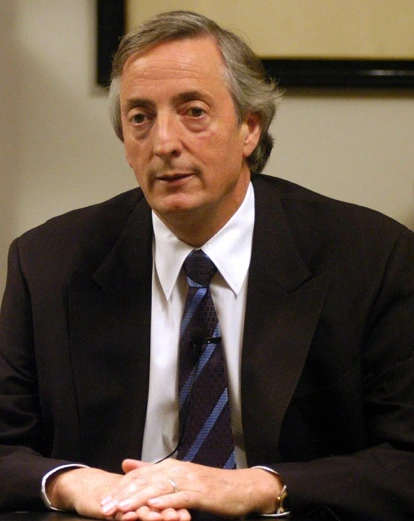
Kirchner’s family was Catholic and middle class. His father’s family was of Swiss German descent, his mother’s of Croatian descent. Kirchner received his primary and secondary education at local public schools and his high-school diploma from the Argentine school Colegio Nacional Republica de Guatemala. In 1969 he moved to La Plata to study law at the National University of La Plata, where he met his wife and joined Peronist student organizations. He graduated in 1976 and moved with his wife back to Santa Cruz, where they worked as lawyers. With the end of the military dictatorship and the restoration of democracy in 1983, Kirchner started his rocket political career. After working as an officer in the provincial government he became mayor of Rio Gallegos (1987-1991), governor of Santa Cruz (1991-2003) and President of Argentina (2003-2007). In 2007 his wife succeeded him in the Presidency and he became National Deputy of Argentina for Buenos Aires Province for a short period of time (2009-2010), leaving this post to become the first Secretary-General of the Union of South American Nations (UNASUR) in May 2010. While serving as President, Kirchner advanced an active foreign policy, was critical of the United States of America (US), opposed the Free Trade Area of the Americas (FTAA) project, and re-established bilateral relations with Cuba. In 2003 he refused to send troops to Iraq without a United Nations mandate or to concede immunity to US soldiers operating in Iraq.
Together with Presidents Hugo Chavez of Venezuela and Luiz Lula da Silva of Brazil, Kirchner promoted cooperation in South America. They supported the rapprochement between Mercosur (Argentina, Brazil, Paraguay, Uruguay) and the Andean Community (CAN: Bolivia, Colombia, Ecuador, Peru, Venezuela) which led to the announcement of a Community of South American States (CASA) at the third South American Summit on 8 December 2004. After Venezuela’s withdrawal from CAN in 2006, Chavez, supported by Kirchner, proposed the transformation of CASA into UNASUR. As a result, Kirchner became one of UNASUR’s founding fathers, signing on 23 May 2008 its Constitutive Treaty, which entered into force on 11 March 2011. Kirchner was pivotal in this political process as the one who mobilized consensus between the two greater powers, Argentina and Brazil. Chavez and Lula were equally supportive of integration in the region, but had considerable divergences with regard to the models of political economy and UNASUR’s role in international politics and global governance. Kirchner managed to re-establish the special partnership with Brazil after deterioration in their bilateral relations during the Argentinean crisis of 2001, when Mercosur was put into question. He also managed to build closer ties with Venezuela. The Venezuelan-Argentinean friendship was instrumental to Argentina, as it assured much-needed credits, and to Chavez, who gained support in his fight against neoliberalism on the continent as well as for Venezuela’s accession to Mercosur. When Ecuador proposed Kirchner as candidate for the post of Secretary-General, Uruguay initially rejected this because of its pulp mill dispute with Argentina. When the dispute was resolved in 2010 and a new president elected, Uruguay supported Kirchner’s candidacy. Kirchner was elected unanimously at a summit of UNASUR member-states in Buenos Aires on 4 May 2010. One of Kirchner’s few direct roles as Secretary-General of UNASUR was being a mediator in the Colombia-Venezuelan crisis of 2010. This border incident was also a conflict between an ally of the US in South America (Colombia) and its main opponent (Venezuela). The crisis was a test case for Kirchner’s political authority and showed his ability to act as a broker, aware of the need to develop a common identity for the regional organization. At the age of sixty he suddenly died of heart failure.
Given Kirchner’s short period in office as Secretary-General, his profile and political authority in UNASUR were mostly borrowed from his performance as Argentinean politician and former President. He did not have enough time to develop a specific profile as Secretary-General, nor to be seen as an actor independent from the Argentinean government, with which he was deeply connected given his wife’s role as President. His performance from when he took office until his death was in continuity with his leadership and political authority as an Argentinean politician aiming at fostering regional integration and contesting neoliberalism and US hegemony in South America. Having suspended amnesty laws in Argentina, he was also seen as committed to the promotion of human rights. However, he was often accused of being populist and authoritarian, and more seriously, of being involved in corruption in domestic politics and in his bilateral relations with Venezuela. Even if these characteristics were defined mainly during his presidency, they consolidated the ground on which he was chosen to be South America’s face in the 21st Century vis-à-vis the rest of the world.
How to cite
Andrea Ribeiro Hoffmann, 'Kirchner, Néstor Carlos' in
IO BIO, Biographical Dictionary of Secretaries-General of
International Organizations
, edited by Bob Reinalda, Kent J. Kille and Jaci L. Eisenberg. https://sandbox.zenodo.org/records/506513 (sandbox preview)
Text © the author(s) and IO BIO, licensed under CC BY-NC-ND 4.0. The portrait is excluded and remains under the rights of its credited
source. We have tried to trace the rights holder to obtain permission for the
use of the portrait, but contact us in case we have failed.