Biography
Jebb was descended from influential English country gentry. When he was seven, his parents’ marriage dissolved. His mother raised Jebb and his two sisters in London, with holidays in the countryside. After preparatory school Jebb was educated at Eton College (1913-1918), where the writer Aldous Huxley tutored him. His subsequent service as a cadet in the army helped improve his physical condition. In 1922 he graduated with first-class honours in History from Magdalen College in Oxford, where academic Francis Urquhart and historian Lewis Namier inspired him. When he failed to win a fellowship to All Souls College, he took the diplomatic service examination at the Foreign Office but failed again because his French proved to be insufficient. He found a job in Paris and a year later he was among the best when he re-took the examination. In October 1924 he started as third secretary in the British legation at Tehran, Persia. His superiors did not appreciate his work and attitude, but his situation improved with the arrival of Harold Nicholson, who had worked in 1919 as Eric Drummond’s private secretary while preparing the League of Nations Secretariat in London. Nicholson became Jebb’s immediate superior and respected his incisive critiques of Nicholson’s writing. When Jebb returned to London in May 1927 he was still uncertain whether to continue in the diplomatic service or not. However, he stayed at the Foreign Office and, through his friendship with Nicholson, began to move in literary Bloomsbury circles. This contributed to a mildly left-wing political attitude and in 1929, the year he was part of the British delegation to the League’s Assembly, he married.
On being assured by Jebb that he was neither Catholic nor homosexual (given Nicholson’s orientation), the Foreign Office in 1929 made him private secretary to Hugh Dalton, the Labour Under-Secretary of State who handled Foreign Office parliamentary matters and edited the replies to parliamentary questions. Jebb learned to recognize sensitivities and, in November 1931, became first secretary at the embassy in Rome, where he served under Drummond until 1935. Jebb was critical of the appointment of a former Secretary-General of the League of Nations as a national ambassador and belonged to Drummond’s group of critics. He regarded Drummond as almost an apologist for Fascist Italian leader Benito Mussolini who was moving into closer relations with National-Socialist Germany and, in October 1935, invaded Abyssinia. Before leaving Rome Jebb participated in a League sub-committee on economic sanctions, which he understood were ineffective if not backed up by force. In November 1935 Jebb returned to the Foreign Office in London, where he took part in the discussion about the defense of British interests in the face of the increasingly aggressive moves of Germany and Italy and the League’s weak collective security system. In early 1936 he was made private secretary to Permanent Under-Secretary for Foreign Affairs Robert Vansittart and, from December 1937 to August 1940, to Vansittart’s successor Alexander Cadogan, who both opposed the conflict-avoiding appeasement policy of Prime Minister Neville Chamberlain. Jebb, still a junior secretary in the Economic Department, was appreciated at the Foreign Office for his well-argued policy papers, ‘based on a tough, realist calculation of British interests’ (Goldsmith 2013: 68), even if his analyses were not yet politically feasible given the policy of appeasement. While working for Cadogan, Jebb observed the policy formation process.
After the fall of France in the Second World War, Jebb witnessed the early days of Brigadier General Charles de Gaulle as leader of the Free French in London. Cadogan made him persuade De Gaulle to accept some last-minute changes to the text of a BBC broadcast to France in June 1940. Jebb would meet De Gaulle more often and, although also critical of his policies, came to admire him. Jebb was soon seconded to assist Dalton, who now headed the newly created Ministry of Economic Warfare in Winston Churchill’s national government. Dalton made Jebb Foreign Policy Advisor of the Special Operations Executive (SOE), which had to support resistance groups in European territories occupied by Nazi Germany. Jebb worked in a situation where both the Foreign Office and the Secret Intelligence Service often opposed the SOE. Jebb gained a reputation as a bully in this scarcely effective world of intrigue. When Dalton was transferred to another department in early 1942, the Treasury employed Jebb for six weeks but had no job for him. In May Jebb was put in charge of the Foreign Office’s new Economic and Reconstruction Department, which was designed to cope with postwar problems. This provided him with a central position in British and international planning for the postwar world.
Philip Noel-Baker, who in 1942 became Joint Parliamentary Secretary to the Ministry of War Transport, initiated with others a campaign for later reconstruction of an international organization. To work on draft schemes for such reconstruction the Foreign Office recruited Charles Webster, a diplomatic historian of the Congress of Vienna, an expert on the League of Nations who was also familiar with the New Deal in the United States (US). Webster was brought into Jebb’s Department to help produce memoranda. Jebb himself became the spirit behind what, as product of collective thought, was named the Four Power Plan. Internal challenge came from Churchill, who preferred a regional system and was reluctant to consider postwar problems. In 1943 Jebb twice discussed ideas for a postwar world organization supported by great powers with the Americans in Washington DC. The idea of a general organization of all peace-loving states to maintain international peace and security was first mentioned in the Declaration of Moscow (October 1943), signed by the ministers of foreign affairs of the three great powers: the Soviet Union, the United Kingdom (UK) and the US. The Moscow Conference confirmed that the three Allies would stick together to enforce the peace. In Tehran in December US President Franklin Roosevelt outlined to Soviet leader Joseph Stalin his vision of the future ‘United Nations’ (a term dating back to the British-American ‘Declaration by United Nations’ of 1 January 1942, soon adhered by other Allied states), based on four great powers (the three plus China) to deal with threats to peace. The Tehran Conference made it evident to Jebb that the Soviets and the Americans between themselves were going to dominate the scene, with less influence for the UK. He also understood the relevance of having the US firmly engaged and to ensure that the Americans did not go isolationist again as had happened with the League of Nations which, as Jebb believed, was institutionally weak due to this great power absence. On his way back from Tehran to London Jebb met De Gaulle in Algiers in North Africa. The British exchanged further ideas with the Americans, whose views proved not very dissimilar, which resulted in a kind of Anglo-American front at the Conference in Dumbarton Oaks in the US (August-October 1944).
At Dumbarton Oaks Jebb did most of the work to make the Soviets accept the Anglo-American view in the small committee with his American and Soviet counterparts, which made him the second important member of Cadogan’s delegation, with Arkadi Sobolev as his Soviet colleague. Although the Soviet delegates arrived with stronger great power views, they were extremely cooperative (for example, Andrei Gromyko, delegation head and Ambassador to the US, spoke in English all the time) and largely tempered their views. Although not keen on economic cooperation, they accepted the idea of the Economic and Social Council (ECOSOC). The Four Power Plan turned into a United Nations Plan (‘Proposals for the Establishment of a General International Organization’), with the main issue of voting in the Security Council still open. The voting issue was solved at the Yalta Conference meeting between Churchill, Roosevelt and Stalin in February 1945. However, the quintessence (no veto on peaceful means of settling disputes, but one on threats to peace) originated in a conversation at Dumbarton Oaks between Cadogan and Jebb. Back in London, Jebb discussed it further with Sobolev. Followed by more diplomatic consultations, Stalin agreed with the formula in Yalta, where it was also decided to set up the new organization in the US, in San Francisco, on 25 April 1945 in order to prepare the organization’s Charter along the lines developed in Dumbarton Oaks.
The Dumbarton Oaks proposals and the supplementary Yalta decisions formed the point of departure for debates among 850 delegates from 50 states in San Francisco. States could express preferences and add topics. Commissions elected their own chairs and decided by a two-thirds majority. Alger Hiss, civil servant in the postwar planning division of the US Department of State, was appointed Secretary-General of the San Francisco Conference. Hiss had attended both Dumbarton Oaks (as secretary) and Yalta and was named by Roosevelt and Secretary of State Edward Stettinius. Hiss presided over the Conference Secretariat, which employed some 2,600 conference staff members and translators, with Jebb, the best informed man in the British delegation, working in the pivotal Executive Committee of fourteen states (four major powers and ten smaller states), the Coordination Committee (meant to put all proposals and committee conclusions into coherent and logical text) and as Deputy to the Foreign Ministers Committee, which had to agree about proposals for submission to the ministers. The main issue to be solved was Soviet Foreign Minister Vyacheslav Molotov’s effort to have a stronger veto in the Security Council, also on procedure, which was excluded in Yalta. US presidential advisor Harry Hopkins was sent over to see Stalin, who overruled Molotov and thus cleared the way for the Soviet signature on 26 June, when all states signed the United Nations (UN) Charter. British delegate member Webster had also played a role by helping South African Prime Minister Jan Smuts insert the Preamble into the Charter text. To put the signed (and soon sufficiently ratified) Charter into operation the Preparatory Commission for the United Nations was appointed the last day, with each signatory state having one commission member. The UK government invited the Preparatory Committee to meet in London and hold the first General Assembly meeting there. It was decided that Jebb would take over from Hiss, who brought the signed Charter to Washington DC and, in 1946, became principal advisor to the US delegation to the first General Assembly in London. Jebb became Executive Secretary of the Preparatory Commission that would work with an Executive Committee of fourteen states (as in San Francisco).
The Preparatory Commission met in San Francisco on 27 June and the Executive Committee began its work in London on 16 August. Jebb found an office and hired David Owen and Brian Urquhart as his first staff members. Former League officials such as Drummond and Egon Ranshofen-Wertheimer made their experience with the League Secretariat available through publications. League Secretary-General Seán Lester, who was not assigned a role in San Francisco, circulated his Summary of the History and Development of the Secretariat as an International Service (November 1944) to Jebb, who circulated it to the Preparatory Commission in early September 1945. The Executive Committee requested that Jebb enlist Lester’s cooperation. Lester had oral discussions with Jebb and Owen and continued working closely with the Preparatory Commission. The most significant US administrative contribution was the introduction of management methods and techniques developed in the context of the New Deal programme to recover from the depression of the 1930s. On 12 November, after nine weeks of intensive work, the Executive Committee adopted its report to the Preparatory Commission, covering the issues set out in San Francisco. The report took the form of recommendations as well as committee reports and supplementary papers on the various UN principal organs (General Assembly, Security Council, ECOSOC, Trusteeship System, Secretariat and International Court of Justice) and appendices on issues such as provisional staff regulations, budgetary and financial arrangements, relationships with specialized agencies, the League of Nations and permanent headquarters. The Preparatory Commission approved the report on 24 November and began its work by establishing eight technical committees, two of them chaired by former League officials Thanassis Aghnides and Erik Colban. The Preparatory Commission amended some of the Executive Committee’s recommendations and the technical committees started their work on 28 November. All of this resulted in the Preparatory Commission’s final report, approved on 24 December, primarily in the form of recommendations to the UN. Jebb had guided the process strictly. He was good at dealing with the national representatives as well as his own staff and knew exactly what he was doing, but ‘deliberately cultivated his aloof image’ about how to get things done (Urquhart 1989: 91). His ‘disciplined mind’ however made it easy for him ‘to take an objective international point of view and to oppose his own compatriots when necessary with ease and even enjoyment’ (Urquhart 1989: 97). Jebb, who was encouraged that unanimity had been reached so quickly, drafted the two reports mostly himself.
The Preparatory Commission prepared the first meeting of the UN General Assembly, which took place in Central Hall, Westminster on 10 January 1946. The Charter was ratified and Jebb made Acting Secretary-General. The permanent members of the Security Council had discussed several Secretary-General candidates beforehand. Looking for a great statesman to fill the post, they wanted to avoid public debate about the nomination. They agreed that it should not be one of their nationals but had different preferences. The General Assembly agreed with them on the importance of finding an eminent statesman but had no formal search or nomination procedures available, so it became a matter of choosing between ‘people who were somehow known’ to the five big powers (Ravndal 2023: 25). Belgian Paul-Henri Spaak showed no interest for the position but won the secret ballot over the presidency of the General Assembly by 28 votes to Norwegian Trygve Lie’s 23. The US preferred Canadian Lester Pearson, while the Soviet Union insisted on two other candidates. The US then saw Lie as a compromise candidate for Secretary-General, to which the other four agreed. On 29 January the Security Council, which had met for the first time on 17 January, nominated Lie, followed by his election by the General Assembly on 1 February with 46 votes in favour, three against and two abstentions. With Lie’s election the Preparatory Commission ceased to exist. Jebb switched over to being a member of the British delegation.
Back in London, Jebb returned to the Foreign Office. As Assistant Under-Secretary of State to Foreign Minister Ernest Bevin (and Deputy Under-Secretary from February 1949) he was made responsible for negotiating the still open peace treaties with Italy and other countries. As UN Advisor to the British Delegation, he attended the UN General Assembly sessions in 1946, 1947 and 1948. In March 1947 he helped negotiate the Treaty of Alliance and Mutual Assistance between France and the UK, known as Treaty of Dunkirk, which in March 1948 was extended with Belgium, Luxemburg and the Netherlands in the Treaty of Economic, Social and Cultural Collaboration and Collective Self-Defence, known as Treaty of Brussels (or Western Union), followed by the North Atlantic Treaty with twelve members in April 1949.
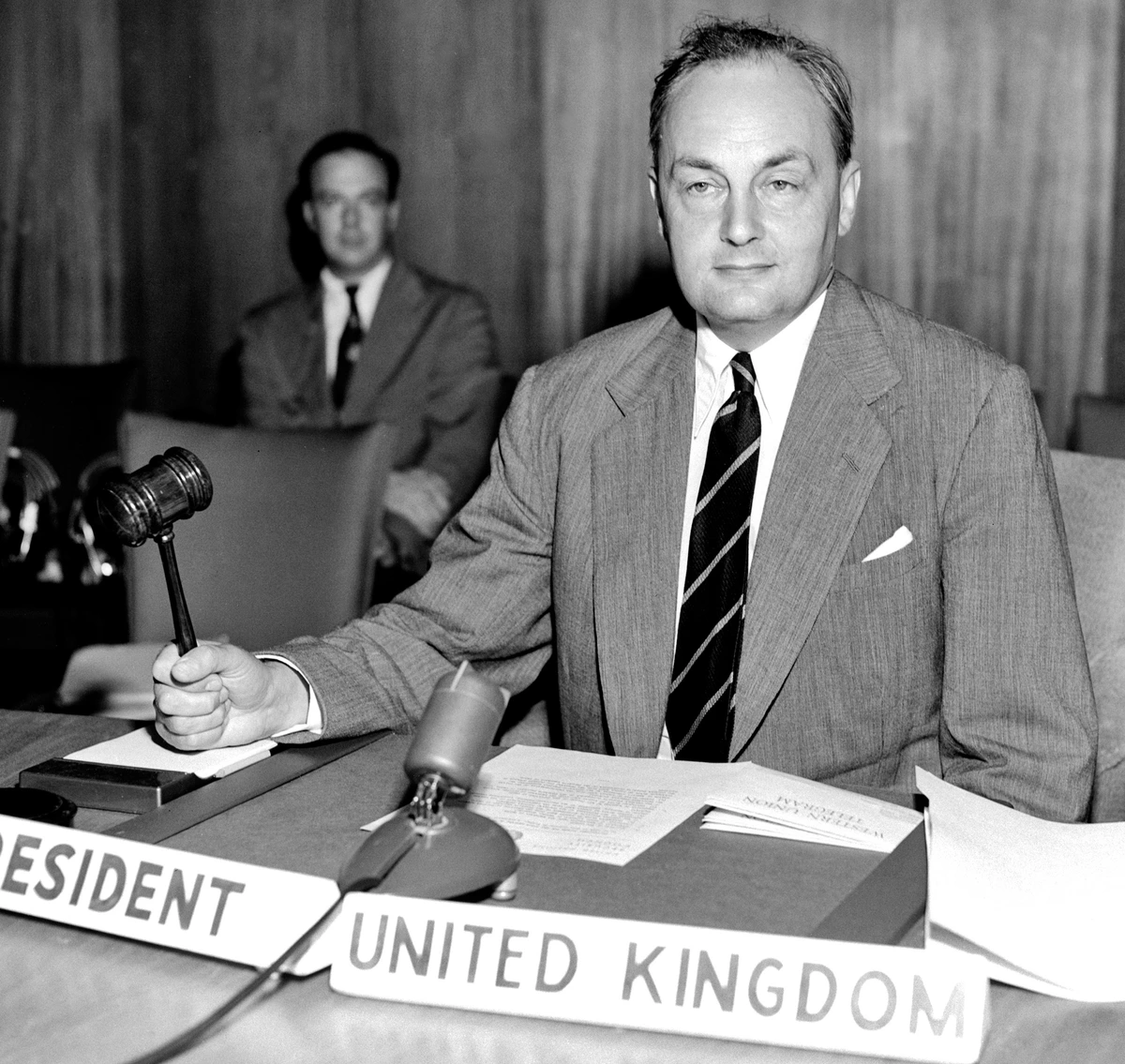
In June 1950 Jebb succeeded Cadogan as British Permanent Representative to the UN at a moment when North Korea attacked South Korea, with the Soviet Union boycotting the UN in a dispute over China’s UN representation. The Soviet boycott allowed for a Security Council decision to deploy US-led UN troops to the Korean War in defense of South Korea. Soviet Representative Yakub Malik, who was instructed to return to the UN, attempted to obstruct the UN actions but found Jebb opposite him on American television, where Jebb made a good impression as he had no nerves regarding this new medium and was quite clear and decisive in his views. Jebb’s ‘calm demeanour and icy sarcasm when dealing with Malik’s interventions were very much to the taste of his American television viewers’ (Campbell 2004: 842). Jebb presided over the Security Council four times (in September 1950, July 1951, July 1952 and May 1953). In 1950 he succeeded in inviting the People’s Republic of China by having a majority vote and no veto. He got the Americans to abstain and needed to correct Yugoslavia once, but then found the seven necessary votes. As Jebb explained later: ‘I managed to get my way by rulings as the President of the Security Council. This was my view… and this was adopted by majority vote – which, of course, was twisting the regulations, really. But I think it was useful’ (Movshon and Powell 1983-1985: 51; Jebb 1972: 238-239). He developed some disillusionment with the UN as the Soviet Union became more and more obstructive. During the ongoing disagreement about Lie’s successor in 1953, Jebb suggested Dag Hammarskjöld.
Jebb would have liked to become Permanent Under-Secretary of State but Foreign Minister Anthony Eden offered him the role of British ambassador to France, which started in April 1954. The ambassadorship coincided with a major shift in the mutual power positions of France and the UK. Jebb played significant roles in influencing the course of the negotiations in Geneva on the French war in Indochina and the relaunch of the Treaty of Brussels as Western European Union (WEU) in 1955 after the failure of the European Defence Community in the French National Assembly. He also felt the differences between the British and French governments in the collaboration over the Suez Crisis (1956). He was wary of getting the UN involved and felt a personal sense of betrayal when Eden did not include him in the planning from the outset. Jebb regarded the British relationship with starting European cooperation as too weak and saw a political need to strengthen western European cooperation against Soviet policies. Moving closer to Europe was primarily a political decision but, according to Jebb, should include direct negotiations between those who favoured a European Free Trade Association and the six countries of the European Economic Community (EEC), as well as the reorganization of key Western institutions around the WEU. Jebb and his wife raised Britain’s profile through glittering soirees at the Paris embassy, a state visit by Queen Elizabeth in 1957 and De Gaulle’s state visit to London in 1960. His ambassadorship marked a crucial period in Franco-British relations and a turning point for British foreign policy as a whole (Goldsmith 2013). Before De Gaulle returned to power Jebb met secretly with him on two occasions in 1957 and 1958. Notwithstanding Jebb’s severe criticism of De Gaulle’s foreign policy, they also had several private discussions in 1959 and 1960 (and again in 1964) to their mutual satisfaction, followed by De Gaulle’s huge farewell dinner for Jebb at the Elysée.
After his retirement in October 1960, Jebb was given a room in the Foreign Office. He became an active participant in public discussion of foreign policy at Chatham House and in the House of Lords. He chaired the Atlantic Treaty Association (1961-1964) and was governor of the Atlantic Institute. Between 1966 and 1973 he was a member of the British delegations to the Parliamentary Assemblies of the Council of Europe and the WEU. Starting in 1964 he was a member of the Liberal Party. During the 1960s he campaigned for ‘Europe’ with Roy Jenkins, who led the Labour Party’s pro-EEC faction during Britain’s entry negotiations in 1970-1971, and was a nominated member of the European Parliament (1973-1975). Jebb published several books during the 1960s, as well as his detailed memoirs in 1972, and contributed recurrently to foreign affairs debates in the House of Lords. He suffered a stroke in 1987 and died after another stroke in 1996. Although Jebb’s contributions to the creation of the UN in 1945-1946 and some later engagements are mentioned in international organization literature, the references remain fragments, in contrast to the discussion of Jebb’s career as British diplomat, such as: ‘Titan at the Foreign Office’ (Greenwood 2008), which has two extensive chapters on Jebb’s UN roles: ‘The Brain Behind the United Nations, 1942-45’ and ‘“Glamour Boy” at the United Nations, 1950-54’.