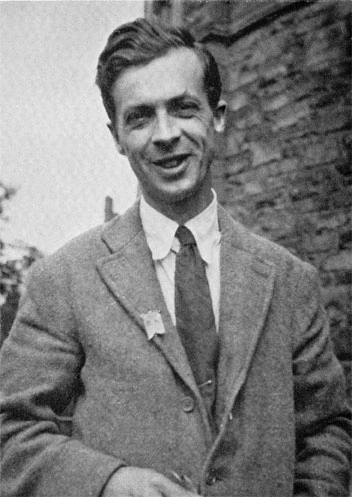
Biography
Huxley grew up in Surrey, England, and belonged to a notable family. He was the grandson of Thomas Henry Huxley, a well-known scientist and supporter of Charles Darwin. His brother Aldous became a famous author (Brave New World, 1932) and his half-brother Andrew a Nobel laureate in physiology (1963). From his childhood Huxley had been interested in nature, in particular as a bird watcher. He was educated at Eton College, which he left in 1905, and Balliol College in Oxford, where he graduated in 1909. He developed a special interest in ornithology, embryology and protozoa. He was doctor of sciences at Oxford University. After a year at the Naples Marine Biological Station, an appointment as demonstrator at Oxford University, and a stay in Germany he became assistant professor (1912-1916) at the Rice Institute in Houston, Texas, where he founded and advanced the biology department. As a result of homesickness and concern about the war effort, he returned to England and between 1916 and 1918 served as a lieutenant in the British Army’s Intelligence Corps where his role was letter censoring, first in Sussex, then in northern Italy. In 1919 he married and was appointed a fellow and lecturer (senior demonstrator) in zoology at New College of Oxford (1919-1925). Thereafter he was professor of zoology at King’s College in London (1925-1927), and Fullerian professor of physiology at the Royal Institution (1927-1931). Both in 1927 and 1929 he resigned as professor to work with G.P. and H.G. Wells on The Science of Life (three volumes on biology, published in 1931, 1934 and 1937). In 1929 and 1930 he visited East Africa and the Belgian Congo on behalf of the British Colonial Office to see the conservation work, including the creation of national parks. In Africa he fell in love with a young American woman, but returned to his wife in 1931. During that year he visited the Soviet Union, where he admired the results of large-scale economic and social planning. After his return to England he became a cofounder of the Political and Economic Planning think tank. No longer a university academic, Huxley lived by his pen and became also general supervisor of biological films for G.B. Instructional Films (1933-1936) and secretary of the Zoological Society of London (1935-1942). In 1938 he was elected a fellow of the Royal Society.
During the Second World War he was part of the ‘Brain Trust’ of the British Broadcasting Corporation. In 1941 Huxley was invited to the United States on a lecturing tour, where he generated controversy a few weeks before the attack on Pearl Harbour by saying that the US should join the war effort. When the US actually joined the war, he found it difficult to get a passage back to England and his lecture tour was extended. In 1943 the British government asked him to join the Colonial Commission on Higher Education and to survey the West African Commonwealth countries for suitable locations for the creation of universities. During his visit to West Africa in 1944 he acquired hepatitis. He also had a mental breakdown and needed a year to recover. As a member of the committee chaired by Arthur Hobhouse, he advised the post-war Labour government of Clement Attlee on nature conservation and laid the foundation for nine national parks to be created by the British government.
In 1944 Ellen Wilkinson, then parliamentary secretary and in 1945 Minister of Education, and John Maud of the newly formed Ministry of Reconstruction persuaded Huxley to become the secretary of CAME, the Conference of Allied Ministers of Education, which led to the creation of the United Nations Educational, Scientific and Cultural Organization (UNESCO). Huxley and the British biochemist Joseph Needham had reflected on the creation of this new organization and had insisted on the importance of science in its mandate. It was under their influence that the organization, initially conceived as UNECO, became UNESCO. As a result of the Wilkinson/Maud decision, the biologist Huxley replaced the classicist Alfred Zimmern, who was sick but had also failed to bridge the two cultures of arts and science or to receive the support of the British scientific establishment (Toye and Toye 2010). In his Memories (II, 1973: 14) Huxley wrote that it was not his explicit purpose to acquire this function, but the rancorous Zimmern organized a muckraking campaign against him, pretending that Huxley was a communist. Huxley, who had been appointed Executive Secretary of the UNESCO Preparatory Commission (1945-1946), demanded that Zimmern leave the commission. Eventually, on 6 December 1946, Huxley was elected the first Director-General of UNESCO, in spite of hostility from American conservative circles who regarded his political views as far too progressive. By a secret agreement, under American pressure, Huxley committed himself to resign after two years, although the mandate of the UNESCO Director-General lasts six years. Because of the American government’s hostility against him, Huxley also had to accept the appointment of an American Deputy Director-General responsible for administration. Walter Laves, who took this post, restricted Huxley’s power. Finally, when Huxley was elected, the US decided to keep the UNESCO budget restricted, in spite of prior more generous commitments.
At the top of UNESCO, Huxley drew attention to himself because of his poor administrative skills and eccentricity. In his Memories (II, 1973: 19) he recalls the numerous ‘headaches’ that the complex administration of UNESCO’s Secretariat caused him. During the meetings ‘I became bored, fed up with all the squabbles, and took refuge in doodling’ (II, 1973: 21). He deplored ‘jealousies between different divisions’ of UNESCO’s Secretariat (II, 1973: 19). According to his friend Charles Ascher, ‘Huxley looked on his directorship of UNESCO chiefly as an opportunity for usually favorable travel’ (Columbia University: Rare Books and Manuscript Library: Collection Ascher, Box 145: letter from Ascher to P. Koffler, 20 March 1975) and ‘in his view being director general of UNESCO was a minor interlude in his career as scientist and philosopher and that in retrospect it was the opportunity for travel to the remote parts of the world that excited him’ (Collection Ascher, Box 1: letter from Ascher to Juliette Huxley, 17 February 1975). In 1947 an agent of the American State Department underlined Huxley’s ‘eccentric’ character and the ‘Alice in Wonderland character atmosphere of UNESCO’ under Huxley (Diplomatic Archives of the USA, NARA, Decimal file, RG59, entry CDF 1945-49 [NND 760050, from 501.PA/3-147 to 501.PA/4-1647]: Box 2242: letter from A. Dawson to M. Zentz, 18 August 1947). However, Huxley developed original ideas and during his time at the top of UNESCO he promoted the creation of international scientific institutes devoted to the Antarctic, the arid zones, the Amazon forest, the humid zones, oceanography, and microbes. In an undated speech for former staff members on UNESCO and the environment, the French scientist and former UNESCO civil servant Michel Batisse judged these ideas ‘absolutely visionary’ for their time. Huxley was also a pioneer in the field of environment. He contributed to the creation of the International Union for Conservation of Nature (IUCN) by UNESCO in 1948. It was also under the influence of articles published by Huxley that the World Wildlife Fund (WWF) on behalf of endangered animals was created in 1961.
Huxley showed an early concern for the problems of ‘underdeveloped’ areas. In The Future of the Colonies (1944: 8, 50-64) he had declared himself favourable to the colonial system, but in favour of an evolution of the colonies towards ‘self government’. During his trip to Latin America as Director-General of UNESCO in 1947 he was shocked by the misery of the indigenous peoples and wanted UNESCO to contribute to the improvement of their conditions. He was convinced that science was the main factor of social progress and harmony between peoples. During his mandate he recruited several scientists at UNESCO, such as Joseph Needham, who became the first head of UNESCO’s Natural Sciences Section, and the French physicist Pierre Auger, who was the second head of that section. Huxley made science become the second budgetary post in UNESCO from 1948 onward. In 1949 UNESCO organized the ‘Month of the Colonies’ as a result of Huxley’s ideas. During his trip to Africa in 1944 he had been struck by the diversity and richness of traditional African art. As he deplored the disappearance of this art that was taking place, Huxley (September 1949) called the colonial powers to safeguard the traditional art of colonized peoples and promoted the idea of the creation of an Art Council for the colonies.
As a non-believer Huxley was hostile to religions, which he considered as harmful and likely to disappear. He argued that UNESCO’s philosophy should be scientific, because science is the best means to improve the well being of humanity. He wanted UNESCO to contribute to a unification of cultures in a ‘one world culture’ and to the creation of a world government (1947 Conférences: 343). He was very concerned by the issue of world population, believing that the world suffered from serious overpopulation (Memories II, 1973: 45, 59). He had also developed eugenic views in his book What Dare I Think? (1931). In The Uniqueness of Man (1941) he had written that eugenics was part of a new religion to be created. He considered that society should favour the reproduction of intellectual superior classes and prevent the reproduction of the inferior ones. He also discussed these ideas in the pamphlet UNESCO, Its Purpose and its Philosophy that he had written and that the Preparatory Commission of UNESCO published in 1946. His advisers had persuaded him not to present his eugenic ideas at the UNESCO General Conference and prevented the pamphlet from being largely spread. But Huxley continued to express his eugenic ideas, for instance in the preface of the UNESCO publication Les droits de l’esprit (Paris 1950). In some texts Huxley appears to be anti-racist. In The Uniqueness of Man (1941), for example, he wrote that the idea of race, applied to men, was a mistake and that the alleged inferiority of coloured peoples was due to socio-economic factors. He proposed to replace the term race by ethnic group. But in other texts, such as We Europeans (1935) he had written that black people were less intelligent than white ones. In 1957 Huxley coined the term ‘transhumanism’ to describe the view that man should better himself through science and technology, possibly including eugenics, but also, importantly, the improvement of the social environment. The British government condemned many of his conceptions. Because of his peculiar ideas Huxley has remained one of the most controversial Directors-General of UNESCO.
In 1946-1948 Huxley was very enthusiastic about UNESCO and many people portrayed him as brilliant and energetic. He succeeded in bringing a very passionate, optimistic, warm and friendly atmosphere to the UNESCO Secretariat. He remembered a utopian spirit: at this time UNESCO was ‘a perpetual rush – and a heat-wave’ (Memories II, 1957: 36). He and other UNESCO civil servants believed that this atmosphere then faded: ‘One fact struck me in those early days. Vital young people came to me to ask: “What can we do for UNESCO?”. Indeed, the staff as a whole was imbued with enthusiasm for this new international venture. Alas, this fine pioneer spirit lasted only a few years, and was later too often superseded by the question: “What can UNESCO do for me?”’ (Memories II, 1937: 34). During this period, which also saw the beginning of the Cold War, Huxley tried to forget the political tensions in heading UNESCO. He remained active, also after his departure as Director-General on 9 December 1948. From 1950 to 1969 he was vice-president of the International Commission for the History of the Scientific and Cultural Development of Mankind. This huge historiographic project under the aegis of UNESCO had started in 1947. Huxley contributed to it by orienting the writing along evolutionist, scientific and positivist ideas. In 1949 he challenged the unscientific ideas of the Soviet agronomist Trofim Lysenko and the political support by the Soviet leadership. In 1959 at the University of Chicago he gave a speech on the population problem, arguing that overpopulation was to lead to a ‘catastrophe’. He repeated this idea at the conference on the World Population Crisis in 1961 and argued that ‘man was going to become the cancer of the planet’, unless the United Nations and UNESCO handle this problem (New York Times, 18 May 1961). During the 1960s Huxley accomplished various missions for UNESCO in Africa to observe the conservation of wildlife. In his Memories (II, 1957: 193-200) he deplored that the reports he wrote after these missions had no effect, ‘by lack of funds – and often by lack of firm government backing’.
As Huxley analyzed in his Memories (II, 1957: 7): ‘one of my chief characteristics has been the ability, when fit, to throw myself wholeheartedly into a multiplicity of activities’. However, he was also manic-depressive and had several terribly depressive periods in his life, during which he had ‘intermittent attacks of black despair’ (Tinker 1973). His brother Trevenen, depressive as well, committed suicide at the age of 25. But in spite of this depressive tendency Julian Huxley wrote about fifty books and accomplished remarkable research in ethology, embryology, genetics, anthropology and cell biology. He was a corresponding member of the French Academy of Sciences and a foreign member of the Hungarian Academy of Sciences and the American Academy of Arts and Sciences. In 1953 he was awarded the Kalinga Prize, a Prize created by UNESCO in 1952 for exceptional skill in presenting scientific ideas to lay people, and in 1958 the Darwin Medal of the Royal Society and the Darwin-Wallace Medal of the Linnaean Society. Huxley was knighted in 1958. In 1973 he suffered a stroke and died at home in early 1975.