Biography
Although Hoffman was born in Chicago, he and his family moved to the Chicago suburb of Western Springs when he was one year old. When American Radiator transferred his father to New York City during Hoffman’s senior year he stayed behind, living in a boarding house in La Grange, Illinois and graduating from Lyons Township High School in 1907. He then moved to New York and took a summer job with American Radiator. In 1908 his parents moved back to Chicago and Hoffman enrolled in the University of Chicago, with the goal of becoming a lawyer. At the end of his freshman year his professors did not encourage him to return (Raucher 1985: 1-4). At age 18 he began working as a porter for the Chicago distributor of Halladay cars. After becoming foreman of the repair department, he began selling Studebakers, first in Chicago and then in South Bend, Indiana. In 1911 Hoffman followed his family to Los Angeles, when his father moved there after being demoted by American Radiator to district branch manager for southern California, because Hoffman believed that the local car market would be particularly lucrative for his sales career (Current Biography 1946: 264; Raucher 1985: 4). He started working that year as an auto salesman for the Studebaker Corporation in Los Angeles, rising to sales manager of the Los Angeles and Orange Counties in 1915 and becoming district manager for entire Southern California in 1917. That year he enlisted in the First World War as a private in the army. After being discharged as first lieutenant of field artillery in 1919, he returned to Studebaker. The company offered to make him manager of the New York City distributorship, its largest, and a member of their board of directors at a salary of 50,000 dollars. Hoffman told Studebaker president Albert Erskine that he wanted to own a distributorship for all of Los Angeles and Orange Counties. Erskine did not want to lose Hoffman and therefore agreed to sell the southern California distributorship for 60,000 dollars, provided he took on a partner (Raucher 1985: 6-7). Hoffman borrowed money from relatives and friends and took a calculated risk that he could earn more money working for himself. He bought out his partner within a year and was soon operating stores in six locations. His success resulted in his selection as the Vice President of Studebaker from 1925 to 1933. He became a millionaire and participated in Republican politics in Los Angeles. Studebaker was in receivership in 1934, but when it emerged in 1935 Hoffman served as its President (until 1948). He operated well with the workers’ union, because he wanted to avoid conflict and promote Studebaker as a friendly factory. While turning Studebaker into a leading independent car manufacturer, Hoffman continued to enhance his reputation as an industrial statesman. He founded the Automobile Safety Foundation and was President (1937-1941) and Chairman (1941-1948), but, given his broad interests, he also became a trustee of the University of Chicago (serving from 1937-1950) and Kenyon College (serving from 1940-1960), was elected a director of Chicago’s Federal Reserve Bank and of United Airlines and served on the United States (US) Department of Commerce’s Business Advisory Council.
Early in 1942 Hoffman and Henry Luce of Time-Life organized a financially successful United China Relief campaign to raise money for this Allied partner. In the same year he founded the Committee for Economic Development (CED), a nonprofit, nonpartisan, business-led, public policy organization known for well-researched analysis and reasoned solutions to critical issues facing the US government. Hoffman served as CED’s Chair from 1942 to 1948 and ‘preached the gospel of American enterprise with evangelical fervor’, according to Paul Douglass (1945: 27). In this capacity he did ‘a little-publicized but effective job’ figuring out how the US could convert from a war economy to a peace economy without a recession (Haussamen 1966: 15). Work with the CED gave Hoffman what amounted to ‘a five-year post-graduate course in applied economics and sociology under the nation’s top specialists’. Added to his other qualifications, this made him an obvious but reluctant – the position paid 20,000 dollars a year, while he was earning 96,000 –choice to serve as the Administrator of the European Recovery Program, more frequently referred to as the Marshall Plan (Haussamen 1966: 16-17). President Harry S Truman had initially wanted to appoint his Under Secretary of State, Dean Acheson, who apparently was willing to accept the position, but the Republican Chair of the US Senate Foreign Relations Committee Arthur Vandenberg told Truman that the Senate could not confirm Acheson (Isaacson and Thomas 1986: 441). A big part of Hoffman’s job was selling the Economic Cooperation Administration (ECA) to the US Congress and the American people (Raucher 1985: 67) as well as dealing with the logistics and getting the money, rather than designing the programs. Within six months of starting this position in April 1948, Hoffman had dispatched missions to 16 of the 19 states and territories that were scheduled to receive Marshall Aid and had built up an efficient staff of more than 3,000. He succeeded in attracting qualified personnel and kept persuading Europeans to cooperate and work with the ECA in order to advance reconstruction. He encouraged the creation of the European Payment Union, which came into being in September 1950, as a multilateral system that replaced bilateral payment agreements. By the time he ended his term of office, in October 1950, he had dispensed 18 billion dollars in US aid toward rebuilding Europe from the devastation of the Second World War. This had been accomplished in spite of Hoffman’s inability to stop the Truman administration’s trend of emphasizing rearmament in the foreign aid program. Some suggest that he began exploring positions outside of government because of this re-emphasis on military preparedness (Raucher 1985: 77). In December 1949 Hoffman was offered the Presidency of the newly formed Ford Foundation, a position he held from 1950 to 1953. Still in its formative state, the Ford Foundation at that time consisted of money that had to be spent quickly in order to avoid the possibility of tax complications. During Hoffman’s presidency the Foundation began a commitment to public media, launched the first fellowship programs and opened the first international office in Delhi, India. Also during that time, for the 1952 Presidential election campaign Hoffman served as the chief fundraiser for Republican candidate Dwight D. Eisenhower (Murphy 2006: 62). Upon his resignation from the Ford Foundation Hoffman accepted the position of the Chairman of the Board of the Fund for the Republic, a legally separate entity, but one set up by the Ford Foundation. This allowed him to continue living in California, whereas the Foundation’s impending headquarters shift to New York City would have required that he move. The Fund’s focus was civil liberties and civil rights, a particularly contentious topic during the McCarthy period in the US. Hoffman also began a three-year stint as Chair of the Board of Studebaker, at a time when Studebaker was a failing company. The company had lost its competitive edge, in part because of its high labor costs relative to other more automated auto companies. Hoffman thought the company’s future rested in a merger with Packard, an arrangement that was completed in October 1954. However, the company’s fortunes did not improve and he resigned.
In July 1956 the Senate confirmed President Eisenhower’s nomination of Hoffman as a delegate to the United Nations (UN). Opposition to his appointment had come chiefly from Republicans, including Senator Joseph McCarthy who said that Hoffman had made statements, which ‘could only be made by a fool or a Communist’ (as quoted in Haussamen 1966: 34). As a member of the US delegation, Hoffman quickly turned his attention to the economic needs of the world’s poorest states and territories. He played an instrumental role in the formation of the United Nations Special Fund in 1958 as a complement to EPTA (Expanded Program of Technical Assistance) and a successor to SUNFED (Special United Nations Fund for Economic Development), which had been strongly opposed by the US because recipient countries were to determine funding allocations. While both the Special Fund and SUNFED sought to increase financial assistance to economically less-developed countries, who determined the amount and distribution of those funds varied considerably between the two institutions. At the same time that Hoffman orchestrated the compromise establishment of the Special Fund, he also worked with Republicans and the World Bank for the organization to establish a soft loan arm, namely the International Development Association (Murphy 2006: 57-63). The Special Fund began operations on 1 January 1959. The US Congress appropriated 11 million dollars for the organization, on the condition that other UN members provide 15 million dollars. UN Secretary-General Dag Hammarskjöld appointed Hoffman as the Special Fund’s Managing Director. Hoffman declared the position to be the ‘most fascinating job I have had in my life because we have to do so much with so little’ (quoted in Haussamen 1966: 37). The Fund, which was a semi-autonomous agency of the UN, was not an operating agency, but rather raised seed money and then farmed out the actual work in the field to the UN or one of the specialized agencies. The Fund’s focus was on pre-investment assistance, namely technical aid designed to help low-income states acquire needed growth capital on a sound basis and then to use that capital to advance economic and social progress. Hoffman insisted that assistance by the Fund be matched by a substantial contribution from the recipient state. Although this was not always popular with recipient governments, the most vicious attack on Hoffman came from the US, which resented the Fund’s approval of an agricultural project in Fidel Castro’s Cuba. Hoffman set his goal as a 25 per cent increase in per capita income in economically less-developed states in the 1960s, the period President John F. Kennedy was the first to call the UN Development Decade. When Hoffman moved to New York in 1959, his wife Dorothy Brown had stayed behind in their home in California, owing to an apparent heart conditions that had restricted her since 1952 (Raucher 1966: 141). After her death in 1961 he married Anna Rosenberg one year later. She was an old friend, business associate and prominent Democrat (Raucher 1999: 248).
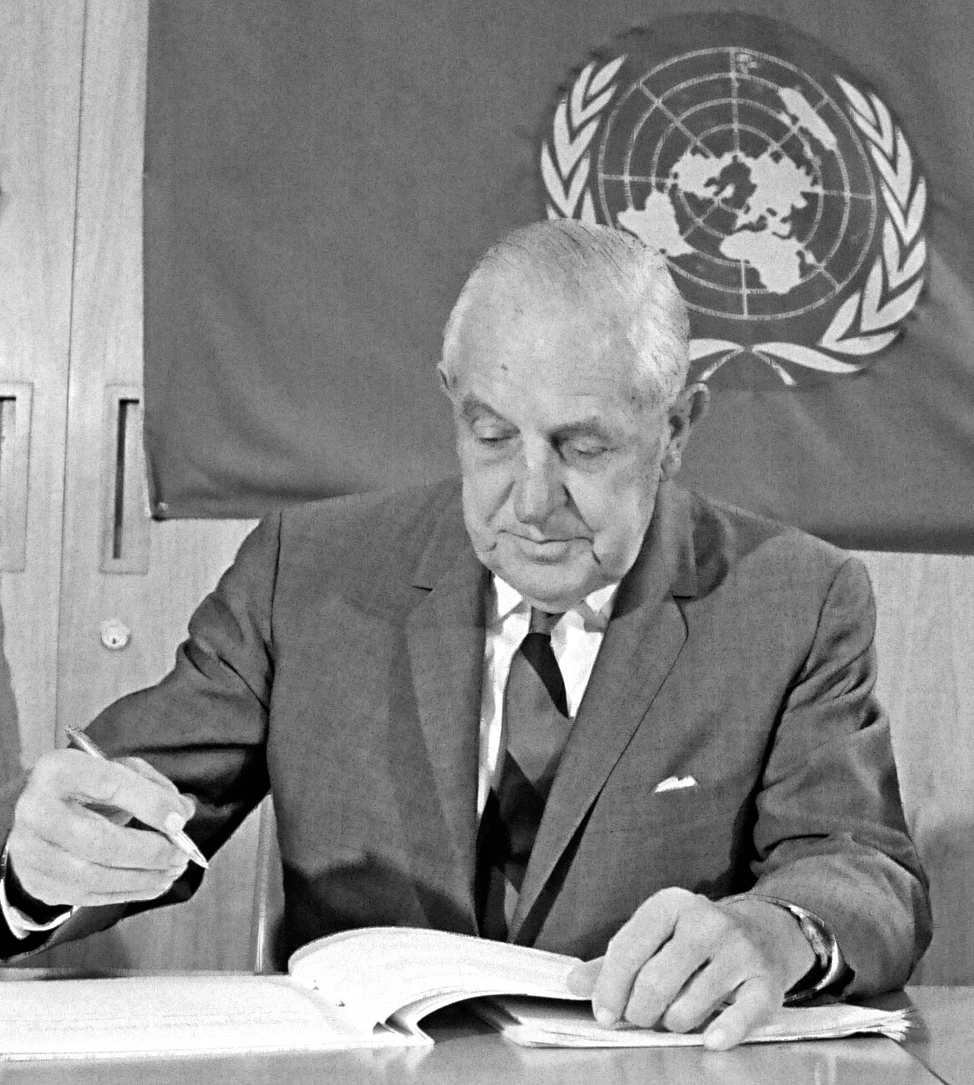
Discussions about merging EPTA and the Special Fund began in 1962. The UN’s specialized agencies opposed the merger because they had a vested interest in decentralization. The Soviet Union also opposed the merger, fearing the combined agency would be dominated by the US. In 1964, however, the UN Economic and Social Council and Secretary-General U Thant endorsed the merger. The UN General Assembly passed an enabling resolution in November 1965 and the merged organization, the United Nations Development Programme (UNDP), began officially on 1 January 1966. Hoffman, almost 75 years old at the time, became UNDP’s Administrator (reviving his Marshall Plan title). Craig Murphy (2006: 67) explains Hoffman’s appointment as Administrator by the fact that the US had been by far the major financial backer of both EPTA and the Special Fund. Murphy (2007: 266) calls Hoffman’s close connections to the private sector the exception and not the rule in the UN at that time. Hoffman concentrated on soliciting contributions and on top-level negotiations. He left the management of operations, including evaluations of all projects and project proposals to his chief assistants. David Owen, who had been in charge of EPTA, was appointed as Co-Administrator. He built the Programme from scratch and created the network of UNDP field Resident Representatives. However, Owen really had little specific authority after the two programs were fully merged, a process that took three years. One new area of activity for the UNDP was population control, a field that earlier Hoffman, like President Eisenhower, had believed was not a proper government activity or responsibility. In spite of some frictions that the UNDP had with various other UN bodies in the development field and continued dissatisfaction of the governments of economically less-developed states with donor states ability to decide who received development funds and for what, Hoffman himself continued to be respected and he was reappointed by the UN General Assembly in December 1968. Over time, criticisms of Hoffman arose, even amongst UNDP supporters. There were some misgivings about UNDP’s procedures under Hoffman’s management, as questions were raised regarding whether there was sufficient monitoring and the speed with which projects were being implemented. Hoffman himself acknowledged that the First Development Decade had not accomplished enough. In anticipation of the second Development Decade for the 1970s, Hoffman sought to respond to these concerns. But he also wanted to underscore how much the UNDP had accomplished. This included providing funds for the ridding of North Africa and parts of Asia of their locust plagues by means of cross-border air patrol and insecticide raids as well as founding the United Nations Fund for Population Activities and the United Nations Volunteers, both offshoots of and reporting to the UNDP. Accordingly, in July 1968 Hoffman hired Sir Robert Jackson to serve as the Commissioner for Capacity, hoping that the study his commission would produce would endorse Hoffman’s views and call for both reform and expansion of UNDP. At the end of September 1969 Jackson submitted his two-volume report A Study of the Capacity of the United Nations Development System. Jackson concentrated on what was wrong with the UN’s development efforts, placing most of the blame on a top-heavy and misdirected administration. Hoffman felt the report was unfair, inaccurate and harmful. Publicly, however, he praised Jackson’s overall effort and declared that UNDP would act on some of the recommendations, while strongly denying that UNDP had reached its capacity. In spite of the report, Hoffman’s personal reputation was largely unsullied and he was still deemed valuable to the organization for soliciting contributions. Many donors expected Hoffman to be reappointed, at least for another year, but in February 1971 the UN Secretariat announced that at year’s end both UN Secretary-General U Thant and Hoffman would retire. When he retired, Fortune observed, ‘More than any single individual Paul G. Hoffman deserves to be regarded as the father of foreign aid’ (quoted in Raucher 1985: 133).
Hoffman received countless awards during his lifetime, with the most prestigious coming in 1973 when President Richard M. Nixon awarded Hoffman the Medal of Freedom, the US’s highest civilian award, for his Marshall Plan role. He also received many honorary degrees from US universities, including Harvard, Yale, Columbia and the University of California. Hoffman passed away on 6 October 1974 at the age of 83. He had been in failing health for two years after having suffered a stroke and a heart attack.