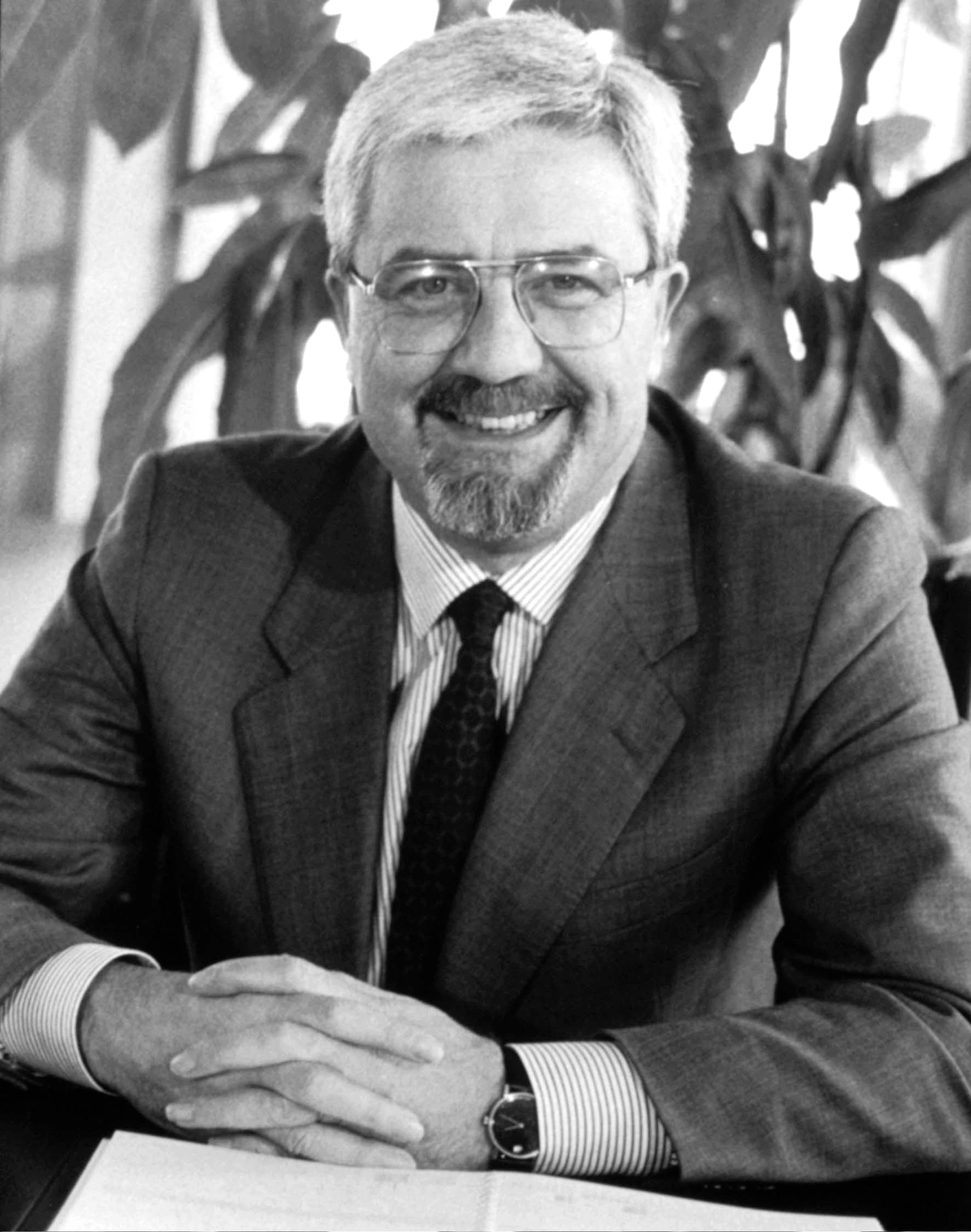
Biography
Born in the French-speaking Walloon region, Hansenne came from a Catholic and modest socio-economic background. His father was a blue-collar worker in the metalworking industry, while his mother started as a secretary but stopped working once she was married. Hansenne went to primary school in his village and Brussels and to secondary school in Seraing and Liège in a private institution. He studied law at the state University of Liège, financing his studies through scholarships and loans, and obtained a doctorate in law in 1962. He remained at the University of Liège, working as a researcher from 1962 to 1972, obtaining an additional bachelor degree (‘licence’) in economics and finance in 1965. He became politically engaged, first as a member of the Young Economic Chamber of Liège, an association oriented towards regional and urban development with an environmental orientation, then as a Christian Social Party sympathizer and an activist in his university, especially during the 1968 student demonstrations. He was inspired by French politicians such as Pierre Mendès France and Jacques Chaban Delmas who embodied the kind of technocratic ethic he favoured with regard to the functioning of universities. Between 1972 and 1974 he worked as an adviser for the Minister of Science Policy, Charles Hanin. In 1974 he was elected as a member of the Belgian Parliament and also served as the political secretary of the Christian Social Party until 1979. In 1978 he married Gabrielle van Landschoot, who as a housewife had no professional career. In April 1979 Hansenne became Minister of French Culture. As such he served until December 1981, when he became Minister of Employment and Labour under Prime Minister Wilfried Martens in a Socialist and Christian-Democratic coalition. In this capacity he represented the Belgian government at the International Labour Conference, the general assembly of the International Labour Organization (ILO). As a minister he published a programmatic book L’emploi: les scénarios du possible (Paris 1985, Employment: Scenarios of What is Possible), in which he analysed the transformations of industrial relations in the Belgian context and made proposals to solve the problem of unemployment. In May 1988 he became Minister of Civil Service in a Liberal and Christian-Democratic coalition, again led by Martens.
On 13 February 1989 Hansenne was elected as Director-General of the ILO. On 27 February he started work and on 3 March he read out the Declaration of Loyalty as required by the staff regulations. His arrival at the ILO represents more of a combination of circumstances than a well-planned career choice, as he never envisaged becoming ILO Director-General. Michel Wallin, formerly of the Belgian Ministry of Labour and Social Welfare and an ILO civil servant for more than twenty years, notably as chief of the Labour Administration Branch, approached him and encouraged him to pursue the position. After his ten years in the Belgian government Hansenne regarded the ILO as a potentially interesting professional turn. Having secured the support of the Belgian social partners and other European Labour Ministers, he ran as a candidate for Director-General and won over the Tunisian candidate Mohammed Ennaceur. As Hansenne acknowledges in his autobiography, he knew little about the organization when he was elected. Even as a Belgian Government representative to the International Labour Conference he had not been deeply involved in ILO activities. He felt more concerned with economic growth and employment issues rather than labour standards. Moreover, he was a newcomer in the worlds of the ILO and the United Nations (UN), in contrast to most of his predecessors, who had been ILO civil servants before they served as Director-General. The fall of the Berlin Wall in November 1989 constituted a major change in Hansenne’s early mandate, as he became the first Director-General to serve after the end of the Cold War. It convinced him of the necessity to reform the institution by putting the ILO at the forefront of the debates on democratization and globalization. However, as he acknowledged, his first term was essentially dedicated to building his knowledge of the organization and analysing the geopolitical context in which it acted. In several annual reports (1990-1992), Hansenne notably insisted on the ILO’s obligation to assist these countries in their transition to market economies. It was really during his second term that the ILO started to engage in earnest in the transformation process in Central and Eastern Europe. Some constituents interpreted this position as a sign of inaction, which created tensions, especially with the employers who, although supporting his election, reproached him for a lack of management strategy (Oechslin 2001).
In contrast with his first term in office, which ended in 1993, Hansenne’s second term (which he already decided to be his last) was marked by significant reforms. In his 1994 annual report Defending Values, Promoting Change, Social Justice in a Global Economy: An ILO Agenda (Geneva 1995) he elaborated a two-tier strategy with regard to the International Labour Office and the entire organization, which was celebrating its 75th anniversary in 1994. Later he compared the secretariat to a dysfunctional clock: ‘the International Labour Office is as regular as clockwork but I’m not sure it gives us the right time’ (Hansenne 1999: 21). He regarded the secretariat the first target of a set of reforms, because he was sceptical about how it functioned. The secretariat lacked effectiveness due to overlapping competences as well as hierarchy and rivalry between some departments, notably between those of standards and technical cooperation. He also denoted an excess of civil servants at the top of the organization and too much connivance between some ILO member states and some civil servants. In this regard he shared the criticisms often addressed to highly bureaucratic structures by the supporters of the so-called new public management, who encourage a market-oriented management of the public sector. However, he also had a clear-cut view on the responsibilities of international civil servants, who he believed should be experts in their areas of competence as well as strong believers in their organization’s values. As a result, his two leading concepts for reforming the International Labour Office were decentralization and budgetary rigour. Although decentralization had been a recurrent theme since the 1960s, Hansenne dramatically encouraged this move by transforming it into what he labelled the policy of an ‘active partnership’ between the Office and the ILO member states, especially towards Central and Eastern Europe where an increased number of resources were affected. He engaged in the transformation, first, by implementing a policy of mobility among ILO staff and, second, by increasing the resources of the organization’s regional offices. The policy of mobility (which still applies in 2012) requires that every senior officer, before being eligible for a leading managing position, must spend several years at a (sub-)regional office. This policy was necessary to make the regions and the ILO headquarters in Geneva cooperate better. He believed the ILO headquarters tended to be too disconnected from the realities of the member states, not bringing them the pragmatic and practicable solutions thereby discrediting the ILO, especially in the eyes of developing and emerging countries. With regard to the ILO’s budget Hansenne adopted the zero growth policy line, as he had to deal with successive financial crises due to governmental budgetary cuts and delays in the payment of their contributions, in particular by the United States. Notwithstanding the criticisms of the employers’ group, the organization followed his policy. In 1995 the Governing Body agreed to a 22 million dollar cut for the 1996-1997 budget, made possible by suppressing operating and administrative activities at the Geneva headquarters, reducing and decentralizing the number of publications and shortening the three-week annual Conference. Hansenne argued in the straightforwardness he was known for: ‘It’s possible to save one minute each speech just by stopping people congratulating each other at the beginning of their speech’ (Naughton 1995). In contrast, the ILO-linked International Institute for Labour Studies, set up in 1960 at ILO headquarters, fell short of being suppressed. In addition to budgetary uncertainty Hansenne (1999) had strong doubts about the usefulness of this research department that he thought neither academic nor practical enough. He suggested its suppression but then decided to maintain it, given the strong support of both the employers and workers’ groups for the Institute (264th Governing Body Session VI/2).
With regard to the ILO’s general orientation Hansenne was the main architect of its progressive focus on fundamental labour standards. In his 1992 annual report Democratisation and the ILO (Geneva 1992: 27) he emphasized fundamental human and labour rights and the necessity to better link the allocation of technical cooperation with the achievement of these rights. Technical cooperation funds distributed by the ILO should ‘bear the imprint of the ILO’. This was notably the spirit of the ILO’s International Programme on the Elimination of Child Labour (IPEC), set up in 1992, which was a successful illustration of both technical and normative international cooperation. In his 1994 annual report Hansenne addressed the question of ‘social clauses’ by firmly opposing their use in free trade agreements. Social clauses, he argued, were too severe for developing countries which regarded them as protectionist measures. On this topic, he was in line with the General Agreement on Tariffs and Trade (GATT) Director-General Arthur Dunkel, who argued that social clauses would hinder free trade and lead to protectionism. Dunkel warned against linking social conditions to imports and argued that ILO conventions and recommendations should not play a role in trade negotiations, a position also held by the ILO’s employers group. Yet, although he opposed social clauses, Hansenne insisted that respect of fundamental rights should derive from ILO membership. Like his predecessors he was convinced that the ILO should be the social pillar of a better-integrated and coordinated multilateral system. Upon his proposition an ILO working party on the social dimension of the liberalization of trade was created to address those issues and first met in November 1995. Hansenne also suggested that the GATT, which in 1995 became the World Trade Organization (WTO), and the ILO undertake concerted action in this area. In December 1996 the trade and finance ministers gathered in Singapore at the occasion of the first WTO ministerial conference. They made a ministerial declaration rejecting the use of labour standards for protectionist purposes and set up a clear-cut frontier between commercial and social issues. Commercial issues were to remain under the WTO’s umbrella, while social considerations fell under the ILO’s responsibilities. Although the declaration was a dismissal of Hansenne’s attempt to link trade and social issues through better cooperation between the two organizations, he also saw it as an opportunity for the ILO to reassess its pivotal role in the field of social and labour rights.
However, the debate over social clauses paralysed ILO activities until 1996 and divided the constituents for an even longer period of time. It had direct repercussions on Hansenne’s positioning towards other UN agencies. At the WTO Singapore summit in 1996 he was declared ‘persona non grata’, which felt like a marginalization of his organization. In order to compensate for this he did not try to engage in a sustainable dialogue with the other economic institutions, with the exception of the International Monetary Fund (IMF), with which he initiated an informal dialogue based on his friendship with IMF Managing Director Michel Camdessus. At the same time negotiations for the adoption of a declaration on fundamental principles and rights at work started at the ILO. In order to secure the support of all groups, Hansenne decided to step back and leave room for manoeuvres to his legal adviser Francis Maupain and Deputy Director-General Kari Tapiola. Adopted in June 1998, the ILO Declaration on Fundamental Principles and Rights at Work states that every ILO member state should abide by, report on and promote a set of eight core conventions even if they have not ratified the core conventions. The 1998 Declaration grew from Hansenne’s conviction that these principles and rights were the real ‘added value’ of the ILO in a globalized economy. The Declaration also resulted in the acceptation and the more systematic recourse to ‘softer’ means of regulation, such as declarations and recommendations rather than conventions. ‘Why set up an international convention where a less constraining recommendation could be sufficient?’, Hansenne (1999: 88) asked in his autobiography. The very spirit of the Declaration remained controversial, as some considered it a political and legal revolution that set up a common ground for all ILO member states, while others considered it a downgrading of the ILO’s normative ambitions. In practice the Declaration is one of the ILO instruments quoted by other international organizations when dealing with social issues.
In addition to these major reforms Hansenne tried to pursue the debate on the regulation of multinational enterprises. This had started in the 1970s but was put aside after the adoption of the 1976 Tripartite Declaration Concerning Multinational Organizations and Social Policy. Hansenne also attempted to initiate a debate on what he called the ‘modernization’ of tripartism. During his second term, in order to counter the proliferation of private corporate social responsibility initiatives, he came up with the idea of setting up a social label to be delivered by the ILO. By this means he aimed to reassess the ILO influence in this field and to fill the quasi-normative void in which transnational corporations had evolved since the 1970s, contrasting the added value of such an ILO tool with the few unclear international codes of conduct for transnational corporations which had been set up by other organizations such as the UNCTAD Draft Code of Conduct on Transnational Corporations or the ISO (International Standardization Organization) 9000 and 14000 standards (ILO 1998: §22 and 24). However, his proposal, made by the end of his tenure, was not met with great enthusiasm, especially by the employers group, which rejected the idea of a special treatment for transnational corporations, and by states who feared being bypassed by the ILO. With regard to tripartism Hansenne advocated a wider social dialogue. He was in favour of opening the ILO to civil society organizations engaged in the defence of human rights and used the question of child labour as an example of the necessary collaboration between trade unions and other civil society actors. Although this did not imply a constitutional transformation of the ILO’s tripartite system, a large majority of the constituents strongly opposed the opening up of the tripartite dialogue to other actors.
As ILO Director-General Hansenne was criticized for his relative absence from the international front. He was very unpopular among the employers group, which opposed him during his entire period in office. With regard to his management of the International Labour Office, his relationship with the ILO staff union was quite difficult, particularly given the scope of and speed with which he implemented both his budgetary cuts and ‘active partnership’ agenda. As a leader he had a clear political line during his second term, but he lacked the capacity to establish broad consensus among ILO constituents, partly due to the hostility of the employers’ group, but also among the developing countries during and after the social clauses debate. As a manager he attempted to introduce new working methods such as the organization of public meetings with the heads of the various departments in order to establish the budget. He was not afraid to delegate responsibilities to his close advisers, even in crucial moments, like during the passage of the 1998 Declaration. He will best be remembered as a technocratic leader of the ILO.
Hansenne retired from the ILO on 3 March 1999, at the end of his second term. He left with the mixed feeling of having achieved some important reforms but also of unfinished business due to his first ‘lost’ term: ‘I didn’t have a project and I was blamed for that very quickly. Some people considered I wasn’t doing anything, which to a certain extent was true. Why? Because I was accumulating knowledge and experience. At one point I knew exactly where I was going and from that moment on nobody could stop me’ (Louis 2012). In the autobiographical essay he published that year, he wrote: ‘I was convinced to leave to my successor a well ordered patrimony that his talent and relations would allow him to promote well beyond what I had been capable to do’ (Hansenne 1999: 135). In June 1999 he was elected a Member of the European Parliament, serving until July 2004 for Belgium and the European People’s Party, the Christian Democratic fraction. His tenure as a European deputy, where he mainly dealt with labour, external trade and WTO-related issues, was quite disconnected from his previous function as ILO Director-General. His contacts with the ILO remained minimal and limited to a small circle of former colleagues. Since then he has dedicated his life to several non-governmental organizations, local church activities and his family.
Typo corrected in version 5 December 2012: he retired in 1999, not 1998 (p. 5) and dates of time in office specified; ILO explained in heading