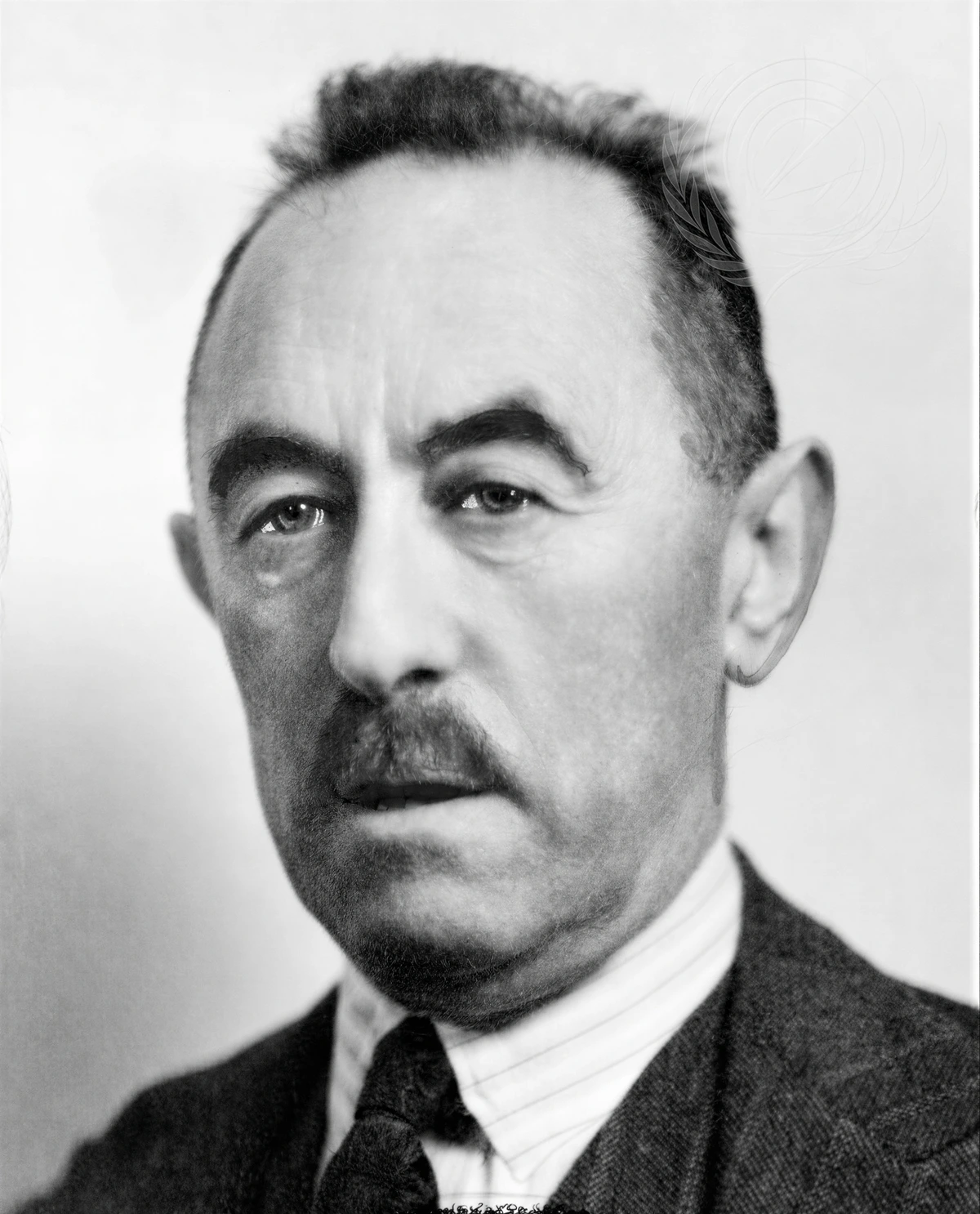
Biography
Gutt’s father moved from the Bohemian city Neuzedlish, then part of the Austrian Hungarian Empire, to Brussels in 1877, where he became director of the journal Le Nord, which Russia financed to restore the country’s image after the Crimean War. He became a Belgian citizen in 1886. Gutt’s mother was from Alsace (French until 1871, when the German Empire annexed it). Although of Jewish descent, both parents were Protestants (while Gutt turned to atheism). After his father’s death in 1891, Gutt was left with his mother and half-sister (from his father’s first marriage). He attended high school at the Royal Athenaeum in Ixelles and managed to pursue his studies through scholarships. He graduated from the Free University of Brussels with a master’s degree in political and social sciences (1904) and a PhD degree in law (1906). In 1906 he married the daughter of a liberal political figure in Brussels, who introduced him to members of the press. Gutt began his professional career as a barrister and journalist and, in 1911, became the editor of the official reports on parliamentary debates for the Belgian Parliament. When the First World War broke out in 1914, he volunteered for the Belgian armed forces. A few weeks later he joined the French army’s Spahi regiment and fought at Ypres (April-May 1915). He then moved to Le Havre in France, where the Belgian government-in-exile was established. In October he was sent to London, where he met Georges Theunis, Head of the Belgian War Material Purchasing Commission, with whom he would develop a lasting friendship.
In August 1919 Theunis offered Gutt the position of General Secretary of the Belgian delegation to the Reparations Commission created by the Treaty of Versailles. This role became central to inter-Allied discussions about the reparations imposed on Germany. In 1921, as Prime Minister and Minister of Finance Theunis appointed Gutt as his chief of staff and, in 1924, sent him to Paris to serve as Belgium’s Deputy Delegate to the Reparations Commission. There Gutt contributed to discussions leading to the approval of the so-called Dawes Plan, which temporarily solved the reparations issue. In 1926 Belgian businessman Emile Francqui became Minister without portfolio tasked with resolving Belgium’s financial situation. He invited Gutt, with whom he had worked in Paris, to serve as adviser and sent him to London to negotiate a loan with British and American banks to stabilize the Belgian currency. Following the completion of this mission and the government’s resignation, Gutt left politics to join the boards of several important Belgian companies operating in the promising non-ferrous metals sector. In 1929 he was appointed, alongside Francqui, to the Committee of Experts for the renegotiation of the Dawes Plan, followed by the 1931 Hoover Moratorium on German reparations. In 1934 King Leopold III asked him to serve as Minister of Finance in a special cabinet meant to address the Great Depression’s impact on the Belgian economy. This government, often disparagingly referred to as ‘government of bankers’, marked the last significant attempt by prominent Belgian businessmen to steer the Belgian economy. Gutt, who resumed his private sector activities in 1935, was invited to return as Minister of Finance in 1939, when Belgium faced another political crisis coupled with financial difficulties. As the threat of war loomed, Gutt warned his fellow ministers of the need to prepare for conflict and proposed measures similar to those suggested in Britain by economist John Maynard Keynes.
Due to the rapid German military offensive on Belgium, Gutt and the other ministers fled to France in May 1940 while the King chose to remain in occupied Belgium. Over the summer Gutt decided to move to London to ensure that Belgium and its resource-rich colony, the Belgian Congo, continued to support the war effort alongside the British. Three ministers joined him and formed the core of the London-based government-in-exile. Gutt was responsible for designing Belgium’s immediate postwar monetary policy, which involved limited devaluation and addressing the financial legacy of the occupation. These monetary restructuring principles, embodied in the ‘Gutt operation’ of early spring 1945, helped curb postwar inflationary pressures. Since 1940 Gutt had actively participated in inter-Allied discussions regarding the postwar monetary and economic order in the committee led by Frederick Leith-Ross, where Gutt advocated for orthodox financial policies based on the gold standard, contrasting with the new ideas advanced by Keynes. When these discussions shifted to Washington DC in 1943 and 1944, Gutt supported Harry Dexter White’s plan for a stabilization fund and international bank, instead of Keynes’ proposal for an international clearing union. Gutt believed that Keynes’ plan had a significant weakness due to its unlimited liability. However, his interwar experience in negotiating international monetary solutions led him to favor a gradual regional approach that would involve countries following the same postwar anti-inflation policies. This approach led to the negotiation of the Benelux monetary and customs union with the Dutch and Luxembourg governments during the war. The agreement was intended to later include Britain and France. However, Britain refused, prioritizing discussions on the postwar economic order with the Americans, while an agreement with France proved impossible due to the ongoing dispute over the Belgian gold reserves, seized by France in early summer 1940, and the uncertainties surrounding French postwar financial and monetary policy. When the 44 Allied and neutral countries met in Bretton Woods (1944) to discuss the establishment of the International Monetary Fund (IMF) and the International Bank for Reconstruction and Development (IBRD), Gutt was appointed Chair of the Belgian delegation, which included Theunis and other Belgian diplomats and businessmen. During the negotiations Gutt mainly addressed discussions related to the future IMF, believing that Belgium had achieved its primary objectives by ensuring that the quota of the Benelux countries would secure them one Executive Director and reduce the future IBRD’s lending capacity to 100 instead of 300 percent of its capital.
After the war Gutt resigned from his ministerial position alongside the rest of the Belgian government. The new Minister of Finance sent him to negotiate the end of the Lend-Lease Act with the United States (US). Due to the Belgian Congo’s contributions to the war effort Belgium emerged as a creditor of the US in 1944, unlike the other Allied countries. Gutt was part of the Belgian delegation to the 1946 inaugural meeting of IMF and IBRD Governors. During discussions leading to the meeting in Savannah, Georgia, Gutt appeared to share Keynes’ view that IMF Executive Directors should not be permanently based in Washington DC. However, the key point of discussion on the IMF at Savannah was the appointment of the first Managing Director. White was the natural choice, but he unexpectedly withdrew his application. Various options were considered, including Bank of Canada Governor Graham Towers, who declined because he opposed Washington DC as the IMF’s headquarters. Another option was Dutch Minister of Finance Johan Beyen, who the British rejected. Ultimately, attention turned to Gutt who received support from the British, Canadian, Dutch and French delegations, while the US delegation did not object. Gutt accepted after discussions with Keynes.
As Managing Director, starting 6 May 1946, Gutt faced the challenge of making the new organization effective, while also dealing with the gradual erosion of the postwar consensus and growing transformation of the international order amid the nascent Cold War. At a macro level Gutt confronted the challenges of Europe’s postwar reconstruction during a time of changing US administration, as President Harry Truman had replaced the late Franklin Roosevelt. Gutt had to deal with four major issues that would have a significant impact on the IMF’s future: the scarcity clause to US dollars, the determination of exchange rates of the members’ currencies (particularly for France), the relationship between IMF and the 1948 European Recovery (or Marshall) Plan and the sterling devaluation of 1949. Gutt’s most pressing issue was whether the IMF’s scarce currency clause (an original rule in case of the stocks of a particular currency might rule out) should be applied to the US dollar. The dollar shortage resulted not only from the massive imports of US products into Europe but also from US monetary policies. The latter led to increasing inflation that exacerbated the dollar scarcity, as an internal IMF report highlighted. The political question was whether the US would agree to make necessary adjustments as dictated by the very system it had helped establish. The Executive Board ultimately concluded that the dollar shortage stemmed from scarcity of production rather than scarcity of the currency itself and decided not to activate the scarcity clause vis-à-vis the US.
Gutt’s second political issue involved determining the par values, or exchange rates, for the currencies of IMF member countries. The IMF’s view was that parities should be fixed at a level that would allow countries, especially European ones, to be able to export while being aware that parities could be subsequently adjusted in cooperation with the IMF. Gutt explained such a view in an article published in 1948. Challenges arose, particularly regarding the French currency following the French plans to devalue the franc. This devaluation was part of a national strategy aimed at restoring France’s public finances and addressing the dollar shortage by promoting French exports while discouraging US imports. Gutt was personally involved in discussions of this plan with the French authorities. While he supported the idea of devaluation, he objected to the French proposal to restore a currency market limited to a select few currencies. This risked creating multiple exchange rates, which was prohibited under IMF rules. The French plan also faced opposition from the US Treasury, which feared it would intensify pressure on the British to devalue their own currency. In a final attempt to resolve the crisis, Gutt proposed a higher devaluation of the French franc, coupled with the restoration of a free currency market limited to certain goods. The French rejected his suggestion. Consequently, the Executive Board refused to recognize the new rate for the French franc, denying France access to IMF resources amounting to approximately 135 million dollars annually. The severity of the IMF’s decisions drew criticism from Europeans, including Gutt’s close friend, Belgian Executive Director Ernest de Selliers de Moranville, who believed it extended the IMF’s powers from merely ensuring monetary stability to deciding on exchange rates. Gutt justified the IMF decisions on three grounds: the need to comply with the Bretton Woods agreements, the necessity of asserting IMF credibility, particularly in the context of discussions regarding its participation in the Marshall Plan, and the need to protect the value of the sterling. The IMF decision’s net effect was to reinforce French hostility towards the Bretton Woods institutions and led the French to believe even more in the need to find a European solution to their monetary and financial problems without IMF involvement.
The third issue concerned the relations between IMF and Marshall Plan. If the Plan was not questioning the objectives of the Bretton Woods system for stable and convertible currencies in Europe, it subordinated these objectives to the fulfillment of some foreign policy objectives linked with the nascent Cold War. The practical question the IMF had to deal with was whether countries benefiting from the Marshall Plan would be able to draw on IMF resources. In April 1948 the Executive Directors decided that purchases of US dollars from the IMF would be allowed for these countries, but only in exceptional and unforeseen circumstances. This decision laid the ground for the position that there was no automatic right to draw on IMF resources (which was to be further discussed in the context of the conditionality of IMF support to its members). The other aspect of the issue was institutional cooperation between IMF and Marshall Plan. Although the US Executive Director considered that such cooperation should remain informal and that the IMF should not interfere with the Plan, Gutt managed to establish close cooperation with Averell Harriman and Paul Hofmann, the Plan’s officials in Paris. But when it came to discussion on payment and trade liberalization, the IMF found itself increasingly marginalized from these discussions. In September 1949 discussions over the establishment of a European Payment Union (EPU) were held but the IMF was excluded. Instead, the Bank for International Settlement was asked to play the role of its clearing agent. If the IMF’s absence was, in Gutt’s own words, the result of ‘genuine misunderstanding’ (IMF Archives, Executive Board meeting, 12 November 1948), it had far-reaching consequences. It led to the IMF being excluded from the discussions on convertibility and payment liberalization in Europe. IMF participation in the EPU would have been difficult for several reasons. It included countries such as Austria, France and Greece that were banned from using IMF resources. The French, who resented the IMF decision related to their exchange rate, objected IMF involvement strongly. The British were not keen either because IMF participation in the EPU Board would strengthen it and could potentially impinge on their national sovereignty. In 1951, in his last address to the Board of Directors, Gutt acknowledged that in relation to Europe the IMF had failed to assert of ‘policy of presence’ and instead had resorted to ‘a policy of absence’ (Gutt Archives, Folder 35, Note for Statement Made by the Managing Director, 19 March 1951).
The last major issue that Gutt and the IMF had to address concerned the 1949 British sterling devaluation. The economic situation in Western Europe showed little improvement and, despite the reduction of the dollar shortage thanks to Marshall Plan aid, it remained substantial. The US Administration was still determined to end all existing trade discriminations in Western Europe. One solution considered was a general realignment of exchange rates through devaluation. Initially, the Americans tasked the IMF with discussing this option. However, the British, who were facing looming elections the following year, strongly resisted this option, which also included a devaluation of sterling. This situation reminded the Labour government of its defeat in 1931 after its decision to devalue the British currency. Nonetheless, faced with renewed pressures from financial markets, the British had no choice but to devalue the sterling by thirty percent. Gutt supported this decision, believing it would allow the British to cope with international competition without imposing too much sacrifice on them. However, the British only discussed their plans with the Americans, keeping Gutt and the IMF in the dark, which further antagonized the French, who viewed the sterling devaluation as a sign of a trade war initiated by the British against their Western European partners.
Another aspect of Gutt’s early years involved the IMF’s relations with other multilateral organizations established in the aftermath of the war, particularly with the IBRD, the United Nations (UN) and the planned new International Trade Organization (ITO). Regarding IMF and IBRD, the first IMF Executive Board established a committee tasked with defining the liaison with the IBRD. The committee initially recommended that this liaison should occur at the levels of their respective Secretaries and Managing Directors and also agreed that the two organizations would keep in close touch with one another. Each might invite the other Board to send a representative to Executive Director meetings whenever deemed necessary. Later, in 1946, a Joint Standing Committee designed a procedure for an exchange of information between the two organizations about their respective operations. This cooperation also comprised staff.
The relations with the UN proved slightly more complicated. At the 1946 Savannah Conference Arcot Mudaliar, President of the UN Economic and Social Council (ECOSOC), invited the IMF to enter negotiations for mutual relations, as outlined in Articles 57 and 63 of the UN Charter. However, a year later problems arose when ECOSOC’s Economic and Employment Commission submitted a report to its parent body, proposing to centralize the responsibility for advising on methods to promote full employment and economic stability, as well as balance of payments issues. Additionally, ECOSOC’s Statistical Commission recommended that the UN become the central agency for collecting, analyzing, publishing, standardizing and improving all statistics serving the general purposes of international organizations. These recommendations posed risks to the IMF’s ability to obtain information from its members as stipulated in Article VIII of the IMF Articles of Agreement. Consequently, Gutt and the IMF Executive Board decided to establish a special committee to engage with ECOSOC and discuss the IMF concerns. ECOSOC then proposed that the IMF sign a formal cooperation agreement, but the Executive Board considered this proposal premature, preferring to first observe how the two organizations could cooperate in practice. Only a year later the IMF was officially recognized as one of the UN specialized agencies.
As far as relations between the IMF and the planned ITO, some major difficulties arose for Gutt. The creation of a future ITO had been agreed upon based on Keynes’ recommendation at Bretton Woods. In 1946 the IMF was invited to the International Conference on Trade and Employment in Havana, Cuba to discuss its establishment. According to the final draft submitted by the US government, the planned ITO activities would run parallel to those of the IMF. However, several concerns quickly emerged. The ITO not only posed a potential encroachment on the IMF’s responsibilities but also included escape provisions that could allow its members to evade IMF jurisdiction. An additional issue revolved around ITO members who were not also IMF members, necessitating special arrangements. However, these would require amendments to the IMF Articles of Agreement, which the IMF legal department opposed. Ultimately, the last session of these discussions in Havana resolved most of the critical issues, paving the way for establishing a Liaison Committee between the two organizations in July 1948. Following the US decision to not ratify the Havana Charter, it was replaced by a General Agreement on Tariffs and Trade (GATT). It was decided that relations between IMF and GATT should remain informal.
Gutt initiated several changes of the IMF’s internal organization. In June 1946 the Executive Board approved the IMF administrative structure, consisting of a Research Division, Operations Division, Legal Division, Secretary’s Office, Comptroller’s Office and Administrative Services unit. In 1950 Gutt noted that the Research Department was overburdened with responsibilities. Headed since 1946 by Edward Bernstein, it played a critical role in providing information and assisting the Managing Director and Executive Board with data that guided their decisions. Gutt proposed creating two new area departments to take over some tasks: the Treasurer’s Department, responsible for executing the IMF exchange operations and overseeing its financial, banking and accounting functions, and the Exchange Restrictions Department to handle exchange restrictions, multiple currency systems and related practices, while managing relations with GATT. The new departments would serve member countries in Europe and North America, respectively those in Latin America, the Middle East and the Far East. The Executive Board accepted Gutt’s proposals in March 1950. During a review of the IMF’s first two years in 1948, Gutt became increasingly aware of the need to improve its public image. This was underscored by what he viewed as misinterpretations in the financial press and the public at large regarding the IMF’s main missions. Gutt and his staff therefore supplemented IMF publications with speeches and briefings to different public groups and the press.
After realizing that his mandate would be renewed for only three years instead of a full five-year mandate Gutt resigned from his position on 5 May 1951. The same offer had been discussed in relation with the renewal of UN Secretary-General Trygve Lie to break the deadlock at the Security Council (Gutt Archives, Folder 90, Gutt to Frere, 12 March 1951). Although officially resigning for personal reasons, Gutt’s decision should be put into the context of his disappointment regarding the Executive Board’s failure to provide the required level of leadership and the increasingly difficult relations between the IMF and the US in the changing international context. Gutt rejoined the private sector as a Board member of the revamped Banque Lambert, one of the oldest Belgian private banks. In 1952 he led a UN mission to assist new Iranian Prime Minister Mohammad Mossadegh to reorganize the Iranian economy and, in 1953, Gutt was appointed President of the International Chamber of Commerce (until 1955). He progressively retired from active life and died in 1971.
Gutt’s role as first IMF Managing Director has attracted limited attention from historians and economists, partly due to the original scarcity of archival materials as well as the assumption that the Marshall Plan and emerging Cold War overshadowed the IMF’s first five years. Assessing Gutt’s leadership and impact on the IMF and the shaping of the postwar economic and financial order varies depending on the lens adopted. Proponents of a rationalist approach would view Gutt and the IMF as instruments of postwar US financial policy within a principal-agent framework. In contrast, supporters of a constructivist approach would emphasize the critical role of IMF staff and Managing Directors and the internal debates and dynamics that shaped emerging IMF norms. Compared to his successors, Gutt had a different professional profile. As a lawyer, he adopted a formalistic view of the IMF’s roles and functions. His past experiences convinced him of the need for the IMF to fully fulfill its role in controlling inflation. Additionally, as an experienced international financial negotiator, Gutt was acutely aware of the fragility of international cooperation and emphasized the importance of basing decisions on sound evidence rather than political considerations, even though it proved difficult to escape them entirely.