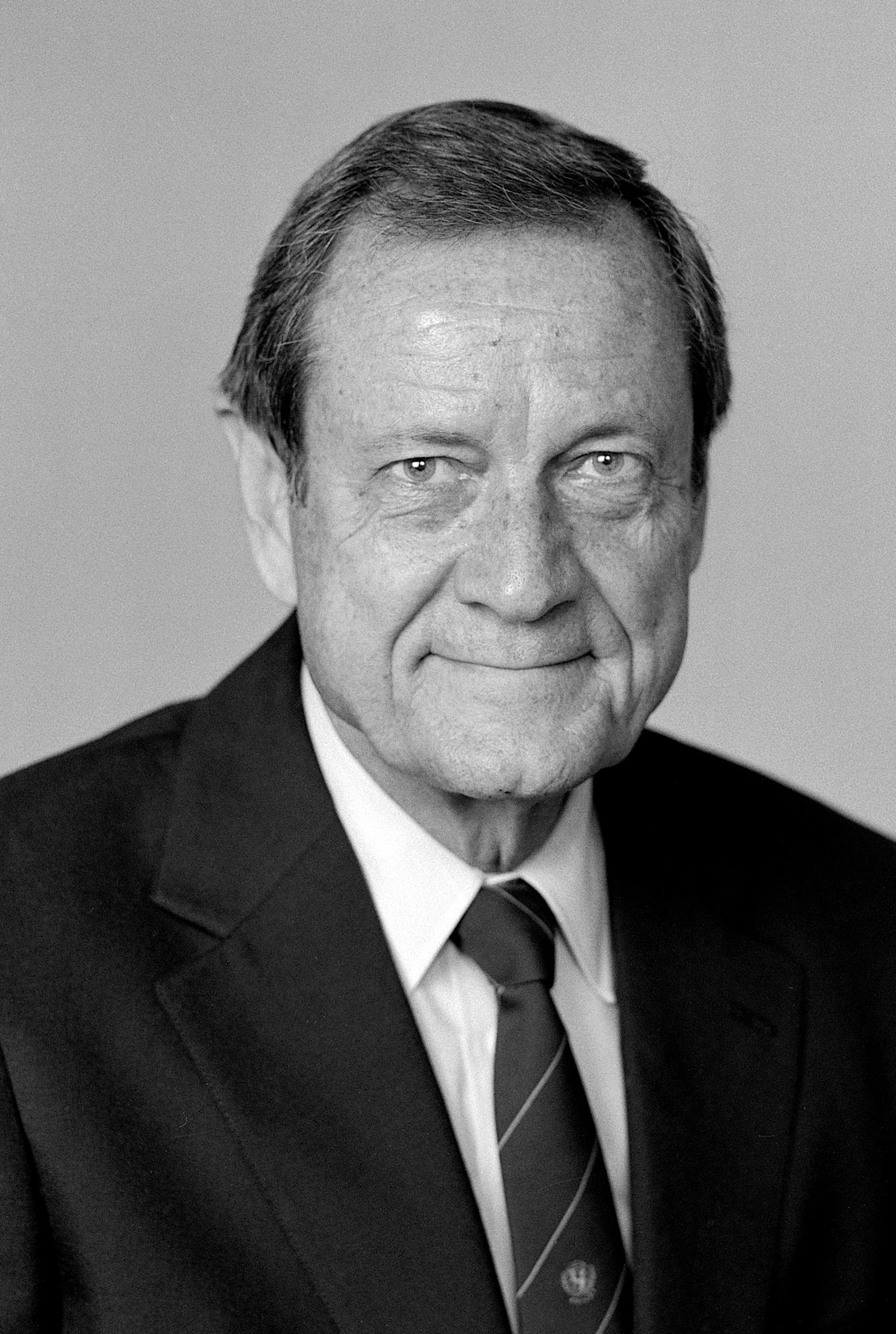
Biography
Grant was born to Canadian parents in China, where his grandfather was a medical missionary and his father a prominent public health specialist who worked for the Rockefeller Foundation and as professor at Peking Union Medical College. Grant grew up fluent in Mandarin, which he was able to speak all his life. He often accompanied his father on trips around China as part of his father’s work, especially in Ding Hsien, where his father and Chinese doctor C.C. Chen pioneered a low-cost healthcare model. His youth in China was central to how Grant came to view the nature of health promotion and development. He saw people who had frozen to death in cold Beijing winters and, while traveling in China as a Boy Scout, he heard the artillery fire of the invading Japanese army in 1933. When he was fifteen Grant moved to the United States (US). In 1943 he graduated with a Bachelor of Arts degree in economics from the University of California at Berkeley and married his fellow student Ethel Henck. Grant became an American citizen following service in the US military during the Second World War. In 1944 he served with the military in Bengal, British India where he saw the immediate after-effects of the great famine of 1943 following the Japanese occupation of Burma and was part of the US military command in China, serving with General Joseph Warren Stilwell, which all had a profound effect on him.
In the immediate postwar period Grant worked for the United Nations Relief and Rehabilitation Administration in China. In 1948 he became Executive Secretary of the Sino-American Joint Commission on Rural Reconstruction, eventually being forced to leave for Taiwan after the Chinese Revolution of 1949. He went back to study in the US and in 1951 received a Doctorate in Jurisprudence from Harvard University. He practiced law in Washington DC, but in 1954 returned to international development, working for the International Co-Operation Administration, which was formally set up in 1955 and in 1961 became the US Agency for International Development (USAID). Grant was Regional Legal Counsel resident in New Delhi, India for US aid programs for South Asia (1954-1956), Director of the US aid mission in Sri Lanka (1956-1958) and Deputy Director of the International Co-Operation Administration with responsibility for worldwide programming and planning (1959-1962). Between 1962 and 1964 he worked briefly for the Department of State under the John F. Kennedy administration and then served as USAID Mission Director in Turkey with the rank of Minister (1964-1967) and as Assistant Administrator for Southeast Asia in Ceylon (1967-1969). In 1969 Grant left government service to become the first head of the Overseas Development Council (ODC), a private think tank in Washington DC that he founded. Grant and others had become disillusioned with how various agencies pursued development and they sought to change the basic methods as well as the definition of development success. While at the ODC, Grant was instrumental in creating the Physical Quality of Life Index, which ODC presented as an alternative measure of development to the simple growth of Gross National Product, and worked hard to advocate for the new approach. Although a development professional, he was also actively engaged in many intellectual movements questioning the orthodoxy on development. His natural inclination, stemming from his China experience, was to seek solutions to problems, rather than accept orthodoxy or give in to those who said the problems of the global poor were insurmountable.
Jointly nominated by US Presidents Gerald Ford and James Carter, Grant was appointed Executive Director of the United Nations Children’s Fund (UNICEF) on 1 January 1980, with the rank of Under-Secretary-General of the United Nations (UN). Grant had served on the Board of UNICEF as US representative since 1978 and had been eyeing the position of Executive Director (Fifield 2015: 15). He lobbied actively for the job. The primary alternative was Ernst Michanek, a Swedish diplomat and development expert, who was supported by his government. Although UNICEF Directors had been Americans (first Maurice Pate, then Henry Labouisse), there was a long period before Grant emerged as the final choice. With a 250 million US dollar budget and over 2,000 employees, the UNICEF he took over from Labouisse upon his retirement was substantially bigger than the original iteration. Despite this increase in size, the tight economic climate at the time forced him to determine how UNICEF could ‘do more with less’ (Black 1986: 416). In 1981 Grant presented UNICEF Board members with an extended budget that, given the economic climate, they deemed overly large. There was also concern that the increase would lead to the growth of headquarters staff in an organization that had always been seen as focused on local-level action. Grant’s challenge, therefore, was to build UNICEF into the organization he wanted it to be while finding the resources that matched his vision. His natural optimism combined with his can-do attitude, often described as ‘very American’ (Adamson 2001: 20), convinced him that he could affect large changes through hard work and persuasiveness. His powerful desire to create real change developed into a more efficient use of resources and what is now known as the Child Survival and Development Revolution, launched in 1983. The roots of this innovation went back to Grant’s observation in post-revolution China where ‘barefoot doctors’ provided basic medical care for millions of rural people, which influenced his perception of how social and political factors impacted health outcomes, as well as his observation of the effects of the Green Revolution on food production, which made him aware of the possibilities of quantum leaps in human welfare through technological innovation (Rohde 2001: 42). As a result he saw bettering health and quality of life as a holistic process, involving improved care, political empowerment and good public policy, and his previous work with the ODC on redefining development had also strongly influenced his approach to improving children’s lives through these interventions.
After taking over UNICEF, Grant realized he led an organization with a great capacity to carry through his vision. He pitched the idea for a new UNICEF direction to staff in various meetings in 1981 and 1982, using ideas developed by him, health experts and his longtime friend and Health Advisor to the Executive Director Jon Rohde. They referred to taking the new direction as shifting gears, a major rethinking of what UNICEF wanted and how the organization should approach reaching its goals. Initially there was a great deal of suspicion and some outright opposition to such a substantial change in UNICEF’s priorities and operating procedure. He was accused of being uncouth, and he sometimes seemed to be too close to the US administration that had appointed him. There was even suspicion that he worked for the Central Intelligence Agency (Fifield 2015: 16-18). He also instituted informal breakfast meetings that surprised staff accustomed to greater diplomatic formality. Grant was able to overcome considerable turmoil through a combination of his own personal charisma and idealism, his ability to hire and fire staff and a judicious use of political alliances and friendships. Grant was known as a tireless worker and a person of a powerful energy, able to sweep people along with his vision through force of will and vigor. His management style was to propose big, often disruptive ideas and then work ceaselessly against any opposition. His method was informal, but also extremely hands-on. As one of his colleagues explained to him at the time: ‘This organization is a 200,000 tonne vessel with a fifteen mile turning circle – it’s an oil tanker and you’re trying to drive it like a speedboat’ (Adamson 2001: 23). Yet, Grant never doubted his vision or his ability to change the organization by convincing people at all levels that they were doing the right thing.
At the heart of Grant’s strategy was his strong belief that the infant and child mortality rates in many developing countries were scandalously high and that reducing them was a vital, moral imperative. His target was nothing less than a 50 per cent reduction in the child death rate. The four techniques that formed the core of his strategy became known as GOBI. This stood for Growth monitoring of small children as a technique to ensure each child received proper nutrition and care, the use of Oral rehydration therapy as a low-cost, low-technology intervention to save the lives of children suffering from diarrheal diseases, the promotion of Breastfeeding, given its proven significant health benefits for children, and Immunization against the most common childhood diseases. These four priorities were laid out in the report The State of the World’s Children 1982-83 (Oxford 1982). Grant introduced the publication of this annual report as an innovation in order to bring attention to the severe, chronic childhood issues that he wanted UNICEF to address. This approach built on an earlier report published under Labouisse during the 1979 International Year of the Child. While the Executive Board of UNICEF got on board fairly quickly with the idea of focusing on GOBI, there was resistance among staff. Furthermore, the World Health Organization (WHO), under Halfdan Mahler, was suspicious of such a ‘top-down’ approach to health, as well as the idea of generalizing across many different countries (Black 1986: 478). Grant’s strategy was barely compatible with Mahler’s Health for All approach, which fuelled inter-organizational tensions and personal rivalries between the two executive heads. Grant traveled the world pursuing commitment from national governments for hitting his ambitious targets for child welfare. Both Grant’s first and second wife accompanied him on his trips and he liked to include them in his work (while on a field trip in India in 1988, Ethel Grant died of a heart attack). Grant would publicly and theatrically challenge national leaders to show their commitment to child welfare. Often this meant bypassing health ministries and going directly to the heads of state or government. Grant had learned from his father the importance of networking and making important friends and this was a central part of his appeal to national leaders to understand the political side of development and child welfare, not just the technical side. When he met heads of state or other important officials he would often use props (such as packets of oral rehydration salts) or surprising questions (that he had prepared in advance in a spiral notebook) to put them on the spot, but would also disarm them with his charm. Ultimately Grant was able to form a good relationship with the WHO as well as other UN agencies. He was a strong believer in the importance of collaboration with other agencies and as a management principle he also believed that letting others take credit for progress was important, so long as the progress was being made.
The first major issue Grant faced as new Executive Director in 1980 was the crisis in Cambodia (then Kampuchea), where the Vietnamese had invaded and overthrown the government of the Khmer Rouge, leading to severe economic disruption and threat of famine. The great challenge was how to deliver aid to all sides of the conflict in a way that did not undermine UNICEF’s neutrality, as the Vietnamese initially did not want UNICEF to deliver aid to areas still under the control of the Khmer Rouge. Grant inherited and helped run the UNICEF relief effort there, but the experience made him wary of taking the lead in large, complex emergencies, as he feared this would divert attention away from UNICEF’s more basic and productive efforts. Grant’s tenure at UNICEF was marked by a number of conflicts and disasters around the world where children were particularly hard-hit. He continued to strongly resist having UNICEF named as lead agency in various emergencies, as he worried this would draw too much attention from the ‘silent emergencies’ of children in dire poverty. It was for this reason that he lobbied to create an Office for Emergency Operations in Africa to take the lead in such crises (Black 1996: 249). Grant was, however, active in negotiating cease-fires in conflict areas, or ‘days of tranquility’, during which UNICEF could operate on behalf of children. He proposed such a cease-fire in El Salvador in 1985. A story is told that Grant had questioned the country director about why child welfare indicators were not improving. When the director explained that he could not operate in a war zone, Grant boldly suggested negotiating a stop to the war (Adamson 2001: 27). UNICEF and the Roman Catholic hierarchy negotiated periodic cease-fires so children could be immunized. In 1989 Grant also personally negotiated with both the government and rebels to implement Operation Lifeline Sudan, threatening each side with bad publicity and world attention should they fail to reach an agreement for children, and traveling throughout the country. Here, as with many other conflicts, Grant insisted on the absolute neutrality of UNICEF: the organization would not take sides in any conflict, nor allow itself to be used for political purposes by either side, and he insisted that children’s welfare be put above partisanship. A witness to many of these negotiations spoke of Grant’s personal qualities in these tense situations: ‘He had the energy of a particle accelerator. He lived on stress; it seemed to nourish him’ and he drew others along with him (Reid 2001: 90).
Grant also used his position as UNICEF Executive Director to try to modify the approach of the main financial institutions, particularly the International Monetary Fund (IMF), to the international debt crisis then unfolding. The predominant strategy followed by the IMF for debtor nations was structural adjustment, that is requiring states to restructure their economies, often using measures of extreme austerity as well as financial and trade liberalization in order to bring economies back into balance. These policies often took a severe human toll on states, as their governments were forced to cut funding for social programs, or choose to cut such programs rather than other areas. Grant used the opportunity of the regular meetings of the UN Administrative Coordinating Committee to raise the human cost of structural adjustment policies and eventually got the attention of IMF Managing Director Jacques de Larosière, who invited Grant to Washington DC. Grant and his colleagues wrote a proposal for a better, more people-centered approach to adjustment and brought a team to IMF headquarters to sell his alternative approach (Jolly 2001: 53). The UNICEF report Adjustment with a Human Face (1987) helped transform structural adjustment by showing the approach’s negative impacts and proposing measures to protect public expenditure on the social sectors, such as health and education. Grant saw the report as a natural carry-over from the Child Survival and Development Revolution, as part of the overall political and social side of development policy. In 1988 Grant and UNICEF proposed a World Summit for Children that would follow up on the 1979 International Year of the Child. With the Child Survival and Development Revolution well under way, calling for the summit seemed a logical way to extend and solidify the gains of UNICEF. The summit, which took place in New York in September 1989, was not without risks, but in the end 71 heads of state attended, far more than even the most optimistic estimates. The success was due in large part to Grant’s tireless promotion of the UNICEF mission and his expert way of leveraging the issue of children’s welfare in a manner that governments could not ignore. As Richard Jolly (2001: 57) noted: ‘No one, not even the most cynical or hard bitten politician could doubt Jim’s sincerity or question his appeal to their better nature… they realized that what was publicly good for their nation’s children was good for their own reputations’.
The 1989 summit also coincided with the opening for signatures of the Convention on the Rights of the Child (CRC). Here, too, UNICEF and Grant had been instrumental in the convention’s success. The idea of a convention had been presented in 1979, as follow-up to the 1959 Declaration of the Rights of the Child. Grant had initially been hesitant to support the idea, as he worried that a set of legal obligations on child rights would involve UNICEF in thorny political questions. UNICEF worked primarily in fields that no one could raise any objection to, such as immunization or promoting breast feeding, and advocating for human rights would raise issues like freedom of speech or the right to nationality that would be much more contentious. By the mid-1980s, however, some members of Grant’s staff, influenced largely by the community of non-governmental organizations that had coalesced around the idea of the convention, had convinced Grant that a convention would help UNICEF in its mission by providing a legal document that could be used to advocate on behalf of children. Grant then used his political skills and the power of his office to push for universal ratification of the CRC, recognizing that if it became the most widely ratified of all human rights documents then this would be a powerful rhetorical tool. Grant’s substantial advocacy for the CRC and his decision to send others from UNICEF to rally support among non-governmental organizations contributed to the immediate success of the convention and its quick rise to nearly universal ratification by the member states. However, Grant continued to see the CRC as primarily an advocacy tool, rather than a document to guide UNICEF programming. Although he talked a great deal after 1989 about children’s rights, this did not lead to a substantial change in UNICEF priorities. Grant continued to worry that the CRC was too political, feeling that it was important to hew to what had worked so well for UNICEF, albeit with a new rhetorical instrument to give him greater leverage over national leaders. Still, by the 1990s there had been evolution in UNICEF programming. A 1986 policy review had led UNICEF to start thinking about children in especially difficult circumstances, which meant trying to help working, disabled and orphaned children, as well as children caught up in the criminal justice system and others who were especially vulnerable and whose problems went beyond simple solutions like immunization or nutrition. In embracing this new agenda, as Maggie Black (1996: 298) put it: ‘He had concluded that his own criterion of “doability” should not be allowed to drive out issues that might be less “doable” than immunization or curriculum reform, but had to be as important’. Grant fretted that other, important child goals might be ignored because they were not as easy to quantify and address via technical solutions. Grant’s speech to the World Conference on Human Rights in Vienna in June 1993 was titled ‘Children’s Rights: The Cutting Edge of Human Rights’.
Grant was diagnosed with cancer in May 1993, but he continued working until only a few weeks before his death. He died shortly after resigning from leadership on 23 January 1995. His tenure at UNICEF marked an era of great change at the organization. Yves Beigbeder (2007: 517) calls him ‘a well-known dynamic innovator who launched several successful campaigns’. Grant left UNICEF with a much higher profile in world politics and a central role in the UN’s development machinery. There were some financial scandals at regional offices under his watch, and his management style could be seen as too single-minded or lacking in judicious caution. His most important personal characteristics were his energy, enthusiasm for his job, an unwavering commitment to promoting children’s welfare at every opportunity and his style of leadership. He was reappointed twice as Director of UNICEF, in 1990 and 1995. His first reappointment went smoothly, but the second involved some politics, as his reappointment was caught up in the feud between UN Secretary-General Boutros Boutros-Ghali and the administration of US President William Clinton, which was upset by his failure to implement sufficient reforms at the UN. Dissatisfaction with Boutros-Ghali’s leadership extended to opposition to his decision to reappoint Grant. This feud also connected to the choice of Grant’s successor at UNICEF, ultimately resulting in the election of Carol Bellamy rather than the administration’s first choice, Bill Foege, an epidemiologist and Director of the Centers for Disease Control in Atlanta, Georgia. Boutros-Ghali in particular objected to Foege because he believed it was important to have a woman as the next Executive Director of UNICEF. In 2004 the James P. Grant School of Public Health was established at BRAC University in Dhaka, Bangladesh.