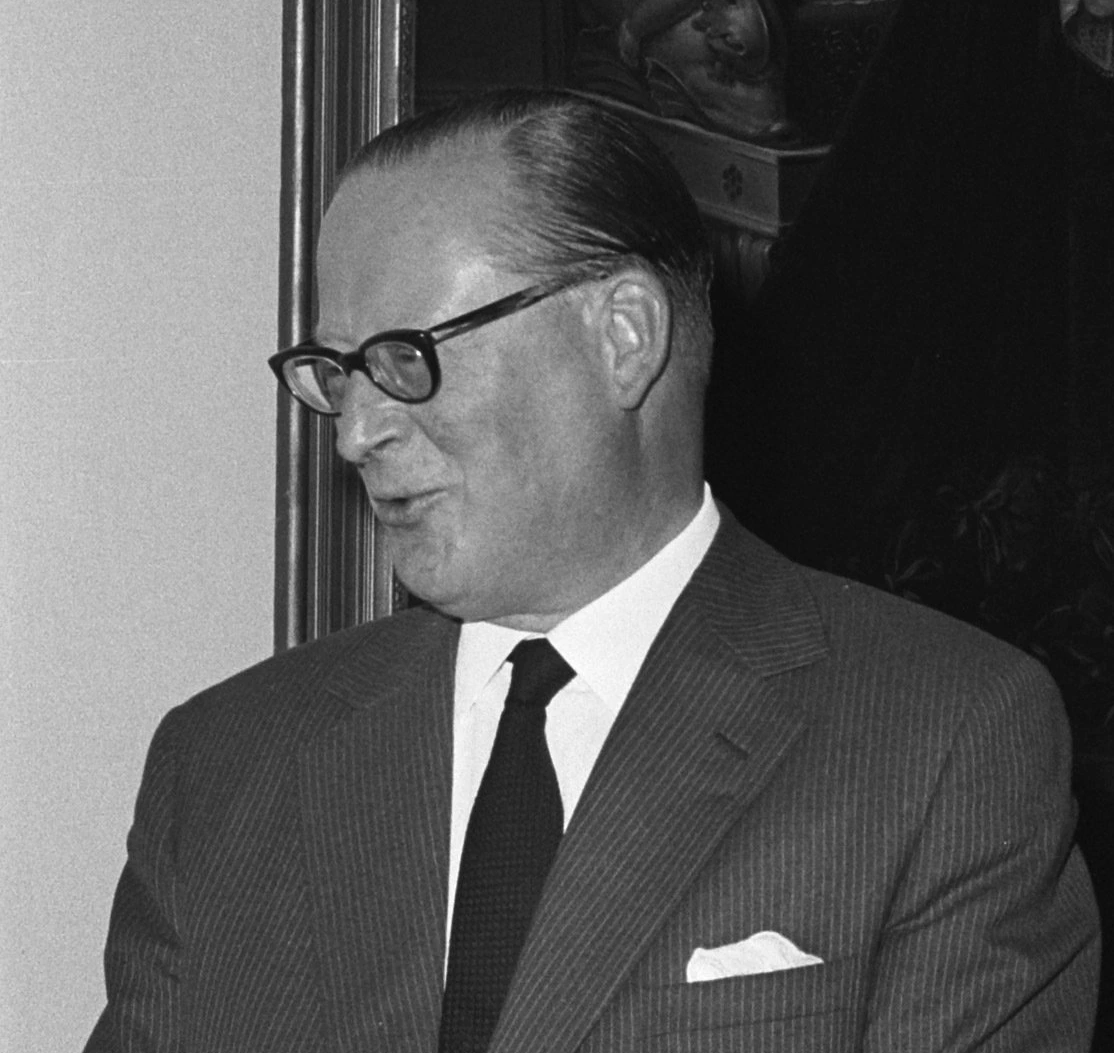
Biography
Goad, whose parents ran a catering business, won a scholarship from Cirencester Grammar School to attend Gonville and Caius College, University of Cambridge, which he entered in October 1933. He was awarded a Bachelor of Arts in 1936 with a double first in history and he held the status of Minor Scholar between 1935 and 1936. He then passed the British Civil Service entrance examination and joined the Ministry of Transport as an Assistant Principal in 1937. He married in 1939 and remained working at the Ministry of Transport throughout the Second World War after he failed his medical test for active military service. He was promoted to Principal in 1942 and an Under-Secretary in 1963. At the Ministry he spent much of his time focused on maritime issues, which had been the most prestigious branch in the immediate postwar era. However, by the early 1960s the emphasis shifted to internal transport, railways and especially motorways. Given this shift Goad, as a maritime expert, decided to leave the British civil service and moved to the Inter-Governmental Maritime Consultative Organization (IMCO), which began operations as a United Nations’ (UN) specialized agency in 1959.
In 1963 Goad began working at IMCO as the Deputy Under-Secretary of the organization and Secretary of the Maritime Safety Committee, serving under French Secretary-General Jean-Eudes Roullier. In those days Secretariat work was limited to administrative and personnel matters. The ‘political’ functions of the Secretariat were confined to explaining the organization’s advantages to member governments and negotiating with other UN agencies over jurisdictional matters, which Robert Cox and Harold Jacobson (1973: 10, 149) called boundary decisions, typically the purview of the Secretariat rather than member governments. The biggest challenge to IMCO came with the UN Conference on Trade and Development’s creation of a Committee on Shipping in 1965. IMCO faced this competition because the governments of economically less-developed countries found advantage in working together in a permanent committee, given the importance of shipping to the trade and balance of payments of many of their countries (Singh 1969: 69-90). During the mid-1960s there was considerable concern that IMCO, given the organization’s narrow scope of activities, might not be able to survive as a specialized agency within the UN system. IMCO’s very technical mission was based on the International Convention on the Safety of Life at Sea (SOLAS), including the Convention’s application and amendments. The first version of the Convention was adopted by an international conference of fourteen states in 1914 in response to the Titanic disaster and the fourth, a major update, by IMCO in 1960. Goad attempted to increase IMCO’s political presence by visiting those member states whose support was crucial to the organization’s existence and by intensifying IMCO’s participation in other UN bodies. A more active role on the part of the IMCO Secretariat was facilitated by new demands placed on the organization as a result of the 18 March 1967 Torrey Canyon disaster on the British southwest coast, at the time the largest oil spill ever and the first involving a new generation of super tankers. After this accident IMCO’s foci expanded to include marine pollution in addition to maritime safety. Heretofore IMCO’s minor, but consistent, involvement in questions of oil pollution had focused on deliberate rather than accidental pollution and on preventing spills rather than on dealing with the economic and legal consequences of their occurrence. In an interview, Goad observed that the Torrey Canyon disaster was a ‘godsend’ for IMCO (M’Gonigle and Zacher 1979: 42). The newly expanded involvement in the pollution reduction gave IMCO a ‘second arm’, increasing its status and salience in the UN system, lessening fears that it would be subsumed under one of the institutional bodies set up and controlled by the UN General Assembly and changing the perception that its visibility in the UN Economic and Social Council was ‘languishing’ (M’Gonigle and Zacher 1979: 42, 309n153). The disaster also resulted in IMCO’s Maritime Safety Committee making a number of recommendations to amend the SOLAS Convention of 1960 as well as additional recommendations for governments outside of the Convention. IMCO also began working closely with the International Labour Organization on issues of training and qualifications of ship officers and crews. While the timing of the Torrey Canyon incident was fortuitous for IMCO, this did not significantly expand the role of the IMCO Secretary-General, which remained focused on attempts to ensure IMCO’s survival as a whole within the UN system and to persuade member states of the organization’s growing utility.
Goad became IMCO Secretary-General effective 1 January 1968. The Council appointed him based on the prior positions he had held and due to the United Kingdom being an essential member of the London-based organization. Whereas the safety of merchant ships remained the largest portion of IMCO’s work, marine pollution activities expanded. This shift was eased by Goad’s replacement of Roullier, who had been hesitant to expand the organization’s roles, in part because of IMCO’s organizational ideology (emphasizing the word ‘consultative’ in the organization’s title) and because the IMCO needed ten years to obtain the necessary twenty-one charter ratifications. This can be explained, in part, by the difficulty of convincing potential members, especially the Scandinavian countries, that IMCO’s tasks would not be expanded beyond those granted by the members (Schechter 1976: 215-216). Thus, the organization remained truly intergovernmental and consultative, as exemplified by events in 1971. In July of that year the IMCO Sub-Committee on Navigation stressed the importance and urgency of adopting measures to improve navigation safety in the Malacca and Singapore Straits. However, after a delegation from the three coastal states, led by Malaysia, met with Goad in September, IMCO dropped the issue. Similarly, even when speaking at a conference, the constraints on the Secretariat and the role of the Secretary-General were evident. In discussing the preparations for an international convention on the prevention of oil pollution in 1968, Goad (1969: 267) said: ‘Whether the Convention has sufficient “teeth”, or whether its dentures are in fact in need of some repair; whether the Convention is as enforceable as it might be are questions of interest on which I regret that I do not feel able to express a personal opinion, since it is for States who are members of the organization to do so’. However, Goad’s role as Secretary-General did produce a major change in IMCO’s structure. He saw no good reason for parity between the technical and administrative divisions, which he thought had been the idea of the first IMCO Secretary-General, Ove Nielsen, in order to overcome the empire-building personalities of the top Secretariat officials in the early 1960s. Goad felt that the technical division had by far become the most important one in the Secretariat. Accordingly, he proposed that the position of Deputy Secretary-General be created so as to allow the Secretary of the Maritime Safety Committee to be solely in charge of the technical division. He also called for separate legal and external relations sections, which led Robert McLaren (1972: 50-51, 127-128) in his comparative study of international secretariats to contend that under Goad IMCO had transitioned from a technical to a technical-legal organization, but still not a ‘political’ one.
High on Goad’s list of priorities as Secretary-General was working out a scheme to provide an oil industry-financed fund that could secure extra compensation for pollution damage. The modus operandi for IMCO in working on such issues was to turn to the International Chamber of Shipping, the principal international trade association for merchant ship owners and operators, and the Comité Maritime International, a long-standing non-governmental organization (NGO) focused on the unification of maritime law and related commercial practices, for their assistance in the preparation of draft articles, which could be used by IMCO’s still relatively small Legal Sub-Committee (Rafgard 2011: 85). The resulting treaty was the 1969 International Convention on Civil Liability for Oil Pollution, with an agreement to meet again by 1971 to re-evaluate the need for a more comprehensive fund. But, as Goad argued, the fundamental problem of controlling oil pollution was enforcement, as signing papers and ratifying conventions was easy (M’Gonigle and Zacher 1979: 327). In practice, ratification was often a problem for IMCO, as implementation was dependent upon governments, with no real role for the Secretariat to ensure implementation (McLaren 1972: 230). The 1966 International Convention on Load Lines, which set a maximum draft for loaded ships, did not enter into force until 1977. One of the major accomplishments of IMCO during Goad’s time as Secretary-General was the 1972 Convention on the Prevention of Marine Pollution by Dumping of Wastes and Other Matter, the London Convention for short, which was one of the first global conventions to protect the marine environment from human activities. The convention entered into force in 1975, after Goad retired. Goad also spent considerable time working towards the 1972 UN Conference on the Human Environment, frequently referred to as the Stockholm Conference. Although the Conference was to focus on all challenges to the environment, marine pollution, including ocean dumping, was earmarked for special attention. Goad’s (1972: 15) hope was that IMCO’s responsibilities in the area of ocean dumping would be legitimized in Stockholm. A number of resolutions relating to the marine environment came out of the Stockholm Conference, however some of them seemed to give more authority to coastal states rather than to any international organization. Stockholm also saw the establishment of the UN Environmental Programme (UNEP). Even though UNEP acted as catalyst and coordinating body with limited funds for activities, early on the new organization had a number of boundary disputes with IMCO, including over UNEP’s promotion of regional pollution accords, particularly in the Mediterranean, and regarding who would furnish advisors to assist countries in dealing with vessel-based pollution. There was also an attempt by some IMCO member states, including Canada, to get the Committee on the Challenges of Modern Society (CCMS) of the North Atlantic Treaty Organization engaged in addressing issues of oil pollution and compensation. Their hope was that any actions taken by CCMS would be less hospitable to the interests of the NGOs, which were then so influential in IMCO’s decision-making process, but their efforts made very little headway.
Goad left IMCO on 31 December 1973, forgoing the chance to continue until age 65. Instead of continuing to work at IMCO, he chose to retire to his beloved Gloucestershire. Throughout his time as Secretary-General, his role, and that of the Secretariat more generally, was never politically significant. How much of that was due to the personalities, characters and beliefs of the Secretary-General and other top officials is open to some dispute, but Goad seemed to believe that the limited role he performed was appropriate (McLaren 1972: 231). In spite of his return to Gloucester he agreed to serve on the World Bank’s Advisory Board, where the Bank wished to include representatives from various economic sectors. On 15 June 1974 Goad was appointed Knight Commander of the Most Distinguished Order (KCMG) of St Michael and St George, which is awarded to men and women who render extraordinary or important non-military service in a foreign country. Decades later Goad was coaxed back into part-time employment. Effective 15 October 1991 he was made a non-executive director of International Registers, Inc., a Virginia-based company that runs the Liberian shipping register as well as one for the Marshall Islands in the Pacific, a position he held until his death in 1998. He also became a consultant to the Liberian Shipping Council, representing it at the International Chamber of Shipping, and was elected to the International Chamber’s Executive Council. Goad continued travelling around the world, including to the Soviet Union, China and the United States until failing health forced him to curtail his activities. He died in Hunters Care Centre in Cirencester in March 1998 at the age of 83. Having converted to Roman Catholicism, his wife’s religion, his funeral took place at St Thomas Roman Catholic Church at Horcott in Fairford, Wiltshire, the same place where his wife’s funeral had been held in October 1980 and he is buried in the churchyard there.
March 2025: typo in Ove Nielsen corrected