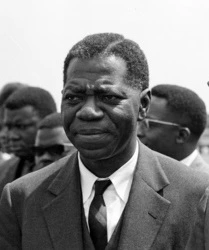
Biography
Gardiner was one of eight children in a prosperous family of traders. His father passed away when Gardiner was only two years old. His mother continued the family business and earned enough money to send all seven surviving children to educational institutions in England. After attending Adisadel College in Cape Coast, Ghana, and Fourah Bay College in Freetown, Sierra Leone, Gardiner continued his studies at Cambridge University’s Selwyn College and graduated with a bachelor’s degree in Economics in 1941. Gardiner then pursued further studies at the University of London and Oxford University. He earned his master’s degree in Economics from Oxford University’s New College in 1943. On his return to Africa Gardiner joined the faculty of Fourah Bay College, where he taught economics for the next three years. Ralph Bunche, then Director of the Trusteeship Division at the United Nations (UN) Secretariat, recruited Gardiner for his first UN post in 1946. Gardiner worked in New York as an area specialist at the Trusteeship Division for two and a half years and resumed his academic career in 1949, when he became Director of Extramural Studies at University College in Ibadan, Nigeria. At the time he was the only African to lead a department at Ibadan. In 1953 Gardiner again left academia, this time to enter the Ghanaian civil service. He successively served as Director of the Department of Social Welfare and Community (1953-1955), permanent Secretary of the Ministry of Housing (1955-1957) and as the first Head of the Civil Service after the country gained its independence (1957-1959). Even though his accomplishments in these positions were widely acknowledged, Gardiner’s career seemed threatened because of the disagreements he had with Prime Minister Kwame Nkrumah. Observers attributed the clashes between the two leading figures to the differing temperaments of the sober, pragmatic Gardiner and the ambitious, idealistic Nkrumah.
Gardiner evaded the conflict with Nkrumah by accepting a nomination as Deputy Executive Secretary of the newly founded UN Economic Commission for Africa (UN ECA) in May 1959. However, not long after settling in Addis Ababa, where UN ECA was seated, he was called away to the Republic of the Congo, where a civil war had broken out shortly after the country’s independence. Gardiner was named consultant in public administration to the chief of the UN Civilian Operation and entrusted with helping rebuild the Congolese civil service. After serving in the Congo from August to November 1960, Gardiner resumed his duties with UN ECA. In March 1961 UN Secretary-General Dag Hammarskjöld asked him to again visit the Congo as a member of a Secretariat mission tasked with working out an agreement aiming at the reorganization of the Congolese army. Instead of returning to Addis Ababa in July 1961, Gardiner took up the post of Director of the Public Administration Division at the UN Department of Economic and Social Affairs. While in New York, he also served as the chief Congo adviser to U Thant, who became Secretary-General after Hammarskjöld’s death. In January 1962 Gardiner was named Officer-in-Charge of UN operations in the Congo, succeeding the Swede Sture Linner. Gardiner took over a UN mission that included around 400 experts in public administration, health services, education, economic analysis and other areas. His task of reunifying the war-torn country seemed to progress significantly when the capitulation of the province of Katanga in January 1963 ended a secession that had lasted for two and a half years.
The relaxation of the Congo situation allowed Gardiner to take up the post of Executive Secretary at UN ECA, the position he would hold for the next 12 years. He had originally been chosen as the successor of Mekki Abbas after the latter’s resignation in January 1962. When Gardiner took over at UN ECA, the Commission was still in the process of establishing itself as a relevant centre for development expertise in Africa. The founding of the Commission had been delayed for almost a decade due to the resistance of the colonial powers who feared that a UN Economic Commission in Africa would become a platform for anti-colonial voices. Indeed, when UN ECA was finally established in 1958, political leaders around Africa saw the founding of the first continent-wide international organization as a moment of great symbolic importance. The political significance of its founding notwithstanding, UN ECA was essentially a ‘technical’ body. Its mandate consisted of promoting the economic and social development of its member countries and strengthening regional economic integration in Africa. The main tools for fulfilling these tasks were the fabrication of expertise on development by the UN ECA Secretariat and the offering of advisory services to member countries. At the time of Gardiner’s arrival, and throughout most of the 1960s, the majority of UN ECA’s professional staff was made up of non-Africans, due to the scarcity of highly qualified African economists and bureaucrats. This contrasted inconveniently with the perception of UN ECA as an ‘African’ organization. Consequently, member governments would utter relentless calls for the ‘Africanization’ of the UN ECA Secretariat at the Commission’s early conferences. Gardiner was a staunch supporter of the ‘Africanization’ policy, whereas he remained aware of the limitations it faced. He advocated ‘Africanizing’ not only UN ECA staff, but also the knowledge base on which the work of UN ECA was founded. He was convinced that the universalistic knowledge claims of development economics had to be adjusted to African realities. In his address at the 1972 graduation ceremony of Haile Selassie University in Addis Ababa Gardiner (1972: 6) said: ‘Theories borrowed from abroad, especially in the social sciences, are of necessity rooted in the history and culture of the countries in which they are formulated. When accepted and applied without caution or adaptation to African conditions, they lead to confusion and unnecessary difficulties’. However, unlike the UN Economic Commission for Latin America and the UN Conference on Trade and Development, which first met in 1964, UN ECA never managed to create an original approach to development. Instead, from its inception, the Commission usually championed the development orthodoxies of the time. UN ECA’s early important initiatives under Gardiner showed the determination to ‘Africanize’ if not big development design, then at least the institutional machinery on the continent. In 1963 UN ECA created IDEP, the African Institute for Economic Development and Planning (Institut africain de développement économique et de planification), in Dakar, Senegal. The founding of the African Development Bank in 1964 aimed at enhancing the role of African countries in development finance. Gardiner would come to see the establishment of the Bank as the single most important achievement of his tenure (Pickett and Singer 1990: xii). A further essential part of the institutional proliferation UN ECA instigated in the 1960s was the creation of sub-regional offices in Lusaka (Zambia), Kinshasa (Democratic Republic of Congo), Niamey (Niger), and Tangier (Morocco), each of them representing one of four previously carved-out sub-regions on the continent.
While these institutional efforts helped bolster UN ECA’s position, the founding of the Organization of African Unity (OAU) in 1963 worked to the contrary. UN ECA lost its status as the sole continent-wide international organization. The newly arrived OAU could lay claim to being a ‘genuine’ African organization, not just yet another UN body. The intense rivalry between UN ECA and OAU that emerged almost immediately after the latter’s founding, has often been attributed to the difficult relationship between Gardiner and the more outspoken Secretary-General of the OAU, Diallo Telli. Gardiner faced even more difficulties in dealing with different factions of African countries. During the 1960s the Francophone bloc in UN ECA came to see the Commission as an Anglophone-dominated club, with the Ghanaian Gardiner frequently being accused of neglecting Francophone Africa and favouring Anglophones for UN ECA posts. At the same time the more politically radical countries on the continent were critical of UN ECA’s non-confrontational style, which they attributed in large part to the Executive Secretary’s own moderate attitudes. However, the biggest challenge for the Commission arose out of its lack of operative powers. In the course of the first decade of UN ECA’s existence, even countries that maintained a generally positive attitude towards the Commission grew dissatisfied over the fact that its mandate limited UN ECA to research and advisory functions. Toward the end of the 1960s Gardiner proposed several reform measures that aimed at adjusting UN ECA’s mandate and institutional machinery in a way that would enhance the Commission’s role in UN development aid. However, these efforts were met with resistance by other UN bodies that feared interference in their own activities, notably by the UN Development Programme, which had been established in 1966 and had a strong presence in Africa. The reforms that were eventually realized, such as the establishment of permanent Development Advisory Teams in the sub-regions, did not significantly increase UN ECA’s influence. Nor did they put an end to Gardiner’s recurring frustration about the Commission’s weak standing in the UN system. In the first half of the 1970s UN ECA seemed to settle in to its role as a reliable producer of development expertise that had long lost the symbolic allure of its beginnings. Gardiner commissioned a set of studies exploring the implications of women’s centrality to development and created the African Training and Research Centre for Women in 1975. In the course of the negotiations on the Lomé Convention between African countries and the European Economic Community, signed for the first time in 1975, the Commission proved its usefulness in facilitating the coordination of African governments when its advice was in demand. But generally the expertise UN ECA produced was of no immediate relevance to African states and the important decisions on development policy in Africa kept being made without the involvement of the Commission.
When Gardiner eventually decided to leave UN ECA in March 1975 (both he and UN headquarters agreed that 13 years in charge of UN ECA were enough), he handed over a well-running UN body with an extensive output of studies on every aspect of African development. However, he had not managed to make the Commission the focal point of innovative development thinking many people in Africa and outside had been hoping for. Consequently, appraisals of his tenure tend to be ambiguous. His successor, the Nigerian Adebayo Adedeji (2007: 46), has been critical of his alleged lack of vision: ‘Robert Gardiner was a conservative economist who didn’t see anything wrong with the extant development paradigm’. At the same time Adedeji (2007: 43) acknowledged Gardiner’s achievements in building up the UN ECA Secretariat: ‘He laid some solid foundation and put together a very high quality secretariat of dedicated professionals who were engaged with issues of appropriate development paradigm for Africa’. Other prominent UN figures who worked with Gardiner have given equally ambivalent opinions. Under-Secretary-General Margaret Anstee (2007: 67) said in an interview with the UN Intellectual History Project: ‘Robert Gardiner, you know, was not liked by all his staff. He was a somewhat controversial character. I thought he was a very fine man. He was very good intellectually’. Whatever mixed opinions exist regarding Gardiner’s achievements and leadership style, there is general agreement that the circumstances UN ECA faced on a decolonizing African continent were significantly more complex than they were for other UN bodies against which UN ECA’s performance is frequently measured. James Pickett and Hans Singer (1990: 7) noted in an essay honouring Gardiner: ‘Full appreciation of his achievements there [at UN ECA] needs an understanding of the limits within which the Commission worked’.
After leaving UN ECA Gardiner returned to Ghana to serve as Commissioner for Economic Planning in the government of General Ignatius Kutu Acheampong, who had replaced a democratically elected government in a coup d’état in 1972. The willingness to work for the military regime drew criticism from several sides, but more lenient voices saw in the move a typical manifestation of Gardiner’s pragmatic, non-political approach to his work. During his three-year stint in Ghana Gardiner stayed involved with the UN Development Planning Committee, the Council for Scientific and Industrial Research, several Ghanaian universities and other institutions concerned with research on development. Throughout his career, Gardiner maintained strong bonds with the academic realm. He was a frequent guest lecturer and held honorary degrees from institutions in Africa, Europe and the United States. Among his favourite leisure time interests Gardiner listed playing golf, reading, listening to music and walking. His personality has been described as quiet, humorous and charming. A successful product of the British colonial education system, Gardiner was frequently compared to a stereotypical English gentleman. The Zimbabwean economist Bernard Chidzero (2007: 34), another collaborator at UN ECA, said of him: ‘He spoke English with distinction. ... In many ways, he was more of a noble Englishman who was intellectual and very clear-minded’. Despite the strong imprint British education had left on him, and notwithstanding his habit of quoting classical British authors in speeches and letters, Gardiner was also proud of his African descent. He was deeply concerned with the fate of the continent and strongly believed in the need for Africans to cooperate in order to achieve prosperity in the postcolonial era.
Date and place of death added; UNECA spelled as UN ECA