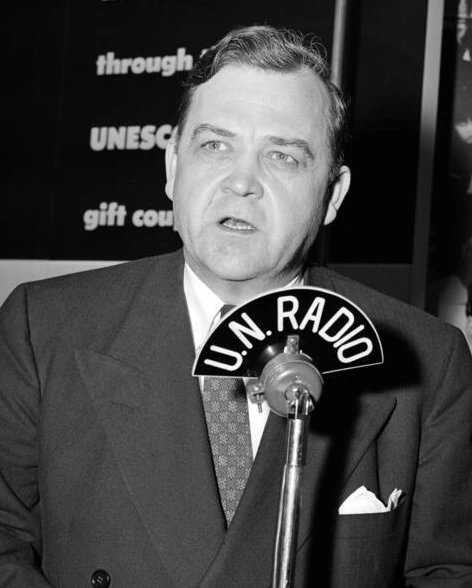
Biography
Evans was born into a modest Methodist family on his grandmother’s farm near Sayerville. Before graduating from high school he worked six months a year in the cotton fields of his family’s farm. He studied political science at the University of Texas and received his Bachelors degree in 1923 and his Masters degree in 1924. Following a summer in Europe, where he visited the League of Nations, Evans went to Stanford University, where he received a PhD in political science in 1927. Both his Masters thesis and his doctoral dissertation discussed the mandate system of the League of Nations, which shows an early interest in international organization and multilateralism. At Stanford he also served as an instructor in citizenship. In 1925 he married Helen Murphy, a University of Texas classmate. From 1927 to 1935 Evans taught political science at, respectively, New York University, Dartmouth College and Princeton University. When he met Harry Hopkins, advisor to President Franklin Delano Roosevelt, he proposed to reorganize the National Archives of the United States (US), which, as he had found out, were in a state of disarray. In 1935 Evans was named National Director of the Historical Records Survey, which surveyed the various archives as part of the Works Project Administration (1935-1939), one of the structures of the New Deal. As a Democrat Evans was inspired by the New Deal, which spurred an interest in social planning.
In the autumn of 1939 his political connections brought Evans to the attention of the newly appointed Librarian of Congress, Archibald MacLeish, who offered him the job of Director of the Legislative Reference Service of the Library of Congress. Evans quickly became MacLeish’s principal lieutenant and within less than a year he became Chief Assistant Librarian (1940-1945) and managed a major administrative reorganization of the institution. During MacLeish’s frequent absences, as advisor to the President, he served as Acting Librarian of Congress. When MacLeish resigned to become Assistant Secretary of State, President Harry S Truman appointed Evans as the tenth Librarian of Congress, and he held this position from 1945 to 1953. Evans continued MacLeish’s efforts of contributing to the cultural and scholarly life of the nation and promoted the Library of Congress as a leader and partner among American libraries. During his tenure Evans greatly expanded the library’s collection and opposed censorship of the library’s holdings. Opposition in Congress often hindered his action. When he asked Congress to nearly double the Library’s budget in 1947, an economy-minded Congress rejected his request. He also tried to establish an international role for the Library, which he believed should be ‘a powerful instrument of peace and progress’ (www.loc.gov/about/librarianoffice/evans.html). Among his important acquisitions and bibliographical achievements were a Library of Congress mission to Europe in order to obtain multiple copies of European publications on the wartime period, microfilming projects in the Middle East, and leadership in developing the so-called Farmington Plan, a cooperative acquisition effort among research libraries. Well-versed in international relations, he returned a number of manuscripts to their countries of origin, among them the Lincoln Cathedral’s copy of the Magna Carta, which was housed at the Library of Congress during the war and returned to British diplomat John Balfour in January 1946. In connection with the United Nations Educational, Scientific and Cultural Organization (UNESCO) he helped draft the Universal Copyright Convention in Geneva in 1952. Assistant Librarian of Congress Verner W. Clapp asserted that Evans invented the phrase ‘bibliographical control’. He had an open management style, frequently consulted his department directors and mixed freely with the staff. Evans strongly believed in the principle of a free flow of information. In the period of McCarthyism he was one of the few government officials who resisted this political pressure and in 1952 hired an administrator whom the State Department had just dismissed as being a ‘security risk’. Evans’ actions and ambitions with regard to the Library, as well as his aggressive and opinionated style, made him a controversial Librarian of Congress, earning the ire of many members of Congress.
Evans’ international career began early. Together with MacLeish he served as a member of the US delegation to the London conference that established UNESCO in 1945. He was an adviser to the US delegation from the second to the seventh session of UNESCO’s General Conference and represented the US in the UNESCO Executive Board between 1949 and 1953. In 1945 he supported the UNESCO declaration on the free flow of information, and, in 1950, the UNESCO decision to give all possible aid and assistance to the United Nations (UN) action in Korea, in the context of the Korean War. Already in 1946 he was one of the first members of the US National Commission for UNESCO and in 1952 became its president. He was acquainted with UNESCO’s second Director-General, Jaime Torres Bodet, whom he had met in Mexico during a trip for the American Library Association in 1946. In 1953 Evans resigned from the Library of Congress to accept the position as UNESCO’s third Director-General (and thus far is the only American to have held this position). On 1 July 1953 he was elected by 39 votes against 17, winning over the Brazilian scientist Paul de Berrêdo Carneiro, who represented the developing countries. His election was a ‘universal surprise’, according to former UNESCO staff member Emile Delavenay (1992: 373), in particular for the US delegation, as the US government had not supported his candidacy. His candidacy for this post may be explained by the fact that a Republican President, Dwight D. Eisenhower, had recently won office and this could have made Evans, as a Democrat, vulnerable at the Library of Congress. While UNESCO was divided into ‘Latin’ (mainly France) and ‘Anglo-Saxon’ clans, members of the former, among them Jean Piaget, opposed his election. During Evans’ entire term in office French intellectuals such as Executive Council member Henri Laugier and UNESCO staff members Delavenay and Jean Thomas competed with him. Hence Evans felt uncomfortable with the French, who favoured intellectual and scientific activities, compared to the Anglo-Saxon penchant for wide-scale educational projects. Unlike Torres Bodet, who used to speak in French and had surrounded himself with French collaborators, Evans spoke only in English and preferred Anglo-American collaborators. As a result French staff members were marginalized. As Evans could not get along with Under Director-General René Maheu, he decided to exile him by appointing him as UNESCO representative to the UN in New York in 1955.
Evans’ style of leading the organization contrasted sharply with that of his predecessors. He was a pragmatic manager, preoccupied with decent administration, good governance and solid efficiency. In his first speech as Director-General Evans declared his aim to serve UNESCO not as an idealist but as a professional administrator, requiring immediate and practical results. Reluctant to accept big ideas and conceptualizations he opposed the idea of a one world culture to be shaped by UNESCO, as was promoted during the years 1945-1948. As a result his term in office contrasted with UNESCO’s early period. Evans wanted to promote the development of social sciences within UNESCO, but found the US government opposed to this. He also was in favour of technical assistance, but believed that UNESCO could act only as a catalyst through limited action. He developed UNESCO’s technical assistance and educational programmes for developing countries in the spirit of Truman’s inaugural address of 20 January 1949, in which ‘point four’ underlined the importance of technical aid to development. However, during his term the developing states successfully demanded more technical assistance and pressured UNESCO to set up regional bureaus, a strategy Evans himself opposed. During his term in office UNESCO became more politicized for three reasons. First, the Soviet Union became a UNESCO member in 1953, opening another arena for tension between the two great powers and their allies. Second, a reform of the status of Executive Council members in 1954 meant that representatives of governments replaced the generally more independent intellectuals. Third, American McCarthyism struck UNESCO. A secret agreement dating back to 1948 allowed the US government to collect information on US staff working for the UN. In November 1952 the so-called McCarran Committee, established by the Senate to investigate America’s internal security and headed by the sturdily anti-New Deal and anticommunist Senator Patrick McCarran, asked UNESCO for a list of American UNESCO staff members, followed by an executive decree of the American president on 9 January 1953 requesting the Director-General to furnish more information on these persons. However, this decree contradicted UNESCO’s constitutional act, which does not permit the Director-General to receive instructions from governments. UNESCO’s staff and Executive Council members firmly opposed these American interventions. Across June and July 1953 the US government threatened to suspend the payment of its contribution to UNESCO and fifteen American staff members were invited to attend the McCarran Committee. When eight of them refused to do so, the McCarran Committee demanded that Evans dismiss them. Evans found himself in a difficult position as an American citizen and under pressure from both the US political institutions and his Executive Council. Eventually, in December 1954, having long hesitated, he accepted the new political reality. But unlike his behaviour while Librarian of Congress, he decided to dismiss seven of the eight holdouts, much to the chagrin of the UNESCO staff, member-state representatives at the General Conference and the Executive Council. In September 1954 the Administrative Court of the International Labour Organization condemned this dismissal, following a judicial action by the UNESCO staff association, and in 1956 the International Court of Justice confirmed the judgement of the ILO’s Administrative Court. UNESCO was instructed to pay significant compensatory allowances to the seven dismissed staff members.
Within UNESCO Evans’ position had become difficult as the US government did not back or trust him. As soon as the Soviet Union had entered UNESCO, the US government had asked him to keep a watch on Soviet actions within UNESCO. Evans, however, had refused, because he regarded this as inappropriate for his position. In 1954 he supported the Soviet demand to make Russian an official UNESCO language and in 1955 he made an official trip to the Soviet Union, which impressed him. This positive view was poorly received by the US government and various Western states. President Eisenhower and Secretary of State John Foster Dulles refused to meet with him and his relationships with American Executive Council members were not easy either. Because the representatives of the Soviet bloc also criticized him as an American, Evans found himself suspected by both sides. Nonetheless he wanted to be re-elected as Director-General in 1958. In April he went so far as to threaten the President of the Executive Council, Vittorino Veronese, suggesting in a letter that if his candidacy was not accepted, he could and would restrict UNESCO’s programme and budget. However, his chances were poor and, although his term was to last until July 1959, he resigned in the fall of 1958. On 4 December he left UNESCO frustrated and disillusioned. Paradoxically, his American citizenship had not resulted in stronger links between UNESCO and the US; on the contrary, relations had deteriorated. Overall, Director-General Evans was judged as a good administrator but less of an intellectual than his predecessors, with, according to UNESCO’s first Director-General, Julian Huxley (1973: 68), a ‘practical-minded Texan character’.
Evans returned from Paris to Texas and soon became the director of a Brookings Institution survey which recommended ways to coordinate the planning and operation of federal libraries. A suggestion in his report showed that he still held strong and controversial views, as he called for the transfer of the Library of Congress to the government’s executive branch, where he felt it would obtain the support it deserved. He also directed a study for the National Education Association on the implications of automation on education. From 1962 to 1971, Evans was Director of the International and Legal Collections of Columbia University Library, and helped develop a new library for the School of International Affairs. He remained active in international peace issues. He became president of World Federalists, U.S.A. (1970-1976), and played an active role in groups such as the American Civil Liberties Union and the United Nations Association. He directed the US Committee on Refugees and set up a US citizen’s lobby on international issues called New Directions. In 1981 he died in San Antonio, Texas, where he had made his home since 1977.
March 2025: p. 3 UNESCO representative to the UN in 1955 (not 1956)