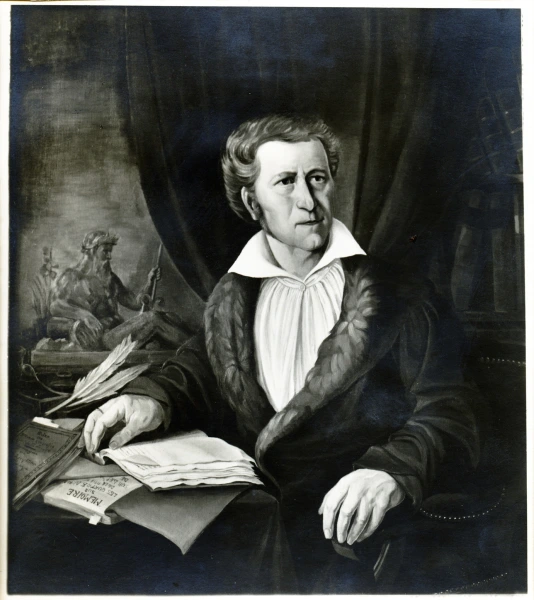
Biography
Bonn, the capital and residence of the Electorate and Archbishop of Cologne, experienced significant changes at the time when Eichhoff, the fifth of seven children, was born in a Catholic family. The new Prince Elector Max Friedrich shifted away from the absolutist and opulent court culture and embraced Enlightenment thinking. With his father being the Prince Elector’s cook for decades, Eichhoff became familiar with the realm of politics and diplomacy from a young age. He was also exposed to the new enlightened ideas in the centre of art and science that Bonn became in the second half of the eighteenth century. Whether he, like his older brother Joseph Peter, attended the Jesuit Gymnasium is unclear. Yet, Eichhoff was a sharp and knowledgeable young man who managed to undertake self-directed study of law and economics during the 1780s, while unenthusiastically holding the position of chef for the Prince Elector. He learned to speak French fluently after being sent to Paris to get acquainted with French cuisine. Through his brother Joseph Peter, by then a famous publicist, Eichhoff entered the local circle of enlightened intelligentsia as a member of the Bonner illuminati order, Minervalkirche Stagira, until its forced dissolution in 1785. Two years later he was a founding member of the Lese- und Erholungs-Gesellschaft (The Reading and Recreation Society), one of the first reading societies in Europe that promoted the Enlightenment through their publications. With his brother he was close friends with fellow townsman Ludwig van Beethoven before the composer and pianist moved to Vienna in 1792. In the 1780s Eichhoff gained considerable material wealth by marrying the somewhat more senior court singer Eva Grau, whose father was a grocer and owned a store in colonial wares. In 1790 the store, brought into the marriage as a dowry, provided Eichhoff a comfortable escape from his court duties.
With the outbreak of the French Revolution in 1789, most of the German enlightened intelligentsia, including Eichhoff and his circle, supported French ambitions to reconstruct society and government along rational principles, not out of hatred against the Holy Roman Empire but out of love for human progress, reason and moderation. However, benevolent support among the larger public altered into disgust and resistance when French revolutionary cosmopolitanism turned more and more nationalist, expansionist and hostile to the old regimes. With the French Revolutionary War of 1792 and the occupation and military exploitation of the left bank of the Rhine two years later, the German populations suffered from deprivation. Eichhoff entered the service of the occupying authorities as a national agent, overseeing the implementation of French laws on the local level. In 1799 he became a member of the municipality of Bonn and two years later its mayor. In 1802 Eichhoff was promoted to Sub-Prefect of the Arrondissement Bonn, the second highest position in the newly established French Department of the Rhine and Mosel. Eichhoff was a practical ally for the French, as he spoke the language and supported the spirit of the Revolution, but in turn used his mediating position as leverage to promote local economic interests in the face of permanent impoverishment.
After the signing of the Lunéville Peace Treaty of 1801, which confirmed the cession of the Rhineland, Eichhoff published his first extensive memorandum on the Rhine in 1802. He presented the waterway as the symbolical key to happiness and prosperity and observed that in the past couple of years important industrious cities such as Bonn, Cologne, Koblenz and Mainz had deteriorated, leaving the inhabitants of the left bank to despair. This collapse was not merely the result of war and occupation, but of the countless artificial hindrances to trade and navigation on the river, such as local privileges, uncontrolled toll levying and, most of all, the relocation of the French customs border at the Rhine, making trade between the two banks unprofitable. If the French Republic would not intervene, it would expose these communities ‘to doubt that the government has their happiness and prosperity at heart; it is to make them acquainted with the republic only through the multiplied burdens and duties which it demands of them’ (Eichhoff 1802: 2). Eichhoff’s suggestions nicely clung on the liberal principle of freedom of navigation, that the revolutionary French themselves had already materialised at the Scheldt in 1792 and had demanded for the Rhine and other rivers at the Congress of Rastatt in 1797. Now that the peace was signed in 1801, Eichhoff argued that the French authorities should practice what they preached and install an enlightened government on the Rhine, allowing stable and reciprocal transactions both within the Republic and between the French Republic on the left and the Holy Roman Empire on the right bank of the river. Eichhoff’s ideas were broadly supported. In 1803 the French diplomat Charles Etienne Coquebert de Montbret started negotiations with the German empire and, in August 1804, for the first time in modern history two sovereign entities agreed on establishing a shared organization for the management of a common river.
The so-called Octroi Convention on the navigation of the Rhine between the German Empire and France, ratified in February and May 1805, aimed at rationalizing and harmonizing the fiscal and commercial regimes for the river between the Swiss and the Dutch borders. Appointed by both governments, Coquebert de Montbret worked vigorously as Commissioner-General to put in place the necessary procedures and administrative organization. Measures such as the reduction of tolling stations (from 32 to 12), the publication of toll schedules and the abolishment of staple rights in Cologne and Mainz saved merchants considerable time, risk and money. The authorities’ commitment to utilize the toll incomes to improve navigability by means of policing along with channel and towpath maintenance increased trade security for merchants and skippers in the longer term. The French and German authorities appointed a small international secretariat that would superintend the full enactment of the Octroi Convention. The Director-General, appointed by both authorities, was responsible for toll collection and general management. Four Inspectors, two appointed by each government, were accountable for inspecting the conditions of the riverbed and the towpaths and for securing a proper course of action at the tolling stations. This five-headed Secretariat, each of whom took an oath of allegiance to both the French and the German authorities, also constituted a Court of Appeal for skippers to object to penalties or presumed wrongdoings committed by Octroi agents. The Octroi administration was unique, not because it fully employed enlightened and revolutionary principles, but because of its supranational legal and institutional organization that governed the Rhine as a unitary whole, as Eichhoff had advocated since 1801.
Even though contemporaries called into question Eichhoff’s authorship of the 1802 memorandum, there was no doubt that with this publication he had manifested himself in the French political arena. From now on he was not only the statistical expert on commerce and navigation along the Rhine, but also a figure above the parties, calling for the establishment of a commission of wise merchants, rather than diplomats, to prepare the stipulations for a future harmonized Rhine regime. Therefore, after the conclusion of the Convention it was no surprise that Eichhoff was recruited, first as an Inspector. In 1806, when Coquebert de Montbret became Director of Statistics at the French Ministry of the Interior, he was discharged as Commissioner-General responsible for setting up the Octroi administration. Eichhoff was first appointed temporary Director of the Octroi administration, and soon thereafter Director-General.
Officially, the administration had its seat in the city of Mainz, but Eichhoff ran his office permanently from Cologne. In 1808 his residence became official because of the importance of this city to Rhine commerce and navigation. Eichhoff worked tirelessly to centralize the Rhine regime under his command. He strictly disciplined his Octroi agents and listened carefully to the wishes of the local merchants, but also sought, so he claimed, to take the various interests equally into account. An important achievement was the reorganization of the Cologne and Mainz boatmen’s associations in 1807, when he subordinated the guilds to his and not the city’s authority. Eichhoff reckoned that some relics from the feudal past could be useful if they improved the central authority of the Director-General. Besides large-scale shipping united in the guilds, he also tried to control small-scale shipping, for example, by categorically banning the Mosel skippers from the river. After all, the Octroi Convention agreed on the freedom of navigation for the skippers of the Rhine banks only, not its tributaries. But his far-reaching reorganization attempts did not result in the desired limitation of competition. Increasingly, the chambers of commerce in Cologne and Mainz advocated for a limited scope of the tasks of the Director-General, leaving Rhine policies and the enforcement of police regulations much more to the local authorities. Eichhoff’s technocratic, but rather authoritarian, rule led to strong animosity between the Rhine stakeholders. Even French authorities in Paris started to think that Eichhoff got too carried away.
After the dissolution of the Holy Roman Empire (1806), the transfer of the German-led part of the Octroi to the French emperor, and the incorporation of The Netherlands into the empire, Emperor Napoleon Bonaparte subjected the Rhine to the French customs authority in 1810. Without formally dissolving the Octroi administration, Eichhoff saw his plans fail. The Rhine had become an exclusively French asset, with the Octroi revenues going straight to the Treasury. There were no significant investments in the maintenance of the towpaths and, with the Continental System in place, the Rhine had become a political tool to exclude rather than an instrument to increase trade and traffic. Eichhoff was sent to Paris, exercising his office there in name only, until allied troops under Prussian leadership managed to cross the Rhine in January 1814. Eichhoff did not hesitate to immediately have his son in Cologne contact the new rulers to offer his service and, some months later, just days after the fall of Paris, he reached out again with extensive letters to the head of the temporary allied administration of the liberated areas, Baron Heinrich vom und zum Stein, and the Prussian Chancellor, Karl August Hardenberg. As a true advocate for a liberal Rhine regime, Eichhoff warned that without the Central Octroi administration local authorities would take Rhine matters into their own hands. In fact, some had already re-installed local regulations, privileges and toll collection systems, threatening Rhine commerce and thus the treasuries of the future ‘princes who own the Rhine’ (Schenk 2021: 37). Eichhoff demanded the establishment of a riparian commission to draft a new regime based on the existing Octroi and sealed with the approval of the high contracting parties. Hardenberg did not respond, and Stein was concise and resolute. The Rhine was placed under the authority of Count Friedrich zu Solms-Laubach, the unity of the Octroi administration was preserved and Eichhoff’s services were not required. Yet, Eichhoff got what he wanted, at least to some extent.
Ten days later, on 30 May 1814, the Peace of Paris was signed, and Article V postulated that ‘The navigation of the Rhine, from the point where it becomes navigable unto the sea, and vice versa, shall be free, so that it can be interdicted to no one’ (see Schenk 2021: 37). Moreover, it stipulated that at the Congress of Vienna, the high contracting parties would decide on the new Rhine regime and would ideally introduce the principle of freedom of navigation to all European rivers that crossed borders. With a certain optimism Eichhoff turned to writing a new memorandum, his Topografisch-statistische Darstellung des Rheines (1814), a work that would determine the spectrum of the negotiations in the special River Committee at the Congress of Vienna in 1815. This can be read as an anthology of the Octroi, and even an extensive application letter. Once again Eichhoff demonstrated how the Rhine could and should be regarded as a whole that needed to be managed as such. He took the liberty to show off how well the Octroi administration had functioned and now envisioned a higher central authority for all rivers that would act as a spider in a web, not as an unlimited authority but bringing coherence to the whole, enabling lower river authorities to share ‘their views on the perfection of the great European river system and the most diverse connections of peoples to be brought about thereby, and jointly found and carried out the means of removing all obstacles still standing in the way of this cosmopolitical purpose’ (Eichhoff 1814: 181). European peace and prosperity equalled the idea of a general union of peoples and states. Well-managed European rivers were key in bringing this ideal about.
In the River Committee of the Congress of Vienna the main proposals as presented by Wilhelm von Humbold and the Duke of Dalberg largely reflected Eichhoff’s proposal. During the sessions, Eichhoff was the only external expert who actively appeared multiple times. Behind the scenes he continued lobbying among the representatives. From the Dutch representative Gerrit Karel van Spaen de Voorstonden he gained personal confidence, mostly because of his liberal mindset and his non-partisan reputation as a technical expert. The Committee, however, did not adopt all his viewpoints. Yet, by sharing his expertise on the matter he contributed to the establishment of common ground between the representatives of Austria, Baden, Bavaria, France, Great Britain, Hesse, Nassau, Prussia and The Netherlands, allowing them to systematically formulate the river stipulations that were incorporated in the Final Act on 9 June 1815. The Rhine states agreed that they would henceforth regulate all matters on navigation jointly. The principle of freedom of navigation for each other’s citizens was adopted, meaning that all skippers were exempted from duties besides a uniform and limited toll. The rights of staples remained abolished, but now also the rights of transfer in Cologne and Mainz were eliminated. The Central Commission for the Navigation of the Rhine, which was to be established, would be the only platform of communication between the riparian states on matters of Rhine navigation and would be responsible for formulating and enforcing common regulations as well as functioning as a Court of Appeal. The Commissioners would elect a Chief Inspector and three Sub-Inspectors, who would constitute the executive administration. Both the Central Commission and the Chief Inspector were seated in Mainz. In May 1815 Humboldt recognized Eichhoff’s services and charged him with the preparation of the new administration for the Central Commission, based on the Octroi regulations but impregnated with the spirit of Vienna.
Between 1815 and 1819 Eichhoff played an important role in the Central Commission, first in the Special Commission for preparatory works, but when the two other members of this Commission, Peter Jacob Gergens and Carl Albrecht von Auer, dropped out in 1816 Eichhoff continued alone. He did so by drafting well-informed versions of an interim plan and by seeking to unite the conflicting interests among the representatives. But his mission to implement an Octroi-like regime failed miserably, and tragically, as he himself became sacrificed, ground in the mill of public diplomacy. The main bone of contention in the Central Commission negotiations was how to insert an interim Octroi-like regime on the Franco-German Rhine, while maintaining reciprocity among the riparian states, including The Netherlands. Boldly, the Prussian Commissioner Johann Friedrich Jacobi stretched the concept of reciprocity by stating that Prussia would only remove the forced transhipment rights in Cologne and Mainz if The Netherlands would eliminate the so-called sea rights in its ports and allow free navigability into the sea. This was unacceptable for The Netherlands, as it would never allow a foreign power to interfere with its sovereign rights, while the Congress of Vienna had clearly established that the transhipment rights were to be eliminated. Eichhoff had demonstrated some ambiguity towards these transhipment rights, but now fully supported The Netherlands. Years of negotiation on this matter and multiple interim drafts passed by, until the majority of the Central Commission felt that the international organization that attempted to secure the legal outcomes of the Congress of Vienna was risking its legitimacy. As it sympathized with The Netherlands, it demanded that Prussia give up its resistance against the removal of the forced transhipment rights, but to no avail.
In 1819 Eichhoff surprised interested parties and the Central Commission with the publication of an extensive book on the current deadlock of the negotiations. He presented it as an official report to the governments of the riparian states and advocated for their, or even the Viennese guarantor Powers’, intervention to finally realise a system of free navigation on, in his words, the most important river in Europe. Whereas The Netherlands had cherished high hopes that Eichhoff might become Chief Inspector of the new Rhine regime, the publication constituted his definitive downfall. The Central Commission understood the book as a public affront and bitterly recorded that ‘the author was not competent to assess the Commission’s negotiations’ (Schenk 2021: 72). Quite boldly, the Central Commission tried publicly to blame its malfunctioning on Eichhoff alone, claiming that it had been his self-righteous yet ambivalent understanding of the status of the forced transhipments that had created discord among the representatives in the first place. In other words, they had listened too much to an outsider, leaving their own inexperience and incompatible interests out of the equation. After his excommunication from the Central Commission, Eichhoff retained his title (Former Director-General of the Rhine Shipping Administration), rank and pension and briefly continued advocating for a liberal commercial regime in Germany. However, after the death of his wife in 1822, he withdrew to his estate in Kessenich, where he died five years later. He therefore did not witness how the Dutch-Prussian deadlock was finally settled in 1831. With the new Mainz Convention, Prussia agreed to remove the forced transhipment rights and The Netherlands conceded to make the river Waal subject to the Rhine regime, while retaining its sea rights. At the intercession of Prussia, Von Auer’s son, the Prussian official Ferdinand Wilhelm August von Auer, was appointed Chief Inspector for life.
Eichhoff’s work has not been forgotten. Almost all major authors on the history of international river regimes mention him, refer to his publications and his achievements as a gifted expert and Director-General of the Rhine Shipping Octroi, even if he effectively held the latter office for only four years. Most of them also mention his authoritarian and perhaps arrogant appearance, often under the guise of being the patron of the common good. It may very well be that Eichhoff was in love with holding and exercising power, claiming authority based on his exclusive policy-relevant knowledge. Contemporary diplomats do regard him as non-partisan, as he turned against former allies if he thought that the stability of the freedom of navigation on the Rhine was at risk.