Biography
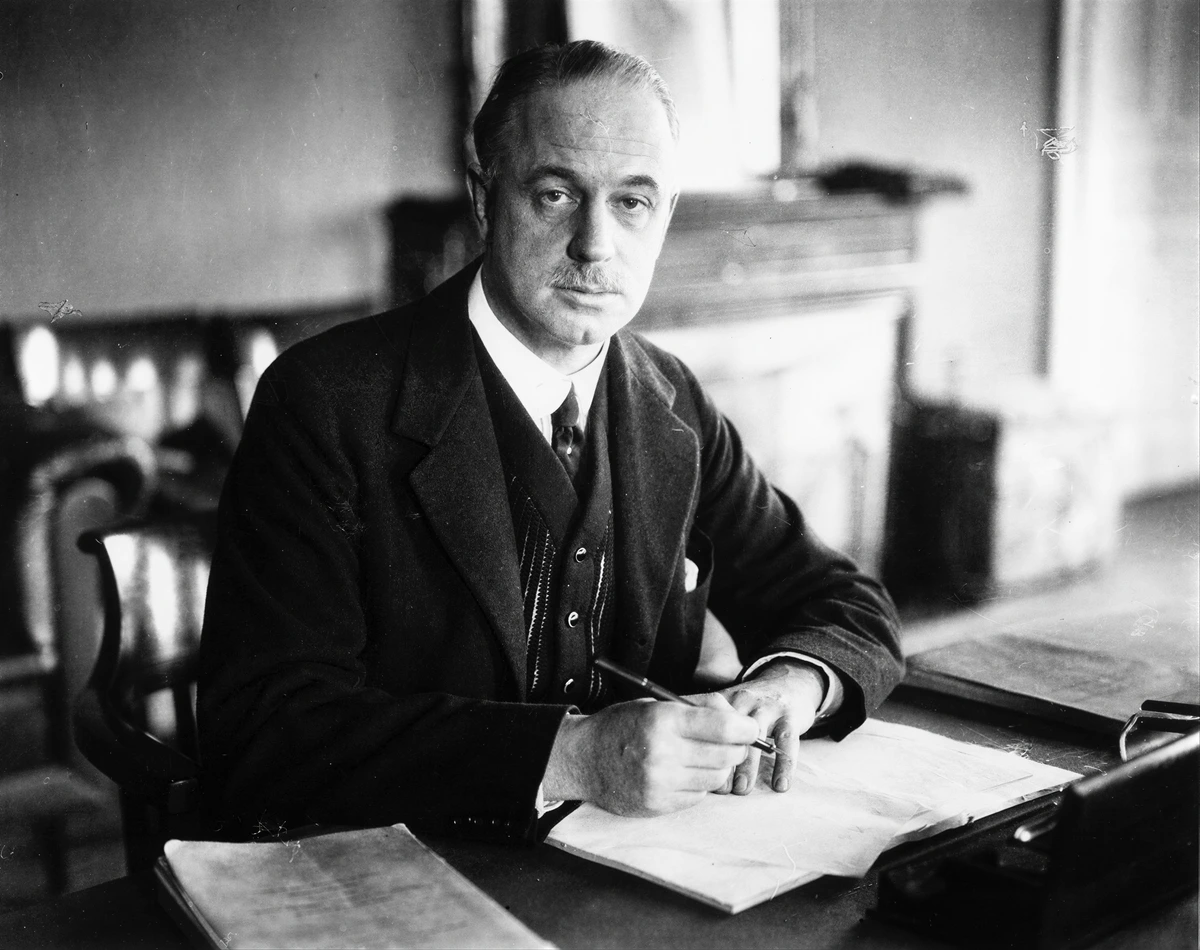
Drummond was born in Yorkshire, England, but belonged to an old Scottish aristocratic family. Yet, in his immediate family there was relatively little wealth. He was the eldest of three children and the only son, but also had two half-sisters and one half-brother from his father’s first marriage. He was educated at Bedford Grammar School and graduated from Eton College in 1895, where he learned French and was captain of the Oppidans (students who had distinguished themselves academically). Drummond had no university training, but after his graduation he spent a year travelling in Europe and studying languages, primarily in Germany. Although raised in a Protestant family, he converted to Roman Catholicism in 1903 in order to marry Mary Maxwell, who was also from an old Scottish family, but Roman Catholic. He entered the Foreign Office in 1900 as a clerk. His work was considered outstanding and, beginning in 1906, his career slowly and steadily progressed through a series of successful private secretaryships. Starting out as secretary to the Under-Secretaries at the Foreign Office, Edmond Fitzmaurice (1906-1908) and Thomas M. Wood (1908-1910), he went on to become private secretary to Prime Minister Herbert Asquith (1912-1915) and Foreign Secretaries Edward Grey (1915-1916) and Arthur J. Balfour (1916-1918). In 1917 he accompanied Balfour on his mission to the United States (US), during which President Woodrow Wilson broached the idea of the League of Nations to Balfour. Drummond and Colonel Edward M. House, who had met in 1915 and understood each other well, drafted a memorandum on the postwar situation in Europe for Balfour and Wilson, which came to be known as the House-Drummond memorandum.
In early 1919 Drummond was attached to the British delegation to the Paris Peace Conference after the First World War, which drafted the League of Nations’ Covenant. The initial British draft plan, which was supported by the American delegation, suggested that the office-holder, then called Chancellor, should be a prominent statesman with the power to take political initiatives and the willingness to engage with international criticism. Therefore, the office was first offered to Greek Prime Minister Elftherios Venizelo, then to Czechoslovakian President Tomas Masaryk, who both turned down the offer. With no other candidates available to play the political role initially envisaged, the nature of the office was reconsidered and drafters of the Covenant decided that the position, now called Secretary-General, should be one of a non-political functionary patterned along the lines of a senior government civil servant. The choice first fell on Maurice Hankey, Secretary to the Cabinet, the Committee of Imperial Defence and the Imperial War Cabinet, and it was only when Hankey declined the offer that Drummond, readily available at the Peace Conference and a trained and experienced diplomat, was offered the position. As a diplomat, Drummond was highly regarded by British and American decision makers who knew him through his wartime work. During the Peace Conference his familiarity with procedure and grasp of detail, combined with a marked detachment and trustworthiness, had also attracted attention and earned him a strong reputation. Little is known for certain about Drummond’s personal motives for accepting the position. He hesitated to take up office, as he feared the enormous task of organizing the League’s Secretariat. However, it seems that the prestige of the appointment in combination with a genuine interest in the idea of a League of Nations, which had been sparked by meetings with Wilson in 1917, were key factors in his decision. Arguably, difficulties advancing in the Foreign Office hierarchy also played a role for his new choice of career.
Drummond was appointed Secretary-General of the League of Nations on 28 April 1919. His appointment was part of a broader arrangement between the United Kingdom (UK) and France, under which a balance was established between British and French representation in the direction of the League and the International Labour Organization (ILO), also founded in 1919. Thus, Frenchman Albert Thomas became ILO Director, supported by a British deputy, while Frenchman Jean Monnet was made Drummond’s deputy. Despite these balancing mechanisms, the fact that the new League Secretary-General was an influential and well-connected British civil servant became the source of continuous debate and suspicion among the member states of the new organization. The formal basis for Drummond’s Secretary-Generalship was limited. Drummond did not hold any independent right to bring up for political discussion matters that might threaten the maintenance of international peace and security. However, he also faced few limitations and specifications as to the nature of the new international office and was left with much room for interpretation and initiative. The only formal guidelines directing his work were Article 6 of the Covenant, which stated that he was obliged to act in his capacity as Secretary-General ‘at all meetings of the Assembly and of the Council’, and Article 7, which granted him and other staff in the Secretariat diplomatic privileges and immunities. With no single political head in situ to whom he was responsible, permanent missions at Geneva still in their infancy and infrequent meetings of the Council and the Assembly (the Council met three to four times a year; the Assembly convened for a month once a year), Drummond was left with considerable scope for action. However, in developing his new role he approached the League in a way typical of the British foreign policy elite, attributing paramount importance to the great powers in international politics. He believed that the source of the League’s power and legitimacy lay squarely with its member states, the great powers in particular, and he had quite moderate expectations for the organization. He did not see it as his job to realize Wilson’s far reaching visions of world peace, but rather aimed to develop a League of Nations that could serve as a useful framework for negotiation, mediation and information exchange.
In keeping with this approach, Drummond’s key priorities as Secretary-General were to create cordial relations and trust with great powers inside the League and to expand the League’s membership to include major powers outside the League. Within the organization Drummond used a combination of tactful and discrete personal diplomacy towards national delegates in Geneva and their home governments and the strategic appointments of high-ranking League officials to increase interactions and build trust with the UK, France and Italy. Though generally respectful of all member states, it was evident that cooperation with the British Foreign Office was particularly close. As Drummond’s biographer, James Barros (1979: 130-131), observed, the Foreign Office was ‘willing within certain limits to work in co-operation with the world organization and saw in the League system certain advantages in helping implement British foreign policy desires and maintain peace. These attitudes in turn helped Drummond immeasurably in executing his own task in Geneva’. Drummond strongly supported US membership in the League since he believed this was paramount not only to the effectiveness of the organization’s collective security system, but would also draw Latin American states closer to the organization and ease cooperation with China. When it became apparent that the US would not be joining the new organization, Drummond worked hard to foster close relations with the US, not least in the League’s technical work. Drummond considered US non-membership to be the League’s fatal shortcoming, as he phrased it in an article in The Spectator (1945: 6): ‘The absence of the United States left the League maimed from its inception. Had America been, as was anticipated, an original member of the League the whole course of history might – and in my opinion would – have been completely different’. Drummond’s view of Socialist Russia was more ambivalent. He believed that it was necessary to recognize the new Communist regime in order to handle the many unresolved political issues after the First World War and worked to build constructive relations with Russia, later the Soviet Union. Personally, however, he was strongly anti-Communist and believed the totalitarian threat from the left to be far more serious than that from rightwing movements. Drummond felt that Germany should unambiguously become a League member. Even though German admission was negotiated outside the League, Drummond contributed to smoothing Germany’s entrance by providing information, comments and warnings during the negotiations and by doing what he could to accommodate Germany in its wishes for representation in the Council and the Secretariat.
In the early 1920s Drummond’s main focus was on navigating the many complicated and politically charged problems left unresolved by the war and the peace treaties. During the Saar, Danzig, Vilna and Teschen conflicts he attempted to secure a minor, but constructive, role for the League by insisting on the organization’s authority to intervene in the problems and to appoint local investigative and administrative commissions and select chairmen and, in the case of Danzig, High Commissioners. Even if his attempts were not very successful, he managed to establish the League as an entity separate from the Allies, capable of setting its own course. Drummond also had some early accomplishments. In 1920 he succeeded in providing the Norwegian explorer Fridtjof Nansen with some resources for his work on the repatriation of German and Russian prisoners of war. This work took on a permanent character when the Council instituted its High Commission for Refugees, headed by Nansen, in 1921. In 1921 Drummond also played an active role in helping solve what was a potentially dangerous dispute between Sweden and Finland over the Åland Islands. He had similar successes in conflicts such as the Costa Rican-Panamanian dispute in 1921, the Greek-Bulgarian border incident in 1925 and the Chaco dispute between Bolivia and Paraguay in 1928. In all of these cases it became evident that Drummond had actual authority to have important questions put on the Council’s political agenda. Overall, Drummond adopted a restrained, evolutionary approach to his work, gradually defining, demonstrating and expanding the League’s authority, much like ‘a winter skater: carefully testing the ice here and there always aware that somewhere further on the ice is dangerously thin’ (Barros 1979: 50).
A key characteristic of Drummond’s political activities as Secretary-General was that he was not promoting a particular, preconceived political course, but rather was focused on helping governments broker political compromise and continuously adjusted his course to find common solutions. In so doing, he worked with tact and discretion and circulated ideas, advice, recommendations, schemes and formulas through confidential talks with government officials or indirectly through delegates, members of the Secretariat or governments not directly involved but interested in the peaceful settlement of a particular dispute. Unlike ILO Director Thomas, Drummond did not place much importance in international public opinion, with the result that his activities were largely invisible. This discretion and careful use of the office increased his reputation among statesmen and by the middle and last years of his tenure, as seen for instance in the Manchurian crisis of 1931, he could undertake initiatives and actions that would have been considered unacceptable in the early 1920s, systematically monitoring the rising tensions in China and proactively developing plans for how to deal with the crisis from as early as 1927. However, he was unable to end the Japanese invasion. By the time his tenure ended in 1933, Drummond had become the confidant of most of the leading statesmen of the day and had ‘firmly established the idea of an international civil service and made the Secretary-Generalship a vital international office’ (Lloyd 2011). Throughout his tenure Drummond’s main focus was on European affairs. This was perhaps inevitable, given that Europe had been the principal battleground of the First World War and was the scene of a multitude of postwar problems. He was also better prepared for his role in the European setting than, for instance, in Latin America, with which his contacts remained peripheral, notwithstanding the League’s role in some Latin American conflicts.
Overall, Drummond focused his own personal activities on the League’s ‘high-politics’, dealing with diplomatic crises and conflict resolution, while leaving substantial room for independent policy development in areas such as the economy, finance, health and the mandate system to other League bodies and sections of the Secretariat. Just as the Secretary-General’s political role was vaguely defined in the Covenant, guidelines for the organization and running of the League’s Secretariat were largely absent. Article 6 stated that the Secretary-General held the authority to appoint secretaries and Secretariat staff with the approval of the Council. As the administrative head of the Secretariat, Drummond was skilful and efficient. Starting with no precedents to build on, he swiftly created a smooth and efficient administration of eventually 700 people from around 40 countries. Similar to his political work, he took a gradualist, pragmatic approach in this respect. In 1919 he laid out a skeleton organization that mirrored all tasks entrusted to the League by the Covenant as well as responsibilities placed on the League by other treaties. He then singled out the issues requiring early action or attention and focused on setting up services in these areas. From then on he let the new organization grow gradually as further needs arose, hiring staff when there was documented demand. The creation of the League’s Secretariat and the development of its activities were driven forward by a small group of dedicated liberal internationalists and statesmen with strong interest in the League. Outside the League, Drummond could draw support from people such as House and Raymond B. Fosdick in the US, Robert Cecil and Balfour in the UK and later Gustav Stresemann of Germany, Aristide Briand of France and Edvard Beneš of Czechoslovakia.
Within the League, Drummond quickly set up a small team of young, capable men and women who helped him develop the new organization, among them Monnet (Deputy Secretary-General from 1920 to 1923), Ludwik Rajchman (Director of the League’s Health Organization) and Rachel Crowdy (Head of the Social Affairs Section). Drummond based the Secretariat’s basic infrastructure on the one he knew from the Foreign Office. However, he was well aware that the League Secretariat could never be analogous to the non-political Weberian bureaucracy of national government. He believed that the Secretariat needed to have permeable boundaries and that a steady flow of ideas, information and people between the major powers and the new bureaucratic structure was a prerequisite for the new Secretariat’s legitimacy and capacity to act. Ensuring this while maintaining core principles of impartiality and a professional, meritocratic civil service that all member states would trust was a key challenge. Drummond dealt with this dilemma primarily by distinguishing between what might be termed ‘political’ and ‘administrative’ positions in the Secretariat, quietly earmarking most of the higher and more important positions for nationals of major states. These senior Secretariat officials were expected to stay in continuous contact with their home governments and national public opinions while similar activities were strongly discouraged in the Secretariat’s lower echelons, where strict impartiality, confidentiality and independence from national prejudice was expected. Drummond selected his candidates for the Secretariat in close cooperation with member states. The more powerful the state, the greater the deference shown in consulting with the state and accepting and acting upon that state’s advice and recommendations for nominations.
This focus on the nationality principle in the Secretariat’s organization was further accentuated by the fact that under secretaries-general and other high-ranking Secretariat officials tended to recruit staff of their own nationality, thereby creating national islands within the organization. This also applied to Drummond, whose immediate assistants were British or from the Dominions. As a consequence, small states and non-European member states were markedly underrepresented among the League’s officials. As leader of the Secretariat, Drummond was open-minded and he knew how to delegate, giving much latitude to his section directors. To these higher officials he was available for consultation and guidance and he actively involved them in policy development, as can be seen in the minutes of the Directors’ Meetings. By contrast, he was considered aloof and unapproachable by the Secretariat’s lower echelons. His wife publicly assisted him in his manifold social duties as Secretary-General in Geneva, which was rapidly becoming an international hub for diplomacy and transnational policy making. While Drummond worked long hours, he also enjoyed sports activities such as tennis, golf and bridge. Drummond’s term as Secretary-General had no legal time limit. However, in 1932 he chose to resign, given the strain of the work over a long time period, and his term ended on 30 June 1933. When he resigned, he tried (but failed) to prevent Deputy Secretary-General Joseph Avenol from succeeding him as Secretary-General. He believed Avenol did not have the personal qualities required for the post and also feared that a French candidate would be opposed by Germany and Italy. When evaluating Drummond’s inclination to prioritize the major powers and the nationality principle in organizing the League, it is worth keeping in mind how novel the idea of an international civil service was at the time. When the League was created in 1919, alternative plans were seriously discussed in which the League’s secretarial work was to be done by national delegations rather than a joint staff. Creating an international administration where staff acted on the instructions of the Secretary-General and on behalf of the organization, as defended by Drummond at the time, was in itself a major achievement. Also, during Drummond’s tenure, a gradual shift took place in which the top ranks of the Secretariat were increasingly seen as shifting away from national loyalties and becoming active proponents for League policies. This became the cause of some concern and criticism, as witnessed most prominently in the report of the so-called Committee of Thirteen in 1930 (Committee of Enquiry on the Organisation of the Secretariat, the International Labour Office and the Registry of the Permanent Court of International Justice, Report of the Committee, League of Nations Document A.16.1930; also Ranshofen-Wertheimer 1945: 25-31).
On his return to the Foreign Office in London in 1933 Drummond wished to become British ambassador to the US. This, however, was rejected by Prime Minister Ramsay MacDonald, who also turned him down for the post as permanent Under Secretary of the Foreign Office and the ambassadorship to France, allegedly all because of old grudges held against Drummond for converting to Roman Catholicism when marrying. Instead, Drummond became ambassador to Italy in October 1933. Drummond’s ambassadorship has been the object of some debate due to his conciliatory approach towards Benito Mussolini’s regime in Italy. He was sceptical of the League’s sanctions after the Italian invasion of Abyssinia in 1935 and after Abyssinia’s annexation in 1936 he argued for the promotion of positive British-Italian relations as witnessed in the 1938 Anglo-Italian agreement. He was on good terms with Mussolini and a personal friend of Italian Foreign Minister Galeazzo Ciano. While his engagement with the Fascist regime was, as Lorna Lloyd (2011) puts it, ‘a thankless and in retrospect futile endeavour’, it was also in line with, and appreciated by, the government in London. Viewed against the backdrop of his work as Secretary-General of the League, it also was in harmony with his fundamental ideas about the importance and rights of the great powers and the role and value of mediation over coercive measures in international politics. He held his ambassador post until April 1939 when he returned to the UK, where he was appointed to the Publicity Department of the British Foreign Office and then made chief advisor to the Ministry of Information (until July 1940). In 1941 he entered the House of Lords as a representative peer of Scotland (until his death), becoming the deputy leader of the Liberal Party in 1946. In 1944 Drummond was appointed chairman of the party’s committee to study the plans for the United Nations (UN) as laid down in the Dumbarton Oaks proposals. He supported the UN Charter’s strengthening of the political role of the Secretary-General, while at the same time arguing that the previous entanglement of the office and major member states on the office now had to end. He believed that the UN Secretary-General should preferably come from a small state and ‘must in no case be open to pressure from any Government, least of all his own’ (cited in Fosdick 1972: 46). Drummond, the seventh Earl of Perth, had succeeded to the earldom on 20 August 1937, following the death of his half-brother William Huntly Drummond. This made him Chief of the Clan Drummond. His son John David succeeded him in his titles when he died of cancer in his home, Funing House, in Rogate, Sussex in December 1951.
There is widespread consensus among historians that Drummond was a skilful administrative head of the League of Nations and a resourceful, cautious and discreet diplomatic representative of the organization, whose approach contrasted with the more open approach of his ILO contemporary Thomas. Views on the political impact and meaning of his office, however, vary. Drummond’s main biographer, Barros (1979), was the first to challenge the predominant view in early League historiography that Drummond had been a shy and passive Secretary-General. While stressing the severe structural constraints of interwar European politics, under which Drummond operated and which rendered most of his political initiatives inefficient, Barros also shows Drummond to be an active and skilled diplomatic operator. Lloyd (2011) draws an even more positive picture, focusing mainly on the intentions and qualities of Drummond’s activities as Secretary-General, while leaving aside the question of political impact. In doing so, Lloyd restates an interpretation presented by Drummond’s close friend Fosdick in 1972. Mark Mazower (2013) has taken an alternative approach to Drummond’s tenure, shifting focus away from his impact on European interwar politics and presenting him as the founder of the first major international public service, thus stressing the important constitutive effects he and other prominent League officials had on twentieth-century international public administration.
March 2025: book title added