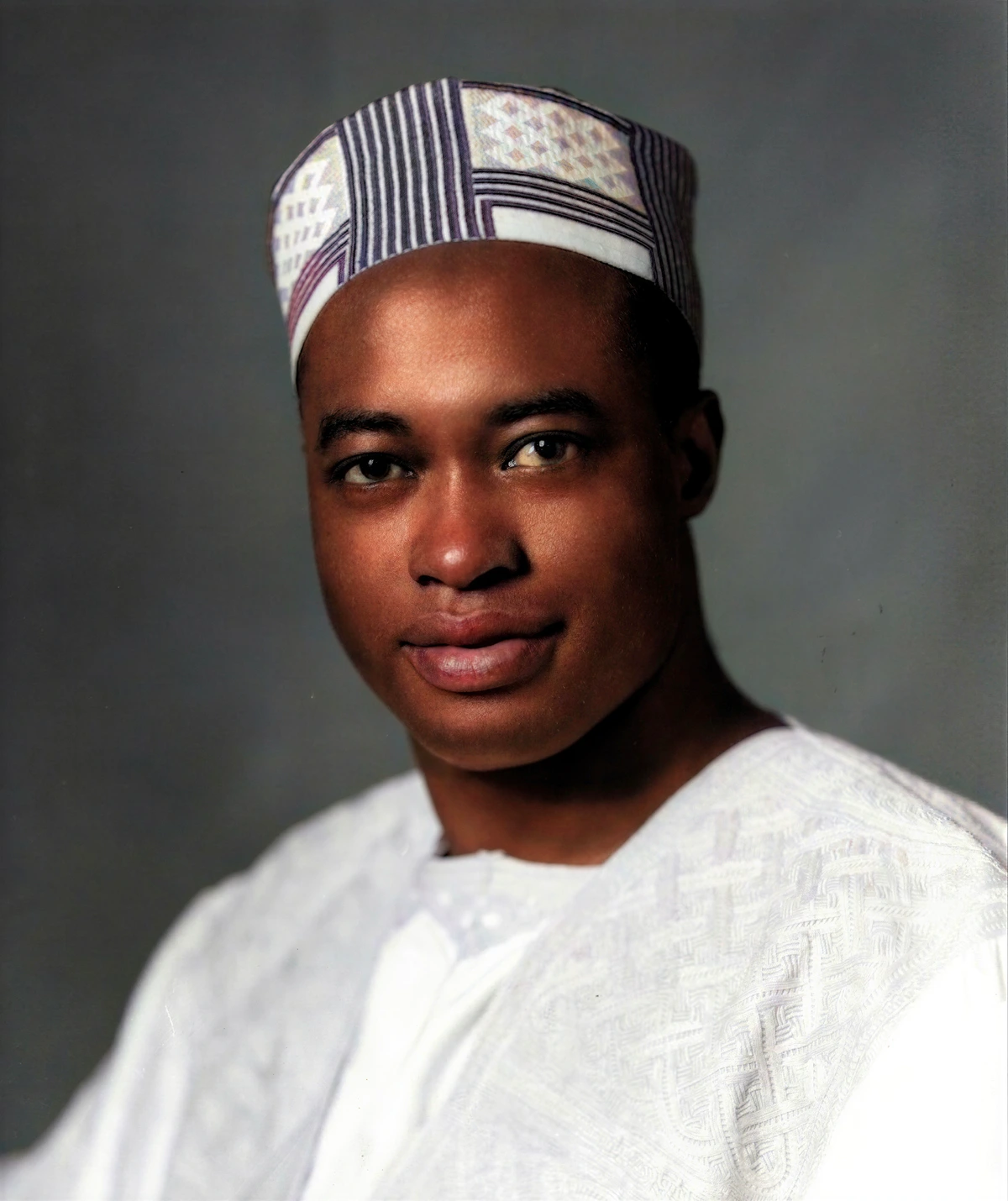
Biography
Diallo was born in a village in the Fouta Djallon highlands in central Guinea, where his father had a small herd of livestock. He was of Fulani origin, the large West-African ethnic group, also known by the French name Peul. Diallo was sent to Koranic school and then to colonial elementary school. The township chief praised Diallo for his commitment to learning. In 1940, when he was fifteen, the family moved south to Teliko and he attended school in nearby Mamou. Thanks to his French teachers, Diallo soon continued secondary school in Conakry. However, he could not complete his diploma (the Baccalaureate) because, at the time, it was unavailable to Africans living on the continent. He travelled to Dakar, the capital of French West Africa in this period, and enrolled in the William Ponty School in Sébikotane which was set up to train the intellectual elite of West Africa. When his family was no longer able to support his studies, he found a job in the general services branch of the General Government of French West Africa in Dakar in 1946. A French colleague drew his attention to a further career opportunity in colonial administration through the National School of Overseas France (ENFOM, École nationale de la France d’outre-mer). As this required the Baccalaureate and study in France, Diallo profited from the new administrative arrangement made for young Africans which allowed him to return to school. His Baccalaureate, awarded in 1947, enabled him to continue higher studies in France. He moved to Paris, where he enrolled in the Faculty of Law and Economics at the University of Paris, enjoyed student life and was influenced by debates about African cultural identity and ending colonialism among African intellectuals involved with the journal Présence Africaine, founded by Alioune Diop from Senegal. In 1951 he obtained his degree in law and economics and prepared his entrance examination for the ENFOM. He was awarded the first prize in the B competition of ENFOM, reserved for young people who were already civil servants. Diallo was among the first black Africans to enter ENFOM and chose the Judiciary Section, rather than the more popular General Administration. In 1952 he wrote his dissertation about divorce among Peul people in the Fouta Djallon region and, in 1954, he received his Doctorate in Private Law. Back in 1951 he married Kadiatou Diallo, who had the same (and in Guinea common) family name, but they were not related. She was also the first in her family to receive more than primary education, attending a French school for girls from eight West African countries in Rufisque, Senegal. The two met when Diallo’s school was organizing a party and he was tasked with contacting her school. Both continued their studies and convinced their parents that they would marry each other, rather than candidates their parents had in mind. She worked as a teacher, but eventually gave this up when she became the wife of a diplomat.
In 1954 Diallo was appointed to the newly created position of Deputy for the Public Prosecutor at the Court of Thiès in Senegal, followed by a position as magistrate at the Court in Cotonou, Dahomey (now Benin). When he became Chief of Cabinet of the High Commissioner for French West Africa in Dakar in 1955 and successfully applied as Secretary General of the Grand Council of French West Africa in 1957, he was ‘the highest-ranking African in the French colonial government’ (Quarles 2016). The latter position enabled him to become familiar with the rules, regulations and procedures of a representative institution and he became acquainted with several future African leaders, among them Ahmed Sékou Touré, who represented Guinea in the Grand Council. Touré, the undisputed leader of Guinea’s trade union confederation and the political movement towards independence, became the first President of independent Guinea in 1958. Following Touré’s wishes, the Guinean people voted ‘no’ in the referendum on a new constitution organized by France in September 1958. They favoured immediate independence, unlike the other colonies which chose more autonomy in the new French Community as proposed by French President Charles de Gaulle. As a result of Guinea’s independence in October France deprived Guinea of every possible support. Touré, who ‘would never quite trust the French-trained civil servant from the Guinean hinterland’ (Mortimer 1992: 282), nonetheless charged Diallo, who had taken unpaid leave to serve his new country, with securing Guinea’s admission to the United Nations (UN). Touré’s own efforts to arrange this through the French administration had failed.
France tried to delay Guinea’s admission, aware that Touré had not made a formal application for admission. Nominated as ambassador and personal representative of Touré on 15 October 1958, Diallo still had to learn to recognize Touré’s psyche. They visited Kwame Nkrumah, President of Ghana, for his support. Diallo, who understood the UN rules, still hoped to handle the admission with the support of France, but soon comprehended the French reluctance. He travelled to visit the British and American governments to know and influence their positions in late November and arrived at UN headquarters on 2 December, where he could use Ghana’s facilities and was received by Secretary-General Dag Hammarskjöld, who spoke French, to Diallo’s relief as his English at the time was poor. Diallo handed him the required papers for Guinea’s admission. He used the following days to learn his way through the UN organization, particularly agenda-setting at the Security Council, the General Assembly and its Fourth Committee (on trusteeship matters). He mobilized support from the African and Asian countries, discussed developments with the Communist countries and met with relevant member states such as Japan, the United Kingdom and the United States (US), while France was isolating itself as a result of its non-cooperative behaviour. On 9 December the Security Council voted to admit Guinea, with the abstention of France. The General Assembly confirmed the vote on 12 December. Diallo took his place in the hall, alphabetically next to Ghana, and was invited to deliver a speech.
Diallo became Guinea’s Permanent Representative to the UN between April 1959 and June 1960 and from March 1961 to June 1964, while he was also Ambassador to the US between April 1959 and June 1961. During the interruption between June 1960 and March 1961 Touré tasked Diallo with aiding and advising Prime Minister Patrice Lumumba of the Republic of Congo in strengthening Congo’s international standing. While Diallo remained a member of the Guinean delegation to the UN, Touré appointed Sory Kaba as Permanent Representative. In November 1960 Diallo left Congo, where a coup had taken place and Lumumba was arrested. Instead of returning to New York he sojourned in Guinea until 1 March 1961, when he presented his credentials as Permanent Representative to Hammarskjöld for the second time. Touré curbed Diallo by giving important functions to his half-brother Ismael Touré, when Touré was visiting the UN, and had Diallo accompanied by an assistant, who looked more like someone guarding him rather than supporting him. Touré also named someone else ambassador to France, a position Diallo would have appreciated. Diallo functioned well at the UN, particularly as an eloquent spokesperson in debates about decolonization and issues such as the Algerian war against French rule and arms supplies to South Africa. He aligned with the African and Asian group of countries that held an independent position between ‘West’ and ‘East’. In September 1962 Diallo was selected as one of the Vice Presidents of the General Assembly and in April 1963 he was elected Chairman of the Special Committee on the Policies of Apartheid of the Government of the Republic of South Africa. In April 1964 he chaired the UN observers’ delegation at the International Conference on Economic Sanctions against South Africa in London. In the UN he was seen as a fighter for Black Africa. US representative to the UN Adlai Stevenson called Diallo and his delegation ‘worse S.O.B.’s [sons of bitches] than the Russians’ (Mortimer 1992: 283). When directing a committee, Diallo impressed ‘experienced delegates with his firmness and competence’. In addition to his efficient direction of debate he was accessible to the press and ready to expound his views. At UN meetings he generally wore conservative European clothes, looking more like ‘an earnest, well-dressed college student than an ambassador’, but for ceremonial occasions he preferred flowing, colourful robes traditional to West Africa (The New York Times, 22 July 1964).
The Organization of African Unity (OAU) was established in Addis Ababa, Ethiopia on 25 May 1963, with the Provisional General Secretariat led by Kifle Wodajo from Ethiopia. The session took place in the Africa Hall of the UN Economic Commission for Africa (ECA). Diallo, who had attended all summits of African heads of state and government since 1958, chaired one of the two drafting committees that prepared the documents for the heads of state and government, dealing with decolonization, apartheid, racial discrimination and disarmament. Senegalese President Léopold Senghor wanted the OAU Secretariat to serve as an administrative body which implemented decisions but did not make them. Other founders also wanted a weak and apolitical secretariat. The office title Secretary-General was therefore changed into Administrative Secretary-General, with the position’s only authority being directing the routine affairs of the Secretariat. On 21 July 1964 the Assembly of Heads of State and Government in Addis Ababa elected Diallo (his name was suggested the previous year, but he had then failed to get the required majority) as the OAU’s first Administrative Secretary-General. He was preferred over other candidates because he was Guinea’s well-known representative to the UN and had the support of Haile Selassie, Emperor of Ethiopia, Nkrumah and Gamal Abdel Nasser, President of Egypt. Diallo won twenty-three votes against ten cast for Émile Zinsou of Dahomey, the candidate of several conservative French-speaking countries. Diallo organized the Secretariat in the buildings provided by Ethiopia and recruited a dedicated multinational staff. He learned to work with a different head of state as OAU chair each year and he often had to remind the member states to meet their financial obligations. The ECA had more resources and modern equipment than the OAU, which it made available to the OAU when needed. However, a rivalry existed between the two institutions and their leaders (Diallo and Robert Gardiner had met at the UN in New York), as the OAU regarded itself as the more genuine African organization and the ECA as the extension of the UN.
Although Diallo was Administrative Secretary-General, he regularly participated in the deliberations of all OAU organs. This practice went unopposed, ‘even during the period of severe attacks on some of his other activities’ for the OAU (Meyers 1976: 511). Diallo used the semi-annual Report of the Administrative Secretary-General to initiate discussion of controversial issues, which he felt the Council of Ministers and the Assembly of Heads of State and Government might try to ignore. He invigorated the Secretariat’s annual publication O.A.U. Review, established a tradition of holding regular news conferences and, as head of the only permanent organ, acted as spokesperson for the organization. He travelled widely and succeeded in involving the Secretariat in tasks which he felt needed attention. As additional responsibilities were delegated to the Administrative Secretariat (‘let Telli do it’), Diallo believed that the Administrative Secretary-General in his actual working ‘has been entrusted with a number of resolutions with some executive functions’ (quoted in Meyer 1976: 511-512). Right in the beginning of his tenure the OAU had to deal with the crisis in the Republic of Congo, where Moïse Tshombe had proclaimed the province of Katanga independent. He called in foreign mercenary soldiers, while Congolese Prime Minister Lumumba successfully requested intervention from UN forces. With the OAU divided between pro- and anti-Tshombe governments and a joint Belgian-American intervention taking place, Diallo kept arguing that the OAU had to resolve the dispute and took care that the organization remained involved. In his 1965 Report he proudly noted that the UN Security Council, by its resolution of 30 December 1964, had for the first time voluntarily turned to a regional organization to solve a problem falling within its jurisdiction. In 1965 he wrote an article about the OAU in historical perspective, in which he argued that its structure was flexible enough to deal with the many disagreements among African leaders. When the Assembly of Heads of State and Government decided in November 1965 that Diallo should formalize the cooperation between the OAU and the UN it reminded him of the limits of his authority, as the Assembly’s next session criticized him for having signed the agreement without having obtained authorization: ‘the reproof demonstrated reluctance to allow any expansion of his prerogatives’ (Meyer 1976: 512). The cooperation allowed Diallo to return to the UN in New York annually.
Diallo regularly visited leaders of OAU member states involved in disputes, reminding them of their obligations under the OAU Charter, and acted as a vehicle of communication between them. ‘Where his services have been needed, he has always been found immediately on the spot’, affirmed Liberian President William Tubman (quoted in Meyer 1976: 517). Diallo’s Report of the Administrative Secretary-General from February to August 1967 called attention to issues which some member states wanted to keep off the agenda, such as the civil war in Nigeria, the rebellion of mercenaries in Zaire and the occupation of Egypt’s Sinai territories by Israel. Secretariat members released controversial segments of the report to the press. During the Nigerian civil war and the secession of Biafra, Diallo was publicly active because he believed that the war was harming all of Africa and, therefore, helped to place it on the agenda of the 1967 Assembly meeting. In early 1968 he was invited to the annual meeting of the OCAM group (Organisation commune africaine et malgache). He publicly criticized the way that OCAM member state Rwanda and the International Committee of the Red Cross were handling the interned mercenaries who had rebelled against the Congolese government. Hamani Diori, President of Niger and Chairman of the OCAM meetings, openly criticized Diallo, who had been asked to not hold a press conference. When his re-election as OAU Administrative Secretary-General was on the agenda in July 1968 the more conservative OAU member states strongly showed their dissatisfaction, with the Rwandan delegation denouncing him for failing to be a neutral civil servant. Nonetheless, Diallo ended up being re-elected. Rwandan rival candidate Fidele Nkundabagenzi withdrew after two ballots. As the number of abstentions prevented the required two-thirds majority, three more ballots were required before Diallo was re-elected.
In his second term Diallo continued to support issues that he personally championed, which kept causing conflicts with less outspoken national politicians. In July 1969 the OAU organized a Pan-African Cultural Festival in Algiers, Algeria, inaugurated by Diallo. His efforts to provide a common understanding of African culture, however, revealed and enhanced contradictions between conservative and progressive countries on the continent. He regarded the ending of the Nigerian-Biafran hostilities in January 1970 as ‘one of the greatest victories of the OAU’ (quoted in Lewin 1992: 154). Diallo criticized British and French foreign policies that kept African states dependent. When Portugal invaded Guinea in November 1970, the OAU proved unable to respond because its Defence Commission rejected the formation of a centralized High Command and regional coordination failed. Diallo lamented that ‘nowhere is the sense of urgency so lacking in the majority of member states as towards the idea of an African High Command whose creation is the outstanding task of the Defence Commission’ (quoted in Franke 2010: 7). In 1971 several OAU member states proposed a dialogue with South Africa. Given the international campaign against apartheid, Diallo expressed strong opposition to this plan. He also opposed the OAU’s seating of the delegation of Uganda which represented the new government led by Idi Amin, who had launched a coup d’état and declared himself president. By 1972 Diallo had alienated quite a few member states and had also lost the support of Touré, whose enmity had grown although Diallo had repeatedly demonstrated his loyalty to him within the OAU. Some member states had even criticized Diallo for pushing Touré’s views too strongly. When the election of the new Administrative Secretary-General was on the agenda in Rabat, Morocco, Diallo was challenged by the less opinionated Nzo Ekangaki from Cameroon, who received thirty first ballot votes to Diallo’s ten. Ekangaki became the new Secretary-General on 15 June 1972.
Diallo returned to Guinea despite his friends and family advising that he stay away from Touré and Guinean politics. Why he returned and why he accepted to become Minister of Justice under Touré in August 1972 remains unclear, but this was likely based on feelings of homesickness, preparations for retirement and the impression that his international reputation would protect him from harm. Given the relevance of law, he urged young people to pursue legal studies. In 1973 he introduced a law that favoured people’s courts at the village and neighbourhood levels which made the judiciary less independent. To make the law function he composed a practical handbook. At its tenth anniversary in 1974 the OAU wanted to bestow upon Diallo its medal of ‘Hero of Africa’ for his contributions to Pan-African cooperation, but the plan failed because Touré forbade Diallo’s departure to Addis Ababa to receive the prize. Touré’s rule at the time had gone ‘from despotism to one of outright paranoia’ in which it did not help that Touré belonged to the Malinké ethnic group, whereas Diallo was of Fulani origin (Quarles 2016). On 18 July 1976 Diallo was arrested on charges that he and other Fulani were plotting to overthrow the government. They were sent to the Boiro concentration camp in Conakry, where they were tortured. Diallo’s first ‘confessions’ were publicly broadcast on 9 August, with new confessions that he was recruited for the US Central Intelligence Agency by Henry Kissinger being broadcast on 22 August. In December and January there was an exchange of letters with Touré, in which Diallo kept his dignity, but this did not prevent Diallo’s subjection to the so-called ‘black diet’ used in the camp. Deprived of all food and water he died on 1 March 1977 and was secretly buried in an unmarked grave (allegedly in the Nongo cemetery in Conakry).
Robert Mortimer (1992: 283) regards Diallo as the executive head who forged the ‘inherently fragile and divided’ OAU into ‘an instrument of creative diplomacy’. His position as an international civil servant, both in the UN and the OAU, however, was subordinate to the more powerful politician Touré. The two men were vastly different leaders: ‘the trade unionist and the magistrate, the national demagogue and the international diplomat’ and the relationship between these two antipodes was destined to end in tragedy (Mortimer 1992: 282). The OAU did not acknowledge the disappearance of its first Secretary-General and his rehabilitation remains a sensitive topic within the African Union. In 1983 Diallo’s death was documented in a book by Amadou Diallo, based on his own experience as a prisoner in the Boiro concentration camp between 1976 and 1980. French diplomat André Lewin, who was ambassador to Guinea (1975-1979) and had known Diallo during the two years prior to his confinement, wrote a detailed biography, published in 1990, based on many written sources and interviews, with the French Ministry of Justice refusing access to Diallo’s administrative dossier. In 1984 the Touré regime was overthrown and the Avenue du Général De Gaulle in Conakry was renamed Boulevard Diallo Telli. In 2005 Diallo was the posthumous recipient of the South African Order of the Companions of O.R. Tambo in Gold for his exceptional contribution to the struggle against colonialism and for championing the unity of the African continent.