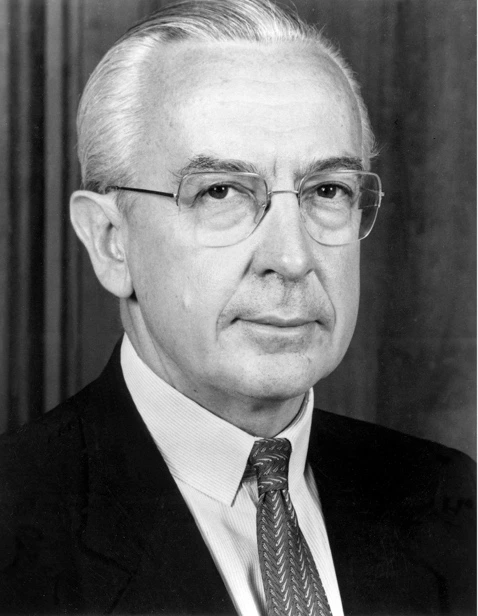
Biography
De Larosière was raised in comfortable circumstances in Paris to parents who, from an early age, taught him the virtue of frugality: ‘I cannot understand excess. When I grew up in Paris, my family never took a taxi; that was frowned upon. It was the Metro for us always’ (Halstead 1998). He attended the Lycée Louis-le-Grand and went on to study law and arts at the University of Paris. He graduated from the Institute of Political Studies (IEP, Institut des études politiques de Paris) in 1950 and received his doctoral degree from the celebrated National School of Administration (ENA, École nationale d’administration) in June 1958. In that year he entered government service in the Ministry of Finance, starting the career of an elite civil servant in the Inspectorate General of Finances. He reported on financial inspections in the fields of armaments and war and was sent on monetary missions to London (1962) and Alger (1962-1963), the capital of the former French colony Algeria which, after a guerilla war and a change of the French political system under President Charles de Gaulle, became independent in 1962. In 1963 De Larosière moved to the External Finance Office and in 1965 to the Treasury, becoming Assistant-Director for Multilateral Affairs in 1967. Between 1967 and 1971 he was Co-Chairman of the Economic and Development Review Committee of the Organisation for Economic Cooperation and Development. In 1971 he became Deputy Director and then Head of the Department of International Affairs of the Ministry of Economics and Finance.
Working with Finance Minister Valéry Giscard d’Estaing under President Georges Pompidou, De Larosière took part in the international monetary negotiations after the August 1971 decision of United States (US) President Richard Nixon to end the convertibility of the dollar into gold, which allowed the dollar to float against other currencies. As a member of the French delegation he helped to produce the so-called Smithsonian Agreement, an effort to achieve a stable exchange rate mechanism following the ideas of the Bretton Woods system, in Washington DC in December 1971. However, this agreement failed during the 1973 oil crisis. In 1974 De Larosière was named chief of staff to Giscard d’Estaing and Director of the Treasury before Giscard d’Estaing was elected President of France in May 1974, with De Larosière serving as Undersecretary for Monetary Affairs between 1974 and 1978. The plan of the European Economic Community (EEC) to create an economic and monetary union during the 1970s suffered from the oil crisis and disagreement between Germany and France over the means to achieve such a goal. The European Commission set up a study group chaired by Robert Marjolin and the Marjolin Report of 1975 pointed out that, given the lack of political will, it was still too early to establish stronger monetary cooperation within the EEC. De Larosière also engaged in discussions about reforming the international monetary system and the International Monetary Fund (IMF). At the initiative of Giscard d’Estaing a summit of five major states (France, Germany, Japan, the United Kingdom (UK) and the US) took place in Rambouillet, France in November 1975. The Rambouillet agreement established at the summit was discussed at an IMF meeting in Jamaica and resulted in a change of the IMF Articles of Agreement in 1976, which was seen as a first step toward a new system of international monetary management.
When IMF Managing Director Johannes Witteveen’s term came to a close in 1978, Giscard d’Estaing put De Larosière’s name forward and the Executive Board selected him unanimously after considering several other candidates. De Larosière began his five-year term as Managing Director on 17 June 1978. While in the French Treasury he had supervised the country’s foreign aid programs in Africa and had become quite sympathetic to the plight of stabilizing the African banking system. Upon assuming his new post he immediately expanded IMF lending to African member states, for which he was later criticized since repayment proved elusive. The program also raised concerns for the more conservative Executive Board members. By 1981 it had become clear to De Larosière that several large developing countries were on the verge of financial collapse and that the IMF could and should play a leading role in managing the looming crises. He played a key part in negotiations and took a hands-on approach to these and other negotiations, upsetting the conventional approach of staff-led talks (Stiles 1991: 35). He determined early on that default by major debtors could have serious, even catastrophic, ramifications for the global banking system since so many private banks were deeply committed and exposed. When Mexican Foreign Minister Jorge Castañeda visited him on 8 August 1982 to announce the country’s intention to impose a debt service payment moratorium the next day, De Larosière pleaded with him to delay and intervened with a few large private banks, assuring them that a bailout program was being negotiated. US Federal Reserve Chairman Paul Volcker was eager to help and the result was a ‘coordinated debt strategy’ whereby the debt was rescheduled and fresh loans were provided, while the Mexican government set about adopting austerity measures that satisfied the creditors (Doze 2005). Throughout the debt crisis, De Larosière often met face-to-face with the leaders of Mexico, Brazil and Argentina and others, pressing them to adopt austerity measures despite the political risks while at the same time acknowledging the particular needs and circumstances of each country. Ultimately, he helped bring about the Extended Fund Facility and other new lending arrangements that provided larger amounts for longer periods on somewhat more lenient terms. He generally consulted with the Executive Board, warning debtor nations of austerity and fiscal discipline as preconditions for bridging loans and debt rescheduling. On the other hand, he was also not afraid to communicate directly with New York bankers to explain the need for additional private lending to supplement IMF and public resources. In a key moment of the debt crisis in late 1982, De Larosière met with a group of bankers to tell them that they would need to provide five billion US dollars in new loans and to roll over existing loans: ‘the pressure put on the banks by the Managing Director was unprecedented, and it sent shock waves through the banking community’ (Boughton 2001: 307). While he was generally in agreement with Volcker on global monetary strategy, he did not hesitate to call the US to account for its budget imbalances. He was particularly sympathetic to US Treasury Secretary James Baker’s proposal in October 1985 to alleviate the debt of the world’s poorest through a series of new loans and outright debt forgiveness and took immediate steps to incorporate the strategy into IMF official policy.
De Larosière, whose command of the English language was better than that of some Anglophone diplomats, developed a reputation for precision and clarity at international monetary conferences. He came to be seen as a ‘technocrat’, perhaps unfairly, according to James Boughton (2001: 5), as he was a master diplomat, able and eager to coordinate delicate talks with debtor nations, major creditor states and the world’s largest banks. He appreciated the need for consensus, with the result being that he gave all interlocutors equal respect. De Larosière was the point man on IMF conditionality, a role that bolstered his reputation as a tough-minded monetarist over his tenure (he was reappointed for a second term without opposition in 1983). He was willing to accept a loss of popularity as long as this resulted in bolstering IMF policy. Because most creditors preferred to have the IMF be the bearer of bad news, they thus held him and his stance in high regard. He was also valued as a master of information and argument, often entering discussions with foreign bank presidents and finance ministers better armed with facts and figures about their own country’s conditions. He was deeply concerned about questions of privacy and discretion and was therefore trusted by many debtor country officials. He dominated the staff throughout his tenure, limiting their discretion and autonomy to a greater degree than his predecessors (Stiles 1991: 35). His reputation for toughness was generally deserved and he held firm to the need for austerity in almost every case of national indebtedness. He also resisted attempts by debtors to form a ‘debtor cartel’, such as the so-called Cartagena Group, and to negotiate with the IMF as a group, moving instead to quickly settle with particular major debtors with the aim of disrupting debtor solidarity. He furthermore took seriously the responsibility debtor nations had to meet their obligations, placing most of the blame on them rather than on over-eager lenders.
On 15 January 1987 De Larosière left office before his second term was concluded, accepting the French government’s invitation to replace Michel Camdessus (who became IMF Managing Director) as the Governor of the Bank of France, where he remained for six years. His new position brought him back to the issue of economic and monetary union in the EEC. Commission President Jacques Delors, who in 1985 had begun his strategy to complete the EEC’s internal market, then started a new campaign for Economic and Monetary Union (EMU). In 1988 Delors persuaded the European Council to set up a Committee, composed of central bankers and experts, with the aim of describing the necessary steps and stages to reach EMU. This so-called Delors Committee produced a report arguing that EMU was a necessary condition for the proper functioning of the internal market, but the Committee meetings were marked by tough struggles between Committee Chair Delors and the President of the German Central Bank, Karl Otto Pöhl, who disliked the close relations between French politics and the Bank of France and favored an independent central bank within EMU. De Larosière consulted with French Prime Minister François Mitterrand and succeeded in concluding an agreement with Pöhl to later propose an independent European central bank, which was not in line with what the French Treasury had in mind. The European Council endorsed the Delors Report in June 1989 and launched the first stage of EMU in July 1990. After the signing of the Treaty on European Union in Maastricht in February 1992 De Larosière succeeded in redrafting the Bank of France’s statute in 1993, making the Bank independent from political power. Between 1990 and 1993 De Larosière chaired the Group of 10, which controlled a financial facility that was related to the IMF but outside the IMF’s jurisdiction, and between 1992 and 1994 he chaired the EEC’s Economic and Monetary Committee, at a time when the UK was forced to leave the European Monetary System. He also played a key role in defending European currencies from aggressive speculation in 1992-1993. While the parameters of a new currency were debated, speculators intervened to manipulate several major European currencies and succeeded in attacking the British pound. In reaction to an attempt on the French franc, however, De Larosière, in coordination with central bankers in Germany and elsewhere, resisted the efforts with counter-intervention of their own.
In 1993 President Mitterand put forward De Larosière’s name as candidate for President of the European Bank for Reconstruction and Development (EBRD), which had been created in 1991 to promote reform in Central and Eastern Europe. The first president, Jacques Attali, proved controversial, given his strong anti-American attitude and the waste and mismanagement at the EBRD’s headquarters in London. The accoutrements were so ornate that the institution became known as the European Bank for Refurbishment and Decoration. Unlike Attali, De Larosière had no apparent political affinities, making him more appealing to the Bank’s member states. The only other candidate, former Polish Finance Minister Leszek Balcerowitz, withdrew and De Larosière was elected unanimously. He began his term on 27 September 1993. Although the Bank was not particularly active at this stage in its development, some very competent staff had been brought on board and it was poised for serious work. While refraining from disparaging his predecessor, De Larosière was personally offended by what he found and he immediately took steps to simplify and lower expectations. He held the operating budget constant in part by limiting staff salary increases and streamlining the agency’s structure and eliminated much of its political role in the process. To set an example of frugality he generally flew economy class (Halstead 1998). Under his tenure the loan portfolio quadrupled and he spearheaded efforts to bring the loan recipients into conformity with rigorous financial practices, a task that was easier said than done. He was careful to segregate loans to private entities from those aimed at non-profit and public institutions. Projects ranged from micro-credit to infrastructure projects. He left the EBRD on 31 January 1998, despite being invited to serve a second term, and formally entered into retirement.
Notwithstanding his retirement, De Larosière remained active. In 2001 he created and led a new think tank, the Observatoire de l’Epargne Européenne (European Savings Observatory), in order to share information and analysis about savings and loan activities across Europe. He continued to serve on corporate boards, particularly as senior advisor to the president at BNP Paribas from 1998 to 2008, and as a member of several informal advisory boards, including the Institute of International Finance, the Group of Trustees for the Principles of Emerging Markets and the financial advisory Group of Thirty that has been consulted by the European Union (EU). He was the French President’s representative to the New Partnership for Africa’s Development, a policy framework set up by the African Union in 2001, and between 2005 and 2009 he was a member of the International Advisory Board of the China Development Bank. He has encouraged the strengthening of international coordination of monetary policy, an increased monitoring capacity for the IMF and the EU and an increased attention to monetary policies, the looseness of which he blames for the 2008 financial crisis (De Larosière 2010). In 2009, shortly after the global financial crisis, the EU asked De Larosière to chair a high-level panel on the reform of the European financial supervisory architecture, the result of which was a detailed report with recommendations on how such a crisis could be averted in the future. In particular, the report called for the creation of new EU coordinating bodies to monitor systemic risk and coordinate regional responses. Both the European Parliament and the Council of Ministers agreed with the report, which in 2010 resulted in the establishment of the European Systemic Risk Board. In 2011 De Larosière co-authored the Schuman Report on Europe, devoted to Europe and the crisis as well as threats at large. De Larosière has received numerous commendations and awards, including induction into the French Légion d’Honneur. In 1993 he was elected a member of the Académie des Sciences Morales et Politiques of the Institut de France to the seat left vacant by the death of Cardinal Henri du Lubac.
May 2021: added that in 1987 Camdessus became IMF Managing Director