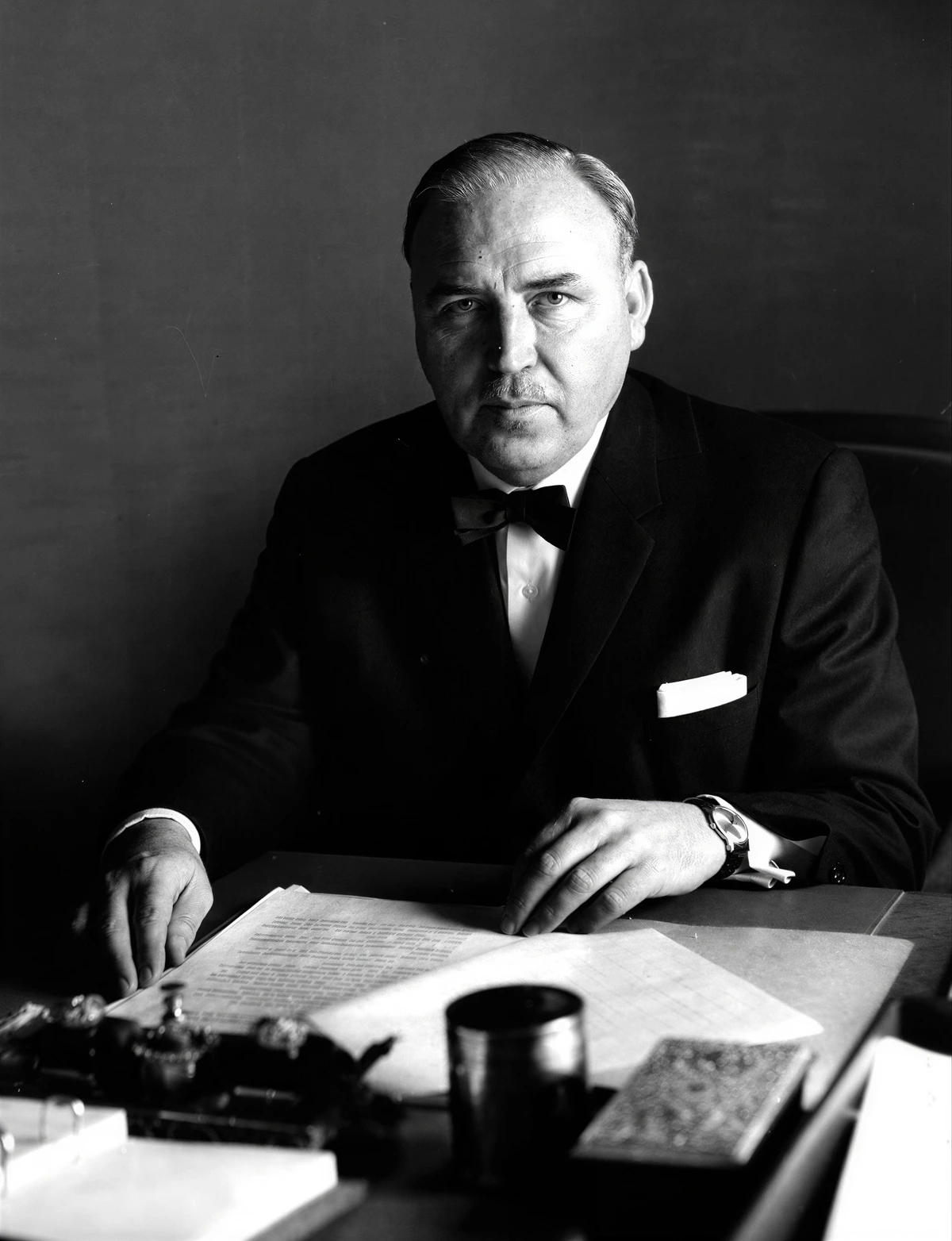
Biography
Davies attended Gladstone Road Elementary School in Barry, and then, from age eleven, Barry County School, where he excelled in his studies. He also enjoyed rugby, poetry and music, and a school trip to Bruges in Belgium in 1929 left lasting memories. His headmaster encouraged him to pursue the arts, but Davies decided to focus on mathematics at the suggestion of his father, who saw it as the ‘queen of the sciences’ (Davies, sixwells.net: 12). Davies earned a scholarship to the University College of Cardiff, where he studied under the mathematician G.H. Livens. He earned a double first degree in mathematics in 1935 and physics in 1936. After briefly considering a career in academia, he joined the Meteorological Office of the Air Ministry in 1936 and trained at Croyden. He made 16 Atlantic crossings studying weather conditions and, between 1938 and 1939, was seconded to the Irish Meteorological Service. When he married fellow student Mary Shapland in 1938, a headline in the South Wales edition of the News Chronicle read ‘fog for weather expert’s wedding’ (Davies, sixwells.net: 20). During the Second World War Davies served as Senior Meteorological Officer of the air component of the British Expeditionary Force. He helped to coordinate Royal Air Force flights over the North Atlantic Ocean and directed meteorological services for the flights that brought materials and delegates to the Yalta Conference in February 1945.
After the war Davies returned to work for the Meteorological Office in London. In 1949 he joined the British colonial service in East Africa as Director of the East African Meteorological Office. Davies managed general meteorological services in Kenya, Uganda and Tanganyika, oversaw the installation of weather radar in the region, participated in the planning of the Owen Falls Dam in Uganda and initiated a system for the automatic measurement of ionospheric layers in the upper atmosphere, which helped to improve radio transmissions. He also engaged in meteorological research projects, especially in tropical hydrology. Experiments included the artificial stimulation of rain through the explosion of impregnated gunpowder in clouds and later the development of cloud seeking rockets to encourage rainfall. Davies participated in the African regional association of the non-governmental International Meteorological Organization (IMO). The IMO was founded in 1873 to facilitate the exchange of weather information between countries and composed of the directors of national meteorological services. In 1950 the organization reconstituted itself as the World Meteorological Organization (WMO) in Geneva. In 1951 the WMO was recognized as a specialized agency of the United Nations (UN), meteorology being the only individual scientific field with such status. The WMO maintained the IMO’s embrace of state and colonial territories by granting membership to both independent states and dependent territories, allowing the broadest possible provision of meteorological services and collection of data. This membership structure also ensured the continuity of international meteorological participation for formerly colonized societies which established their own meteorological offices once they attained independence. As president of the African regional association (1951-1955), Davies participated in the WMO’s activities. His early experiences left him convinced that ‘knowledge of weather and climate, and the application of such knowledge to economic and social development, was a prime necessity in all countries of the world, whatever their state of development’ (Davies memoir: 152).
In 1955, after five years in East Africa, Davies was chosen to serve as Secretary-General of the WMO by the delegates at the WMO’s second Congress. On 1 January 1956 he replaced the organization’s inaugural Swiss Secretary-General, Gustav Swoboda. Davies’s candidacy received strong support from the African states and territories, which had previously elected him as the inaugural president of the WMO’s Regional Association I (Africa) in 1951. Davies established three main objectives as Secretary-General: to develop a more efficient Secretariat, to include every country in the WMO’s programs, a necessity for the intrinsically collaborative nature of meteorology, and to ensure that the WMO acted as a full member of the UN system. As an administrator, Davies sought to achieve greater efficiencies within the WMO. Looking back on his career in retirement, he was satisfied that he had increased the quality of WMO staff throughout his tenure while still adhering to the UN human resources principle of regional distribution (Davies memoir: 158, 161). He felt that his army staff college training helped him to devise an efficient document identification system for the WMO, where the purpose of each document was made apparent as it traveled through the organization. He was also successful in communicating the organization’s often technical work to lay audiences (Symonds - Davies, 31 January 1990, Bodleian Ms. Eng. c. 4667/295; Davies - Symonds, 13 February 1990, 4667/297). Davies understood that meteorology is an international undertaking in that it is a common interest, it depends on all states to contribute weather data and it requires the most recent technology and scientific expertise for operational and research purposes. Under his leadership, the WMO secretariat helped to develop such expertise and to provide scientific equipment, financial support and meteorological training to countries in the global South whose meteorological infrastructure was underdeveloped. The WMO established its own technical assistance program in 1968, now known as the Voluntary Cooperation Programme, to administer assistance. The WMO’s status as a UN specialized agency allowed it to participate in UN assistance programs, and the majority of WMO technical assistance has been administered in cooperation with first the UN Expanded Programme of Technical Assistance, and from 1972, the UN Development Programme (UNDP). An example has been the close cooperation of the WMO with UNDP, as well as the Office of the Disaster Relief Coordinator and the UN Environment Programme (UNEP), encouraged by the General Assembly in 1972. Davies oversaw an increase in WMO technical assistance aid from 250,000 American dollars in 1955 to over six million by the end of his tenure in the late 1970s. He regarded meteorology as one global collective issue where a high degree of international cooperation had been achieved. In his words, there were ‘three truly international languages – mathematics, music and the international meteorological codes’ (Davies memoir: 98). His signature achievement was the World Weather Watch Programme, created in 1963. This global weather data exchange system wherein states collaborate in the collection, analysis and dissemination of international weather information was made possible by the advent of satellite technology. It was later augmented by a Volunteer Cooperation Programme, wherein countries undertake their own projects which collectively contribute to the World Weather Watch.
In 1957 and 1958 Davies oversaw the WMO’s collaboration with the International Council of Scientific Unions (ICSU) in the International Geophysical Year. This was a program to collect reliable meteorological and other geophysical data on a global scale for one year. Several countries established research stations in Antarctica as part of the plan, an important prelude to the Antarctic Treaty which entered into force in 1961. Davies visited the American stations in Antarctica in 1960. The WMO also worked with the ICSU, as well as the UN Educational, Scientific and Cultural Organization’s Intergovernmental Oceanographic Commission, on the Global Atmospheric Research Program (GARP), which ran from 1967 until 1982. GARP’s capstone was the World Climate Research Programme, launched in 1980, which studies humanity’s impact on the global climate and has its secretariat hosted by the WMO. Davies’ interest in geophysical issues spoke to his view that meteorology, as an atmospheric science, was intrinsically connected with other geophysical sciences, such as oceanography and hydrology, and is thus invested in questions of the human environment. For these reasons, he came to see the WMO as an environmental organization which could play an important role in the study of human beings’ impact on the natural environment. Drawing in part on his experience in Africa, Davies helped to integrate hydrology into the WMO’s activities. As meteorological science developed, Davies came to believe that the WMO was the most appropriate UN organization to address issues such as the depletion of the ozone layer, the greenhouse effect and seismology. Indeed, he argued that much UN geophysical work could be centralized at the WMO (Taba 1991: 17). Davies also believed that it was important to foster greater collaboration with other UN specialized agencies whose mandates overlapped with that of the WMO. These included the Food and Agriculture Organization, the International Atomic Energy Agency, the International Civil Aviation Organization, the Intergovernmental Maritime Consultative Organization (subsequently the International Maritime Organization), the International Telecommunication Union, UNESCO and the World Health Organization (WMO 1990: 12; Davies memoir: 159). He also played a leading role in the UN Administrative Committee on Coordination (ACC), the body comprised of the executive head of each UN agency, which facilitated inter-agency coordination. Davies used the ‘direct personal contact’ with other agency executive heads to initiate and manage many of the WMO’s collaborative programs (United Nations Monthly Chronicle 1970; Davies 1985: 287). A signature achievement in this regard was his work as chairman of an ACC working group on the environment in advance of the UN Conference on the Human Environment in Stockholm in 1972. He delivered an address to the Stockholm conference in this role.
The WMO operated largely as an apolitical organization across Davies’ tenure as Secretary-General until 1979. Up to that point, the organization’s practical and scientific focus, as well as Davies’ efficient leadership, allowed it to balance ‘the sometimes conflicting interests of the advanced countries, which provided most of the resources, with those of the developing world, which carried most of the votes’ (Mason 1990). Davies worked closely with member states, making regular visits during his long tenure as Secretary-General. In March 1972 he was the first representative of the UN to make an official visit to the People’s Republic of China, which had just been recognized by the UN. Davies was impressed especially with the cooperative and enthusiastic participation in the WMO of both the United States and the Soviet Union. An American and a Soviet scientist, Harry Wexler and Victor Bugaiev, worked with Davies and WMO staff to prepare a report on the forces affecting the climate and the development of effective weather forecasting capabilities. The report was sent to the UN Economic and Social Council in response to a series of UN General Assembly resolutions on international cooperation for the peaceful use of outer space, and formed the basis for what would become both the World Weather Watch and the Global Atmospheric Research Program. The collaborative spirit which infused the WMO’s activities suggests that the geopolitical tensions of the Cold War have diverted historical attention from the substantive degree of East-West cooperation during the post-1945 era (Davies memoir: 208-209, 153; Iriye: 62, 67-68). The WMO developed a reputation under Davies’ leadership as an international organization where rationality, the free exchange of data and a collective adherence to the scientific method have prevailed over political and ideological conflicts (Soroos 1997: 17; Schemeil 2004: 79-80). This has set the WMO apart from many other UN organizations, although it is important to note that the WMO has left policy decision making for meteorological issues to partner organizations. An example is its close collaboration with UNEP. The latter drew upon WMO studies and data to galvanize support for the protection of the ozone layer, an effort which reached fruition with the Montreal Protocol of 1987. Davies worked with three UN Secretaries-General during his career, Dag Hammarskjöld, U Thant and Kurt Waldheim. He held Hammarskjöld in high regard and spoke on behalf of the ACC at a UN ceremony in Addis Ababa in 1961 marking Hammarskjöld’s death. Davies was impressed with U Thant’s political judgment (he represented the UN specialized agencies at the UN Geneva memorial after Thant’s death in 1974) and respected Waldheim as a diplomat (Taba 1991: 19). As the senior member of the ACC during Waldheim’s tenure, Davies did believe that Waldheim used the ACC as more of a sounding board rather than the forum for open deliberation and debate that Hammarskjöld and Thant had fostered (Davies, sixwells.net: 86). Waldheim awarded Davies the UN Peace Medal on his retirement in 1979. The WMO’s congress of 1979 made Davies Secretary-General Emeritus. Davies continued to pursue the theme of intra-organizational cooperation within the UN after his retirement from the WMO, attempting to organize a study group composed of retired heads of UN agencies and programs which would provide advice on UN affairs. The idea attracted some interest from other retired program heads such as Robert McNamara, but ultimately amounted to little (McNamara-Davies, 21 May 1985, Bodleian Ms. Eng. c. 4667/11). In his retirement in Wales, Davies edited and contributed to a history of the WMO, Forty Years of Progress and Achievement, and was active in the Welsh Centre for International Affairs.
Davies’ six consecutive terms as Secretary-General of a UN organization are impressive. Meteorology’s functional nature provided structural incentives for member states to cooperate, aiding Davies’ administrative tasks, but it was in part due to his administrative talents that the WMO grew beyond a narrow technical field of activity. The World Weather Watch and the Global Atmospheric Research Program in particular were ambitious global governance projects, which have proved successful on their own terms and have enabled the WMO to become an important actor in the global response to climate change. Through these and other collective initiatives, the WMO under Davies’ Secretary-Generalship established meteorology as a project of ‘infrastructural globalism’ (Edwards 2006: 230). As the nexus of a global information and standard-setting network for meteorology, the WMO under his leadership also became a model organization within the UN system. His colleagues (Obituary 1991: 266) regarded Davies as a ‘stern taskmaster’, but one possessed of integrity, sound judgment and composure. Hessam Taba (1991: 5), a member of the WMO secretariat from 1960 until 1984, lauded Davies’ ‘thoroughness’, a highly prized skill for both a scientist and an administrator, and his composure, noting that Davies ‘rarely showed irritation and anger was virtually unknown’.
June 2021: 1955 replaced by 1956 as start year at WMO