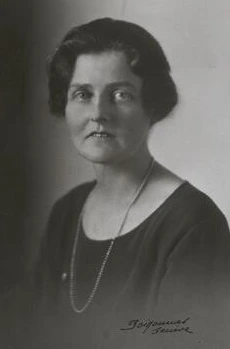
Biography
Crowdy’s father was a solicitor in Kensington. All four daughters in the family grew up with strong motivations to pursue careers involving social reform. Crowdy was educated in London, where she attended Hyde Park New College. At an early age she decided to become a nurse and started training at, first, the Jenny Lind Hospital in Norwich and later the Norfolk and Norwich Hospital, only to have her studies cut short by ill health. At the Jenny Lind Hospital she contracted blood poisoning and at the Norfolk and Norwich Hospital she suffered appendicitis and jaundice. Once her health was restored, she became a probationer at Guy’s Hospital in London where she qualified as a nurse in 1908. Having assisted a sick friend on a world cruise, she returned to London where she qualified for a diploma from the Apothecaries’ Hall enabling her to dispense medicines. Thereafter she managed a Government Provident Dispensary in a poor area of London. In 1911 she became a Red Cross volunteer, making her the first female dispensing chemist in that organization. She joined the City of Westminster Voluntary Aid Detachment (VAD number 22) and provided nursing support to the Territorial Army of Great Britain, in which she held the position of an officer. Between 1912 and 1914 she also lectured at the National Health Society.
Through the VAD, and together with Katherine Furse, her friend from Guy’s Hospital, Crowdy became active during the First World War establishing first aid and home nursing courses across the United Kingdom (UK). A group of VAD nurses, led by Furse and including Crowdy, was sent to Boulogne, France where it set up a medical support centre for wounded soldiers. During the first battle of Ypres, the unit assisted 30,000 men. At the end of 1914 Furse was ordered back to the UK, leaving Crowdy as Principal Commandant of the VADs on the Continent. She set up medical support centres along the main transport routes in France and Belgium, organized ambulance stations as well as quarters for nurses and the relatives of wounded soldiers. The VADs were so successful that an office was established in the Joint War Committee Centre at Boulogne to coordinate them. In addition to being mentioned in dispatches and receiving the Mons Star (a British medal for service in the war), her work earned Crowdy the Royal Red Cross Second Class in 1916 and First Class the next year. Despite suffering ill health herself during the war (pleurisy and pneumonia), she remained in France to work for a year after the armistice. In 1919 she became the first woman to be knighted by King George V, so receiving the title Dame of the Order of the British Empire. When Queen Mary visited northern France, Crowdy gave her a tour of the medical facilities.
As Crowdy’s medical role in France was ending, the postwar settlement in Versailles was being finalized. During the process women’s organizations, including the International Council of Women and the International Women Suffrage Alliance, lobbied the peacemakers demanding that women be considered for posts in the League of Nations. Their desires were reflected in Article VII of the Covenant, which declared that posts in the Secretariat would be open to men and women equally, and thereafter the institution exhibited fewer barriers than most public organizations of the time to the employment of women. When the League finally was pieced together in 1919, Crowdy was identified to lead its social projects. She did not, however, get the job just because she was a woman. Secretary-General Eric Drummond originally wanted a Scandinavian to lead the social projects because he had enough Britons involved in the Secretariat already, but when no suitable person could be identified, he appointed Crowdy (Gorman 2012: 63). Hence, she became the only woman to head a department of the Secretariat, a post she held from 1919 to 1931. The League’s Covenant contained two articles which became significant for her: Article 23, calling for measures to promote aspects of social welfare, such as steps against the traffic of women, children and opium as well as the control of disease, and Article 25, highlighting the need for cooperation with the Red Cross to improve health and to mitigate suffering around the globe. The Social Affairs Section was part of the League’s Secretariat and took a particular interest in trafficking. It was rebranded in 1920 to include, temporarily, health and again in 1922 when it was made explicit that the Section be responsible for opium traffic. Crowdy was extremely active. She worked to contain the typhus epidemic in the states bordering Russia during 1920-1922 and participated as the only woman in the epidemic commission’s investigative tour of the affected areas in Poland. She also played a part in the creation of the Health Section in 1921, out of the Social Affairs Section. She liaised with the International Office of Public Hygiene in Paris and the League of Red Cross Societies to smooth the way for the new Health Organization of the League that was to be led by Ludwik Rajchmann. Crowdy’s engagement with the typhus epidemic led to the development of an epidemic intelligence system. This began during the typhus period with the collection of information about the incidence of disease around Central and Eastern Europe as well as Russia, but later was expanded to the Far East with the opening of an epidemic intelligence office in Singapore to assemble information from that part of the world as well.
Her role in the Social Affairs Section also led Crowdy to champion initiatives to protect women and children as they crossed international borders, work which at the time she described as the most important project of her life (Spaull 1924: 48). In 1921 the League of Nations hosted an international conference on the trafficking of women and children, which led the same year to the International Convention for the Suppression of the Traffic in Women and Children. The League’s work in this area began through a committee, but after several years was firmed up through the establishment of a permanent commission, in part funded by the Bureau of Social Hygiene in the United States (US). At a time when many doubted that such trafficking was actually taking place, the commission tried to draw on the experiences of a number of staff who ‘worked as part of the underworld’ trying to understand the trade (Crowdy 1927: 157). In 1924 a Child Welfare Committee was established as part of the section and two years later a Child Welfare Centre was created. Crowdy’s background as a dispensing chemist also gave her an interest in the opium trade. With the drug viewed as a social scourge especially in the Far East, she worked alongside the League’s Opium Commission to define what quantity of the drug needed to be produced for strictly medical purposes, with the aim being to eventually restrict manufacture to this amount alone. Conferences on the illegal drug trade hosted by the League of Nations in 1924 and 1925 led to the International Opium Convention of 1925, which strengthened the 1912 convention of the International Opium Commission and aimed to establish controls over a range of drugs, including Indian hemp. The convention required signatories to keep a record of the production of opium and cocoa, also the distribution of heroine, morphine and cocaine. Crowdy was pleased by the large number of states that eventually signed the convention and, in due course, praised steps taken by India to reduce opium exports and the work of a League’s commission, which visited Persia to offer advice on how best to provide substitute crops for opium poppies.
Already in 1920 the international women’s organizations and Crowdy had urged the League to also take into consideration the situation of deported women and children in Turkey and neighbouring countries. The Assembly invited the Council to set up a commission with at least one female member. This commission was set up in early 1921 with two female members, Dane Karen Jeppe and American Emma Cushman (later replaced by American Caris Mills). Somewhat later the commission that collected information saw its powers extended, including the appointment of a Commissioner of the League in Constantinople to oversee the reclamations of women and children and the establishment of Neutral Houses in both Constantinople and Aleppo for the temporary reception and examination of reclaimed women and children. Despite the difficult political and military situation several thousand women and children were rescued by 1927, with many more receiving some form of aid. Jeppe and Mills carried out most of the work in the two cities, which resulted in Crowdy’s comment in 1925 that the two women of the commission were ‘the men of the party’ (Miller 1992: 139). Within the League Crowdy had to defend the continuation of women’s engagement in this kind of activity, struggling against not only the disapproval of fellow-members of the Secretariat but also against a lack of support from the British Foreign Office. By the end of the 1920s the importance of the work that the League had entrusted to women began to change significantly. Crowdy warned against this trend in 1929 at an annual dinner of women Assembly delegates, claiming that ‘a strong tendency was arising in the Secretariat of replacing by men the women who had developed small posts into great administrative offices because these posts had become too important for women’ (Miller 1992: 94). She herself was uncertain about her contract, as it had been renewed only by one year. A year later Secretary-General Drummond, who had allowed some women but never encouraged them, replaced her with a male Swedish diplomat, who had no social experience but humanitarian interests (Ranshofen-Wertheimer 1945: 161-162).
As her work with the League of Nations wound up in 1931, Crowdy began to take up a series of new roles for the British government. In 1930 she attended a conference on Pacific affairs in Honolulu and a similar event in Shanghai the next year. In 1935, putting her expertise in trafficking to good use, she sat on the Royal Commission on the Private Manufacture of Armaments. The body concluded that state control of the armaments industry was impossible, but recommended steps towards the extensive regulation of the trade. In 1937 she participated in a parliamentary commission, which went to observe the Spanish Civil War, and from 1935 to 1939 she served on the Royal Commission on the West Indies. In 1939 she married a British officer of the Indian army. During and immediately after the Second World War she served in the Ministry of Information as a regions adviser (1939-1946), which was her last appointment. Her husband died in 1952, but she lived for a further 12 years before succumbing to a coronary condition at her home in the outskirts of London at the age of 80.
Crowdy, who described herself as a social worker, was reputed to be a strong-minded woman who, through the force of her personality, her determination and manifold abilities, made a significant impact at a time when institutions more usually were populated and led by men. She was regarded as a particularly adept committee member. Her prominence in the League found a resonance with contemporary international women’s organizations, some of which had lobbied for women’s rights during the drafting of the peace settlement in Versailles in 1919. As her section pursued its work, her office provided a new kind of liaison between the League, governments and non-governmental pressure groups. In the process she helped build up international professional networks and generated a new model of international policy development. This does not mean that her work lacked all imperfections. There are signs that the quality of information obtained about human trafficking at times was poor and also, later in life, she regretted not doing more to address directly the problem of women’s inequality, not least in respect of pay (Crowdy unpublished: 4-6). Nonetheless, as increasingly the security agenda of the League of Nations is understood to have involved more than just collective security and élite diplomacy, so her projects deserve much greater discussion. Her leadership of the Social Affairs Section made Crowdy the most senior woman in the League of Nations during the 1920s (along with Florence Wilson, the League’s librarian between 1919 and 1927, and Nancy Williams, the de facto chief of the personnel office), although oddly she never received the same title of ‘Director’ as did other (male) section heads. She worked for the League for 12 years and received a number of awards as a result. These included the Order of Polonia Restituta (1922), for her part in the fight against typhus, and, as her time with the League concluded, the Order of Alphonso XII of Spain ‘for services of outstanding value in the international field of social reform’. In 1926 she received the honorary title Doctor of Laws from (woman-only) Smith College in the US. Once asked if the League of Nations spent too much time on humanitarian questions instead of material disarmament, her reply was that ‘spiritual disarmament was just as necessary as actual disarmament’ (Crowdy 1926). On another occasion she (1927: 153) commented more fully: ‘Those people who gave voice in Part XIII of the Treaty of Versailles to the sentiment that social unrest in any one country is a fruitful source of discord in all showed vision ... You may disarm the world, you may reduce your troops or abolish your battleships, but unless you introduce better economic conditions, better social conditions and better health conditions into the world, you will not be able to maintain peace even if you obtain it’. Crowdy completed the manuscript of her autobiography in 1940, which John Murray had agreed to publish but it was destroyed during the blitz that year. After the war she completed a revised version, To Ourselves Unknown, but she was unable to find a publisher then. Crowdy figures in Frank Moorhouse’s Grand Days (Chippendale 1994), which is a fictional account of the League of Nations, but based on archival research.