Biography
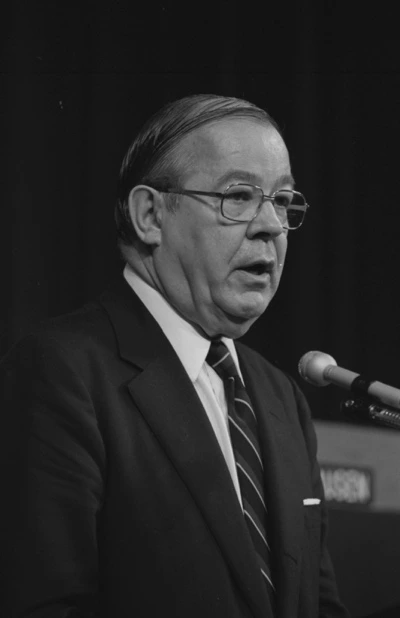
Clausen was born in the small town of Hamilton on the Mississippi River, where his father published and edited the local weekly newspaper. He was the second child, attended public schools in Hamilton and was brought up in a staunch Presbyterian and conservative Republican environment. He acquired his lifelong nickname Tom while playing a role by that name in a high school play. He earned his bachelor’s degree from Carthage College in Carthage, Illinois and, in 1944 during the Second World War, served in the United States (US) Army Air Corps as a meteorological officer and flew missions out of the Azores. After being discharged from the Army in 1946, Clausen took advantage of the G.I. Bill, entering law school at the Duluth campus of the University of Minnesota. He received his Bachelor of Laws in 1949 and was admitted to the Minnesota bar that same year. After graduating from law school, he went to Los Angeles in hopes of marrying Peggy Crassweller, the sister of a former classmate, who had moved to California. He intended to return to Minnesota with his new bride, but she was not prepared to immediately accept his proposal. They were married a year-and-a-half later.
In California Clausen took a temporary job counting cash in the Bank of America’s vault and went to night school to study for the California bar exam. His part-time job led to an offer to enter the Bank of America’s executive training program at a well-paid salary. When he passed the California bar exam in 1950 Clausen hoped that he would be offered a position in the Bank’s legal department. However, he progressed through the ranks of branch management and found the diversity of the tasks he was offered quite interesting, perhaps more so than practicing law. Assigned to the lending department of the Bank’s Los Angeles branch, where he specialized in high-tech firms, Clausen worked his way up to head the corporate finance department. In 1961 he became Assistant Vice President for financial relationships in electronics. In 1963 he was transferred to the Bank’s world headquarters in San Francisco and became a Senior Vice President in 1965. In the following year he completed the advanced management program at Harvard University’s Graduate School of Business Administration and was moved to an office next to that of the Bank’s President, Rudolph A. Peterson. As Executive Vice President, a position he held from June 1968 to May 1969, Clausen engineered one of the Bank’s most important international transactions, one that raised 250 million dollars for the development of open-pit copper mines on the South Pacific Island of Bourgainville. When Peterson announced his retirement, Clausen, who had become Vice Chairman of the Board of Directors in May 1969, was tapped for the Bank’s Presidency, a position he assumed on 1 January 1970, along with that of Chief Executive Officer of the Bank of America and its parent company, the Bank of America Corporation. During his first term as Bank President (1970-1981), the Bank’s assets more than quadrupled and it became one of the most profitable commercial banks in the world. He decentralized the Bank’s management, made extended loans to minorities a priority and introduced a policy for hiring minorities at all levels, including in the executive training programs. Clausen also introduced a wide-ranging disclosure code that anticipated the protection of lenders codified in the Truth-in-Lending laws passed by the US Congress in 1968. During his presidency he also raised the visibility of the Bank by serving as president of the International Monetary Conference of the American Bankers Association (1977), director of the trade council with the Soviet Union (U.S.-U.S.S.R. Trade and Economic Council, 1974-1981) and co-chair of the Japan-California Association (1973-1980).
Clausen’s international activities and actions at the Bank of America caught the attention of US President-Elect Jimmy Carter, a Democrat. The two met shortly after the November 1976 Presidential election. Carter’s advisers had named Clausen as their first choice for Secretary of the Treasury, but Clausen, who considered himself a conservative Republican, turned them down. When Robert S. McNamara told President Carter in June 1980 that he planned to retire as World Bank President when he turned 65 in mid-1981, Carter remembered Clausen. This time Clausen was receptive to Carter’s overtures, even though he had to take a significant reduction in personal income, from his 600,000 dollars annual salary to 78,000 dollars as World Bank President. Having spoken with foreign officials and US Congressional leaders and secured the approval of Republican Presidential candidate Ronald Reagan, Carter nominated Clausen for the post in October 1980, shortly before the November US Presidential elections, thereby forestalling other member states from arguing for a non-US World Bank President. Even though Reagan had given his consent, his close adviser on economic policy at the time, George Shultz, later revealed that the future president admitted that ‘had the choice been his, he might have selected someone else’ (Kraske 1996: 214). Clausen, who took office in July 1981, was unlike any prior World Bank President. All those who went before him were familiar with the workings of the US government, the World Bank or both. Before assuming the Presidency, Clausen immersed himself in a study of international business affairs and financial problems and undertook a ninety-day world tour to meet with political and business leaders and financiers. He also realized that he had to disassociate himself from his predecessor, McNamara, whose views of the Bank’s role in the world economy had become increasingly out of sync with the times, and especially views of many in the US government. This got to the point that when Clausen wanted to make a speech on disarmament, he gave up the idea when he was told he would sound too much like McNamara. Clausen understood his major task as convincing wealthier states to help economically less developed countries as a matter of self-interest. This turned out to be a daunting task, given that the Reagan administration and much of the US Congress was highly skeptical of foreign aid in general and the World Bank in particular. Almost immediately the Reagan administration undertook a comprehensive review of the merits of US participation in multilateral development banks, taking an especially close look at the International Development Association (IDA), the World Bank’s affiliate for concessional loans to some of the world’s poorest countries. Although the review demonstrated the merits of the IDA, a ‘lingering prejudice’ (Kraske 1996: 221) remained and affected working relations between the World Bank and its major shareholder, the US, throughout Clausen’s presidency.
Clausen expanded World Bank loan programs that demanded states liberalize their economic policies as a condition of receiving loans and argued for further trade liberalization and the importance of market forces. He raised fees on World Bank loans, replaced the traditional Bank practice of charging fixed interest rates for its loans with a system of variable interest rates and emphasized that the causes of economic problems in economically less developed countries were due to domestic policies rather than external causes. He did not believe in ‘taking from the rich and giving to the poor’, but rather ‘in helping the poor help themselves’ (quoted in Guhar and Clausen 1983: 3). He put new emphasis on the International Finance Corporation, the private sector arm of the World Bank Group and, according to Mahbub Ul Haq, announced early on in his term that poverty alleviation ‘did not figure in his thinking at all’ (quoted in Kraske 1996: 225). Although these positions accorded with views widely held by conservatives in the US government, he was criticized for his support of the IDA and his few statements (in 1982 and 1985) that alleviation of poverty remained one of the Bank’s central missions, for his strong advocacy of population control, for his decision to make two senior appointments against the views expressed by US Treasury officials and for moving too slowly to confront the debt crisis that affected economically less developed countries in Africa and Latin America, particularly Mexico. The World Bank’s delayed response, including relative to the International Monetary Fund (IMF), depended partly on ‘the wishful but almost universal estimate’ that the crisis posed a ‘liquidity’ and not a ‘solvency’ problem and that the division of labor between the two organizations allocated such short-run matters ‘mainly to the IMF’ (Kapur et al. 1 1997: 24). Clausen was also criticized, inside and outside the Bank, for meeting with those who criticized the Bank’s failure to take into account the environmental consequences of its projects, particularly the Polonoroeste Road project in Brazil’s Amazon from which he eventually withheld funding, and for meeting with those who advocated the need for the Bank to impose ecological design and review procedures for its projects. There was more support for the Bank’s interactions with China, which acceded to the World Bank toward the end of McNamara’s presidency. Under Clausen, the Bank’s role was primarily a ‘didactic one of educating a cadre of Chinese officials’ in new economic ideas and technical systems, putting together comprehensive reports on the Chinese economy and using early loans to rebuild a higher education system that still suffered from the aftermath of the Cultural Revolution (Kapur et al. 1 1997: 24). Whereas China and education were a new focus of Bank attention, during Clausen’s term the bulk of the Bank’s funding went to agriculture, Sub-Saharan Africa and energy, the latter being particularly important in the aftermath of increased oil prices by the Organization of Petroleum Exporting Countries. While the US initially supported the Bank’s loans in the energy sector, criticism later arose in the Reagan administration from those who believed that lending for oil and gas exploration and development should be left to the private sector. Clausen initiated a new Bank affiliate, the Multilateral Insurance Guarantee Authority, whose mission is to promote foreign direct investment in economically less developed countries, although this was not established until after Clausen had left office. Clausen also took an active role in promoting co-financing of projects, with funds coming from the Bank, official sources, export credit agencies and commercial banks.
Clausen’s admirers valued his managerial expertise and commitment to delegation of authority, a vivid contrast to his immediate predecessor. Others, however, found that his consensual decision-making style resulted in ‘little easy consensus’. The two Senior Vice Presidents, Ernest Stern and Moeen Qureshi, headed separate factions that managed to generate ‘pervasive tension in the organization, which kept many, including the president, on edge’ (Kapur et al. 1 1997: 26). Clausen also had some problems with the Bank’s executive directors, who themselves were prepared to take on management of major issues. This included confrontations over the Bank’s budget. Clausen welcomed the replacement of Donald Regan with James Baker as US Treasury Secretary. Personally, he much preferred ‘the pragmatic, gentlemanly Baker to the outgoing secretary, the ideological, confrontational Donald Regan’ (Kraske 1996: 234), even when Baker, no less than Regan, wanted to limit US financial commitments to the IDA and the World Bank. Even after Congress authorized payment of funds, through spread over four years instead of three, relations with the Bank remained tense. Liberal politicians and commentators believed that the stringent reforms advocated by the Bank ‘harmed developing countries’, using ‘public monies to bail out the commercial banks’, while right-wing politicians did not want to ‘waste’ money on foreign aid in the midst of a serious domestic economic recession (Kraske 1996: 235). Clausen made no secret of his disappointments and frustrations and publicly criticized the Reagan administration’s fiscal policies. In addition to his regular appeals to the Bank’s governors to support an expansion of the Bank’s roles, Clausen took the Bank’s case actively to the news media, business gatherings and bodies such as the Overseas Development Council and the Bretton Woods Committee (the latter was set up in 1983 to publicly discuss the importance of these international financial institutions). In October 1985, as the annual IMF-World Bank meetings were about to start in Seoul, South Korea, Clausen was told that the US would not support his reelection the following year. In his speech the next day he preemptively announced that he would be stepping down. This actually surprised many in the administration, who had not yet agreed on a successor. His retirement became effective 30 June 1986. Clausen may have contributed to a change in attitude in the US government, but such change was only apparent after he had left the Bank. While he was in office he lacked the ‘insiders’ knowledge of Washington ‘needed to deflect the ideologically and politically motivated attacks leveled at the Bank’, but whether anyone could have ‘navigated more skillfully through those troubled times’ remains unclear (Kraske 1996: 244).
Clausen’s retirement did not last very long. On the evening of his last day at the World Bank he received calls from key members of the board of directors of the Bank of America about the problems that had grown up in the years of his absence. By October 1986, a month after he had joined the board of the pharmaceuticals group Wellcome as a non-executive director, the board of the Bank of America had fired the top management and recruited Clausen as Chief Executive Officer to manage a serious financial crisis and to ward off the threat of a hostile takeover. This reappointment was not without controversy, but when Clausen returned to the Bank of America, he found that it had huge loan losses, both domestically and in Latin America, and that it was suffering from low morale and antiquated technology. He embarked on a program of cost cutting and capitalizing on the Bank’s retail branch network. He cut jobs, sold businesses and fought off a vigorous takeover attempt by First Interstate Bankcorp, about which he said: ‘I have so far seen no compelling advantage in the proposed merger – for either the shareholders of Bank of America or the customers and communities we serve’ (quoted in Robinson 1987: 2). By the time he left the Bank in May 1990, it had posted a one-billion-dollar annual profit. Clausen estimated it was ‘within shouting distance of being an excellent bank’ (quoted in Schwartz 2013: D6). Accordingly, in 1990 he was quoted in the San Francisco Business Magazine as saying: ‘I am now a turnaround specialist’ (quoted in Miller 2013: Bl0). Although always known as a workaholic, Clausen found time throughout his career to serve on the boards of the World Affairs Council of Northern California, the University of California San Francisco Foundation, the Haas Business School at the University of California-Berkeley and Carthage College. He also served as a trustee of the Asia Foundation and the International Center for Economic Growth and was a member of the Bretton Woods Committee, the Brookings Institution, the Japan Foundation for Global Partnership, the California Business-Higher Education Forum and the Korean-US Wiseman’s Council. Clausen died in January 2013 due to complications from pneumonia. His enduring charitable legacy continued in the form of the Clausen Center for World Business at Carthage College, the A.W. and Mary Margret Clausen Chair at the University of California Memory and Aging Center, the Diabetes Center at the University of California-San Francisco and the Education and Support Scholarships at the Northern Light School in Oakland, California.
May 2021: IBRD and World Bank explained in heading