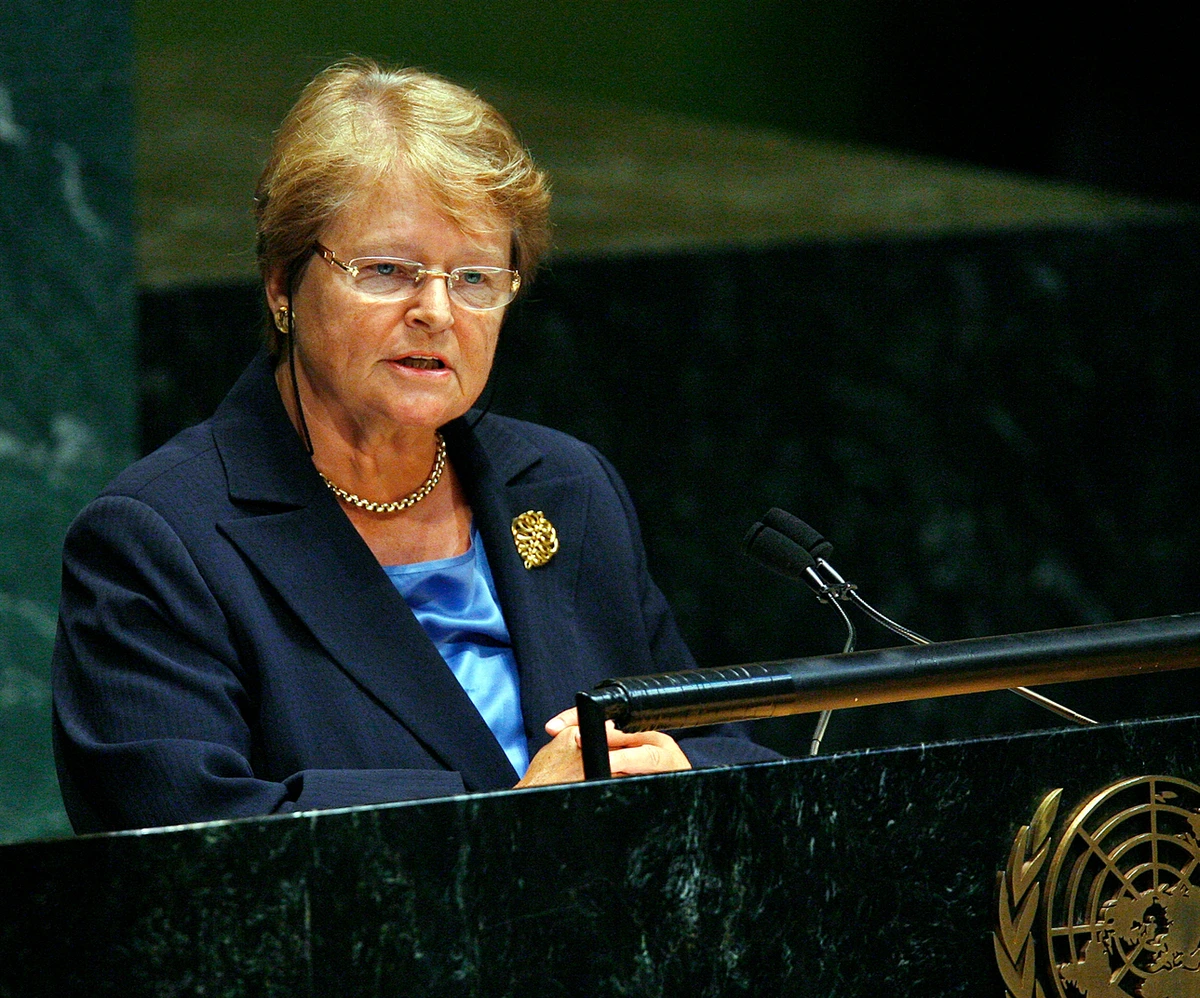
Biography
Harlem, the first of four children, was born into a family of prominent Social Democrats a few months before the Second World War broke out. Her parents had met in 1938 in Norway, but, because of the hardship of the German occupation, they left for Sweden in 1943 and stayed there until returning to the Norwegian capital Oslo at the war’s end in 1945. Her mother, born in Sweden, had studied law and, at times, worked for the Parliamentary group of the Norwegian Labour Party. Her Norwegian father was a physician, also involved in politics from an early age when he was a member of the Communist organization Mot Dag, but he had joined the Labour Party, Arbeiderpartiet, in 1936 and would serve in the government twice, first as Minister of Social Affairs (1955-1961) and then as Minister of Defence (1961-1965). Their children were raised in an egalitarian environment and were introduced to politics at an early age, with Harlem enrolled in the Social Democratic youth organization at the age of six. When her father received a Rockefeller scholarship to conduct studies in medical rehabilitation, the family stayed in New York from August 1949 to May 1950. A few years later they lived in Egypt, where her father served as a United Nations (UN) expert in rehabilitation. Harlem followed in the footsteps of her father, enrolling in September 1957 at the University of Oslo to study medicine. During her studies she met Arne Brundtland, a student in political science with opposite political views. He was a member of the Conservative Party and became an academic at the Norwegian Institute of International Affairs. They married in 1960. He agreed to support his wife’s career by sharing household duties and the upbringing of their four children, who were born between 1961 and 1967. She graduated in 1963 and won a scholarship to undertake a Master’s degree in Public Health at Harvard University in the United States, where she wrote her thesis on the importance of breast-feeding for both mother and child, and deepened her interest in the relationship between medicine and society as well as the environment. Her education strongly influenced her political ideas: ‘As a social democrat I strive to change society in such a way that it is healthy for people, enhances equality and distributes primary needs in an honest way’ (quoted in Ribberink 2006: 72). Back in Norway in 1965 she worked as a physician for nine years, and also acted as a consultant to the Ministry of Health (1965-1967), a medical officer for the Health Department of Oslo (1968-1969) and Deputy Director of the Oslo School Health Services (from 1970). She had a particular interest in public health and children’s health issues and during the early 1970s moved closer to the feminist movement. She supported the abortion rights movement, which succeeded in legalizing abortion in Norway in 1978.
Brundtland’s political rise began in 1974, when she became Minister of the Environment. Her defence of the right to abortion had caught the attention of the Labour Party executives, although as an educated woman from a prominent family she did not match the party’s common membership. However, at the time the party was struggling with internal and leadership problems. Brundtland succeeded in developing several environmental policies, especially the preservation of the Hardangervidda wilderness through the creation of a national park and taking action against acid rain. In 1977 she was credited for her rapid reaction in preventing a leak on a North Sea oil platform from developing into a natural disaster. The media began to refer to her as ‘green goddess’ (Ribberink 2009: 586). In 1975 Brundtland had become deputy leader of the Labour Party and in 1977 she was elected as a Member of Parliament. After resigning as Minister for the Environment in 1979 in order to revitalize the party, she sat on the Finance Committee. In 1981 she became party leader and also Norway’s youngest and first female Prime Minister, when Odvar Nordli, also from the Labour Party, stepped down for health reasons. In her memoirs Brundtland (2002: 151) explains that she felt that her critics were harsher because she was a woman and that she was attacked for her clothing, hairstyle, speech, gait and manner of leadership. Strengthening women’s rights and reducing the gender gap became important goals of her mandates. In total she fulfilled four terms as Prime Minister, always with a minority government (1981, 1986-1989, 1990-1993 and 1993-1996). Eight of 18 ministers in her second cabinet were women. Brundtland insisted on promoting the representation of women in politics, economics and civil bodies and introduced gender quotas. She also worked on facilitating the combination of household tasks with a paid job by strengthening childcare facilities, followed by the introduction of a Ministry of the Child in 1990. During her second term she dealt with a particularly difficult economic situation, which obliged her to conduct an important devaluation of the Norwegian krone. She could not prevent her party from losing the 1989 elections and had to step down. Between 1989 and 1990 she led the opposition until the Labour Party regained power in 1990. During her third and fourth terms she gave high priority to tackling unemployment. In international affairs she supported the North Atlantic Treaty Organization, the creation of the European Economic Area in 1991 and the entry of Norway into the European Economic Community. She was disappointed that the Norwegian people voted against entering the European Community by a majority of 52 per cent in the referendum of 1994. She was not universally praised for her environmental actions as Prime Minister. Greenpeace criticized her for authorizing the resumption of commercial whaling in 1992, her most controversial decision, which damaged her reputation as a champion of the environment. The family suffered a tragedy in that year, when they lost their youngest son, who took his life at 25 after battling psychiatric problems for years. In her memoirs Brundtland wrote at length about her sense of guilt and despair. To lessen her workload she resigned from party leadership. In October 1996 she decided that she was not going to lead the Party through another election and resigned as Prime Minister, but did not retire from political life because she continued as a Member of Parliament. She also used that period of time to write her memoirs, Madam Prime Minister, first published in Norwegian and later translated into English. In the private sphere her mother, who acted as her daughter’s personal secretary, and her husband, who stayed a convinced conservative until the late 1980s, both supported her. Her husband announced in 1989 that he was now voting for his wife’s party and he chronicled their lives in two books, published in Norwegian, Married to Gro (1996) and Still Married to Gro (2003).
As a politician Brundtland had gradually gained attention on the international scene. In 1980-1981 she was a member of the Independent Commission on Disarmament and Security Issues, chaired by the Swedish Social Democrat Olof Palme, which enabled her to gain new insights into world affairs and to build relationships with other international leaders. International recognition came in 1983, when UN Secretary-General Javier Pérez de Cuellar appointed her as head of the World Commission on Environment and Development, which was tasked with investigating worldwide problems relating to the environment, poverty and population growth. In 1987 the Commission presented its report, Our Common Future, popularly known as the Brundtland report. The report placed the environment high on the international agenda, calling for environmental thinking to be integrated at all political levels, and presented the new concept of sustainable development as ‘development that meets the needs of the present without compromising the ability of future generations to meet their own needs’ (1987: 43). The report brought Brundtland much praise and also called for a follow-up conference, the Earth Summit, which was organized in Rio de Janeiro in 1992, where Brundtland delivered the opening speech. At the 1994 UN Population and Development Conference in Cairo she criticized the religious condemnation of contraceptives and abortion and asked for their decriminalization, which caused uproar with religious leaders. Due to her international stature, she was under consideration for several international organization leadership positions, with UN Secretary-General Kofi Annan contemplating her as a possible candidate for Deputy Secretary-General of the UN and the Norwegian Minister of Health exploring the idea of her taking over the leadership of the World Health Organization (WHO).
In April 1997, after being approached by two Norwegian physicians who had worked at the WHO, Brundtland agreed to run for the position of Director-General of the organization. The WHO Executive Board elected her in January 1998, when she polled 18 votes out of 32 in the fourth round, against ten to George Alleyne, Director of the Pan American Health Organization, and four to Uton Muchtar Rafei, WHO’s regional director for Southeast Asia. On 13 May the World Health Assembly confirmed her nomination and Brundtland took office on 21 July 1998. She was a candidate from outside the organization as well as a woman, and the election of someone with these two qualities signalled that things at the WHO were changing. She was elected with a clear mandate to reform the organization and to restore its place on the international stage. During the 1980s and the 1990s the WHO had been weakened by internal difficulties. The management of Hiroshi Nakajima of Japan, Director-General from 1988 to 1998, was severely criticized for its over-centralization and cronyism and the United States and Western European countries had contested his re-election for a second term in 1993. The WHO was also facing financial and organizational difficulties. The organization’s regular budget was frozen and in 1996 it had lost leadership in the fight against HIV/AIDS, which was regarded as the decade’s major health threat, to the new organization UNAIDS. When Brundtland took office, her goal was to give health a higher visibility on the global agenda. This was reflected in her first address to the World Health Assembly, in which she (1998: 3) described the WHO’s role ‘as being the moral voice and the technical leader in improving health of the people of the world. Ready and able to give advice on key issues that can unleash development and alleviate suffering’. One of Brundtland’s first decisions was to replace the WHO top staff members with an entirely new team from a diverse range of backgrounds. Eight out of ten members of her cabinet came from outside the WHO, six of them were women and Northern and Southern countries were evenly represented. All this was unusual for the organization. The new Executive Directors would each head a cluster of areas and would thus form a ‘government-style’ cabinet. Brundtland (March 1998: 229) described the new WHO as having a ‘flatter structure, [with] better communication, more transparency, [and] a clearer distribution of responsibilities’. The new structure of the WHO was organized around nine clusters and reflected Brundtland’s vision of health and previous experiences, with a focus on the link between health and sustainable development (the related cluster was disbanded when she left the organization), and a higher visibility was given to Noncommunicable Diseases and Mental Health, which had an equivalent cabinet status to Communicable Diseases, one of the WHO’s traditional fields. She thus deliberately oriented the organization towards ‘global health’, not limiting it to international actions to fight the spreading of infectious diseases. Her turn towards global health meant building new relationships with other health actors. In her first speech she (1998: 4-5) declared that the WHO had to reach out to the private sector: ‘We need open and constructive relations with the private sector and industry, knowing where our roles differ and where they may complement each other’. She created a WHO-industry roundtable and proved to be a powerful advocate of the use of public-private partnerships to tackle health issues. She played a leading role in the establishment of several ‘in-house’ partnerships, such as Roll Back Malaria (hosted by the WHO), and external ones, such as the GAVI Alliance (focused on increasing access to immunization in poor countries), GAIN (the Global Alliance for Improved Nutrition) and the Global Fund to Fight Aids, Tuberculosis and Malaria. Some non-governmental organizations (NGOs), such as Health Action International, World Vision, Save the Children and Médecins Sans Frontières contested this evolution because they feared undue influence by corporate interests. To counter these accusations Brundtland tasked the Secretariat with the formulation of Guidelines on Working with the Private Sector to Achieve Health Outcomes, which were adopted in 2000. She also enforced new Standards of Conduct and Financial Disclosure for top-level officials and a new declaration relating to interests of WHO experts. From 2001 to 2003 the WHO organized training classes for its employees on the topic of avoiding conflicts of interest.
Brundtland believed that the WHO could regain its place as an international leader only if it was to provide factual proof of its efficiency. Therefore, she put the organization on the evidence-based track. She established a cluster on the issue, which was headed by the former Mexican Minister of Health, Julio Frenk, and recruited staff from the World Bank, to continue the work on a health indicator coined by the World Bank in 1993 as DALY (Disability-Adjusted Life Year). Brundtland enjoyed good relations with James Wolfensohn, President of the World Bank from 1995 to 2005. They worked together on the issue of children’s immunization, even though the World Bank was threatening WHO’s leadership on global health. She also launched an evaluation of the efficiency of health systems and had the results published in the report Health Systems: Improving Performance (2000). In January 2000 she established the Commission on Macroeconomics and Health, led by Professor of International Trade at Harvard University, Jeffrey Sachs, whose task was to focus on the economic and human costs of ill health and disease and to propose specific quantifiable and budgeted solutions. This vision centred on both performance and efficiency and was highly inspired by the World Bank’s approach on health issues, which, however, had been severely criticized by scholars, NGOs and even some WHO staff for privatizing healthcare and for being detrimental to the poor. Brundtland’s mission in this respect was to put health at the top of the global agenda and she used all of her political capital and networks to do so, for instance, by addressing the G8 summit in July 2000, given the G8’s increased concern with public health. In terms of health priorities her time at the WHO saw major achievements in two fields: the fights against malaria and tobacco. On malaria Brundtland and her team pushed forward a new approach, centred around public-private partnerships, with the creation of the Roll Back Malaria partnership, and the engagement of manufacturers of bed nets, pharmaceuticals, diagnostics and public health leaders, among them prominent African heads of state. In order to control the unhealthy consequences of the use of tobacco Brundtland decided to develop a binding international legal instrument, as is provided for under Article 19 of the WHO Constitution. The negotiation process of the Framework Convention on Tobacco Control was difficult and led to an open conflict with the tobacco industry, which tried to destabilize the WHO and to derail the negotiation process through contacts with WHO staff and payments to journalists and consultants with the aim of denigrating the organization. The Framework Convention was adopted in 2003 and was seen as a success for Brundtland. She was nevertheless criticized for the recruitment of Sissel Brinchmann, a Merck employee and former head of the Norwegian pharmaceutical association, to the staff of the Free Tobacco Initiative, the body tasked with preparing the negotiation of the Convention. On 23 August 2002 Brundtland unexpectedly announced that she would not seek a second mandate as Director-General. She stated private reasons to justify her decision, such as being 69 and possessing less energy by the end of a second term, and she also cited wishing to spend more time with her family. In 2002 she underwent surgery for uterine cancer, though she never openly mentioned her health as a justification for stepping down after only one term. She expressed that she was satisfied with what she had accomplished in five years and was especially glad that the Framework Convention was adopted before she would leave the organization. Others have suggested that Brundtland was rebuffed by the amount of criticism regarding her reform and management of the WHO. Critics claimed that appointments at the WHO were as political as those under her predecessor Nakajima, that consultation inside the organization remained superficial and that reforms were targeted for a donor audience, with the developing countries left aside (Yamey 2002: 1170-1773).
Brundtland was 64 when she left the WHO on 21 July 2003, but she did not really retire from international service. She joined the Council of Women World Leaders, an international network of current and former women presidents and prime ministers, and of the Club of Madrid, an organization of former leaders of democratic states that works to strengthen democratic governance. In 2007 Nelson Mandela invited her to join The Elders, a group of former world leaders. She became Deputy Chair in 2013 and focuses on The Elders’ initiative against child marriage and on the partnership Girls Not Brides: The Global Partnership to End Child Marriage. In May 2007 UN Secretary-General Ban Ki-moon named her to serve as one of the UN Special Envoys for Climate Change, which she did until 2010. She was also a member of the International Commission on Nuclear Non-Proliferation (from 2008 to 2010). She also became the subject of criticism when she worked as a health consultant for Pepsico in 2007. This generated uproar and incomprehension, but she responded that she had supported the lowering of sugar levels in sodas during her time at the WHO. Another controversy arose shortly thereafter, when the press (see VG Nyheter, 7 January 2008) revealed that she had received medical treatment in Norway, paid for by Norwegian taxpayers, although she was no longer entitled to Norwegian social security benefits. She and her husband had begun to spend time in their second house in southern France and she had changed her primary residence to France, which she then changed back to Norway after the press revelations. On 22 July 2011 she escaped an assassination attempt by Anders Breivik, who committed the Oslo and Utoya massacres and killed 77 people. She had been on the island to give a speech to the Workers’ Youth League’s Summer Camp. During his trial Breivik revealed that she had been his main target, but he had missed her because he was delayed by transportation and she had already left the island.
Brundtland was an influential WHO Director-General. She took office in a time of crisis for the organization and she faced a mandate tied to high expectations for renewal of the WHO. She was able to draw upon her unusual background and political capital to help to revitalize the organization. She was a physician, as required by WHO status, but she was also a well-known and well-established politician, which differentiated her from earlier WHO Directors-General. Due to her long Norwegian political career and her international stature, she succeeded in promoting a political vision of health and in achieving one of her goals as head of the WHO: putting health on the global agenda. However, she was much less successful in her other task of reforming the organization, which weakens the overall view of her success. Nonetheless, Brundtland provided the organization with a new direction for her successors to build upon.