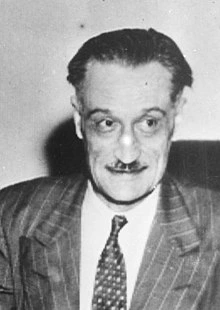
Biography
Bonnet grew up in an intellectual bourgeois family in a small town in central France and was educated at the Lycées of Tours and Paris. He finished his study of histories at the École normale supérieure, part of the University of Paris, in 1913. He briefly worked as a history teacher but with the outbreak of the war in 1914 he was conscripted and remained in the army during the entire First World War period, rising to the rank of captain. In 1919 Bonnet became the foreign policy editor of the new radical daily in Paris, L’Ère nouvelle: Politique, économique, intellectuelle et sociale, and discussed French foreign policy with Maurice Baumont, who worked at the League of Nations Secretariat. Pierre Comert, the Director of the Secretariat’s Information Section, attracted international civil servants such as Salvador de Madariaga and Arthur Sweetser and, in 1920, also Bonnet. Comert had explicit ideas about how the news of events and decisions should be described and communicated, a topic that appealed to Bonnet. During the 1920s Bonnet worked for Comert’s Information Section in Geneva, Switzerland, while also becoming chief of staff at the office of Deputy Secretary-General Joseph Avenol in 1921. He learned to consider problems from a wide-reaching perspective, rather than being confined by national circumstances. He was known for his ‘conscientious hard work while retaining a natural sense of humor and friendly personality’ (Jessner 1983: 91). As part of the Secretariat, he became involved in the League’s cultural affairs activities.
In 1922 the League of Nations created its International Committee on Intellectual Cooperation, designed to improve the material condition of intellectual workers, to facilitate contacts between scholars and artists and to promote the League as an instrument of peace among teachers. The Committee had eminent members, among them Henri Bergson, Marie Curie, Albert Einstein and James Shotwell, but its programme was modest and it did not receive much support from the League Assembly or Council. Lack of resources for the establishment of the International Institute of Intellectual Cooperation as the International Committee’s executive arm led Committee Chair Bergson to appeal to the member governments of the League, with a positive response by the French government. The Institute was established in Paris (not Geneva) with an autonomous status, separate from both the League of Nations and the French government but de facto tied to both. States appointed delegates to represent their interests at the Institute and were invited to establish a National Committee of Intellectual Cooperation. The Institute was inaugurated on 16 January 1926, with Frenchman Julien Luchaire nominated as its first Director in July 1925. Luchaire, a friend of Bergson, was the driving force behind the French offer to host the Institute in Paris. Among the projects he launched was the International Studies Conference. He also drew attention to the role of the cinema in art and education. However, from 1928 his colleagues increasingly criticized his leadership for its limited international orientation and lack of awareness against rising nationalism. Bonnet sided with George Murray, who had become the International Committee Chair in 1925 and, according to Bergson, represented ‘the deeper spirit of the League’ (Thompson 1983: 530).
After Luchaire’s formal resignation in April 1930, several organizational changes were set in motion. Luchaire was given an advisory position at the International Committee’s Permanent Committee of Arts and Letters and continued to receive his director salary during 1931. Bonnet became Director of the International Institute for a seven-year period starting on 1 January 1931 (renewed in 1937 for another seven years). Under Bonnet’s direction, the Institute took some years to become efficient but it ‘worked admirably, so far as its limited budget would allow’ (Walters 1952: 192). Bonnet, who from his League Secretariat position had a clear idea of how the process of international collaboration worked, travelled all over the world to establish National Committees (around 40 by 1939). In 1931 he headed the educational mission to advise in the planning of the reorganization of Chinese schools. He met with famous politicians, writers and thinkers. Although his focus was on the intellectual field, he also touched on League issues such as disarmament and women’s rights. Bonnet launched the Institute’s so-called Entretiens Series, which gathered public intellectuals for interviews and conversations on a variety of topics and published the proceedings. This became one of the Institute’s most visible projects. Other projects focused on collaboration on popular arts, libraries, radio broadcasting and the teaching of history. The Institute facilitated intellectual exchanges between states to encourage collaboration in the arts, letters, sciences and education, with special emphasis placed on ‘the need to prepare the young to think in world terms’ (Jessner 1983: 91). This was accomplished in part by projects to eliminate national biases in social science textbooks. By the late 1930s Bonnet had managed to receive financial contributions from most member states (but not the United Kingdom which had opposed the French project since the Versailles peace negotiations) and American foundations, such as the Carnegie Endowment for International Peace and the Rockefeller Foundation. Contrary to what had been feared, the Institute operated ‘free from any nationalist pressure on the part of France’ (Walters 1952: 192). In December 1938 a conference in Paris adopted the International Agreement Concerning Intellectual Cooperation meant to confirm the organization’s structure as a real international organization, although the Second World War blocked the ensuing ratification process. Neither the Institute, nor the International Committee, which met for its last pre-war session in July 1939, took precautions in case war broke out. Since that December the Institute published the bi-monthly Informations, which included a series of letters on the role of intellectual cooperation during war time as well as solidarity appeals of student organizations.
Following the German invasion of France in May 1940, Bonnet left the Institute on 10 June. He transferred the Institute staff in possession of the archives first to Guérande in Brittany and then to Bordeaux, with Paul Ristorcelli in charge of the administration and finances. Bonnet did so on the instruction of the French Foreign Ministry. He also appointed an Interim Committee for Intellectual Affairs. However, when the staff returned in July, they found the Institute occupied by the German police, which meant that the Institute remained closed during the occupation. In June Bonnet and his wife Hellé Zervoudaki (the Greek former wife of Thanassis Aghnides, the Director of the Disarmament Section of the League of Nations Secretariat, whom Bonnet had married in 1932) decided to leave for London, together with Jean Monnet, who had been the League’s Deputy Secretary-General between 1919 and 1923. In London Bonnet met French military leader Charles de Gaulle, who set up the Free French movement. Whereas Monnet stayed in England, Bonnet and his wife continued to the United States (US), invited by the Rockefeller Foundation. In New York City Bonnet became a teacher at the École libre des hautes études, the Francophone branch of the New School for Social Research, which was set up for intellectuals who had to flee Europe, while his wife started an elegant hat shop. In 1941 Bonnet helped establish France Forever, which united French residents in the US behind De Gaulle’s effort to liberate occupied France. He became its Vice-President and was an editor of the French exile publication Monde libre. He also became involved in the World Citizens Association, established in Chicago in 1939 by Anita Blaine, who, after the Pearl Harbor attack of December 1941, adopted the cause of the United Nations with the same enthusiasm that she had earlier put into the League of Nations. Between 1941 and 1943 Bonnet was an Executive Director of the Association and participated in various conferences and publications of experts in international cooperation to discuss what the future United Nations could be and could become. He contributed on both the general institution and intellectual cooperation but regarded the war effort as his main priority.
Following two previous conferences on intellectual cooperation in Latin America (a roundtable in Buenos Aires, Argentine in 1936 and a regional conference of all American National Committees of Intellectual Cooperation in Santiago, Chile in 1939), the Second Pan-American Conference on Intellectual and Cultural Cooperation took place in Havana, Cuba in November 1941, with Bonnet credited as observer. The conference raised Latin American expectations of an International Institute in exile in Havana and under Bonnet’s leadership. However, disagreement between the Latin Americans and the US delegation crushed the expectations. The US, not impressed by the League construction, preferred an Inter-American arrangement and developed a special relationship with the British, who had not been supporters of the International Institute. Bonnet himself was ‘conflicted on what to do’ with the pre-war organization. He saw the Institute as a positive force in the right direction but desired a new body that would be ‘stronger, larger, and well-financed’ (Pernet 2014: 349). Although the Carnegie Endowment financed a meeting of seven persons to take steps for an exile organization in Havana in October 1943, the seven proved unable to obtain the necessary resources and Bonnet had already left the US.
In June 1943 De Gaulle called Bonnet to Algiers, the Allied headquarters in North Africa, to oversee information in his French Committee for National Liberation, while Monnet, also called to Algiers, was given the task of preparing France’s postwar modernization plan. Inspired by American press associations, Bonnet overcame the internal French opposition and, in February 1944, presented a complete reform of the French press to the Provisional Consultative Assembly in Algiers in the form of a law, with restrictions during the war and a period of transition between the liberation of France and the establishment of a regular government. His proposal included ideas about keeping the press from being influenced by commercial, financial or foreign interests and a reform of newspapers published in the French colonies. His later French news distribution decree was criticized by American and British press representatives for giving a monopoly to French agencies, but he explained in a press conference that the decree was only temporary, because governmental control would be ended after France was fully liberated. When the French Committee for National Liberation transferred to Paris, which was liberated in August 1944, it became France’s provisional government. Bonnet kept the information portfolio with the new rank of Cabinet Minister but, in December 1944, was appointed French Ambassador to the US (until 1955). De Gaulle selected him for the post in Washington DC because of his experience in the US and diplomatic talents. On New Year’s Day 1945 Bonnet presented his credentials to US President Franklin Roosevelt. When the United Nations (UN) Organization was established in San Francisco on 26 June 1945 Bonnet, whose official term in office at the International Institute had ended on 31 December 1944, signed the UN Charter on behalf of France.
In February 1945 Frenchman Jean-Jacques Mayoux replaced Bonnet as Interim Director of the International Institute of Intellectual Cooperation. Mayoux tried to reposition the Institute by reopening it in Paris and rallying support for its continuation. As part of the French delegation in San Francisco, Bonnet introduced a motion that an intergovernmental conference should be called to set up a new organization of intellectual cooperation. He failed to have the word ‘intellectual’ included in the UN Charter, but the recommendation for a conference about international cultural cooperation was accepted. Bonnet attended the conference in London in November 1945 that put an end to the International Institute of Intellectual Cooperation (per 31 December 1945) and established the United Nations Educational, Scientific and Cultural Organization (UNESCO), not according to the French proposal but based on the Anglo-Saxon vision which was developed since the 1942 Conference of Allied Ministers of Education. The decision to make Paris the headquarters of the new organization ‘amounted to a compromise, an attempt to keep “the Latins” on board with UNESCO’ (Pernet 2014: 356-357). The archives and library of the International Institute and some personnel were carried over to UNESCO in 1946.
As France’s Ambassador to the US between 1945 and 1955 Bonnet participated in the negotiations establishing the Marshall Plan (1948), the signing of the North Atlantic Treaty (1949) and the (unratified) European Defence Community (1952). When George Marshall became US Secretary of State in early 1947, Bonnet was given a comprehensive statement of American thinking on the issue of economic support to Europe, while he used the opportunity to explain that coal was the most important matter for France since half a million tonnes from the German Ruhr area in 1947 and one million tonnes in 1948 were needed monthly. He also stressed that the French wanted ‘their own technicians and managers in the Ruhr to make sure that these quantities were forthcoming’ (Milward 1984: 140). When the use of US funds to influence economic policy in the context of the Marshall Aid aroused resentment in some French political circles, Bonnet replied that ‘his countrymen must be educated to understand that the counterpart funds were necessary to enable the objectives’ of the economic plans Monnet had developed for France, ‘which in turn would lead to the reestablishment of French independence’ (Wells 2011: 112). Bonnet’s wife was known in France as ‘the ambassadress of French taste in the United States’, according to the French magazine Elle of July 1946. She was seen ‘to have embodied French taste and excelled at representing her new country’. Her ‘permanent switch of loyalty to France seems to have been taken for granted after her marriage to a French diplomat’ (Erlandsson 2022: 46). Back in France Bonnet became Vice-President of France-Amérique, which promoted friendship between the two countries, and he was engaged in the French branch of the UN Children’s Fund. He retained an indestructible optimism and faith in international cooperation. His wife passed away in 1962, he in 1978.
Bonnet can be seen as someone whose activities as Director of the League of Nations-related International Institute of Intellectual Cooperation (1931-1940) had strengthened and widened the scope of the Institute’s work, ‘turning it into the forerunner of UNESCO’ (Jessner 1983: 91). He also understood the Institute’s weakness and his efforts to keep the old institute recognisable in a period when the US steered international cooperation were feeble. In the meantime, he developed into a high-class ambassador from having started his career as an international civil servant at the League of Nations Secretariat.