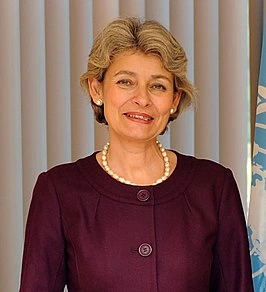
Biography
Bokova grew up in Bulgaria during its Communist era. Her parents hailed from a village in the Pirin Mountains known for its partisan activists during the Second World War. Both were actively engaged in the resistance movement against the Fascist Bulgarian government connected to Nazi Germany. Toward the end of the war the Soviet Red Army entered Bulgaria, after which the monarchy was abolished and the People’s Republic of Bulgaria established in 1946 under Bulgarian Communist Party (BCP) leader Georgi Dimitrov. Following the war, many former partisans were recognized as party members and the Bokov family became part of the leading members of Bulgarian society. Bokova’s father was Editor-in-Chief of the official newspaper Rabotnichesko Delo and her mother, who had left school at primary level, returned after having children to become a radiologist and a Doctor of Philosophy in medical sciences as well as a member of Bulgaria’s Science Academy. Her father taught Bokova to be self-reliant, while her mother encouraged her to achieve in life. Due to his stubbornness, her father, a politically strict disciplinarian and not a dissident, was stripped of his party positions in 1976, but went on to publish a book about modern Bulgaria in 1981. Bokova graduated from the country’s first English Language School in 1971. She then moved to the Soviet Union, where she studied at the Moscow State Institute of International Relations and had two children with her first husband. She graduated in 1976, earning a master’s in international relations.
Bokova returned to Bulgaria and began her career as a civil servant with a position at the Ministry of Foreign Affairs after spending time as an intern with the Ministry’s newly formed United Nations (UN) Department. In 1980 she joined the BCP. From 1982 to 1984 she served as Third Secretary to Bulgaria’s Permanent Mission to the UN in New York. From 1984 to 1990, back in Sofia, she was First and then Second Secretary to the UN and Disarmament Department, acting as an advisor to the minister of foreign affairs. From January to August 1989, Bokova was a Fellow at the University of Maryland’s School of Public Affairs in Washington DC, with a focus on the decision-making process of United States (US) foreign policy. Here she met Madeleine Albright of Georgetown University. After the fall of the Berlin Wall in November of that year and the changes taking place in Bulgarian politics, she joined the Bulgarian Socialist Part (BSP) in 1990 and became a BSP member of the Constituent National Assembly (1990-1991), which drafted Bulgaria’s new constitution. As part of her role in the transition process she organized Bulgaria’s first roundtable discussion on human rights. In 1991 and 1992 she was back at the Ministry of Foreign Affairs. From September 1992 to December 1994 she was a North Atlantic Treaty Organization (NATO) Fellow, participating in NATO’s Programme for Central and Eastern Europe on Democratic Institutions, with a focus on national and legal mechanisms for the protection of minorities.
Bokova worked her way to the top of the ministry and served as Deputy Minister of Foreign Affairs (1995-1996), responsible for UN matters as well as relations with NATO (of which Bulgaria would become a member in 2004), the Organization for Security and Cooperation in Europe and the European Union (EU). In 1995 she attended the UN’s Fourth World Conference on Women convened in Beijing, China as Vice-President of the Bulgarian delegation, after having been a delegation member at the previous world conferences on women in Copenhagen, Denmark (1980) and Nairobi, Kenya (1985). In 1996 Bokova was a vice-presidential candidate in the national elections, running with Ivan Marazov of the BSP, but they lost. She then became Acting Minister of Foreign Affairs under Zhan Videnov’s short-lived Socialist government (November 1996-February 1997). In November and December 1999, she attended Harvard University’s John F. Kennedy School of Government in an executive program in leadership and economic development. In her second parliamentary term (2001-2005), Bokova represented the Coalition for Bulgaria group of parties. She was Deputy Chairperson of the Foreign Policy, Defense and Security Committee and the Joint Parliamentary Committee. She was also a member of the European Integration Committee, becoming first negotiator for Bulgaria’s bid to join the EU (effective from January 2007). Between 2005 and 2009 Bokova served as Bulgaria’s Ambassador to France and Monaco and was Bulgaria’s permanent delegate to the United Nations Educational, Scientific and Cultural Organization (UNESCO) in Paris. She became a member of UNESCO’s Executive Board in October 2007, and, in February 2008, she chaired the Second Extraordinary Session of the Intergovernmental Committee for the Safeguarding of the Intangible Cultural Heritage in Sofia.
The term of UNESCO Director-General Koichiro Matsuura of Japan ended in 2009. Bokova was a candidate in what became a lengthy and often contentious election process that went through five rounds of votes. She defeated nine other candidates, including in the fifth round Farouk Hosny from Egypt who was highly favored and received 27 votes against Bokova’s 31 on 22 September, during the thirty-fifth session of UNESCO’s General Conference. Bokova was the first woman and first East European to become Director-General. Despite the fraught election and close contest, the organization managed to avoid a visible politicization, with Bokova having the added advantage of being a diplomat and being familiar with UNESCO’s inner workings. She did not react to criticisms of her Communist past. In interviews and speeches, she avoided ‘the high idealism of the 1960s and 1970s’ and instead focused on ‘UNESCO’s sectoral priorities and lack of resources’ (Singh 2011: 39). She officially assumed her post on 15 November 2009.
Bokova’s first year in office focused on sectoral priorities (education, culture, science, social sciences and communications). The UN had designated 2010 as International Year for the Rapprochement of Cultures, with UNESCO as lead agency. Bokova noted the contradictions of globalization: interdependence and cultural interactions, but also incomprehension, mistrust and insecurity resulting from the economic, environmental and ethical crisis. She regretted that culture had not been included among the UN’s eight Millennium Development Goals (MDGs) of 2000-2015 but affirmed her commitment to exchange and dialogue between cultures as the best tools for building peace. The MDGs, however, included girls schooling as a priority goal (Target 3A). At Harvard University she argued that ‘empowering girls and women is almost the most powerful way’ to reach the MDGs. She highlighted UNESCO’s agreement with the US Smithsonian Institute to promote aspects of ‘intangible culture’ (oral traditions, performing arts, rituals and festive events), and declared that culture, ‘the ultimate renewable energy,’ needed support (Schorow 2010). However, her emphasis on the value of culture (tangible and intangible) would be tested by a fiscal crisis and terrorist destruction of heritage sites.
In 2011 Bokova faced a difficult situation when the US government under President Barack Obama declared its opposition to a seat for Palestine on UNESCO’s governing body. On 29 November the UN General Assembly voted to change Palestine’s status from ‘observer entity’ to ‘non-member observer state’ by a vote of 138 in favor, 9 against (including the US) and 41 abstaining. UNESCO followed suit, when its General Conference voted to admit Palestine as a member-state, by a vote of 107 in favor, 14 against and 52 abstentions. The Obama Administration and many US Congress members vehemently opposed those moves, maintaining that Palestinian statehood could only be realized through direct negotiation between Israelis and Palestinians rather than through membership in UN entities. Bokova was caught in a bind, expecting budgetary penalties that would jeopardize proposed programs for women and girls. The US then withheld approximately 80 million dollars from UNESCO’s funding for the next year, as required by two Congressional laws enacted in the 1990s that prohibit funding to UN entities that admit the Palestine Liberation Organization as a member (Public Law 101-246) or grant full membership as a state to any organization or group that does not have the internationally recognized attributes of statehood (Public Law 103-236). Despite the funding restrictions, the Obama Administration stated that it did not intend to withdraw the US from UNESCO. Still, the US lost its voting rights and Bokova expressed her regret at the outcome (www.unesco.org/en/articles/irina-bokova-regrets-loss-us-voting-rights). In 2017, under President Donald Trump, the US withdrew entirely from UNESCO, citing the organization’s presumed anti-Israel bias. The loss of one-third of its budget compelled the organization to eliminate some 400 jobs and turn to the private sector, donor agencies and the European Union for program funding. Unpaid or delayed dues from other member-states was a persistent headache for Bokova.
On 4 October 2013 UNESCO’s Executive Board nominated Bokova for a second term as Director-General. The General Conference re-elected her on 12 November. During her second term, Bokova faced another crisis, that of the theft and destruction of cultural artifacts. The trade in stolen cultural artifacts began after the ensuing chaos brought about by the 2003 invasion of Iraq by the US and the United Kingdom. The illicit trade was compounded by the 2011-2012 internationalized civil conflict in Syria. Both events gave rise to the terrorist organization ISIS (Islamic State of Iraq and Syria), which embarked on a campaign to destroy ‘idolatrous’ ancient monuments and Christian churches. On 21 November 2014 (International Day of Peace) Bokova called for an end to the destruction of cultural diversity and the persecution of minorities and responded decisively to protect cultural heritage. UN Security Council Resolution 2199 (February 2015) officially recognized the link between illicit traffic and security. The resolution outlawed all trade in cultural goods from Iraq and Syria and requested that UNESCO coordinate, together with the international police organization Interpol, efforts to protect Iraqi and Syrian artifacts. On 28 March UNESCO launched Unite4Heritage, a campaign aiming to create a global movement to protect and safeguard heritage in areas threatened by extremists, such as al-Qaeda and ISIS. The initiative was ‘an outcome of [Bokova’s] visit to Iraq after ISIS invaded, took over Mosul and started [the] terrible destruction of the museum that was seen by so many on YouTube’ (https://whc.unesco.org/en/news/1254). ISIS had wreaked havoc elsewhere. In the Iraqi city of Nimrud and at the World Heritage Site of Hatra, therefore, a campaign was launched to ‘enable people to exchange ideas, to support each other, and to create dialogue amongst cultures under the broad theme of a ‘common heritage’ uniting people from across the globe (www.un.org/press/en/2017/sc12764.doc.htm). Bokova called ISIS’ cultural destruction in Iraq ‘cultural cleansing’ (English 2016). Another headache for her occurred in 2015 when the Shinzo Abe government of Japan objected to UNESCO’s decision to include documents relating to the 1937 Nanjing Massacre in the latest listing for UNESCO’s Memory of the World Programme. Protesting ‘vehemently,’ the Japanese government criticized Bokova’s trip to Beijing, China and her participation in the seventieth anniversary of the end of the Second World War. The Japanese threatened to withhold its annual funding (Ryall 2015).
Despite the serious political and budgetary challenges UNESCO faced, due to the loss of US funding, Bokova and her team expended considerable efforts to protect, preserve or reconstruct humanity’s common cultural heritage in the face of violent extremism. During her tenure, mausoleums were rebuilt in Timbuktu, Mali after al Qaeda-linked extremists decimated the city in 2012-2014. A bridge was rebuilt connecting two communities in Mostar, former Yugoslavia. At Bokova’s urging, the February 2015 UN Security Council Resolution 2199, which aimed to cut off the jihadists’ oil and kidnapping revenues, included three paragraphs on trafficked antiquities (https://documents.un.org/doc/undoc/gen/n15/040/28/pdf/n1504028.pdf; English 2016). The UN Security Council’s March 2017 adoption of Resolution 2347 was the first to focus exclusively on the protection of cultural heritage and its necessity for peace and security both in war and peace times. This resolution condemned cultural looting and trafficking. It called on member-states to contribute to the UNESCO Heritage Emergency Fund to protect endangered cultural heritage in armed conflicts and to support preventive and emergency operations.
Dedication to education was another hallmark of Bokova’s two terms as Director-General. As usual for leadership across the UN system, she commemorated International Women’s Day each year. In keeping with UNESCO’s broad mandate in education, Africa, science policy and gender equality, her message on 8 March 2011 highlighted disparities at the secondary level in Africa over the previous decade and reiterated UNESCO’s emphasis on strengthening bridges across education, training, science and technology and the labor market in the interest of fostering decent employment. This starts early, according to Bokova, with quality education for all girls and young women from the primary to the tertiary level (https://unesdoc.unesco.org/ark:/48223/pf0000191391/PDF/191391eng.pdf.multi). In opinion pieces, speeches and interviews she noted the dire effects of armed conflict on children and their access to schooling. In 2014 she spoke of 8 March as an opportunity to recognize the achievements of women and to call for greater equality and empowerment. When the UN’s Sustainable Development Agenda 2030 was adopted in 2015, UNESCO assumed responsibility for several of the goals, including Goal 4 on ‘Inclusive and equitable quality education and life-long learning for all.’ Having visited Afghanistan and Pakistan’s Swat Valley, where extremists were present, Bokova offered the view that, to fundamentalists, educated girls were more dangerous than drones (Driscoll 2016). UNESCO also had a role to play in the achievement of Goal 5 on gender equality. The UNESCO Priority Gender Equality Action Plan (2014-2021) was a companion document to the new Medium-Term Strategy 2014-2021 (37 C/4) and the Programme and Budget 2014-2017 (37 C/5), encompassing several flagship programs that aimed to promote greater equality, with a focus on Africa.
In 2016, at an invitation lecture, Bokova spoke of her mother’s modest rural background but determination to succeed, eventually earning a doctorate. This may help explain her support for the greater participation of women and girls in the Science, Technology, Engineering and Mathematics (STEM) fields. At UNESCO, initiatives were aimed at breaking gender stereotypes, addressing barriers that hindered women’s participation in those fields and encouraging greater gender equality in scientific research and innovation. UNESCO promoted the International Day of Women and Girls in Science (11 February) to highlight the achievements and challenges faced by women and girls in STEM. Another Bokova initiative was the Organization for Women in Science of the Developing World, a forum and network for female scientists worldwide to advance scientific and technological research and education for women. Founded in 1987 by the World Academy for Sciences (with more than 200 researchers across 63 countries), a new partnership began in 2017 toward the end of Bokova’s term, providing fellowships to female researchers, with multiple subunits providing grants and information to women in developing countries. In March 2017 Bokova launched ‘Empowerment of Women in Engineering in the Workplace’ and the ‘One Million Girls in STEM Campaign.’ That year, UNESCO and the non-profit organization WomEng sponsored an event at the annual meetings of the UN’s Commission on the Status of Women in New York. On 8 March 2017 Bokova stated that women and men had to fight together towards the same goals. She also highlighted the importance of women's participation in peacebuilding and conflict resolution and the need to address gender-based violence and discrimination (https://unesdoc.unesco.org/ark:/48223/pf0000247425).
Between mid-2014 and end-2016 Bokova was a candidate for the position of UN Secretary-General to replace Ban-Ki Moon, having been nominated in June 2014 by the Bulgarian government. Several articles noted her strong candidacy (Roche 2015, Sousanne 2015, English 2016). In 2015, however, the Bulgarian government expressed less enthusiasm for her and nominated another Bulgarian woman candidate, Kristalina Georgieva. Neither Bulgarian candidate won the post, which, in 2016, went to António Guterres of Portugal. During Bokova’s tenure the gender balance of senior management staff at UNESCO grew from 25 percent women to 50 percent. There was a decrease in the number and share of women at the professional and director (P5) level (from 40 percent in 2010 to 33 percent in 2017), but the female share of directors (D1, D2) increased from 24 percent in 2010 to 51 percent in 2017 (candidates for such positions often are suggested by member-state delegations). By the end of Bokova’s term as Director-General women comprised 55 percent of all UNESCO staff.
Bokova’s term as Director-General ended on 15 November 2017. She was succeeded by Audrey Azoulay, a French civil servant of Moroccan background. In its October 2017 tribute to Bokova, UNESCO’s Executive Board noted ‘her profound commitment to UNESCO’s values and dedication to promoting its “soft power” through a positive vision of peace,… embodied in the principles of a new humanism, which she has shared across the world.’ The tribute also acknowledged her ‘steadfast advocacy to rising recognition of the links between the protection of culture and the maintenance of security.’ She was able ‘to raise the visibility of UNESCO globally’ (UNESCO Executive Board 2017). Bokova conversed with staff members and member-state delegates alike in English, French, Russian and Spanish. She was described as approachable and her management style as engaged and personal.
After stepping down, Bokova was invited by the Perry World House of the University of Pennsylvania as Distinguished Visiting Fellow for the academic year 2017-2018. Among other universities, she was a visiting lecturer at the Paris School of International Affairs at SciencesPo Paris, Geneva University, Kyung-Hee University in Seoul, South Korea and Beijing Foreign Studies University in China. She sits on several academic boards or advisory boards, such as those of l’Institut de relations internationales et stratégiques in Paris and the School of Public Policy and Management at Tsinghua University, Beijing. In 2020 she was elected International Honorary Member of the American Academy of Arts and Sciences as well as Honorary Fellow of the World Academy of Arts and Sciences, patron of the International Science Council to advocate for the global voice for science and member of the twentieth Beijing Forum on Internet Communication. Since 2022, she has been Chair of the Governing Council of the University of Peace (UPEACE) in Costa Rica and Patron of the International Science Council. She is also Chair of the Board of Democracy and Culture Foundation in London. Along with Helen Clark, former Prime Minister of New Zealand, she has chaired the Global Commission on Science-led Sustainability Missions. With Clark and Susanna Malcorra, former Foreign Minister of Argentina, she is a founder and member of the Board of Global Women Leaders for Change and Inclusion in Madrid, Spain.
During Bokova’s productive and accomplished career, she served both her country and the international community. She was on the Forbes list of the world’s most influential women for 2016. In addition to opening the door to women’s leadership at UNESCO, her legacy lies in her skillful management of two major crises during her tenure: the US withdrawal from membership and the massive ISIS assaults on citizens and cultural artifacts in Iraq and Syria. Her skills as a former diplomat with understanding of multilateralism enabled her to overcome the severe budgetary shortfall and political fallout. The same skills, coupled with a commitment to cultural preservation and diversity, enabled her to mobilize the necessary human and material resources for the reconstruction of damaged or destroyed cultural sites.