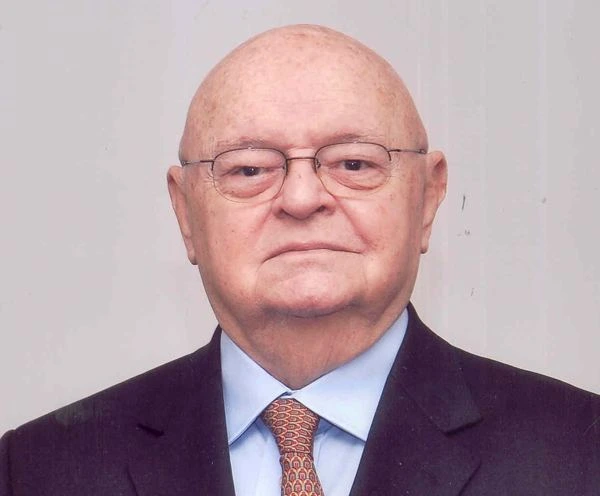
Biography
Baena Soares, the only child of a military officer in the Brazilian Army and a housewife, had a nomadic lifestyle, spending his childhood years in Belém, a major trade depot at the gates of the Amazon River in northern Brazil, Pelotas and Curitiba, both in southern Brazil, and Rio de Janeiro, the then capital of Brazil. At the age of seventeen he settled in Rio to complete his studies and obtained his degree in Law, with academic merits and awards, at the Pontifical Catholic University in 1953. In the same year he also concluded the two-year Formation Course for diplomats at the Rio Branco Institute and assumed the post of third secretary of the Division of Cultural Affairs in the Ministry of Foreign Affairs (Itamaraty). His outstanding performance as a diplomatic candidate resulted in a three-month internship programme at the United Nations (UN) in New York and the Organization of American States (OAS) in Washington DC in 1954. Between 1955, when he married, and 1962 he served in three diplomatic posts in Asunción, Paraguay, Lisbon, Portugal and Guatemala City, Guatemala. Back in Brazil he became the interim head of the Ministry’s African Division (1962) and worked in the Cabinet of the Foreign Minister, João Augusto de Araújo Castro (1963), as well as the Cabinet of the Secretary-General of Itamaraty (1964). When the military came to power in Brazil through a coup d’état in March 1964, Baena Soares demoted himself. As a sign of his personal discomfort with the new guidelines for Brazil’s foreign policy he assumed a bureaucratic role within the ministry. As a fierce critic of the automatic alignment with the United States (US) he decided to leave for a foreign post and served in Florence, Italy in 1966 and in Brussels, Belgium in 1967. In 1968 he met up again with Araújo Castro, then the head of the Brazilian Permanent Mission to the UN in New York. Baena Soares served at the UN until 1970, when he temporarily left the Ministry to work as a special advisor for public relations to the Presidency. When President Ernesto Geisel and Foreign Minister Antonio Azeredo da Silveira took office in 1974 and promoted a major shift in Brazil’s diplomatic orientations, Baena Soares returned to Itamaraty and became the head of the Department of International Organizations, which was in charge of all multilateral institutions, except for the OAS. Three years later he was nominated to the newly created position of Special Secretary for Multilateral Affairs and became a close aide to the Foreign Minister. The activities he undertook after returning to the Ministry were the prelude to his appointment as Secretary-General of Itamaraty (1979-1984) under Foreign Minister Ramiro Guerreiro and President João Batista Figueiredo. Following the resignation of OAS Secretary-General Alejandro Orfila in March 1984, Baena Soares decided to run for the vacant post, duly backed by his Foreign Minister and in line with Itamaraty’s strategy to have Brazilian diplomats take the lead in international organizations. He thus broke the relative distance the country had kept from multilateral discussions since the mid-1960s, when Brazil as a rising ‘third-world’ country began to criticize ‘great power multilateralism’ as a ‘policy of freezing the world power structure’ to the detriment of middle powers (Araújo Castro 1971). He won by unanimity, with the wholehearted support of South America and the Central American and Caribbean states, and took office on 20 June 1984.
As the newly elected Secretary-General Baena Soares faced a situation of institutional and political crises. His predecessor had left one year before the end of his term, having been charged with administrative and personal misconduct, and feelings about the organization’s role at OAS headquarters in Washington DC were generally pessimistic. Several national representatives shared this mood. Thus, restoring the Secretary-General’s credibility was Baena Soares’ first challenge. He undertook several key institutional reforms, including proposing amendments to the OAS Charter. As a result the 31 member states agreed to adopt an all-encompassing reform at the Summit of Cartagena in Colombia, which empowered the organization with greater political leverage and more dynamic and effective mechanisms to address regional conflicts and economic setbacks. The Cartagena Protocol, which was approved on 5 December 1985, acknowledged the political character of the Secretary-General’s functions and gave the Secretary-General several prerogatives beyond the traditional one of taking matters of international peace and security to the consideration of the OAS General Assembly or Permanent Council, such as helping to promote development in the region. Although the reforms would not enter into effect until 1988, Baena Soares decided to make use of his implicit powers, in the ‘spirit of Cartagena’, and as early as 1986 led an effort to confront the crises in Haiti and Central America. The political turmoil that led President Jean-Claude Duvalier to flee Haiti prompted the Permanent Council to adopt Resolution 441, which expressed the organization’s commitment to the democratic principles enshrined in the Charter and authorized the Secretary-General to provide humanitarian assistance to the Haitian people. The decision represented an unprecedented enlargement of the Inter-American role in the solution of civil conflicts and paved the ground for a more active presence of the OAS in the hemisphere. In November 1986 the General Assembly passed resolution 824, which authorized the establishment of the Inter-American Fund of Priority Assistance to Haiti and granted Baena Soares, who had proposed the fund, the powers to administrate it.
Until Cartagena the OAS had stayed largely silent about the three civil wars in Central America at the time (in Nicaragua, Guatemala and El Salvador). However, in late 1986 Baena Soares decided to embark on a diplomatic trip to the region, together with UN Secretary-General Javier Pérez de Cuéllar, upon an invitation by the Group of Rio (eight Latin American countries committed to the peace process in Central America). Even though the idea was to offer a political contribution to the peace process in Central America, Baena Soares’ decision to act on the ground met with clear US opposition. The US Representative to the OAS, Richard McCormack, called upon the Secretary-General to explain himself before the Permanent Council about the reasons why he had accepted to interfere in the negotiating process in Central America without prior consultation of all member states. Baena Soares upheld his position by stating in the Council meeting in January 1987 that he was acting in accordance with the Charter and with the support of the interested parties, and that working for peace was the Secretary-General’s first and foremost duty. The 17 delegations that spoke after him seconded his words. The official OAS mission to Central America took place in late January 1987. The overall reactions were positive and the mission resulted in a peace plan in the following months, envisioned by Costa Rica’s President Oscar Arias (the Esquipulas II Agreement). Between 1987 and 1988 Baena Soares managed to work closely with Central American governments. This helped parties to reach positive outcomes, such as the Sapoá Agreement of March 1988 between the Nicaraguan government and the resistance movement and the Tela Agreement of August 1989 between Honduras and Nicaragua. As a result of the latter the International Support and Verification Commission (CIAV) was launched with responsibility for the demobilization of the fighters in Nicaragua and for the repatriation of Nicaraguans from Honduras and Costa Rica. Even though CIAV started as a bilateral decision under the framework of the Tela Agreement, the functions that fell under the competency of the OAS were ultimately turned into the first OAS peace mission, which operated between 1990 and 1997 as CIAV/OAS.
In 1989 Baena Soares began another five-year term by acclamation. The enduring civil war in El Salvador was another challenge he had to address. In November 1989 the Permanent Council authorized the launching of a mission to San Salvador, led by Baena Soares, which would gather with the parties to the conflict: the government and the representatives of the Farabundo Martí National Liberation Front (FMLN). On his second day in the Salvadoran capital the noise of intense gunfire woke Baena Soares up in the middle of the night. The FMLN guerrilla had just invaded the Sheraton Hotel, asking for the location of the Secretary-General. While Baena Soares, his aides and several guests were ordered to hide in a room to protect themselves from the attack, the Salvadoran army and the guerrilla fighters engaged in armed clashes outside the building with helicopters, rockets and machine guns. After several hours of anxiety the army’s special forces managed to get through the shooting and to remove the guests safely from the hotel. Due to the high risk involved in the mission, the Permanent Council decided to cease OAS activity in El Salvador for the coming years. 1989 was also a year of turmoil in Panama, where a crisis erupted during the electoral process to choose the successor of General Manuel Noriega, Panama’s military ruler for the six previous years. The defeat of the pro-Noriega candidate Carlos Duque to the opposition coalition, led by Guillermo Endara, dragged the country into a major political upheaval in the following months. A popular commotion ensued, and the US, which controlled the Panama Canal, considered intervening in the crisis. The OAS was immediately called upon to help the parties reach a solution. Baena Soares held meetings with all parties involved, including Noriega himself who, however, refused to sign the final agreement due to recurring US military manoeuvres along the Canal. In December the George H.W. Bush administration launched Operation Just Cause, entering the country to topple Noriega and swear Endara into office. The American invasion was one of the greatest political defeats for Baena Soares but also for the US, because at the OAS consultation meeting that followed the invasion all other member states formally condemned the military action. The outcome of the Panamanian crisis unveiled the limits of OAS actions in regional conflicts.
Although the Charter had, in its preamble, several references to the need to promote and foster representative democracies in the hemisphere, the organization lacked mechanisms to ensure that the democratic rule would be maintained. Therefore, strengthening democracy was one of Baena Soares’ challenges, even more so in a context of growing enthusiasm about the triumph of political and economic liberalism that followed the end of the Cold War. In June 1991 the Declaration of Santiago reaffirmed the organization’s support for democracy and laid the foundations for Resolution 1080 on ‘Representative Democracy’, which embodied sanction mechanisms for cases of abrupt or irregular interruption of democratic functioning. This was complemented by the Washington Protocol of 1992, which amended the OAS Charter to allow collective action as a last resort mechanism to suspend a country from the OAS in case of a coup d’état. The new framework was successfully tested in the cases of Peru (1992) and Guatemala (1993). It was preventively employed in Venezuela (1992) and Argentina (1994), with positive results, but failed in Haiti (1991), mostly due to a clash of mandates between the OAS and the UN Security Council, whose solutions to the Haitian crisis differed. In 1991 the OAS also assisted with mine clearing in Nicaragua. Baena Soares requested the Inter-American Development Bank to plan the operations and to provide technical assistance to the mine-clearing programme, which was coordinated by the OAS Unit for the Promotion of Democracy.
As Secretary-General Baena Soares transformed the entire procedure of OAS electoral observations. When he took office in 1984, the organization’s participation in monitoring elections was feeble and remained restricted to the appointment of some notable individuals to follow the process in the days that the elections occurred. In March 1985 the procedure took a more formal shape with Resolution 441 by the Permanent Council, which adopted more specific standards for observation missions. Under the new framework the OAS appointed representatives to follow elections in El Salvador (1985, 1988 and 1989), Suriname (1987), Haiti (1987), Bolivia (1989), Honduras (1989) and Costa Rica (1990). An even more dramatic change would take place with the Nicaraguan elections in 1990, for which the Secretary-General established a mission with enlarged capacities in which hundreds of OAS observers also participated in the pre- and post-electoral processes. This new modality was applied in 15 elections in Central and South America between 1990 and 1993. Baena Soares’ second term also saw the admission of three new OAS members: Canada (1990), Belize and Guyana (1991), as well as the joining of observing members, such as the European Union (1989). The enlargement of the organization came to fulfil its long-standing aspirations for universality in the Western Hemisphere.
On 20 June 1994 Baena Soares completed his second term as Secretary-General of the OAS. According to the Charter, Secretaries-General may not be re-elected more than once or succeeded by a person of the same nationality. His ten years in office were particularly hectic and challenging, due to the various crises in Central America and the political turmoil in some South American states as well as the urge to adapt the organization to the new times. Under his tenure member states adopted mechanisms to improve the OAS conflict resolution capabilities, to strengthen democracy in the hemisphere and to enlarge the role of the Secretary-General. During the 1980s the OAS, according to Carolyn Shaw (2004: 86), took a more active role in the implementation of the accords through the management of observation and verification forces, ‘in part due to the work and reputation of Soares’. None of the personalities who succeeded Baena Soares lived up to the Secretary-General’s political activism of those years, as he acknowledged in an interview in 2003 (D’Araujo 2006: 99). Following his time as Secretary-General, Baena Soares returned to Brazil, where he acted as president of the Alexandre de Gusmão Foundation – in his own words, the ‘academic branch of Itamaraty’ (D’Araujo 2006: 101) – between 1995 and 1998. After retiring from his diplomatic career in 1998 he founded the Brazilian Centre of International Relations, one of the Brazil’s leading think tanks, and became a university professor, with posts at several universities in Rio de Janeiro. His wife passed away in 2001. Baena Soares was elected twice to be a member of the UN International Law Commission (1997-2001 and 2001-2005) and in 2009 also of the Inter-American Juridical Committee, where he was appointed chairman for the 2011-2014 term. In November 2003 Baena Soares was one of fifteen appointees to the High-Level Panel on Threats, Challenges and Change, headed by UN Secretary-General Kofi Annan, which produced the report A More Secure World in late 2004. In September 2006 he was appointed to the UN Human Rights Council’s High-Level Commission of Inquiry charged with probing allegations that Israel systematically targeted and killed Lebanese civilians during the 2006 War. Baena Soares remains an active lecturer on foreign policy issues, often engaging in the public debate of international politics in Brazil.
March 2025: date of death added