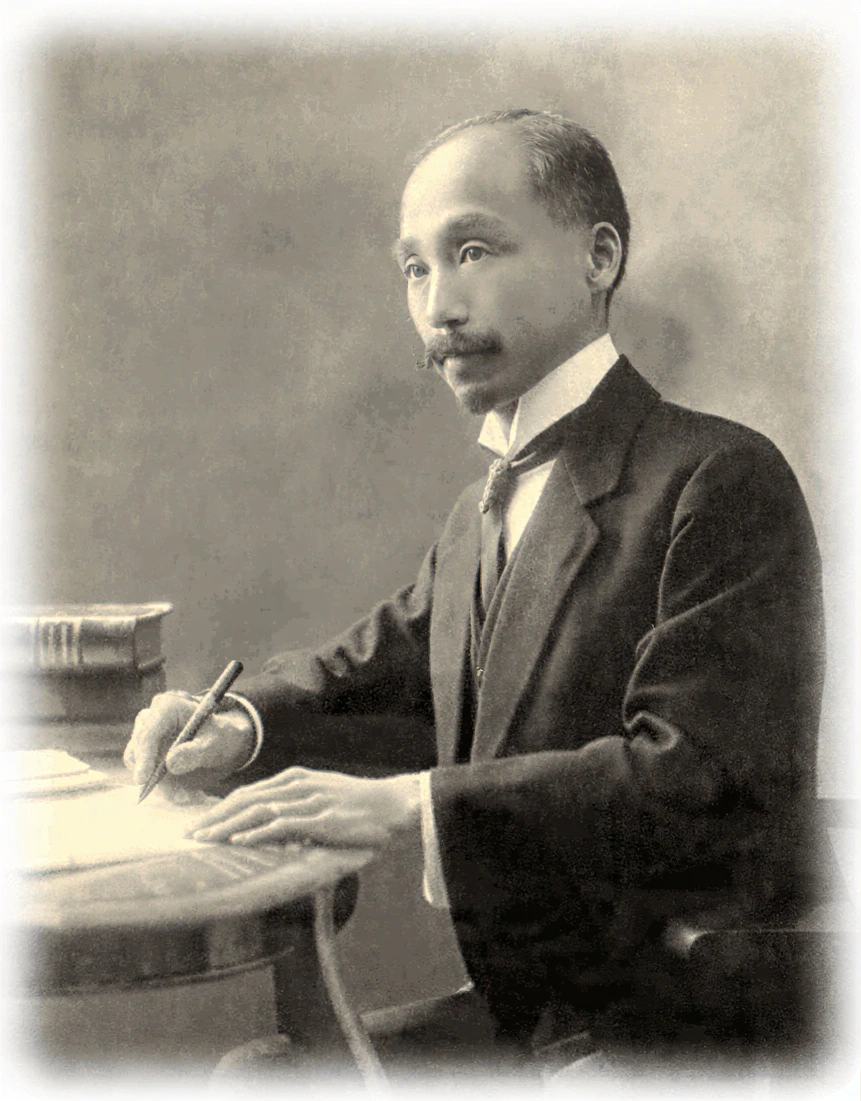
Biography
Adatci was born in the town of Yamanobe in the Yamagata Prefecture in north-eastern Japan and was the eldest son of four siblings. His father worked as a teacher at an elementary school and later became the town’s mayor. Adatci attended the Hōmeikan school for children and showed his extraordinary potential by authoring a Chinese classic poem for submission to a magazine when he was only six years old. He completed elementary school in 1879 at the age of ten. Given his outstanding achievements at school, he was appointed as a teaching assistant at the school. However, after six months he left the job and joined the Yamagata Normal School to begin his law studies. In 1884 he moved to Tokyo, where he entered the Ministry of Justice’s Law School and achieved complete mastery of the French language. In 1889 Adatci decided to focus on international law and was admitted to the Faculty of Law of Tokyo Imperial University (later known as The University of Tokyo). Just before entering the university, Adatci stressed in a letter to Nobushige Hozumi, a professor of German and comparative law, that: ‘We are obliged to have a good knowledge of international rules, when it is our wish that our weak country would compete with other stronger countries’ (Yanagihara 2019: 5). By then it had become apparent that the Treaty of Amity and Commerce, which Japan had signed with the United States (US) in 1858 and which served as a model for additional Japanese treaties with European states, had fundamental flaws for Japan because the agreements favoured the other signatory states. The 1886 Normanton Incident brought this to light dramatically and also impacted Adatci. The British cargo vessel Normanton, which carried 38 crew members and 25 passengers from Yokohama to Kobe, sank in a storm. While the British captain and European crew members were able to board lifeboats and make their way to safety, the Japanese passengers and Asian crew members perished at sea. Efforts by the Japanese government to bring the captain and crew members to trial failed because the 1858 treaties imparted judiciary powers to the consulates of the Western states. This outcome outraged the Japanese people, who called on their government to rescind the discriminating treaty provisions.
Adatci majored in French law at the Imperial University, where he attended lectures with Gustave Emile Boissonade de Fontarabie, a French legal scholar who contributed to the drafting of Japan’s civil code, criminal code and criminal procedure as an advisor to the Japanese Ministry of Justice. Adatci also served as an interpreter for Alessandro Paternostro, an Italian legal scholar and advisor to the Ministry of Justice who authored a considerable number of opinions and memorandums on the revision of Japan’s unequal treaties with Western powers. In 1892 Adatci published a brief article on international law, entitled ‘Shortcomings of Legal Research in Japan’ (Nihon Hōgaku no Ketten), in which he emphasized the importance of international law and appreciation for the establishment and activities of the Institute of International Law, set up in Ghent, Belgium in 1873. He repeatedly emphasized that having a strong army alone would never make Japan a great power. He argued that Japan should abide by international law in order to demonstrate that the country had been sufficiently civilized in its behaviour to become recognized as one of the great powers in international relations.
After graduating from the university as a doctor of law in 1892 Adatci married Kane Takazawa, the daughter of his first law teacher, Sukenori Takazawa. His wife taught at a school to train elementary school teachers. Adatci then entered the Ministry of Foreign Affairs to become a diplomat, ultimately working for 38 years in the Japanese diplomatic service. He spent almost 30 of those years abroad: in Belgium, France, Italy and Mexico. There were only three periods of domestic service: 1892-1893, 1903-1908 and 1915-1917. Among his major achievements was to accompany the Japanese delegates to the 1905 Portsmouth Peace Conference to end the Russo-Japanese War, where he organized the difficult negotiations for the drafting of the peace treaty and acted as an interpreter. After serving in Mexico as Minister Plenipotentiary from 1913 to 1915, Adatci was appointed Minister and Ambassador to Belgium for ten years (1917 to 1927). His name was widely known in Brussels, which became his family’s favourite residence. In addition to diplomatic ties, Adatci regarded cultural ties as a bulwark of peace. Based on his recommendation the Japanese government donated large amounts of Japanese books to the Library of the Catholic University in Leuven, which was destroyed during the First World War. Adatci, who loved art, supported and interacted with various artists in Belgium and France, while also promoting Japanese art in Europe. He purchased paintings by Tsuguharu Fujita, a Japanese-French avant-garde painter who had moved to Paris, and introduced his paintings to wealthy Europeans.
Adatci was a Japanese delegate to the Versailles Peace Conference of 1919, where he served as head of Japan’s specialists’ group. He contributed to the establishment of the Permanent Court of International Justice (PCIJ) as a member of the Advisory Committee of Jurists, which convened in 1920 according to Article 14 of the League of Nations’ Covenant. At the committee meetings Adatci insisted that all different kinds of civilizations, especially those of the Far East, should be taken into consideration and represented by the PCIJ. In 1920 he was appointed as a member of the Japanese delegation at the Assembly of the League of Nations. At first Adatci was not a fervent supporter of the League. While serving in Mexico from 1913 to 1915 he had witnessed US President Woodrow Wilson’s military incursions to repress the revolution. By the time of the Versailles Peace Conference Adatci feared that Wilson would impose his peace ideals on other states without considering each country’s security and strategic interests. Adatci’s firm belief in the League of Nations as a significant vehicle toward peace was only gradually nurtured through his time at the League as Japanese delegate to the Assembly, from the first to the tenth ordinary session (1920-1929; in 1930 Kenkichi Yoshizawa, Japan’s Ambassador to France, succeeded him). Within the League Adatci devoted himself to promoting the peaceful resolution of international disputes. He showed an active commitment to the special subcommittee that in 1924 drafted a new protocol, known as Protocol of Geneva, for the peaceful resolution of disputes. The protocol’s original draft attempted to define aggression and stipulated that any state refusing peaceful settlement of the conflict by the Permanent Court or the League was to be deemed the aggressor and subject to sanctions. However, the draft did not give weight to how the subject of the dispute arose within the domestic jurisdiction of the state. Because his government did not support the protocol in its original form, Adatci submitted a draft amendment to the effect that even if the conflict was recognized by the Permanent Court or the League’s Council to be a matter solely within the domestic jurisdiction of the state, this decision should not prevent consideration of the situation by the League under Article 11 of the Covenant, which stipulated that any war or threat of war shall be declared a matter of concern to the whole League. In his explanation for the amendment, Adatci insisted that the protocol should emphasize nurturing a conciliatory spirit between conflicting parties and promoting the peaceful settlement of conflicts. Adatci also contributed to the Assembly’s role in solving European minority questions. After the First World War Lower Silesia, which had a German majority, remained with Germany, while Upper Silesia, after a series of insurrections by the Polish inhabitants, was split. As a rapporteur for all minority questions, Adatci summarized the facts and related legal issues, such as school enrolment of German residents in Poland and Polish residents in Germany, and promoted a compromise between them. He strongly believed that if a rapporteur examined a case and decided with a strong sense of justice, fairness and conscience, then any conflict could be solved peacefully. His excellent language skills and internationalism were advantages which allowed him to play a significant role in the resolution of conflicts that were brought to the Council of the League. His ‘brain and temper functioned with more than Latin rapidity: the endless haggling over details which this work involved was a sore trial to his patience’, but he did arrive at a series of agreed resolutions (Walters 1952: 407). According to Under Secretary-General Inazo Nitobe, ‘the tongue of Adatci was a national treasure of Japan’ (Adachi Mineichirō Kenshō Kai 2011: 134).
On 27 August 1928 the Kellogg-Briand Pact, which sought to remove war as a mechanism to resolve disputes or conflicts between states, was signed. Most of the established states at the time eventually signed the Pact. Adatci attended the signature ceremony at the French Ministry of Foreign Affairs as Ambassador to France and was one of the few contemporary Japanese who understood the agreement’s real significance. He appreciated Article 2, which called for the peaceful settlement of international disputes and insisted on the necessity of developing mechanisms for conflict resolution. Responding to those who expressed doubts regarding the Pact due to the lack of provisions for economic and military sanctions against an aggressor state, Adatci insisted that the Pact should not be dismissed as a useless enterprise since it could provide an important focal point for rallying international public opinion to prevent future aggression. In his 1930 lecture at the Tokyo Imperial University branch of the Japanese League of Nations Association, entitled ‘The League of Nations Has Made Sound Development’ (Kokusai Renmei no Hattatsu wa Kenzen Nariya), he urged the audience to pay attention to the moral sanction imposed by international public opinion. While Adatci admitted that moral sanction was still weak and international wars might continue to occur in the foreseeable future, he still hoped that the Pact would gradually lead to a more peaceful world. Additionally, in 1929 Adatci was a member of the Assembly committee to study the plans for a new League building.
After his long service at the League of Nations, Adatci was elected to serve as a judge at the PCIJ in September 1930. Adatci’s ability to solve intra-European disputes that were brought to the Council of the League paved his way for this position. According to Shinohara Hatsue (in Akami 2019: 431), this was not due to his service as a competent diplomat representing his own country, but rather as someone with the quality of an international judge based on ‘the fairness and sense of justice in his decisions, his thorough and rigorous research and clarity in analysis, his careful consideration of the views of all the involved parties, his firm stance and swift response, his patience, and his communication and negotiation skills.’ In 1931 he was elected as the fourth President of the Court and the first Asian in that position, having received more votes than any other candidate in the League’s Assembly. In his inaugural address in January 1931 Adatci expressed his hope that the Permanent Court would ‘be the living embodiment of the conception of peace based on law’ (Yanagihara 2019: 73-74 and back page). As President, he drafted two judgements in 1933, the Eastern Greenland case between Denmark and Norway and the Hungaro-Czechoslovak Mixed Arbitral Tribunal. He was also responsible for seven advisory opinions, including one on access to German minority schools in Upper Silesia (in 1931). Regarding the competence of the Court, Adatci opposed the compulsory jurisdiction principle, in accordance with the opinion of the Japanese government, but did not exclude the possibility of Japan’s acceptance of compulsory jurisdiction in the future. In 1920 the League’s Assembly had added an optional clause to the Court’s Statute, which implied that in all cases of a legal character the Court should have compulsory jurisdiction. Forty-one states had signed this clause by 1929. Adatci firmly believed that international disputes would be increasingly settled by adjudication through the enforcement of the Kellogg-Briand Pact, but began thinking seriously about Japan’s acceptance of compulsory jurisdiction, though as a careful former diplomat he never concretized his thought on this issue.
In September 1931 the Manchurian Incident erupted, which resulted in a conflict between Japan and China, the invasion of Manchuria by Japan and the so-called independence of ‘Manchukuo’ in the following year. Adatci did not oppose Japan’s expansion in China as, even for him, the intervention of the League or the Court in the conflicts over Manchuria, where it was believed that Japan had ‘vital interests’, was not acceptable. However, in the midst of the heightened international crisis Adatci never entirely discarded his hope for an international solution. In the preamble of a 1932 book summarizing the Court’s activities of the previous ten years, Adatci expressed his conviction that the role of the Court was to look towards the future. Ten years was too short to judge its life as an international organization. Responding to an inquiry from the Japanese Ministry of Foreign Affairs about possible impacts of Japan’s withdrawal from the League of Nations on its relations with the PCIJ, Adatci emphasized that the Permanent Court was an independent organization and that Japan should thus keep its membership, even after leaving the League. Although Adatci was encouraged to serve a second term as President by the other judges, including Dionisio Anzilotti, José Gustavo Guerrero, Frank Kellogg and Ch’ung-hui Wang, he did not accept a second term since he regarded another three years as President to be too heavy of a burden. The Japanese government decided that he could remain at his post when it withdrew from the League in 1933, but that he would not be replaced. In December 1933 Adatci decided to resign as President, but retained his seat.
In December 1934 Adatci passed away in Amsterdam. The Dutch government accorded him a state funeral in recognition of his service to the Permanent Court and the official obsequies of the Permanent Court praised his dedicated work. Akira Iriye (1983: 4) notes that Adatci’s skills as a parliamentarian, knowledge of international law and commitment to the principles of the League were widely recognized at the time. In his obituary for Adatci, Åke Hammarskjöld (1936: 115-116), the first registrar of the Permanent Court, recalled that Adatci worked hard every day to fulfil his sacred duty to the end and described the duty of a judge ‘to robe himself with divinity’. Adatci’s wife, who continued to live in Brussels, did not return to Japan until 1958 where she, in 1960, established the Adachi Memorial Foundation, which supports young international law researchers. Throughout his life Adatci corresponded internationally and nurtured friendships with various influential people, including Belgian Ambassador to Japan Albert de Bassompierre, Hammarskjöld and American lawyer and statesman Elihu Root. Although, due to his sudden death, Adatci did not publish any books, he published several articles and gave numerous talks. His letters have been archived in multiple institutions around the world, among them the Diplomatic Archives of the Ministry of Foreign Affairs of Japan, Le Centre des Archives Diplomatiques de la Courneuve in France, the Royal Library of Belgium, the National Archives of Sweden and some university libraries such as the Harvard Law School Library. A selection of his letters, edited by the Committee to Honor Mineitciro Adatci (Adachi Mineichirō Kenshō Kai), was published in 2011 as Mineitciro Adatci, Seeker after Peace and Justice Based upon International Law: Centering on Letters. The collection of his writings, edited by Masaharu Yanagihara in 2019, Bankoku no Heiwa wo Kishite: Adatci Mineitcirō Chosakusen (Peace Among All Nations: A Collection of Mineitciro Adatci’s Writings) includes letters, articles, lectures and talks and is, so far, the most comprehensive collection of Adatci’s writings. The first substantial study of Adatci as the first non-Euro-American President of the Permanent Court was published (in Japanese) by Yanagihara and Hatsue Shinohara in 2017 (and reviewed in English by Tomoko Akami in 2019). The book reveals, according to Akami (2019: 421), the fundamental issues in the development of the international judicial system and the significance of the roles of non-Euro-American actors in shaping the system.
June 2021: correction regarding the 1905 conference